In an increasingly globalized and socially conscious professional landscape, the pursuit of diversity, equity, and inclusion (DEI) has moved from a peripheral concern to a central strategic imperative for organizations worldwide. A critical frontier in this endeavor is the hiring process, specifically the language used in job descriptions, which can inadvertently deter qualified candidates from diverse backgrounds. Recognizing this challenge, a new generation of sophisticated diversity tools has emerged, leveraging artificial intelligence and natural language processing to scan, analyze, and optimize job descriptions for inclusivity, fundamentally transforming how companies attract talent.
The Imperative for Inclusive Hiring
For decades, hiring practices have been susceptible to various forms of unconscious bias, often embedded in the very language used to describe roles and ideal candidates. Traditional job descriptions, frequently laden with gender-coded terms, ageist implications, or culturally specific phrasing, inadvertently narrow talent pools, discouraging women, minorities, older professionals, and individuals with disabilities from applying. Research consistently demonstrates the tangible benefits of diverse workforces, including enhanced innovation, improved decision-making, greater employee engagement, and superior financial performance. A 2018 McKinsey report, for instance, found that companies in the top quartile for gender diversity on executive teams were 21% more likely to outperform on profitability, and those in the top quartile for ethnic/cultural diversity were 33% more likely to do so. Conversely, homogenous teams risk groupthink, missed market opportunities, and a decline in employee morale.
The modern push for DEI, amplified by global social movements and evolving regulatory frameworks, has prompted organizations to scrutinize every aspect of their talent acquisition pipelines. It became evident that while intent might be inclusive, the execution often fell short, particularly at the initial touchpoint: the job advertisement. The subtle psychological impact of a single word, such as "aggressive" or "nurturing," can significantly alter how potential applicants perceive a role and whether they see themselves fitting into the organizational culture. This realization spurred the development of specialized software designed to identify and rectify these linguistic pitfalls, making job descriptions not just compliant, but genuinely welcoming.
A Chronology of Innovation: Evolution of Diversity Tools
The journey towards technologically assisted inclusive job writing has seen several phases of development, each building upon the last.
- Early Detection (Late 2000s – Early 2010s): The initial wave of tools primarily focused on identifying gender-coded language. These were often simple algorithms that flagged words statistically associated with masculine or feminine traits, based on linguistic studies. Tools like the Gender Decoder emerged from academic research, providing a free, accessible way for individuals and small businesses to gain basic insights into their job ad language. This period marked the recognition of "gender coding" – the subtle signals in language that indicate sexuality or relative masculinity/femininity – as a significant barrier.
- Augmented Writing and Broader Bias (Mid-2010s): As AI and natural language processing (NLP) capabilities advanced, tools became more sophisticated. They moved beyond simple gender checks to analyze a wider spectrum of biases, including those related to race, age, and disability. This era saw the rise of platforms like Ongig’s Text Analyzer and Textio, which not only identified problematic words but also offered intelligent, inclusive alternatives in real-time. These tools began to provide comprehensive scores and dashboards, allowing organizations to track their progress and compare against industry benchmarks. The focus shifted from mere detection to "augmented writing," where the software actively assists in crafting better, more inclusive content.
- Holistic DEI Integration (Late 2010s – Present): The latest evolution integrates bias detection within broader DEI strategies. Companies realized that inclusive job descriptions are just one piece of a larger puzzle. Tools began to emerge that combined language analysis with DEI analytics, cultural assessment, and even AI-powered job description generation. Platforms like Blendoor and Diversio started offering solutions that not only optimize job ads but also provide insights into overall diversity metrics, track sentiment, and offer actionable recommendations for systemic DEI improvements across the organization. AI job description generators (e.g., Recruitment SMART, Manatal, Jasper Chat, Skima AI) represent the cutting edge, capable of creating optimized, inclusive job ads from scratch, learning and improving with each iteration.
Leading Diversity Tools: A Deep Dive
The market for diversity tools has matured, offering a range of solutions catering to different organizational needs and budgets. These can broadly be categorized into Bias & Language Checkers, DEI Analytics & Culture Tools, and AI Job Description Generators.
Bias & Language Checkers: These tools are primarily designed to refine existing job descriptions.
- Text Analyzer by Ongig: Launched with a strong focus on gender bias in 2017, Ongig’s Text Analyzer has since expanded its capabilities to detect bias related to race, age, and disability. It boasts an intuitive interface, providing a "Total Score" and "Gender Bias Score" that can be filtered by team or location, allowing for granular analysis. Beyond flagging biased terms, it offers hundreds of inclusive replacements, ensuring immediate actionable feedback. Ongig also differentiates itself by going "much deeper as a job description bias tool" compared to some competitors, focusing on the nuanced impact of language. Furthermore, it enhances readability by suggesting simpler alternatives for complex phrases and identifies missing critical sections like salary, benefits, or diversity statements, which candidates increasingly value.
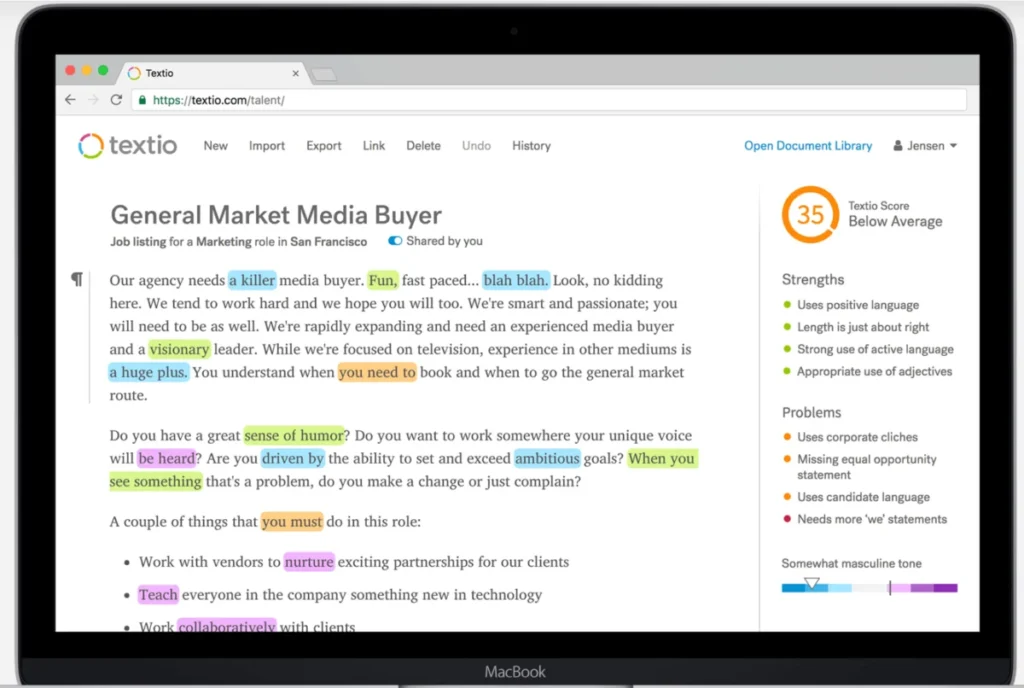
- Textio: A prominent player, Textio leverages machine learning and real-world hiring outcomes to analyze job description language. It assigns a score based on diversity, neutrality, and overall success potential, offering color-coded feedback and suggested improvements. Textio is well-known for its "gender writing analysis," flagging "masculine-toned" words and providing alternatives, and has become a benchmark in augmented writing for talent acquisition.
- Gender Decoder: A free and straightforward tool, Gender Decoder originated from academic research on how specific words attract different genders. It performs a basic gender writing analysis, categorizing words as masculine-coded or feminine-coded. While not as comprehensive as commercial platforms, it remains a valuable resource for small businesses or individuals seeking a quick, cost-effective gender bias check.
- Clovers (formerly Talvista): This platform extends beyond simple text analysis to guide hiring teams through a more inclusive overall hiring process. Its integrated job description builder reviews text for word choice, positive/negative language, and includes a gender decoder feature with alternative suggestions. Clovers highlights problematic words (e.g., feminine words in green, masculine in red), offering visual cues for improvement.
- The Polite Type: While not exclusively for job descriptions, The Polite Type is an open-source tool aimed at promoting inclusive language by auto-rewriting hurtful or discriminatory terms (e.g., replacing slurs with respectful identifiers like "Jewish person" or "Black person"). Developed in partnership with Finnish youth, it focuses on broader anti-bullying and respectful communication, complementing job description bias tools by addressing other forms of offensive language.
DEI Analytics & Culture Tools: These platforms take a more holistic approach, embedding language analysis within broader organizational DEI strategies.
- Allie: A chatbot companion, Allie integrates with communication platforms like Slack to foster workplace inclusivity. It disseminates D&I surveys, gathering employee perspectives on inclusion and cultural nuances. Allie also provides curated diversity-related news, keeping teams informed, and facilitates employee feedback for proposing DEI enhancements. Crucially, Allie offers diversity training sessions, equipping staff with the skills for effective and inclusive workplace interactions.
- Blendoor: This diversity analytics and hiring software champions unbiased hiring through blind recruitment and diverse candidate sourcing. Blendoor provides organizations with a "Blend Score" by analyzing government and marketplace data, benchmarking their DEI performance against peers. It offers actionable insights and tools for tracking diversity progress, along with an assessment tool to identify areas for improving hiring inclusivity.
- Diversio: Diversio provides a comprehensive suite of DEI tools. Its "Bias Corrector" monitors communication platforms for cultural insensitivity or unconscious bias, while the "Social Media Barometer" tracks public sentiment regarding a company’s D&I record. The "Recommendation Engine" uses algorithms to match organizational challenges with optimal DEI interventions, acting as a strategic advisor for driving meaningful change.
AI Job Description Generators: The latest frontier, these tools use AI to create optimized and inclusive job descriptions from scratch.
- Recruitment SMART: This AI-driven platform automatically generates optimized job ads tailored to specific roles and company goals. It boasts an 80% reduction in JD posting time and a 70% increase in content consistency. Its built-in equitable hiring tool provides diversity analytics, facilitates anonymous hiring processes (removing identifiers like name, age, location), and includes a bias checker for objective candidate data scoring.
- Manatal: An advanced recruitment automation system, Manatal offers an intuitive interface for generating inclusive JDs at scale. Users input company, role, location, and target recipient details, and Manatal’s AI assistant drafts comprehensive job descriptions. It provides a generous monthly generation limit and a prompt refinement tool to ensure the output aligns perfectly with hiring needs, streamlining the JD creation process for recruiter agencies.
- Jasper Chat: This advanced chatbot leverages natural language processing (NLP) to generate structured job descriptions in minutes. Users simply converse with the AI, providing vacancy details, and Jasper Chat interprets the input to create scalable and customized JDs. Its conversational interface makes it user-friendly for rapid content generation.
- Skima AI: Skima AI empowers hiring teams to generate quality JDs by inputting key details like job titles, skills, perks, and benefits. Its expert algorithm analyzes top-performing JDs to derive "winning recipes" for impactful descriptions. Users can easily edit, remove, or regenerate sections. Skima AI continuously learns from user best practices, ensuring compliance with industry requirements, streamlining candidate matching, and significantly reducing drafting time.
Implications and Future Outlook
The proliferation of these diversity tools signifies a profound shift in talent acquisition. No longer is DEI solely a matter of policy; it is now deeply integrated into operational workflows through intelligent technology. These tools empower HR and hiring managers to proactively address bias, rather than reactively dealing with its consequences. They standardize the process of crafting inclusive language, ensuring consistency across an organization’s hiring efforts and reducing reliance on individual awareness or training alone.
However, the adoption of these tools also comes with important considerations. Over-reliance on AI without human oversight can lead to new forms of "AI bias," where algorithms inadvertently perpetuate existing societal biases if not carefully trained and monitored. The effectiveness of these tools hinges on the quality and diversity of the data they are trained on. Furthermore, while technology can refine language, it cannot fully replace the human element of empathy, cultural understanding, and strategic decision-making in fostering true inclusion.
Looking ahead, the integration of these tools is expected to deepen. We may see more predictive analytics, where AI not only identifies bias but also forecasts the potential impact of different word choices on candidate demographics. Personalized DEI interventions, tailored to specific team or organizational needs, could become standard. Ultimately, these diversity tools are not just about finding the "right" words; they are about dismantling systemic barriers, broadening horizons for talent, and fostering genuinely equitable and thriving workplaces for all. As organizations increasingly recognize that diversity is a strategic asset, the role of sophisticated technological aids in achieving this vision will only continue to grow.