A significant shift is occurring in the global job market, with a striking number of professionals actively seeking roles below their established career level, a phenomenon termed "downleveling." This trend is particularly pronounced within the human resources sector, where nearly three-quarters of professionals engaging with HR roles on the JobLeads platform are actively considering positions below their self-reported career status. This re-evaluation of career trajectories, often accompanied by substantial potential pay reductions, underscores a complex interplay of economic pressures, evolving professional priorities, and persistent hiring biases.
Unpacking the JobLeads Analysis: A Deep Dive into Downleveling
According to a recent JobLeads analysis of activity on its platform, human resources recorded the highest rate of downleveling among all tracked industries. A remarkable 74.4% of users interacting with HR roles dedicated the majority of their job-search efforts to considering positions beneath their self-identified career level. This figure far surpasses other sectors, signaling a unique set of circumstances affecting HR professionals. The analysis, which meticulously tracked user engagement rather than hiring outcomes, provides a compelling snapshot of current job-seeker intentions and market dynamics.
The propensity for downleveling intensifies with seniority. JobLeads found a clear correlation between a professional’s current leadership level and their likelihood of exploring lower-tier positions. For instance, 57% of "heads of department" directed most of their search activity towards lower-level roles. This figure escalated significantly for vice presidents, with 75% focusing on less senior positions. While JobLeads did not release these specific senior leadership figures exclusively for the HR sector, it raises pertinent questions about whether HR leaders mirror or even exceed this pattern, given the overall high rate of downleveling within their field. This suggests a systemic re-evaluation of the demands and rewards associated with top-tier leadership roles.
The Economic Undercurrents Driving Career Reassessment
The current economic climate serves as a crucial backdrop to this downleveling trend. Over the past few years, the global economy has navigated unprecedented volatility, marked by the lingering effects of the COVID-19 pandemic, supply chain disruptions, soaring inflation, and aggressive interest rate hikes by central banks. These factors have fueled anxieties about a potential recession, leading to widespread layoffs, particularly in the tech sector, and a general tightening of the labor market. In this environment, job security and stability can often eclipse rapid career advancement or maximizing income.
The "Great Resignation" of 2021-2022 saw millions of workers voluntarily leave their jobs, driven by a desire for better pay, improved work-life balance, and more meaningful work. This period was often followed by a "Great Reassessment," where professionals critically evaluated their career paths, their relationship with work, and the toll high-pressure roles took on their well-being. For many, downleveling might represent a strategic pivot born from this reassessment, prioritizing factors like reduced stress, more flexible hours, or a shorter commute over the traditional pursuit of upward mobility. The financial implications, while significant, might be deemed a worthwhile trade-off for enhanced personal well-being.
The Potential Price Tag of Downleveling: A $51,000 Annual Pay Cut
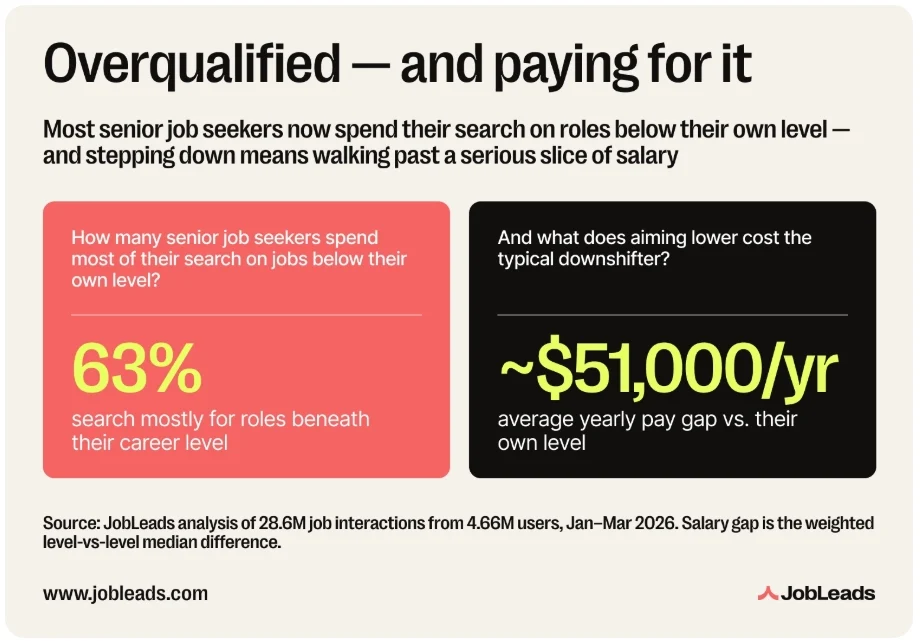
JobLeads estimates the financial impact of downleveling to be substantial, projecting that individuals exploring roles below their usual level could be looking at positions that pay approximately $51,000 less per year. It is critical to understand that this figure is an estimate based on typical pay ranges associated with different seniority levels, not a guaranteed outcome for every job seeker. However, it powerfully illustrates the significant financial concession experienced professionals might be contemplating when aiming lower in their job search.
This potential pay cut extends beyond immediate income loss; it carries long-term financial implications. Reduced earnings can affect retirement savings, investment potential, and overall financial security. For individuals nearing retirement, a substantial pay reduction could necessitate delaying retirement or adjusting lifestyle expectations. For younger professionals, it might mean slower wealth accumulation and a longer path to financial independence. The decision to downlevel, therefore, often involves a complex calculation balancing immediate needs and long-term financial health against non-monetary benefits like reduced stress and improved quality of life.
Downleveling Across Employment Statuses and Global Borders
The downleveling trend is not confined to those actively seeking new employment due to job loss. Even among JobLeads users who reported being currently employed, nearly two-thirds spent the majority of their job search activity looking at roles below their current level. This figure stands in close proximity to the approximately seven in ten unemployed users exhibiting the same behavior, underscoring a proactive, rather than purely reactive, shift in career strategy.
This pattern was particularly pronounced among managing directors. A staggering 86% of unemployed managing directors and 82% of those who reported simply "browsing" for new opportunities focused predominantly on lower-level positions. While these figures are based on the 14% of JobLeads users who shared their employment status, they nonetheless offer compelling insight into a widespread re-evaluation of career ambition even among highly successful professionals.
The phenomenon is also strikingly global. JobLeads conducted similar analyses in five other international markets, revealing that job seekers in each country frequently explored roles below their stated career level. Spain led this international cohort with an 83% rate of downleveling, followed by Italy at 81%, and South Africa at 77%. The United Kingdom and the United States were tied at 63%. These international figures suggest that while specific local economic conditions may influence the exact percentages, the underlying drivers — whether economic uncertainty, burnout, or a desire for better work-life balance — are likely universal, reflecting a broader shift in professional priorities across diverse cultures and labor markets.
The HR Professional’s Unique Predicament: Burnout and Evolving Demands
The disproportionately high rate of downleveling among HR professionals warrants specific attention. The human resources function has undergone immense transformation and pressure in recent years. Post-pandemic, HR teams became central to navigating remote work transitions, managing employee well-being and mental health crises, spearheading diversity, equity, and inclusion (DEI) initiatives, and grappling with unprecedented talent acquisition and retention challenges during the "Great Resignation." More recently, many HR professionals have been tasked with the difficult responsibility of managing layoffs and restructuring, adding another layer of emotional and strategic burden.
This relentless pace and the expanded scope of responsibilities have led to widespread burnout within the HR community. A 2022 report by Lattice, for example, found that 98% of HR professionals reported feeling burned out in the previous six months, with 53% feeling "extremely" burned out. The demand for HR leaders to be strategic business partners, data scientists, culture architects, and compassionate counselors simultaneously can be overwhelming. Consequently, downleveling might represent a conscious decision by many HR professionals to step back from these high-intensity roles, seeking positions with less strategic oversight, fewer direct reports, or reduced pressure to be constantly "on."
Furthermore, the skill sets required for modern HR are continually evolving. There is an increasing emphasis on data analytics, HR technology implementation, change management, and strategic workforce planning. Professionals who feel they are not keeping pace with these demands, or simply prefer to focus on more traditional HR functions, might also find lower-level roles more appealing or accessible.
The Connotations of "Overqualified" and the Pervasive Threat of Bias
The concept of being "overqualified" is a critical component of the downleveling narrative, carrying significant connotations for recruiters and job seekers alike. As the JobLeads report authors noted, "It is often a soft rejection meaning they have concerns that you’ll be bored, expensive or gone as soon as something better appears." This perception creates a significant hurdle for experienced professionals seeking less senior roles, as recruiters often fear a lack of long-term commitment or motivation.
This sentiment is echoed by employer survey data. An Express Employment Professionals/Harris Poll survey revealed that 75% of hiring managers believe overqualified employees may struggle to stay motivated in lower-level jobs, and 74% worry these workers will leave when a more fitting role becomes available. These figures, while reflecting employer concerns, do not necessarily prove that such candidates will behave this way. They highlight a significant perceptual barrier that experienced candidates must overcome.
Beyond concerns about fit and retention, the "overqualified" label can unfortunately function as "coded language for age bias," as the report suggests. This is a critical point, given that candidates, particularly those over 50, frequently report being told they are overqualified. Age discrimination remains a pervasive issue in the labor market. AARP research consistently shows that older workers fear age discrimination, with 74% of workers aged 50 and older believing their age could hinder their ability to get hired.
This bias is not always overt; it can manifest subtly through assumptions about a candidate’s adaptability to new technologies, energy levels, or long-term career aspirations. Employers who dismiss candidates as "overqualified" without a thorough assessment of their actual skills, motivations, and cultural fit risk perpetuating age discrimination and overlooking a valuable pool of talent. The challenge for employers is to move beyond assumptions and focus on the realities of the role and the candidate’s genuine interest and capability.
Navigating the Landscape: Implications for Individuals and Organizations
The rise of downleveling presents multifaceted implications for both individual professionals and organizations.
For Individuals:
Professionals considering downleveling must carefully articulate their motivations. Instead of presenting it as a fallback, framing it as a deliberate career choice focused on new priorities—such as work-life balance, a desire for hands-on work, or a pivot to a new specialization—can be more effective. Leveraging their extensive experience to highlight how they can bring unique value, mentor junior staff, or streamline processes, even in a less senior role, is crucial. It also necessitates a realistic adjustment of salary expectations and a clear understanding of how this move aligns with their long-term financial and personal goals. Career counselors often advise individuals to conduct thorough self-assessments, network strategically, and prepare compelling narratives that address potential employer concerns proactively.
For Organizations and HR Strategy:
This trend presents both challenges and opportunities.
- Talent Acquisition: Employers should re-evaluate their recruitment strategies to genuinely consider "overqualified" candidates. This means focusing on skills-based hiring, conducting structured interviews that assess motivation and cultural fit, and actively challenging internal biases against experienced candidates. There is an opportunity to acquire highly experienced talent at a potentially lower cost, bringing valuable institutional knowledge and mentorship capabilities to the team.
- Workforce Planning: Organizations need to understand the evolving career aspirations of their employees. This may involve creating more flexible career pathways, including opportunities for lateral moves or even "managed downleveling" within the organization without stigma. Offering sabbatical programs, flexible work arrangements, and robust well-being initiatives can help retain experienced talent who might otherwise seek less demanding roles elsewhere.
- Diversity, Equity, and Inclusion (DEI): Addressing age bias directly within hiring processes is a critical DEI imperative. Training recruiters and hiring managers on unconscious bias, implementing diverse interview panels, and standardizing evaluation criteria can help ensure that experienced candidates, including older workers, are assessed fairly based on merit and fit, not on assumptions.
- Culture: Fostering a workplace culture that values diverse career paths—not just the traditional linear ascent—is essential. Celebrating different forms of contribution, including mentorship, specialized expertise, and stable performance, can create an environment where downleveling is seen as a legitimate and sometimes beneficial career choice, rather than a sign of failure.
Limitations of the Data and Future Outlook
It is important to reiterate the inherent limitations of the JobLeads data. The findings illustrate user activity and stated intentions on a specific platform; they do not definitively show whether users were hired for lower-level jobs or actually accepted the associated pay cuts. Additionally, the methodology allowed for users to interact with jobs in multiple fields, meaning the same individual might be represented in more than one industry category, which could slightly skew specific industry percentages. However, despite these limitations, the analysis provides a compelling indicator of a significant and growing trend in job-seeker behavior.
Looking ahead, the downleveling phenomenon is likely to persist, particularly if economic uncertainty continues or if the societal re-evaluation of work-life balance gains further momentum. As automation and AI reshape various industries, the demand for certain high-pressure, highly specialized roles may shift, prompting more professionals to seek stability or pivot to less demanding, yet still meaningful, positions. This trend could reshape traditional career trajectories, challenging the long-held notion that career success is solely defined by continuous upward mobility and increasing income. Instead, it may usher in an era where flexibility, well-being, and purpose become equally, if not more, valued metrics of professional fulfillment.
The rise of downleveling is more than a fleeting job market anomaly; it represents a profound reflection of evolving professional priorities, persistent economic anxieties, and the ongoing challenge of combating hiring biases. For HR professionals, who are often at the forefront of managing organizational change and employee well-being, their leading role in this trend is particularly telling. Understanding and adapting to this shift will be crucial for individuals navigating their careers and for organizations striving to attract, retain, and effectively utilize a highly experienced and increasingly discerning workforce.