Artificial intelligence is no longer a futuristic concept; it has permeated the fabric of our daily lives and is now profoundly reshaping the landscape of management. This seismic shift necessitates a re-evaluation of traditional leadership paradigms, ushering in an era defined by the emergence of the "Supermanager." This comprehensive analysis, drawing upon recent research and industry observations, delves into the evolving role of managers in an AI-driven world and introduces the concept of the Supermanager as a critical driver of organizational success.
A Historical Perspective on Management
For decades, the fundamental understanding of management, as articulated by thought leaders like Peter Drucker, has centered on a clear dichotomy: managers manage, and workers perform tasks. The manager’s role has traditionally been to set direction, ensure alignment, establish priorities, and equip individuals with the necessary skills and resources to achieve objectives. When performance falters or alignment is lost, managers are tasked with coaching, reassigning, or, in some cases, letting individuals go. This established framework, while enduring, has always acknowledged the inherent complexities of leadership. Managers are consistently faced with difficult decisions regarding hiring, promotions, and team performance optimization. Consequently, various management philosophies have emerged over the years, from the assertive "Jack Welch" style and Howard Schultz’s "servant leadership" to Jeff Bezos’s customer-centric "press release" approach and Elon Musk’s "first principles" thinking. These models, while distinct, all aim to address the core challenges of guiding and motivating teams.
However, the advent of artificial intelligence introduces a novel and transformative dimension. The rapid integration of AI into virtually every job function and business process demands a new level of preparedness from managers. The question is no longer solely about how to manage existing structures but how to foster an environment ripe for experimentation, continuous change, and the reinvention of teams. This emergent leadership imperative is precisely what defines "the rise of the Supermanager."

The Unprecedented Nature of AI in Management
The current wave of AI integration differs significantly from previous technological advancements. Unlike earlier productivity systems that offered static tools, AI possesses the unique capability to learn, adapt, and personalize its interactions with individuals and teams. This dynamic nature bestows unprecedented power upon workforces, enabling them to derive vast insights from enterprise data and fostering the development of sophisticated tools like Digital Twins. Consequently, AI transformation is not merely an implementation exercise but a profound undertaking in enablement, continuous learning, and organizational reinvention. Line managers, who may have historically awaited directives from corporate innovation hubs, are now positioned at the forefront of this change, tasked with leading their teams through this transformative process.
The Dual Nature of AI Transformation: Bottom-Up and Top-Down
Compelling evidence suggests that many of the most impactful AI innovations are germinating within front-facing teams who are adept at identifying practical applications and developing novel solutions. Consider the case of a distribution center in Thailand that independently developed a photo-based inventory management application. This self-created tool dramatically reduced monthly inventory processing time by an astonishing 75%. Upon sharing this innovation with corporate headquarters, the company was able to replicate the app across its entire global operations, demonstrating the power of decentralized innovation.
Another striking example comes from the airline industry. An analyst at IATA (International Air Transport Association), utilizing AI tools, constructed a sophisticated model for staffing, skills, and workforce planning. This self-developed AI solution not only saved months of traditional planning effort but is now being shared with airline leaders worldwide, highlighting the scalability and broad applicability of AI-driven insights.
Within the financial sector, an individual investment advisor at a major bank took initiative to develop a portfolio advisor using the company’s secure AI agent platform. This individual’s creative endeavor was subsequently leveraged by the IT department to build a comprehensive global portfolio management system for high-net-worth clients, illustrating how individual contributions can scale to enterprise-level solutions.

These anecdotal accounts are indicative of a broader trend. Opportunities for AI transformation abound across various functions, including marketing content generation, job analysis and recruitment, data analysis for performance evaluation, and automated performance appraisal writing. Crucially, many of the most innovative ideas originate from frontline employees. Supermanagers play a pivotal role in this ecosystem by enabling, encouraging, and empowering their teams to bring these groundbreaking ideas to fruition – the essential "three E’s" of AI transformation.
Supermanagers: The Nexus of Execution and Innovation
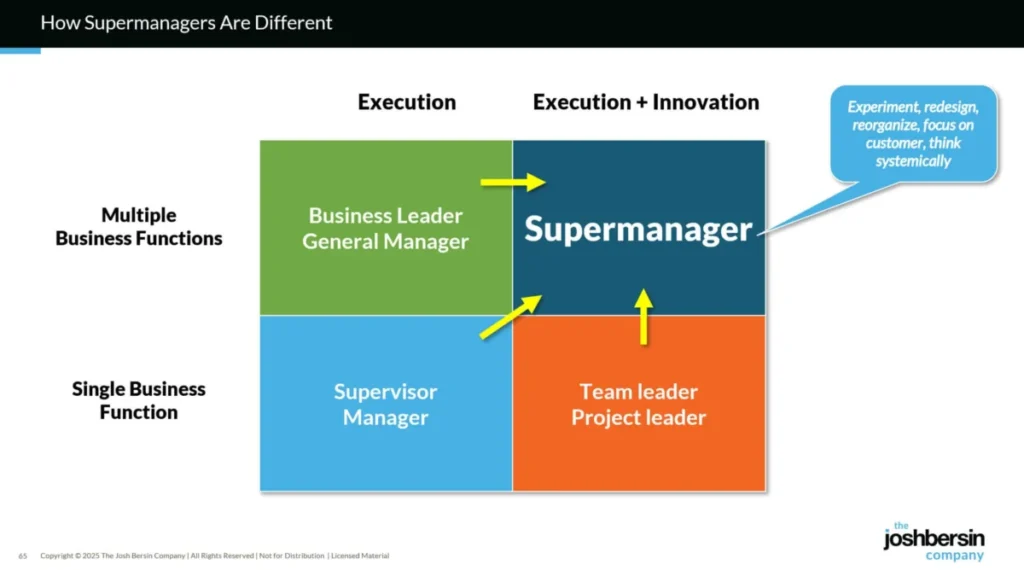
What distinguishes Supermanagers, individuals many of us have had the privilege to work with, is their remarkable ability to seamlessly blend a sharp focus on results with a deep commitment to reinvention. This duality is achieved through a distinct set of capabilities, and importantly, they are not necessarily characterized as "rebels" or "disruptors" in the traditional sense.
While many organizations are establishing AI steering committees and dedicated technology teams to develop standardized platforms and manage large-scale initiatives, these centralized bodies often lack the granular insight to identify every emerging opportunity. For instance, Standard Chartered is undertaking the ambitious development of a global onboarding platform designed to streamline complex talent acquisition processes across more than 80 countries. While such initiatives are crucial, they represent only a fraction of the potential AI applications.
Supermanagers, conversely, cultivate an environment where their teams are encouraged to generate novel ideas, critically prioritize those with the most significant potential impact, and actively champion their innovations. Instead of passively awaiting solutions from "corporate," they proactively support and foster an innovative spirit within their ranks.

The Indispensable Role of Supermanagers in AI Transformation
The current challenge facing organizations is a widening chasm between technological advancement and our capacity to effectively leverage it. As illustrated by recent data analysis, while powerful AI tools like Microsoft Copilot are becoming increasingly accessible, the time required to fully integrate and harness their potential often lags. This disparity results in a growing gap between the pace of technological evolution and the corresponding increase in business productivity.
Supermanagers act as the vital catalyst, the "fuel and energy," required to bridge this gap by driving the upward trajectory of business productivity. Traditional managers, often constrained by established processes, may default to waiting for IT to deliver solutions or simply instruct their teams to "become more productive." This passive approach is insufficient in the current landscape.
Supermanagers, on the other hand, demonstrate a proactive engagement with AI. They actively explore its capabilities, encourage experimentation within their teams, collaborate with IT departments to overcome technical hurdles, and foster a culture of creative problem-solving that transcends conventional boundaries. These localized, front-line innovations generate momentum, build practical experience, and articulate clear demands for IT support. The cumulative effect is a company rich with diverse innovations, each contributing to closing the productivity gap. As new AI features emerge, these Supermanaged teams of "Superworkers" continue to drive innovation forward.
This continuous cycle of innovation is facilitated by the increasing ease with which AI systems can be programmed and customized. The ability to craft effective prompts or manage data within AI agents, akin to using a spreadsheet, empowers individuals. Galileo, for example, offers an open system with numerous features for developers, making AI more accessible than ever. A capable Supermanager can effectively lead their teams through this rapidly evolving AI landscape.

Strategic Imperatives for Organizations
Organizations must critically examine their existing leadership models. To what extent do these models prioritize execution and results over innovation and creation? How much autonomy do managers possess to redefine roles and establish new positions? Are leaders adequately trained in job design and organizational change management?
Furthermore, a fundamental understanding of AI is no longer optional for leaders; it is a prerequisite. The pervasive impact of this revolutionary technology across all business roles necessitates that leaders actively acquire AI proficiency. HR leaders, in particular, must set the example by championing this upskilling imperative.
A thorough review of management models and associated reward systems is essential. As highlighted in recent industry analyses and discussions, investing in the development of Supermanagers may represent the most significant and impactful strategic investment an organization can make in its AI transformation journey.
The research paper, "The Rise of the Supermanager," offers in-depth insights into this evolving leadership paradigm. Additionally, tools such as Galileo for Managers provide leaders at all organizational levels with an AI-powered resource designed to enhance their leadership capabilities.
Further Exploration and Resources
- Introducing Galileo™ for Managers, The Leadership Guru At Your Fingertips: This resource provides a detailed overview of an AI-powered tool designed to support managerial development.
- The Rise of the Supermanager (Podcast): An audio exploration of the key themes and findings related to the Supermanager concept.