

The burgeoning artificial intelligence landscape, while dominated by titans like Anthropic and OpenAI boasting astronomical valuations, is revealing a critical truth: the real return on investment for businesses lies not in the sophisticated AI models themselves, but in their practical application and the data they leverage. This paradigm shift echoes the transformation witnessed in the relational database market during the 1990s, where the underlying technology became a commodity, and value migrated to the applications built upon it. As the industry grapples with the proliferation of advanced "frontier models" from major players and a growing array of powerful open-source alternatives, the focus is increasingly moving from the novelty of AI to its tangible integration into business solutions.
This evolving perspective is gaining significant traction, underscored by prominent voices in the tech industry. Satya Nadella, CEO of Microsoft, articulated this sentiment in a recent Wall Street Journal op-ed, "We Can’t Let AI Giants Eat the Economy." His commentary aligns with the growing understanding that AI is transitioning from a bleeding-edge marvel to a foundational enterprise technology, akin to other essential business tools.
Recent research, including an upcoming report titled "Enterprise AI Playbook" that surveyed over 200 companies, indicates that only a small fraction, approximately 8%, are currently developing robust, mission-critical enterprise AI applications. This suggests a widespread tendency for organizations to adopt AI tools with the hope that individual employees will discover valuable use cases, often viewing AI adoption more as an employee benefit than a strategic business initiative. This approach can lead to inefficient resource allocation, as highlighted by the experience of companies utilizing tools like Galileo, which, while powerful and capable of integrating with various models, requires a focused approach on specific domain problems to yield significant returns. Without this focus, the exploration of AI capabilities can devolve into unproductive experimentation.

The Maturation of Enterprise Technology Adoption
The traditional lifecycle of enterprise technology adoption typically involves a rigorous process. A business need is identified, a compelling business case is developed, and the solution is integrated with existing IT infrastructure, security protocols, and data management systems, all with clear return on investment (ROI) objectives. This methodical approach is common when companies procure specialized AI applications, such as those offered by Paradox, Eightfold, or Radancy, which are designed to solve specific business problems. However, this structured adoption is often absent when organizations simply grant access to general-purpose AI models like Claude, leaving employees to explore their potential without a defined strategic framework.
Even as generative AI demonstrates remarkable capabilities in coding, content creation, data analysis, and information retrieval, the inherent "fun and interesting" aspects of these models do not automatically translate into business value, especially when consumption incurs significant costs. The true payoff for AI investments emerges from the unique data, proprietary applications, and contextual understanding that an organization possesses. The substantial capital, estimated at $1.5 trillion in forward-looking investments, that has fueled the rapid development and deployment of AI technologies, is now expected to yield concrete returns. This investment has encompassed the significant costs associated with engineers, data centers, advanced hardware like NVIDIA processors, and the energy infrastructure required to power them. As this investment matures, the era of freely accessible AI experimentation is likely drawing to a close, with organizations increasingly bearing the direct costs of AI consumption. This shift is further underscored by recent market trends, including a notable 20% price increase observed in some AI-related offerings.
The Inevitability of Commoditization and Price Wars
The emergence of price wars within the AI market, as reported by The Wall Street Journal, is a natural consequence of this maturation process. When leading AI vendors, including those at the forefront of "frontier models," begin to engage in competitive pricing strategies, it signals a move towards commoditization. This phenomenon is characteristic of markets where switching costs are relatively low and differentiation becomes increasingly centered on price and broader ecosystem integration.
Microsoft’s strategic positioning with its "Microsoft AI" (MAI) models, designed to be significantly more cost-effective than premium offerings, exemplifies this trend. Nadella’s commentary emphasizes that the future of AI in the enterprise will be defined by solutions that offer value commensurate with their cost, mirroring the dynamics of established technology markets. This transition signifies a move away from the initial hype and a deeper focus on practical, economically viable applications.
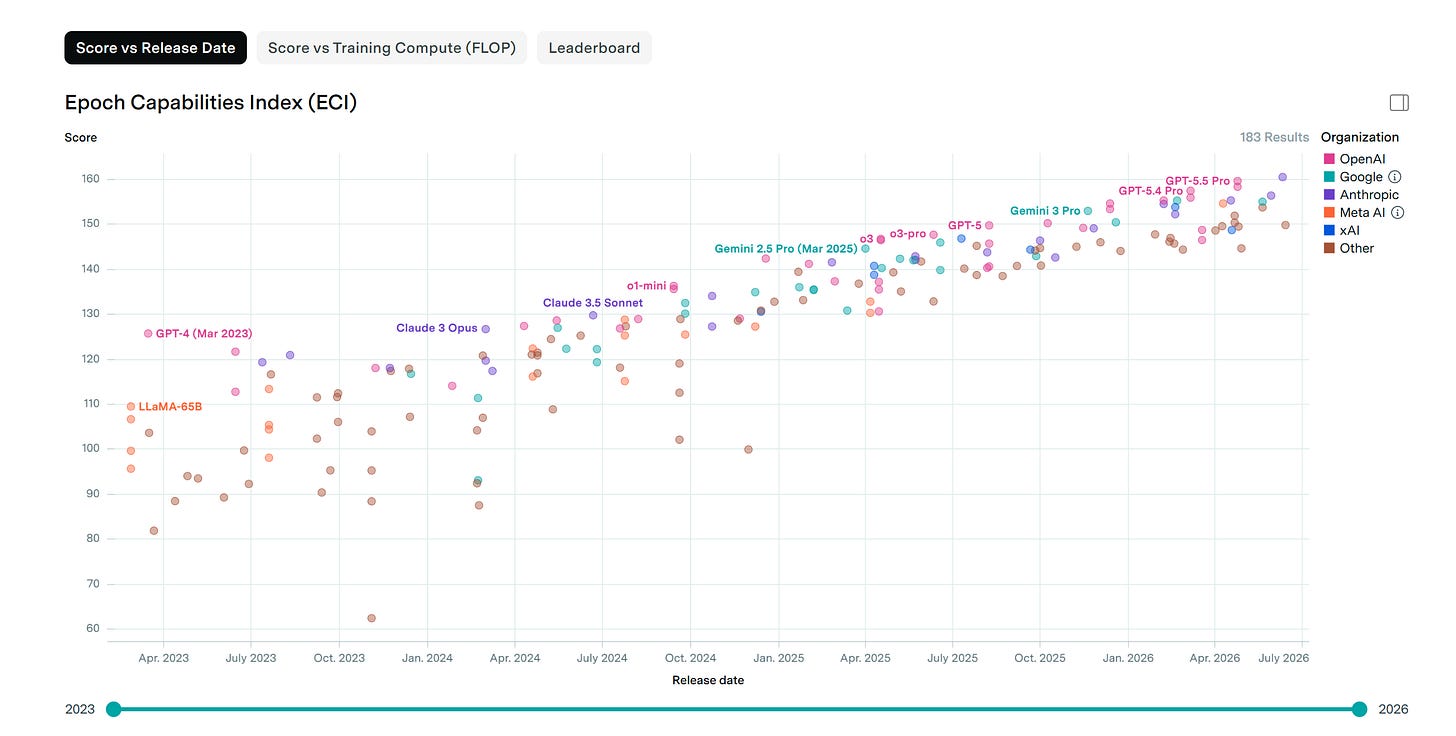
The velocity of AI model improvement, while once breathtaking, is also showing signs of a slowdown. Charts tracking AI capability evolution suggest a stabilization, which is a positive development for businesses. This deceleration allows organizations to shift their focus from the rapid pace of model development to the more deliberate and impactful work of problem-solving. The emphasis is moving from simply "buying AI" to strategically "applying AI" to address specific business challenges.
Reengineering Processes for AI Value Creation
The path to unlocking significant ROI from enterprise AI requires a more profound reengineering of business processes than often initially assumed. This is evident in the human resources sector, where the "HR 2030" model, a blueprint for high-value AI solutions, highlights the need for strategic investment beyond the core AI technology.
For instance, transforming the hiring process to enhance speed and efficiency involves not only acquiring specialized AI agents and superagents but also necessitates close collaboration with IT departments and a fundamental redesign of talent acquisition workflows. This often leads to a restructuring of roles within talent acquisition teams. Similarly, optimizing employee service centers using platforms like Microsoft Copilot, Workday Sana Core, or ServiceNow requires a comprehensive "project" approach. This entails consolidating policies, establishing robust governance frameworks, managing data effectively, and fostering cross-functional teamwork, often resulting in the reorganization of learning and development functions.
Building high-performance onboarding programs, as demonstrated by companies like Rolls Royce and Lockheed Martin, exemplifies this strategic imperative. Such initiatives demand consensus-building on program components, the development of globally and role-specific use cases, and the establishment of governance models to integrate tactical and strategic content effectively. In these scenarios, the large language model (LLM) itself represents only a small fraction of the overall solution.

A comprehensive blueprint for HR AI solutions identifies approximately 130 distinct agents, some of which can be purchased off-the-shelf, while others require custom development. To achieve meaningful AI payoffs, organizations must prioritize implementation efforts, collaborate with IT, and prepare their workforce for evolving roles, new skill requirements, and innovative workflows.
The Relational Database Analogy: Applications Trumping Platforms
The current state of the LLM market bears a striking resemblance to the relational database market in the late 1990s. At that time, vendors like Oracle, Sybase, Informix, Ingres, and Postgres offered powerful and sophisticated database management systems, competing on advanced features such as stored procedures and specialized indexing. However, as the technology matured, the distinctions between these relational database management systems (RDBMS) became less critical. The focus of value creation shifted decisively from the underlying database technology to the applications that were built upon them.
A similar evolutionary trajectory appears to be unfolding in the AI sector. While the underlying LLM technology is undeniably impressive, its inherent capabilities are increasingly becoming commoditized. The true value proposition for enterprises lies in how these models are applied to solve specific, high-value problems.
Companies like Galileo, which specializes in modeling entire organizations and addressing complex issues in reorganization, compensation structures, and skills analytics, demonstrate this shift. The development of such sophisticated solutions, which can condense months of consulting work into a matter of weeks, took years of dedicated effort. This involved not just leveraging an LLM, but also meticulously training it, integrating custom workflows, and harnessing the model’s features within a broader application architecture.
The Future of Enterprise AI: From Experimentation to Engineering
The future for HR and IT professionals in the coming years will involve identifying high-value business problems and strategically applying AI to develop, acquire, or customize solutions. The "magic" residing within the LLM is rapidly becoming a secondary consideration. As the $1.5 trillion invested in AI seeks tangible returns, the industry must transition from an experimental phase to one of architectural design and engineering. This shift is crucial for unlocking the enormous potential and realizing significant payoffs from AI investments.
The path forward involves moving beyond simply experimenting with AI tools and embracing a more structured, engineering-driven approach. This means prioritizing use cases that align with strategic business objectives, collaborating with IT to ensure seamless integration and robust security, and investing in the training and development of the workforce to adapt to new AI-driven workflows and roles. The success of enterprise AI will ultimately be measured not by the sophistication of the models themselves, but by the tangible business outcomes they enable through well-designed applications and data-driven insights.
The ongoing evolution of the AI market, marked by increasing accessibility of advanced models and the commoditization of core AI capabilities, presents both challenges and immense opportunities for businesses. By embracing a strategic, application-centric approach, organizations can navigate this evolving landscape and harness the transformative power of AI to drive significant and sustainable value.







