Picture this: a hiring manager, faced with a sudden crisis, sends an urgent Slack message on a Monday morning. Two senior engineers have just departed for a competitor, a third is slated to begin parental leave in six weeks, and the ambitious product roadmap necessitates the onboarding of four new hires by the end of the quarter. This translates to seven, potentially eight, critical open roles landing on the desks of a two-person recruiting team already managing a full workload. This scenario, far from being an anomaly, represents a pervasive and often underestimated challenge in talent acquisition: the quiet breakdown of hiring workflows when demand unexpectedly spikes. The issue isn’t a lack of effort or experience; it’s a systemic failure rooted in processes designed for steady states, not seismic shifts.
The fragility of these hiring pipelines becomes starkly apparent within days. Scheduling backlogs lengthen, candidate feedback becomes inconsistent, and promising finalists, overwhelmed by the pace, accept offers elsewhere. These aren’t failures of individual performance but rather symptoms of a fundamental design flaw. As demand triples due to a funding round, organizational restructuring, market fluctuations, or simply the seasonal pressures of a busy quarter, the system doesn’t merely slow down; it seizes.
The Tipping Point Most Organizations Never See Coming
Most hiring processes are meticulously crafted for a predictable rhythm. A steady flow of roles opens each month, candidates progress through defined stages on a known cadence, and recruiters can dedicate focused attention to each search. This manageable rhythm, however, is precisely what makes the system inherently fragile. When volume doubles or triples, the existing infrastructure buckles under the strain.
Scheduling becomes a Herculean task, with the coordination of multiple stakeholders and their packed calendars transforming into a full-time job in itself. Interview panels, often comprised of the same subject matter experts, find themselves stretched thin, simultaneously evaluating candidates across numerous roles. The candidate experience, once a point of pride, becomes a lottery, varying wildly depending on the recruiter who is least overwhelmed that particular week.
This strain is not merely anecdotal. Recent research underscores the severity of the issue. A comprehensive talent survey of 700 global organizations revealed that a significant majority struggle to redesign their work processes, opting instead to layer additional activity onto existing, inadequate frameworks. For recruiting teams, this translates directly: when requisition volume surges, the default response is to increase effort, extend working hours, and expedite screening—rather than questioning whether the underlying architecture can truly handle the load. More often than not, it cannot.
Where Delays Compound and Opportunities Evaporate
The problem is not a single catastrophic failure but a cascading series of smaller breakdowns that reinforce each other, leading to a significant increase in time-to-hire and a decline in candidate quality.
Screening Becomes a Bottleneck: In high-volume scenarios, manual initial resume reviews and phone screens inevitably fall behind. Candidates who apply on a Monday might not receive a response until Thursday, or even later. In today’s competitive talent market, this window of silence is often ample time for a more agile competitor to engage, schedule interviews, and extend an offer. This delay directly impacts the applicant pool, as the most sought-after candidates are likely exploring multiple opportunities simultaneously.
Interviewer Availability Grinds Progress to a Halt: The same senior engineers, managers, and subject matter experts are frequently required for every technical role. Their calendars, already brimming with project deadlines and strategic initiatives, become a significant impediment. Coordinating a three-person interview panel for a candidate with a limited decision window can devolve into a complex scheduling puzzle that frequently takes longer than the candidate is willing to wait. This logistical hurdle can derail promising candidates before they even have a chance to showcase their full capabilities.
Feedback Loops Stall and Decisions Languish: Post-interview debrief notes are often submitted late, if at all. Hiring managers, spread thin across multiple searches, may lack the bandwidth to provide the focused evaluation each candidate deserves. Decisions that ideally should be made within 48 hours can stretch into a week or more. During this extended period, candidates are actively interviewing elsewhere, and the organization risks losing them to more decisive competitors.
Each of these delays does not operate in isolation. A slow screening process directly leads to delayed interview scheduling. A delayed schedule compresses the decision-making window. A compressed window often results in less rigorous evaluation, potentially leading to suboptimal hiring decisions. Throughout this entire chain reaction, the most critical factor is the candidate’s perspective. Top talent, accustomed to efficient processes, rarely waits for organizations to sort out their internal inefficiencies.
The impact of these delays is substantial. Research from PwC highlights that AI-powered agentic solutions can liberate hiring managers and recruiters by saving them up to 70% of their time on sourcing activities alone. This figure starkly illustrates the significant amount of time currently consumed by manual, often inefficient, processes within traditional hiring workflows.
The Illusion of Scale: Why More Recruiters Aren’t Always the Answer
When hiring processes falter under pressure, the instinctive reaction is to increase headcount. While more recruiters can offer incremental support, their effectiveness is severely hampered if the underlying workflow remains the bottleneck. Adding more individuals to a system with inherent structural flaws simply means more people waiting on the same broken steps.
This is a key insight from Eightfold.ai’s "Infinite Workforce" ebook, which posits that legacy hiring systems were designed for administrative tasks, not agile execution. These systems excel at tracking headcounts, ensuring compliance, and storing records, but they were not built to operate at the speed and scale required by today’s dynamic labor market. The advent of software has, in many ways, provided faster typewriters rather than autonomous authors. Hiring more recruiters to navigate an undersized process is akin to augmenting a factory floor with more workers when the assembly line itself is fundamentally too slow.
The core of the problem lies in what can be termed a "human-scale speed limit." Every step in a traditional hiring process requires a human to initiate, respond to, or approve an action. Scheduling necessitates a recruiter sending availability. Screening requires a recruiter to read and evaluate resumes. Feedback relies on a hiring manager to document and submit their assessment. When volume surges, these numerous human checkpoints create a compounding bottleneck. Even with additional headcount, the fundamental design of the process, which hinges on one human’s action enabling another’s, prevents true scalability.
Despite significant investments in HR technology, a substantial portion of organizations report that these investments have failed to meet expectations. The primary reason cited is the workforce’s inability to effectively utilize the new tools. The technology may have become faster, but the underlying processes remained unchanged, rendering the technological advancements less impactful than anticipated.
The Promise of Scalable Hiring: Consistency, Speed, and Strategic Focus
A hiring process that can withstand and even thrive under pressure possesses distinct characteristics, none of which are dependent on heroic individual effort.
Unwavering Consistency: A truly scalable process delivers a consistent candidate experience, regardless of application volume. Whether an organization is processing 20 applications or 2,000 for the same role, the experience should remain uniform. Inconsistency at scale is not just a candidate experience issue; it’s a data integrity problem. When screening criteria fluctuate based on the recruiter, the week, or available bandwidth, the ability to make fair and objective comparisons across the entire candidate pool is compromised.
Velocity in Early Stages: The initial stages of screening and interviewing are where the majority of time-to-fill is lost, and where the "human-scale speed limit" is most acutely felt. A scalable process eliminates manual bottlenecks in these critical early phases, ensuring that candidates receive prompt feedback and can progress through the pipeline without being held up by a recruiter’s schedule.
Empowering Human Judgment: Perhaps most importantly, a scalable process liberates human interviewers to focus on the aspects of hiring that truly require their nuanced judgment. The most valuable moments in a hiring process involve assessing cultural fit, evaluating leadership potential, and building the rapport necessary to convert a finalist into a committed new hire. These are the areas where recruiters and hiring managers should be dedicating their expertise, not wrestling with scheduling complexities or chasing down incomplete interview notes.
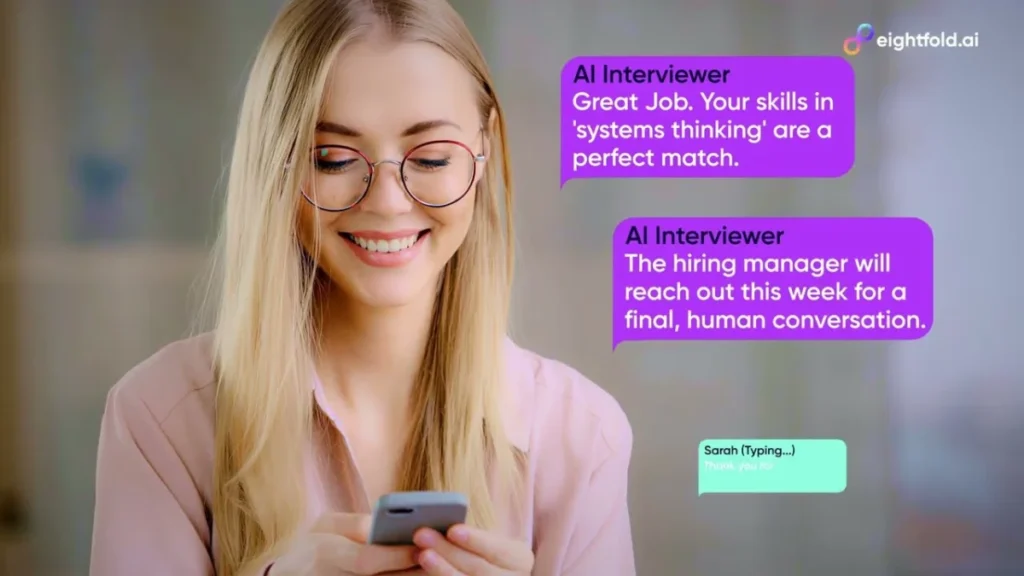
This is where artificial intelligence, specifically AI interviewing agents, enters the equation. These tools are not designed to replace human judgment but to act as digital workers capable of operating at scale. Rather than assisting a recruiter in scheduling faster, an AI interviewing agent can autonomously conduct initial screenings and structured interviews at any volume, 24/7, across languages and time zones.
Organizations that have adopted AI Interviewer solutions have reported dramatic reductions in hiring cycles, compressing them from an average of 42 days to under a week, with a decrease in time-to-interview by up to 90%. Interview completion rates have soared to 92.5%. By automating up to 80% of manual recruiter tasks at the screening stage, these systems empower recruiters to shift their focus to the strategic conversations that are crucial for securing top talent.
Crucially, these advanced systems are not built on general-purpose AI. They are purpose-built for the intricacies of hiring, trained on billions of real-world career trajectories, and meticulously designed to evaluate skills rather than mere credentials, with a strong emphasis on reducing bias, not amplifying it. Research evaluating the use of Large Language Models (LLMs) in hiring decisions has shown that general-purpose models significantly underperform purpose-built systems on fairness metrics, often disadvantaging candidates due to inherent biases present in uncurated training data. Therefore, scalable hiring is not merely about achieving speed; it is about obtaining accurate and equitable insights at speed.
Returning to Monday Morning: A Shift in Architecture
Consider again the hiring manager facing that critical Slack message and seven urgent open roles. In a traditional, steady-state process, this message triggers a frantic scramble, a reactive attempt to catch up. In a process designed for scale, however, this message initiates a smooth, automated workflow. Applications begin to move immediately. Initial screening occurs without delay, independent of a recruiter’s immediate availability. Qualified candidates are identified quickly, consistently, and with documented rationale. By the time a human interviewer engages, they are focused on the critical evaluative stages that only they can perform.
The stark difference between these two scenarios lies not in effort or intent, but in architectural design. Most hiring processes were never engineered to absorb sudden surges in volume. Recognizing this fundamental limitation is the essential first step toward building a hiring framework that can not only withstand pressure but also leverage it for strategic advantage.
To explore the frameworks, research, and strategies behind building a hiring process that scales without breaking, interested parties are encouraged to download "The Infinite Workforce" ebook.