
A well-structured performance review template is far more than a bureaucratic formality; it is a pivotal instrument for fostering clarity, cultivating trust, and driving tangible employee growth. When organizations implement thoughtfully designed performance review forms, they empower managers and employees to establish clear expectations, concentrate on impactful behaviors and outcomes, and engage in equitable and productive dialogue. This consistency and dedicated space for candid feedback cultivate transparency, ultimately fueling enhanced development and engagement across the entire workforce.
The Indispensable Role of Constructive Feedback
At the heart of any effective performance review lies constructive feedback. This crucial element serves as a catalyst for employee performance enhancement and accelerates professional development. It equips managers with the tools to guide their teams toward growth, skill refinement, and continuous improvement. The characteristics of great feedback are multifaceted: it should be specific, actionable, timely, and delivered with a focus on behavior rather than personality.

Research underscores the profound impact of regular feedback. Studies by Quantum Workplace, for instance, indicate that employees who receive more frequent feedback exhibit double the engagement levels, are three times less likely to seek external employment opportunities, and are 1.4 times more inclined to remain with their current organization. This data highlights that helpful feedback transcends mere suggestion; it is a cornerstone of employee engagement and retention. Organizations seeking to inspire their next performance evaluations can draw upon a wealth of resources, with over 170 performance review examples, comments, and phrases available to guide their efforts.
Defining the Performance Review Template
A performance review template is essentially a standardized document designed to structure and guide employee evaluation conversations. Its primary function is to ensure consistency among managers, clearly delineate performance expectations, facilitate fair assessment, and meticulously document progress against defined criteria. A robust template ensures that employees possess a clear understanding of how their performance is evaluated, what they are excelling at, and areas where they have opportunities for advancement.
The adoption of a performance review template, employee review template, or employee review form streamlines the entire evaluation process, rendering it more focused, organized, and accessible for both managerial staff and employees. For human resources departments, the consistency afforded by templates is invaluable. They serve to mitigate bias, standardize performance dialogues across the organization, bolster compliance documentation, and generate clean, comparable performance data. This data is instrumental in identifying organizational trends, providing targeted support to managers, and refining the overall performance management framework.

The Compelling Rationale for Employing Performance Review Templates
The implementation of a performance review template significantly simplifies the task for managers, enhancing their understanding of the review process and their capacity to deliver feedback that genuinely contributes to employee development. A structured employee review template or form ensures that performance discussions remain focused, equitable, and consistent.
Furthermore, these templates empower managers to provide constructive feedback effectively, accentuating strengths and identifying areas for improvement in a manner that motivates employees. For HR departments, this organizational consistency is paramount. It guarantees that every employee receives clear, actionable guidance, supports fair and objective evaluations, and simplifies the tracking and analysis of performance data across the enterprise.
Essential Components of an Effective Performance Review Template
Best practices dictate that a performance review form should incorporate clear and specific performance criteria. It should provide illustrative examples of employee accomplishments alongside identified areas for growth, thereby adopting a balanced perspective. While a rating system can be included, it should not overshadow the substance of the conversation. Ample space should be allocated for comments and feedback from both the reviewer and the employee. Crucially, the template should be forward-looking, fostering employee growth through the establishment of well-defined goals and development plans.
The core components of an effective performance review template contribute to discussions that are meaningful, transparent, and fair. A well-conceived appraisal template offers a consistent framework throughout the organization and alleviates the administrative burden on managers, enabling them to initiate effective conversations with greater ease.
Pitfalls to Avoid in Employee Performance Review Templates
Several common errors can undermine the effectiveness of performance reviews. Performance review templates can play a significant role in mitigating these common pitfalls. These often include vague feedback, a lack of specific examples, an over-reliance on recent events (recency bias), personal biases influencing evaluations, and a failure to connect performance to organizational goals. A well-designed template should prompt for evidence-based assessments and encourage forward-looking development plans.
A Spectrum of Performance Review Templates for Diverse Needs
Employee review templates introduce consistency, clarity, and structure into performance conversations. They serve as invaluable guides for managers and employees, offering structured questions, facilitating goal alignment, and encouraging thoughtful reflection. By integrating various employee review templates throughout the performance cycle, organizations can cultivate a consistent rhythm of meaningful, growth-oriented discussions.
Exploring Key Performance Review Template Variations:
1. The G.O.O.D. Performance Review Template
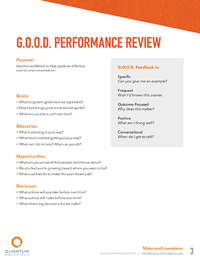
The G.O.O.D. template, a staple in Quantum Workplace’s internal culture, is utilized for monthly manager-employee performance check-ins. G.O.O.D. stands for Goals, Obstacles, Opportunities, and Decisions. This template excels at facilitating monthly one-on-one meetings, enabling both managers and employees to gain a broader perspective and revisit overarching objectives.
- Goals: This section prompts a review of current objectives and their alignment with broader team and organizational aims. It encourages employees to articulate what they aim to achieve in the coming period.
- Obstacles: Here, the focus shifts to identifying any challenges or roadblocks hindering progress towards goals. This section encourages problem-solving and collaborative identification of support needed.
- Opportunities: This segment explores potential avenues for growth, learning, or improvement. It might involve skill development, new project involvement, or innovative approaches to existing tasks.
- Decisions: This final pillar centers on actionable steps. It requires identifying key decisions to be made, commitments to be undertaken, and immediate next steps for both the employee and the manager.
Pros: This template fosters a culture of open dialogue, encourages proactive reflection, and supports forward-looking planning.
Cons: It does not inherently include metrics for quantitative comparison of employees, a characteristic that Quantum Workplace deliberately avoids in favor of qualitative development.
2. Quarterly Check-In Template
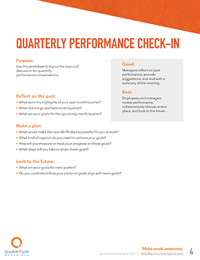
For organizations where monthly performance conversations are not feasible, quarterly check-ins represent a strong alternative. This template facilitates collaborative reviews of employee performance, discussion of action plans, and strategic future planning.
- Reflect on the past: This section guides a review of achievements, challenges, and lessons learned from the preceding quarter.
- Make a plan: This segment focuses on outlining concrete steps and strategies to address identified areas for improvement and capitalize on opportunities.
- Look to the future: This part of the template encourages forward-thinking, setting priorities, and aligning individual goals with upcoming team and organizational objectives.
Pros: Enables timely action on performance insights and adjustments.
Cons: May not always maintain a consistent focus on long-term strategic goals for both the individual and the company.
3. Mid-Year Performance Review Template
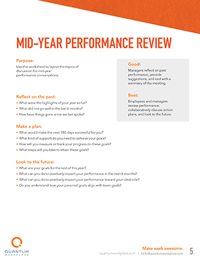
The mid-year performance review offers a crucial juncture to assess progress toward annual goals and make necessary adjustments. It emphasizes key highlights, addresses obstacles encountered, and outlines a clear path forward.
- Reflect on the past: This section involves reviewing performance and accomplishments during the first half of the year.
- Make a plan: This part details strategies for improvement and development for the remainder of the year.
- Look to the future: This segment focuses on setting revised goals and priorities for the second half of the year, ensuring alignment with annual objectives.
Pros: Provides a critical opportunity for recalibration before the end of the performance cycle.
Cons: If it’s the sole formal review, it leaves significant gaps between performance evaluations.
4. Annual Performance Review Template
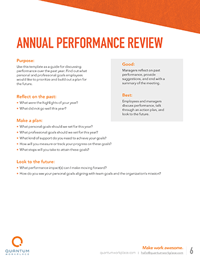
The annual performance review serves as a comprehensive summary of performance over the entire year. It is also an opportune moment to identify employee aspirations for the next performance cycle.
- Reflect on the past: This section involves a holistic review of accomplishments, contributions, and challenges throughout the year.
- Make a plan: This involves developing specific action items for development and goal attainment in the upcoming year.
- Look to the future: This part focuses on long-term career aspirations and setting overarching goals for the next review period.
Pros: Offers a broad perspective on an employee’s performance over an extended period.
Cons: Condensing an entire year of performance into a single conversation can be challenging.
5. One-Page Performance Review Template
For organizations prioritizing brevity and efficiency, a one-page template offers a concise overview. These templates typically include a defined rating scale for a quick assessment.
Pros: Streamlined and straightforward, with a clear rating structure.
Cons: Offers limited space for detailed commentary and may not fully encourage reciprocal dialogue.
6. Self-Assessment Template
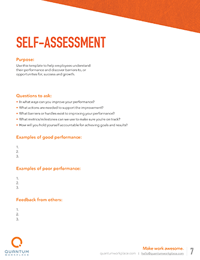
A self-assessment empowers employees to reflect on their own performance, identify personal barriers, and recognize opportunities for growth. This process fosters employee ownership of their career pathing and provides valuable insights for managerial coaching.
- Key Questions: Prompts encourage reflection on achievements, areas for improvement, and contributions to team and organizational goals.
- Share examples of good performance: Employees articulate specific instances of successful work.
- Share examples where you could improve: Employees identify areas where development is needed.
Pros: Cultivates reflective habits and encourages employees to take accountability for their performance.
Cons: Does not incorporate feedback from peers or managers.
7. Upward Feedback Template
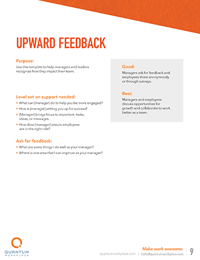
This template is crucial for managers to solicit feedback on their own performance. Upward feedback allows employees to share insights with their manager’s superior, fostering accountability and continuous improvement at all leadership levels.
- Level set on support needed: Employees articulate the resources and support they require from their manager.
- Ask for feedback: Employees provide constructive input on their manager’s leadership style, communication, and effectiveness.
Pros: Opens avenues for two-way conversations regarding managerial effectiveness.
Cons: Employees may harbor reservations about providing critical feedback due to potential repercussions.
8. Team Performance Review Template
High-performing teams are fundamental to organizational success. This template is designed to build trust by fostering an open feedback culture within teams, encouraging candid discussions about challenges and collaborative solution development.
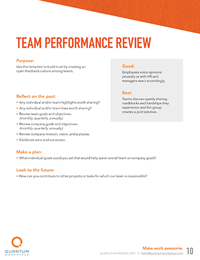
- Reflect on the past: Review team accomplishments, setbacks, and learnings.
- Review team goals and objectives: Assess progress against established short-term and long-term targets.
- Make a plan: Outline strategies for collective improvement and addressing team-level obstacles.
- Look to the future: Set collective objectives and define how the team will work together to achieve them.
Pros: Provides insight into overall team performance rather than solely individual contributions.
Cons: Highly polarized scores from a few individuals can potentially skew the overall results.
9. 360 Performance Review Template
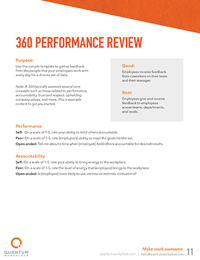
A 360 review gathers feedback from an employee’s peers, subordinates, and supervisors, providing managers with a comprehensive perspective on an employee’s performance. This diverse feedback can illuminate strengths and challenges not always apparent to a direct manager.
- Performance Self: Employees and reviewers rate various aspects of performance, such as accountability, collaboration, and innovation.
- Accountability Self: Evaluates an individual’s responsibility and ownership of tasks and commitments.
Pros: Offers a holistic view of an employee’s impact, extending beyond the manager’s direct observation.
Cons: Can be challenging for individuals to provide consistently accurate assessments of others.
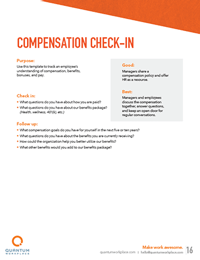
10. Professional Development Template
Professional development and career growth are significant drivers of employee engagement and performance. This template facilitates discussions on aligning employee strengths, skills, and goals with their current role and future career aspirations.
- Address alignment: Assess how current skills and aspirations match job requirements and company opportunities.
- Discuss development: Identify specific areas for skill enhancement and knowledge acquisition.
- Talk through training and goals: Outline training programs, mentorship opportunities, and career pathing steps.
Pros: Enables comparison of aligned expectations before and after the performance cycle.
Cons: Can sometimes result in generalized development plans.
11. Performance Improvement Template
When an employee’s performance consistently falls short of expectations, a performance improvement plan (PIP) becomes necessary. This template helps identify performance barriers and establish a structured plan for improvement.
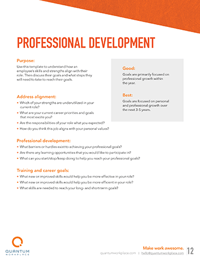
- Address accountability: Clearly define performance gaps and expectations for improvement.
- Make a plan: Outline specific actions, resources, and timelines for addressing deficiencies.
- Reflect: Schedule follow-up sessions to monitor progress and provide ongoing support.
Pros: Provides a structured approach to address declining performance and offers employees a fair opportunity to improve.
Cons: Requires significant commitment and follow-through from both the employee and the manager.
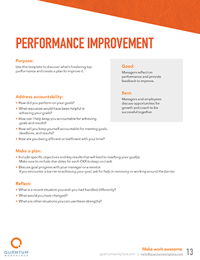
12. Behavior Change Template
Employee behaviors significantly influence individual and team success. This template aids in understanding and addressing behaviors that either propel or hinder performance.
- Questions to ask: Prompts focus on identifying specific behaviors, their impact, and strategies for positive change.
Pros: Facilitates collaborative identification of issues, needs, and barriers between managers and employees.
Cons: The effectiveness of the conversation is heavily dependent on the employee’s willingness to engage constructively.
13. Compensation Check-In
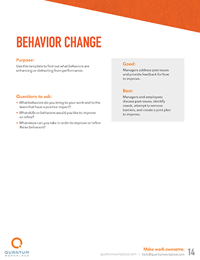
Open and transparent discussions about compensation are vital. This template guides conversations about salary, benefits, bonuses, and pay, ensuring managers and employees are aligned and questions are addressed.
- Check in: Initiate dialogue about compensation, performance, and market value.
- Follow up: Document discussions, outline any agreed-upon actions, and set expectations for future reviews.
Pros: Promotes pay transparency and open communication within organizations.
Cons: Employee expectations regarding compensation may not always be met due to budgetary or performance constraints.
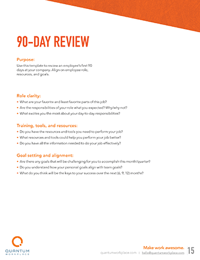
14. 90-Day Review Template
The initial 90 days of employment are critical for new hires. This template facilitates an early review of their performance, helps set short-term goals, and establishes a shared vision for their integration into the organization.
- Role clarity: Ensure the new hire understands their responsibilities and expectations.
- Training, tools, and resources: Confirm the employee has the necessary support to succeed.
- Goal setting and alignment: Establish initial performance objectives and align them with team goals.
Pros: Provides crucial clarity and early performance feedback for new employees.
Cons: The scope is generally limited to the initial onboarding period.
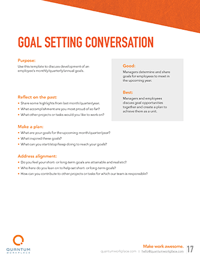
15. Goal Setting Conversation Template
Effective goal-setting is a cornerstone of performance management. This template assists in developing measurable, aligned goals for employees at monthly, quarterly, or annual intervals.
- Reflect on the past: Review progress on previous goals.
- Make a plan: Define new, specific, and achievable goals.
- Address alignment: Ensure individual goals support broader team and organizational objectives.
Pros: Facilitates the establishment of aligned and measurable performance objectives.
Cons: Lacks effectiveness if not revisited and discussed regularly throughout the performance cycle.
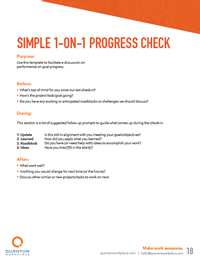
16. Simple 1-on-1 Progress Check
While formal reviews are important, consistent weekly check-ins are equally vital. These brief conversations allow managers and employees to address immediate obstacles and monitor progress in real-time.
Pros: Enables quick and frequent communication, fostering agility and proactive problem-solving.
Cons: Requires managers to dedicate specific time for each employee’s weekly check-in.
Transforming Performance Reviews into Strategic Initiatives
Performance reviews are instrumental in aligning teams with organizational objectives, driving both employee and business success, and enhancing engagement and culture. By emphasizing the value of feedback, these reviews can evolve into powerful tools for professional development and career advancement. Simple performance review templates empower HR and managers by:
- Providing a structured framework for consistent evaluations.
- Facilitating open and honest feedback.
- Documenting employee progress and development.
- Identifying training needs and career development opportunities.
- Supporting objective decision-making regarding promotions and compensation.
Quantum Workplace: Enhancing Performance Review Efficiency
Performance conversations need not be arduous. Quantum Workplace’s solutions ensure managers and employees remain synchronized through engaging performance reviews. Their performance review software provides teams with reliable context, facilitating more objective and impactful discussions. Key features include:
- Customizable Reviews: Tailor review modules to meet specific organizational needs and cultural nuances.
- Manager Habit Building: Integrate performance processes into existing workflows to foster positive coaching habits.
- Response Rate Tracking: Monitor review progress in real-time to ensure accountability.
- Integrated Goal Setting: Embed performance goals directly into evaluations for cohesive discussions.
- Multi-Rater Feedback: Incorporate feedback from various sources to provide a holistic view.
- Data Visualization: Utilize talent dashboards for a comprehensive organizational overview and informed talent management decisions.
Performance Review Template FAQs
What are the most important sections in an employee review template?
The most effective templates include clear sections guiding meaningful conversations. Key components typically include:
- Goals and Objectives: Reviewing past achievements and setting future targets.
- Key Responsibilities and Performance Areas: Assessing performance against core job duties.
- Strengths and Areas for Development: Identifying areas of excellence and opportunities for growth.
- Employee Comments: Providing a space for employee reflection and input.
- Manager Comments and Development Plan: Documenting the manager’s assessment and outlining future growth strategies.
- Signatures: Formalizing the review process.
These sections ensure consistency, fairness, and alignment, while also providing HR with valuable insights into performance trends.
How to write a good performance review template?
Crafting an effective template involves creating a framework that promotes clarity, alignment, and action. Define what constitutes excellent performance within your organization and develop prompts that encourage reflection and future-oriented planning. An effective template should:
- Be clear, concise, and easy to understand.
- Focus on observable behaviors and measurable outcomes.
- Include space for specific examples and evidence.
- Encourage two-way dialogue and collaborative goal-setting.
- Balance assessment of past performance with planning for future development.
The best templates blend structure with flexibility, supporting both strategic evaluation and human-centered interactions.
What is an example of a good performance review?
A good performance review highlights achievements, evaluates progress towards goals, and establishes clear future expectations. Quantum Workplace’s G.O.O.D. Performance Review Template, for example, utilizes Goals, Obstacles, Opportunities, and Decisions to foster a holistic and interactive dialogue. A strong example includes:
- Specific examples of accomplishments tied to measurable results.
- A clear assessment of progress against defined goals.
- Constructive feedback on areas for development, with actionable suggestions.
- A collaboratively developed plan for future growth and goal attainment.
This approach strengthens trust, enhances clarity, and supports both employee engagement and overall organizational performance.
What are the 5 words for a performance review?
Five key words that guide productive performance conversations and actionable growth are:
- Goals: What are we trying to achieve?
- Obstacles: What is preventing progress?
- Opportunities: Where can we improve or grow?
- Decisions: What actions will we take?
- Development: How will we support future growth?
Quantum Workplace’s G.O.O.D. model encapsulates these principles, providing a framework for meaningful reviews and check-ins.
How can HR create effective performance review templates?
HR teams can design effective templates by prioritizing fairness, clarity, and strategic alignment. Key steps include:
- Define Performance Standards: Clearly articulate what constitutes successful performance at all levels.
- Incorporate Feedback Mechanisms: Include sections for self-assessment, manager feedback, and potentially peer or upward feedback.
- Focus on Development: Integrate prompts for goal setting, skill development, and career pathing.
- Ensure Clarity and Simplicity: Use straightforward language and a logical structure.
- Pilot and Refine: Test templates with a small group and gather feedback for iterative improvements.
An effective employee review form should simplify performance conversations, not complicate them.
By optimizing the performance review process, organizations can transform it from a perfunctory administrative task into a strategic driver of talent development and business success. Quantum Workplace’s performance review software aims to facilitate this transformation, empowering teams to conduct more effective, efficient, and engaging reviews.