A classroom without a teacher is more than just an open requisition; it represents a student without a dedicated educator, potentially impacting their learning trajectory. Similarly, a hospital ward short two nurses is not merely a staffing gap; it signifies longer wait times for patients, increased burden on existing staff, and a diminished capacity to provide timely, quality care. For the human resources leaders and recruiters tasked with staffing these vital public-serving organizations, the hiring process transcends an operational function. It is a direct conduit to the individuals who form the very foundation of their mission: students and patients. This immense responsibility weighs heavily during every hiring season. School principals must ensure classrooms are staffed before the first bell rings, and nursing directors need shifts covered before seasonal surges like flu season peak. Their challenge is amplified by the need to compete for talent against private-sector employers who often possess greater agility and offer more competitive compensation packages. In this high-stakes environment, Artificial Intelligence (AI) interviewing has emerged as a pragmatic solution, empowering public-serving organizations to accelerate their hiring processes without compromising the quality of candidates.
The Shared Strain: Education and Public Health Face Parallel Hiring Dilemmas
While a school district and a public hospital system may appear operationally disparate at first glance, a closer examination of their hiring calendars and the pressures they face reveals striking similarities. Both sectors are characterized by intense, predictable hiring waves. Educational institutions gear up for the academic year, often experiencing turnover mid-year, necessitating continuous recruitment. Healthcare systems and public health departments witness significant hiring demands tied to seasonal outbreaks like influenza, annual budget cycles, and unpredictable public health emergencies that cannot be scheduled around.
In both scenarios, the available hiring window is remarkably short, and the volume of applications is substantial. This confluence of factors transforms the screening process – not just candidate sourcing – into a critical bottleneck. Furthermore, both sectors find themselves in direct competition with employers who can operate with greater speed. Private clinics or corporate training companies are not typically encumbered by the same lengthy procurement timelines, complex union negotiations, or rigid budget cycles that can slow down public sector hiring. Consequently, public-serving organizations often find themselves navigating the same talent market with fewer inherent speed advantages.
The repercussions of a delayed or flawed hire are not confined to internal metrics within these organizations. The impact is directly felt in the community: a student’s educational experience is compromised, a clinic’s capacity to serve is reduced, or a critical call to a health hotline goes unanswered. This shared reality underscores the importance of examining AI interviewing as a unified solution for both sectors, rather than as isolated use cases.

The Seasonal Squeeze: Public Education’s Hiring Crucible
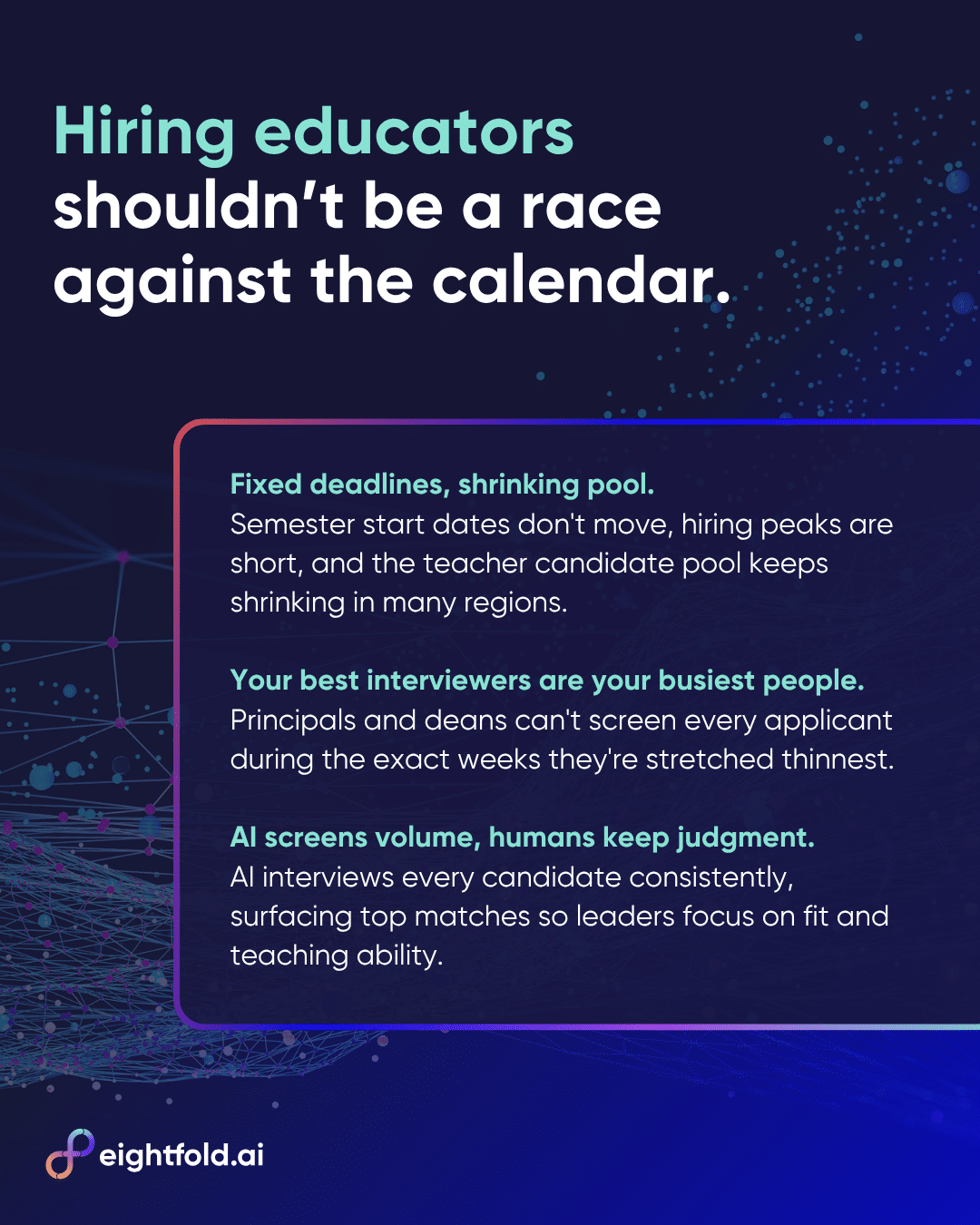
The hiring cycle in public education, encompassing both K-12 and higher education, is dictated by a relentless seasonal clock. Districts and universities face the imperative of filling positions before the commencement of each semester, with virtually no flexibility to shift these critical deadlines. Compounding this challenge is the fact that the individuals responsible for conducting interviews – principals, department chairs, and deans – are often the busiest professionals within their institutions during the very weeks when hiring volume reaches its apex. Expecting them to personally screen every applicant on top of their existing responsibilities in August or January is both unrealistic and unfair to them and to the candidates.
Simultaneously, the applicant pool for many teaching and instructional roles has been shrinking in various regions. This scarcity means that the candidates who do apply need to move through the hiring process with exceptional speed, lest they accept opportunities elsewhere. This is precisely where AI interviewing finds its value. Rather than supplanting the crucial human judgment required in education hiring – such as a candidate’s ability to connect with students or their cultural fit within a school’s community – AI interviewing effectively manages the sheer volume that precedes such qualitative assessments. It can screen a large cohort of applicants during peak hiring pressure weeks, posing the same role-specific questions to every candidate and identifying the strongest matches. These selected candidates are then advanced to human-led interview rounds, where teaching aptitude and cultural alignment can be thoroughly evaluated.
This approach significantly alleviates the burden on principals and department heads during their most demanding periods. It also ensures that candidates receive timely feedback, avoiding the frustration of waiting in silence while their applications navigate a slow-moving internal process. Eightfold.ai’s AI Interviewer, for instance, can be configured to meticulously screen for qualifications, certifications, and criteria specific to each role. This includes assessing teaching licenses, subject-matter expertise, or experience with particular student populations, thereby transforming the screening stage from a mere resume triage into a meaningful evaluation of essential competencies.
Furthermore, internal data from Eightfold.ai demonstrates the scalability of this solution. A single job posting can attract hundreds of applicants. AI Interviewer efficiently processes candidates invited by a school, providing concise summaries for each. This allows hiring managers to approach interviews with valuable context rather than an overwhelming backlog of applications. This efficiency is critical in a sector where timely staffing directly impacts student learning and teacher retention.
The Front Lines of Care: Public Health and Healthcare Systems’ Staffing Imperative
Public hospitals and health departments often operate from a more challenging starting point than many private healthcare facilities. They frequently contend with chronic understaffing, constrained budgets, and the urgent mandate to fill clinical and support roles rapidly, as every vacant shift translates directly into a capacity problem. Moreover, these institutions often lose promising candidates to private hospitals and health systems that possess more streamlined hiring pipelines, sometimes extending job offers before the public sector has even completed its initial screening phase.

The screening stage is frequently the point at which these vital systems lose candidates. A qualified applicant applies, only to endure days of waiting for a callback while juggling other potential offers. By the time contact is made, the candidate may have already accepted a position elsewhere.
An AI interviewer effectively eliminates this critical delay by engaging candidates immediately. In practice, this can mean a candidate completes an interview on the same day they apply, maintaining their engagement and keeping them within the pipeline during the crucial window when they are most likely to be exploring other opportunities.
For roles where specific credentials are non-negotiable – such as a nursing license, a specialized certification, or a required background check – the AI Interviewer platform can be configured to assess these qualifications directly within the interview process. This ensures that no critical requirements are overlooked at a stage where a missed credential could surface much later, causing significant delays and potential disqualification.
This capability is particularly significant in regulated environments. AI Interviewer is designed to evaluate solely the content of a candidate’s responses, deliberately excluding facial expressions, tone of voice, or emotional cues. This approach is specifically engineered to promote fairness and ensure compliance with stringent regulations, such as New York City’s Local Law 144, Illinois’ Biometric Information Privacy Act, and Maryland’s HB 1202. This evaluation methodology, coupled with integrated fraud detection safeguards, empowers public health employers to document a consistent and legally defensible hiring process.
The impact of AI Interviewer on hiring cycle times is particularly relevant to public health, where much of the recruitment is high-volume and shift-based. Early adopters of AI Interviewer have reported accelerated hiring cycles, reducing them from approximately six weeks to under a week. The time taken to bring a candidate to their first interview has been compressed by as much as 90%. In chronically understaffed systems, this significant reduction directly translates into more shifts being covered and fewer open positions.
Bridging the Divide: Efficiency Without Compromise
In both education and public health, a delayed hire carries consequences far beyond internal HR metrics. It can mean a classroom relying on substitute teachers for an extended period, impacting the continuity of learning. It can result in a healthcare unit operating with insufficient staff during critical periods like flu season, compromising patient care. The individuals most affected by these delays are not within the HR department; they are the students and patients whom these organizations are fundamentally established to serve.
AI interviewing does not force HR leaders in education and public health to make an untenable choice between speed and quality. Instead, it shifts the burden of high-volume tasks – the initial screening that historically consumed weeks and the valuable time of the busiest personnel – to an automated layer. This layer can operate around the clock, evaluate every applicant against the same objective criteria, and present the hiring team with a concise list of genuinely qualified candidates, rather than an unorganized pile of applications.
Crucially, the ultimate decision-making authority remains with human professionals. They are empowered to make faster, more informed choices, and critically, they are better positioned to retain promising candidates who might otherwise be lured away by the faster-paced private sector. As these vital public institutions navigate periods of increased hiring demand – whether it’s the start of a new academic year, a staffing surge for flu season, or a wave of recruitment driven by budget cycles – exploring the capabilities of AI-powered screening becomes an essential strategic consideration for optimizing their recruitment efforts and, by extension, their service delivery.