
In an increasingly competitive and regulated global talent market, organizations are confronting a critical challenge: the antiquated and inefficient process of manually creating job descriptions (JDs). What was once a seemingly straightforward administrative task has evolved into a complex, time-consuming endeavor fraught with collaboration chaos, compliance risks, and a significant drain on valuable HR and recruiting resources. The lingering prevalence of manual JD workflows is not merely an inconvenience; it represents a substantial impediment to efficient hiring, effective employer branding, and the crucial pursuit of diversity, equity, and inclusion (DEI) goals.
The experience of drafting, reviewing, and publishing a job description manually rarely, if ever, proceeds smoothly. This laborious process is characterized by a myriad of issues that consistently slow down recruitment cycles, often stretching what should be a week-long task into a month-long ordeal. Such delays are not benign; they directly impact an organization’s ability to secure top talent in a fast-moving market, leading to missed opportunities and increased operational costs.
The Escalating Challenge of Manual Processes
The core problems stemming from manual job description creation are multifaceted, touching upon every aspect of the talent acquisition pipeline:
1. Time and Resource Consumption: Manual JD creation is inherently slow and resource-intensive. The lack of a structured workflow means HR professionals, hiring managers, and other stakeholders often find themselves starting from scratch or piecing together information from disparate sources. This disorganization leads to excessive time spent on information retrieval, redundant tasks, and a perpetual struggle to move the JD forward. Industry reports suggest that drafting and finalizing a single job description manually can consume anywhere from 10 to 20 hours of an HR professional’s time, often stretching over several weeks as it navigates various departmental siloes. This translates to significant productivity losses that could otherwise be dedicated to strategic talent initiatives.
2. Approval Bottlenecks: A critical bottleneck in manual processes is the approval stage. A job description requiring just a few signatures can take weeks to clear, primarily due to unstructured processes. Lack of clear communication channels, difficulty tracking review progress, and the absence of automated reminders mean documents often sit unaddressed, waiting for feedback or authorization. This sluggish approval cycle directly impacts time-to-hire, lengthening recruitment timelines and potentially causing qualified candidates to accept offers elsewhere while an organization’s internal process grinds to a halt. Surveys reveal that up to 40% of hiring delays are attributed to stalled internal approvals, with job descriptions being a primary culprit.
3. Collaboration Chaos and Version Control Issues: Modern job descriptions demand input from multiple stakeholders: hiring managers, talent acquisition specialists, DEI teams, compensation experts, and legal/compliance departments. When this collaboration occurs through email threads, shared drives, and disconnected tools, chaos ensues. Conflicting feedback, outdated versions circulating simultaneously, and the arduous task of reconciling edits become common occurrences. This lack of a central, real-time collaboration platform not only slows down the process but also significantly increases the risk of errors and inconsistencies, potentially requiring multiple rounds of revisions and further delaying publication. A lack of centralized collaboration tools can increase the time spent on JD revisions by as much as 30%.
4. Dispersed Information and Lost Productivity: Without a centralized repository, teams spend an inordinate amount of time searching for critical information. Questions like "Who has the latest version?" or "Where is the template for this role?" are commonplace. This fragmentation of information prevents teams from efficiently leveraging past work, standardizing content, or quickly accessing necessary legal and company-specific clauses. This constant information hunt consumes productive hours that could be better spent on strategic recruitment activities. HR teams reportedly spend 25-30% of their workday searching for information across various platforms and documents.
5. Mounting Compliance Risks: The regulatory landscape surrounding job descriptions has become exceptionally complex. With the rise of pay transparency laws across various states and countries, evolving DEI mandates, and an increasing focus on non-discriminatory language, manual JD creation exposes organizations to significant legal and reputational risks. Ensuring adherence to local, state, federal, and international regulations is nearly impossible without automated checks. Errors in salary range disclosure, omission of required legal disclaimers, or inadvertently biased language can lead to costly fines, lawsuits, and damage to employer brand. With over 100 new labor laws and regulations introduced globally each year, manual compliance checks are prone to error, potentially leading to fines ranging from thousands to millions of dollars per violation.
6. Inconsistent Employer Branding and Candidate Experience: Manual processes often result in inconsistent job descriptions across an organization. Varied formatting, inconsistent tone, different terminology, and a lack of standardized content create a disjointed candidate experience. This not only makes it harder for candidates to understand roles and expectations but also projects an image of disorganization, potentially deterring top talent. Inconsistent job descriptions can deter up to 60% of qualified candidates who perceive the organization as disorganized or unprofessional, directly impacting the quality and volume of applicants.
7. Unconscious Bias in Language: Despite best intentions, manual JD creation frequently introduces unconscious biases. Phrases like "recent graduate" (age bias), "strong cultural fit" (affinity bias), or gender-coded words (e.g., "dominant," "supportive") can inadvertently exclude diverse candidates. Identifying and neutralizing these subtle biases manually is an incredibly time-consuming and error-prone task, often requiring specialized training and extensive review. Consequently, organizations inadvertently narrow their talent pools, undermining diversity initiatives and missing out on highly qualified individuals. Research indicates that biased language in job descriptions can reduce applications from underrepresented groups by as much as 25-30%.
8. Lack of Real-Time Visibility and Data-Driven Insights: Manual processes operate in a data vacuum. Without centralized tracking and analytics, organizations lack real-time visibility into the performance of their job descriptions and the efficiency of their hiring process. Critical questions such as "Which JDs attract the most diverse talent?" or "How long does it typically take to approve a JD for a specific department?" remain unanswered. This absence of data prevents HR and TA leaders from identifying bottlenecks, optimizing strategies, and demonstrating the impact of their recruitment efforts on business goals. Without integrated analytics, organizations miss opportunities to optimize their recruitment funnels, potentially increasing time-to-hire by 15% and hindering continuous improvement.
The Solution: Embracing Job Description Software
The antidote to these pervasive manual challenges lies in the adoption of specialized job description software platforms. These tools are designed to centralize, streamline, and automate the entire JD lifecycle, transforming it from a chaotic administrative burden into a strategic asset.
Streamlined Workflows and Enhanced Efficiency: JD software introduces structured workflows, automating stages from drafting to publishing. Features such as customizable templates, content libraries, and automated routing for approvals drastically cut down creation time. What once took weeks can now be completed in days, freeing up HR professionals to focus on more strategic talent engagement.
Centralized Collaboration and Version Control: A key benefit is the provision of a single, cloud-based platform for all stakeholders. Real-time editing, commenting features, and clear version history eliminate confusion, ensure everyone works on the latest document, and facilitate seamless feedback integration. This centralized approach fosters efficient teamwork and significantly reduces errors.
Automated Compliance and Bias Detection: Modern JD software integrates advanced compliance checks and bias detection algorithms. These tools automatically flag non-compliant language, ensure adherence to pay transparency laws, and identify gender-coded or age-biased terminology. This proactive approach safeguards organizations from legal risks and actively promotes inclusive hiring practices, expanding the talent pool.
Data-Driven Insights and Continuous Improvement: By centralizing JD data, these platforms offer real-time analytics and reporting. Organizations can track metrics such as JD creation time, approval cycles, candidate engagement with specific JDs, and even the diversity of applicant pools. This invaluable data empowers talent acquisition teams to identify areas for improvement, optimize JD content for better performance, and make data-backed decisions to enhance their overall recruitment strategy.
Consistency and Employer Branding: With template management, content libraries, and enforced style guides, JD software ensures consistency across all job descriptions. This uniformity not only streamlines the creation process but also strengthens employer branding by presenting a professional, cohesive image to prospective candidates.
Expert Perspectives on Modern Hiring
"The shift from manual to automated JD processes isn’t merely an efficiency upgrade; it’s a strategic imperative for organizations aiming to attract top talent in a highly competitive and regulated market," states Dr. Elena Rodriguez, a prominent HR technology analyst. "The cost of inaction, in terms of lost talent, legal exposure, and diminished employer brand, far outweighs the investment in modernizing these critical workflows." Recruitment leaders across industries increasingly recognize that effective job descriptions are the cornerstone of a successful talent acquisition strategy, and manual methods simply cannot keep pace with today’s demands.
Strategic Implications for Talent Acquisition
The implications of moving from manual to automated job description management extend far beyond mere efficiency gains. Organizations embracing this transformation benefit from:
- Improved Candidate Experience: Clear, consistent, and unbiased JDs attract a wider, more qualified, and diverse pool of candidates.
- Reduced Time-to-Hire: Streamlined workflows and faster approvals accelerate the recruitment cycle, allowing organizations to secure top talent more quickly.
- Enhanced Legal Compliance: Automated checks mitigate risks associated with evolving labor laws and regulations, protecting the organization from penalties and reputational damage.
- Stronger Employer Brand: Professional, consistent, and inclusive job descriptions reinforce a positive employer brand, positioning the organization as a desirable workplace.
- Greater DEI Outcomes: Proactive bias detection and inclusive language suggestions help build more diverse and equitable workforces.
- Strategic Resource Allocation: HR and TA teams can reallocate time spent on administrative tasks to more strategic initiatives like candidate engagement, talent pipelining, and long-term workforce planning.
A Call for Proactive Adoption
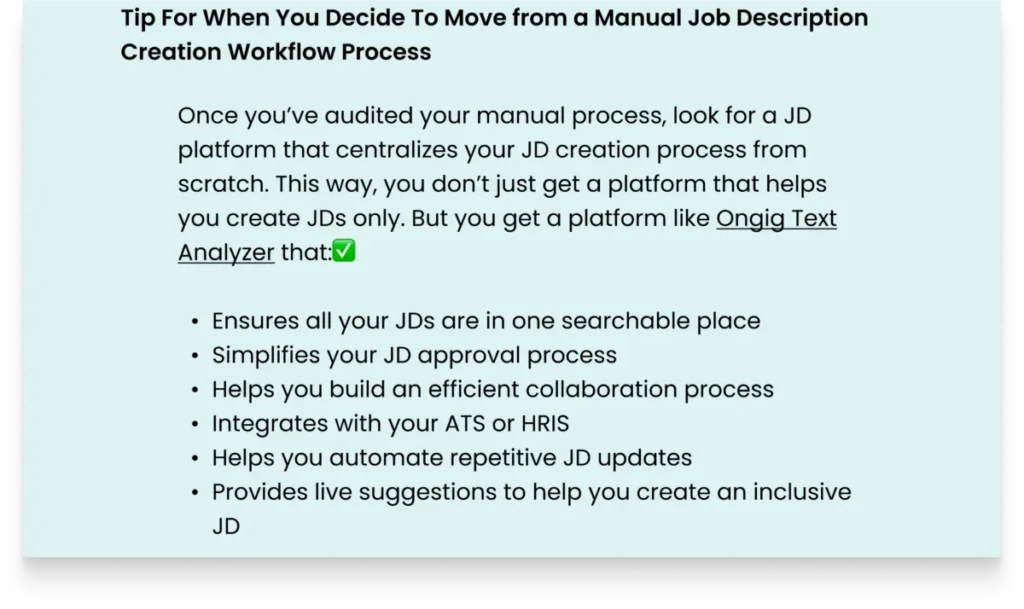
For organizations contemplating this transition, an initial audit of existing manual processes is recommended to pinpoint specific bottlenecks and pain points. This understanding will inform the selection of a JD platform that comprehensively addresses these challenges, offering a centralized solution for content optimization, compliance, collaboration, and analytics. Leading platforms integrate seamlessly with existing Applicant Tracking Systems (ATS) and Human Resources Information Systems (HRIS), enhancing rather than disrupting current recruitment technology stacks.
The era of labor-intensive, error-prone manual job description creation is rapidly drawing to a close. Organizations that embrace specialized software are not just streamlining an administrative task; they are fundamentally transforming their approach to talent acquisition, fostering efficiency, compliance, diversity, and ultimately, a more robust workforce capable of meeting future business demands. The decision to modernize JD workflows is no longer a luxury but a strategic necessity for thriving in the contemporary talent landscape.






