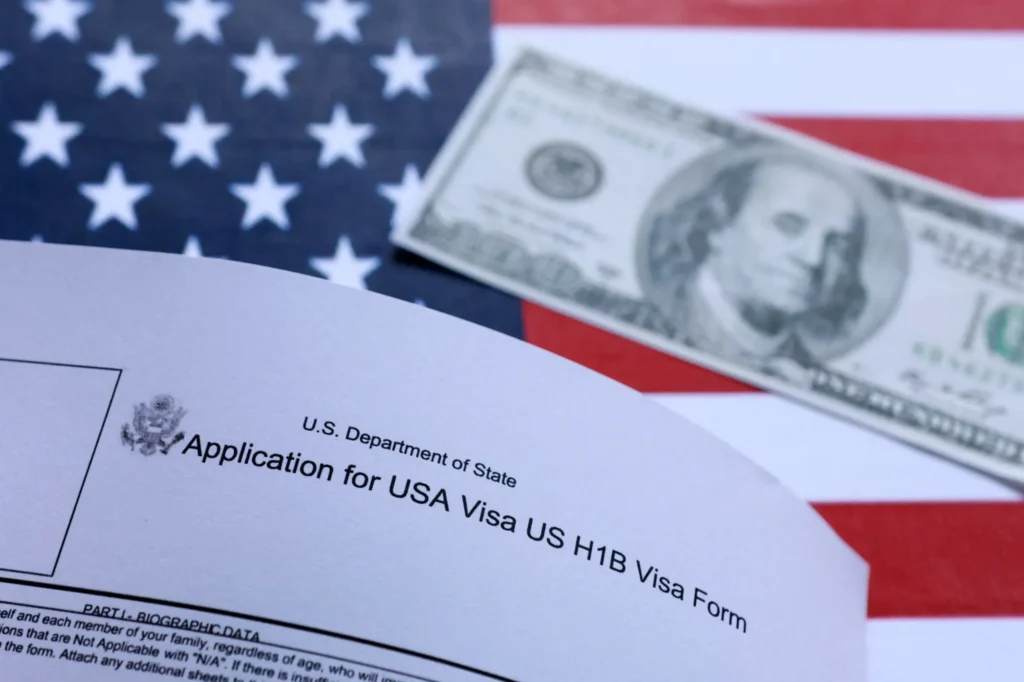
The Trump administration has moved to solidify a contentious, unprecedented fee of more than $100,000 on new H-1B visas for highly skilled foreign workers, a measure that has faced significant legal hurdles and widespread industry opposition. The proposed regulation, published in the Federal Register by the U.S. Department of Homeland Security (DHS), seeks to codify a fee that was temporarily imposed last year and subsequently blocked by federal courts. This move escalates a protracted debate over the H-1B program, a cornerstone for talent acquisition in critical sectors like technology, education, and research, potentially reshaping the landscape of skilled immigration to the United States.
The proposed rule aims to make permanent a fee of $103,265, a drastic increase from the typical visa processing costs which previously ranged between $2,000 and $5,000. This significant financial imposition on employers seeking to hire foreign nationals with specialized skills comes at a time when the H-1B program is already under intense scrutiny. The administration argues that the fee is necessary to offset costs associated with the program and to deter potential misuse, while critics contend it acts as an insurmountable barrier to essential talent and constitutes an unlawful tax.
Background of the H-1B Visa Program and the Fee Imposition
The H-1B visa program, established by the Immigration and Nationality Act, allows U.S. employers to temporarily employ foreign workers in specialty occupations that require theoretical or technical expertise. These occupations typically demand a bachelor’s degree or higher in the specific field or its equivalent. The program allocates 65,000 visas annually, with an additional 20,000 reserved for individuals who have earned a master’s degree or higher from a U.S. institution. These visas are generally approved for an initial period of three to six years.
The H-1B visa has become indispensable for many U.S. industries, particularly the technology sector, which relies heavily on foreign talent to fill specialized roles and maintain its competitive edge. Universities and research institutions also depend on the program to attract leading global researchers and academics.
The extraordinary fee was first introduced as a temporary measure by the Trump administration in October 2025, through a proclamation that invoked presidential authority to restrict the entry of certain foreign nationals deemed detrimental to U.S. interests. The justification provided was that the fee would fund programs aimed at assisting displaced American workers. However, the timing and magnitude of the fee immediately raised concerns among businesses and immigration advocates, who viewed it as an attempt to severely curtail the program rather than reform it.
Legal Challenges and Judicial Intervention
The legality of the fee was swiftly challenged in federal courts. In June 2026, a federal judge in Massachusetts ruled against the Trump administration, deeming the fee illegal and blocking its collection. The judge’s decision characterized the fee as an unlawful tax, arguing that the executive branch overstepped its authority by imposing such a substantial financial burden without congressional approval. This ruling was a significant victory for businesses and advocacy groups that had opposed the fee.
Following this initial setback, the Trump administration pursued appeals. A Boston-based appellate court has been reviewing the June 2026 decision. Concurrently, another court was examining whether a lower court had erred in rejecting a separate challenge to the fee brought forth by a major business consortium. These legal battles highlight the deep divisions and the complex legal interpretations surrounding the administration’s approach to immigration and visa regulations.
The temporary fee imposed last year was set to expire in September 2026, one year after its issuance. The proposed rule published on Monday by DHS is an effort to ensure the fee’s continuation beyond this expiration date, aiming to make it a permanent fixture of the H-1B visa application process. This proactive regulatory step suggests the administration’s determination to implement its policy despite ongoing legal opposition.
Details of the Proposed Fee and Its Scope
The proposed regulation specifies a fee of $103,265 for new H-1B visas. This amount is significantly higher than the pre-Trump era fees, which were typically in the range of $2,000 to $5,000. The administration asserts that this fee is not intended as a traditional tax but rather as a tool to manage the program and fund specific initiatives.
It is important to note that the proposed fee would not apply to all H-1B visa applications. Specifically, foreign citizens already in the United States on student visas (F-1) who are transitioning to H-1B status would be exempt. This exemption is significant, as students on F-1 visas constitute a substantial portion of new H-1B recipients, particularly those with advanced degrees. Additionally, renewals of existing H-1B visas would not be subject to this new, elevated fee. This targeting suggests an intention to impact the influx of new foreign talent rather than retain existing skilled workers or facilitate pathways for those already integrated into the U.S. educational system.
The H-1B program’s annual cap of 65,000 visas, plus the 20,000 for advanced degree holders, means that demand often outstrips supply. Employers must navigate a lottery system for many H-1B applications, adding another layer of complexity and uncertainty to the hiring process. The increased fee could exacerbate these challenges, potentially pricing out smaller companies or those in less profitable sectors from accessing the global talent pool.
The Debate Over the H-1B Program Intensifies
The H-1B visa program has been a consistent point of contention throughout recent administrations. President Trump and his supporters have frequently voiced concerns that the program is exploited by companies to hire foreign workers at lower wages, thereby displacing American workers. This perspective often frames the H-1B program as a mechanism that undermines domestic employment and suppresses wages for U.S. citizens.
Conversely, business groups, technology firms, and many employers argue that the H-1B visa program is critical for addressing a shortage of skilled American workers in specialized fields. They contend that without access to global talent, U.S. companies would struggle to innovate, expand, and remain competitive on the international stage. The ability to recruit top-tier foreign talent is seen as vital for maintaining economic growth and technological advancement.
Data released by U.S. Citizenship and Immigration Services (USCIS) indicates a trend of declining H-1B registrations in recent years. In 2025, employers registered for approximately 344,000 H-1B visas, a decrease of over 25% compared to 2024. This figure is less than half of the 794,000 visas sought in 2023. This downturn has been attributed to a combination of factors, including the broader immigration policies enacted during the Trump administration, increased scrutiny of applications, and a general slowdown in the tech sector. The proposed fee could further contribute to this decline, potentially creating a more restrictive environment for skilled immigration.

A limited number of employers have already paid the $100,000 fee. According to court filings from late February 2026, approximately 70 employers had paid this fee for a total of 85 visa applications. This indicates that while the fee faced legal challenges and uncertainty, some entities were willing to bear the cost in their pursuit of essential talent.
Broader Implications and Industry Reactions
The proposed permanent fee carries significant implications for various sectors of the U.S. economy. The technology industry, which is a major beneficiary and proponent of the H-1B program, has expressed strong opposition to the fee. Companies argue that it would stifle innovation, hinder growth, and potentially drive talent and investment to other countries with more favorable immigration policies.
The U.S. Chamber of Commerce, the nation’s largest business lobbying group, has been at the forefront of challenging the fee. The Chamber, along with a coalition of other business organizations, labor unions, and Democratic-led states, has filed lawsuits arguing that the fee is an unlawful imposition and that the administration is overstepping its executive authority. These lawsuits contend that the H-1B program’s framework, established by Congress, cannot be unilaterally altered by presidential proclamation or executive action to impose such significant financial penalties. They also assert that the Department of Homeland Security lacks the statutory authority to levy fees that function as revenue-generating taxes without explicit congressional authorization.
The Trump administration, however, maintains that the president’s authority to restrict entry into the United States under immigration law is broad and that courts have limited power to review such executive decisions. The administration views the fee as a necessary measure to protect American jobs and ensure that the H-1B program serves the interests of the nation.
Beyond the H-1B fee, the Trump administration has pursued other policies aimed at reforming or restricting the H-1B program. These include enhanced vetting processes for H-1B applicants and proposals for a new visa selection system that would prioritize higher-skilled and better-paid workers. In a separate regulatory action earlier in August, DHS introduced fees of up to $4,500 for applications related to extending the stay of H-1B workers or transferring employees from overseas operations to the United States. These measures collectively indicate a sustained effort to reshape the landscape of skilled immigration under the Trump administration’s broader immigration agenda.
The future of the H-1B program and the proposed $100,000 fee hinges on the outcomes of ongoing legal battles and the potential for future regulatory or legislative actions. The proposed rule’s finalization could trigger further legal challenges, potentially leading to protracted court proceedings. Meanwhile, the debate over the H-1B visa program reflects a larger national conversation about immigration, economic competitiveness, and the role of foreign talent in the American workforce. The administration’s persistent push for the high fee suggests a belief that it aligns with its vision for national interest, even as it faces strong resistance from the business community and legal experts. The coming months will be critical in determining the long-term impact of these policies on the U.S. economy and its ability to attract and retain global talent.