Employee recognition is precisely the act of formally or informally acknowledging and appreciating an employee’s contributions, efforts, or achievements. Its core function is to reinforce positive behaviors, deepen employee engagement, and cultivate a pervasive culture of appreciation within the workplace. This isn’t just about making individuals feel good; it’s about embedding a feedback mechanism that guides and motivates the entire workforce.
The Evolving Landscape: Why Employee Recognition Matters Now More Than Ever
The contemporary business environment, characterized by rapid change, hybrid work models, and intense competition for talent, has amplified the significance of employee recognition. Employees are no longer solely motivated by compensation; they seek purpose, connection, and validation. What an organization chooses to recognize sends a powerful signal about its true values, a critical component of any robust HR strategy. When recognition is delivered in real, meaningful ways, rather than relegated to infrequent annual reviews or entirely absent, it directly correlates with higher engagement, increased productivity, and significantly improved employee retention rates.
Data from the Achievers Workforce Institute (AWI) underscores this urgency, revealing that employees recognized weekly are five times more likely to feel deeply connected to their company culture. This statistic highlights recognition’s role as a vital compass, guiding employees on which actions and efforts warrant attention, appreciation, and repetition. The outcome is a stronger, more cohesive alignment between stated organizational values and the daily activities of its workforce. In an era where company culture can be a decisive factor in attracting and retaining top talent, consistent and meaningful recognition becomes an indispensable strategic asset.
A Brief Chronology of Recognition Practices
Historically, employee recognition often took rudimentary forms. In the early 20th century, as industrialization boomed, recognition was primarily transactional—bonuses for exceeding quotas or basic safety awards. The mid-century saw the emergence of more formalized programs, albeit often bureaucratic and infrequent, such as "Employee of the Month" plaques or long-service awards. These often suffered from a lack of personalization and timeliness, failing to truly impact daily behavior.
The latter half of the 20th century brought a greater understanding of human psychology in the workplace, influenced by theories from figures like Abraham Maslow and Frederick Herzberg, who emphasized intrinsic motivators beyond mere monetary rewards. This paved the way for a shift towards recognition tied to achievements, though still often confined to annual cycles.
The digital revolution of the 21st century marked a significant turning point. The rise of HR technology platforms enabled real-time, peer-to-peer recognition, making appreciation more frequent, visible, and integrated into daily workflows. The advent of remote and hybrid work models further accelerated this evolution, necessitating virtual recognition tools to maintain connection and morale across dispersed teams. Today, recognition is viewed not as an HR add-on but as a fundamental component of employee experience and organizational strategy.

The Science Behind the "Feel Good" Factor
While recognition undoubtedly elicits positive emotions, its effectiveness is rooted in robust scientific principles, extending far beyond simple "warm fuzzies." Neuroscientific research demonstrates that receiving recognition activates the brain’s reward system, releasing dopamine—a neurotransmitter associated with pleasure, motivation, and learning. This biological response reinforces the behaviors that led to the recognition, making employees more likely to repeat them.
From a psychological perspective, employee recognition taps into several core human needs. Self-determination theory, for instance, highlights the importance of competence, relatedness, and autonomy. Recognition directly addresses the need for competence by affirming an individual’s skills and contributions. It fosters relatedness by strengthening social bonds and a sense of belonging within the team and organization. Furthermore, recognition serves as a powerful form of operant conditioning, where positive reinforcement (the recognition) increases the likelihood of desired behaviors occurring again. David Bator, Managing Director of the Achievers Workforce Institute, reflects on research from Harvard Business Review, emphasizing that the true impact of recognition stems from its ability to influence future actions, rather than merely acknowledging past ones. This forward-looking aspect is what transforms recognition from a pleasant gesture into a strategic lever for behavioral change and organizational goal attainment.
Data-Driven Insights: Quantifying Recognition’s Impact
The business case for robust recognition programs is compelling, backed by extensive research:
- Engagement and Retention: A Gallup study found that organizations with highly engaged employees enjoy 21% higher profitability. Recognition is a primary driver of engagement. Similarly, SHRM reports that companies with effective recognition programs experience 31% lower voluntary turnover rates.
- Productivity: Research from Bersin by Deloitte indicates that organizations with sophisticated recognition programs have 14% higher employee engagement, leading to enhanced individual and team productivity.
- Customer Satisfaction: When employees feel valued, they are more likely to deliver exceptional customer service. Studies have shown a direct correlation between employee satisfaction (boosted by recognition) and improved customer loyalty and satisfaction scores.
- Financial Performance: A recent study by Harvard Business Review Analytic Services revealed that 88% of organizations with highly effective recognition programs intentionally design them to drive specific employee behaviors, compared with a mere 28% of organizations with ineffective programs. This intentionality translates into tangible business outcomes. For example, integrating recognition data into HR systems, as exemplified by Workday, led to a 70% year-over-year increase in employee feedback available to managers, providing a more holistic view of performance and enabling targeted development.
Navigating the Pitfalls: Common Recognition Mistakes and How to Avoid Them
While the intent behind recognition is almost always positive, poorly executed programs can undermine their purpose. Organizations must be vigilant against common pitfalls:
-
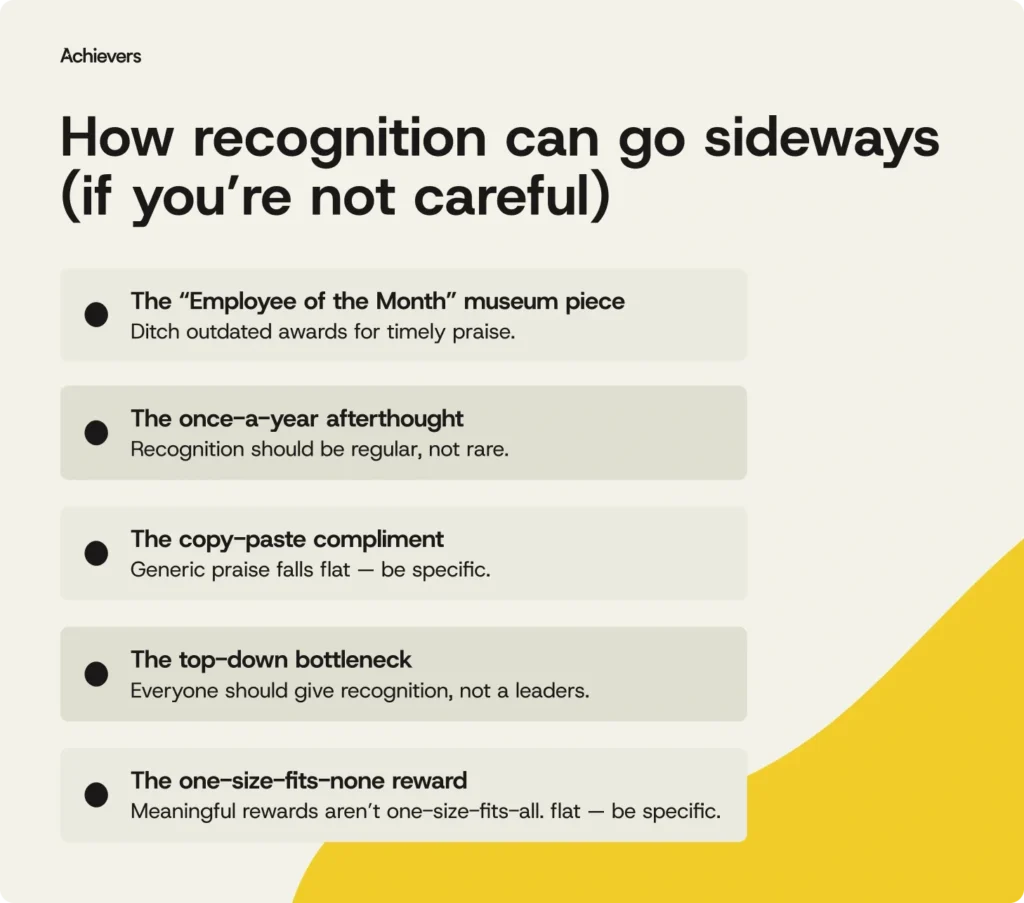
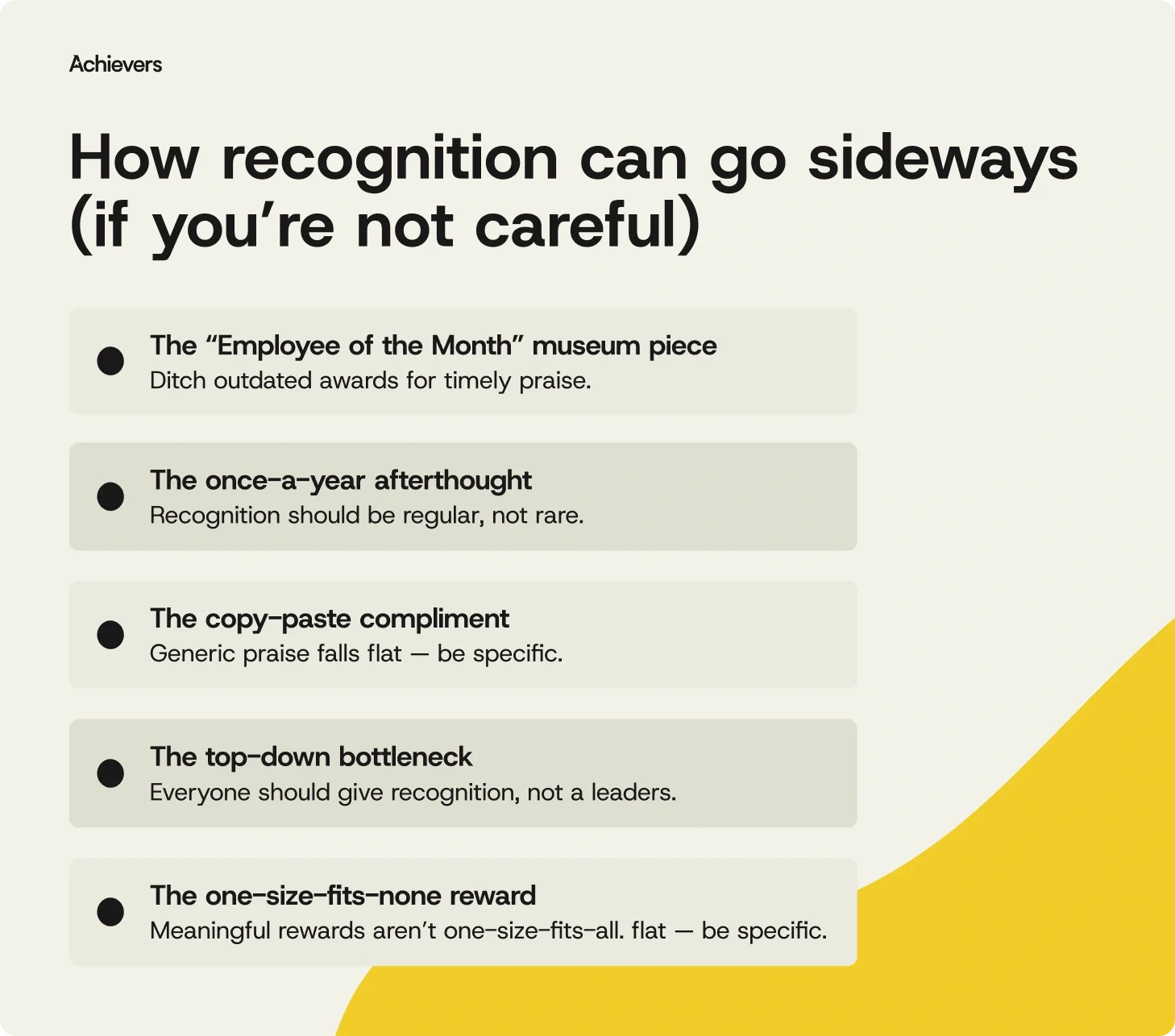
The "Employee of the Month" Museum Piece: This traditional approach, often involving a lone plaque in a breakroom, feels archaic and exclusive. Its primary flaw is its scarcity: only one person is recognized, often months after their achievement, by a committee rather than a direct peer or manager.
- Solution: Replace exclusive, delayed awards with continuous, inclusive, and real-time recognition. Implement spot awards for specific achievements, peer-to-peer recognition systems, and values-based commendations that allow anyone to acknowledge anyone, anytime.
-
The Once-a-Year Afterthought: If recognition is reserved for annual reviews, holiday parties, or service anniversaries, its impact is severely diminished. Delayed appreciation loses its motivational power, akin to giving feedback weeks after a project is completed.
- Solution: Integrate recognition into the daily fabric of your company culture. Utilize digital platforms that facilitate instant feedback and appreciation. Encourage managers to make recognition a consistent part of their one-on-one meetings and team huddles, making it a routine, not a rare event.
-
The Copy-Paste Compliment: Generic praise like "Good job!" or "Thanks for your hard work" lacks sincerity and specificity. It fails to inform the employee what specific behavior was valuable or why it mattered, thus losing its ability to reinforce desired actions.
- Solution: Emphasize specificity. When recognizing someone, clearly articulate the behavior, effort, or achievement being celebrated. Explain the positive impact of their contribution on the team, project, or company goals, and ideally, link it to organizational values. For instance, instead of "Great presentation," say, "Your clear explanation of the market trends in today’s presentation helped us finalize our strategy, demonstrating strong analytical thinking and collaboration."
-
The Top-Down Bottleneck: When appreciation flows exclusively from managers to employees, it creates a hierarchical barrier and misses the immense power of peer-to-peer recognition. Employees often see the contributions of their colleagues more directly than their managers do.
- Solution: Empower every individual within the organization—from entry-level staff to senior leadership, and even customers—to recognize contributions. Implement multi-directional recognition systems where teammates can celebrate each other, and cross-functional collaborators can acknowledge valuable support. This fosters a more authentic, inclusive, and sustainable culture of appreciation.
-
The One-Size-Fits-None Reward: While company swag and standard gift cards have their place, relying solely on generic rewards can make recognition feel impersonal and transactional. What motivates one employee may not resonate with another.
- Solution: Offer personalized and choice-based rewards that reflect individual preferences and motivations. This could include experiences, professional development opportunities, charitable donations, or a selection of gift options. Better yet, build a culture where managers and peers truly understand what motivates their colleagues and tailor recognition accordingly. It moves beyond a branded stress ball to something genuinely meaningful.
Modernizing Employee Recognition and Rewards for the Future
Modernizing employee recognition and rewards programs transcends merely updating old practices; it signifies a fundamental shift in philosophy. This means moving beyond sporadic annual awards, manager-centric recognition, and standardized rewards. Today’s most effective programs are designed to be continuous, highly visible, deeply integrated into the daily employee experience, and, crucially, intentionally behavior-driven.
Organizations featured in the Harvard Business Review report are actively integrating recognition into everyday work processes, demonstrating its critical role in contemporary HR. This shift ensures that recognition isn’t an afterthought but a core component of how work gets done and how culture is built.
Recognition That Drives Measurable Results
In conclusion, the question "does employee recognition matter?" can be answered with an unequivocal yes. Its significance extends far beyond being a mere nicety; it is a powerful, data-backed strategic tool. Recognition effectively shapes behavior, strengthens organizational culture, and directly contributes to measurable business results. Companies that prioritize and intelligently implement recognition programs see tangible returns on investment in the form of enhanced employee engagement, improved retention, increased productivity, and a more resilient, positive workplace culture.
Platforms like Achievers are specifically designed to facilitate this modern approach, enabling organizations to deliver frequent, meaningful recognition that fuels performance and retention without adding unnecessary friction to anyone’s day. While recognition may indeed begin with a simple "thank you," when strategically deployed and technologically supported, it culminates in a profound and measurable impact on both individual success and organizational prosperity.