
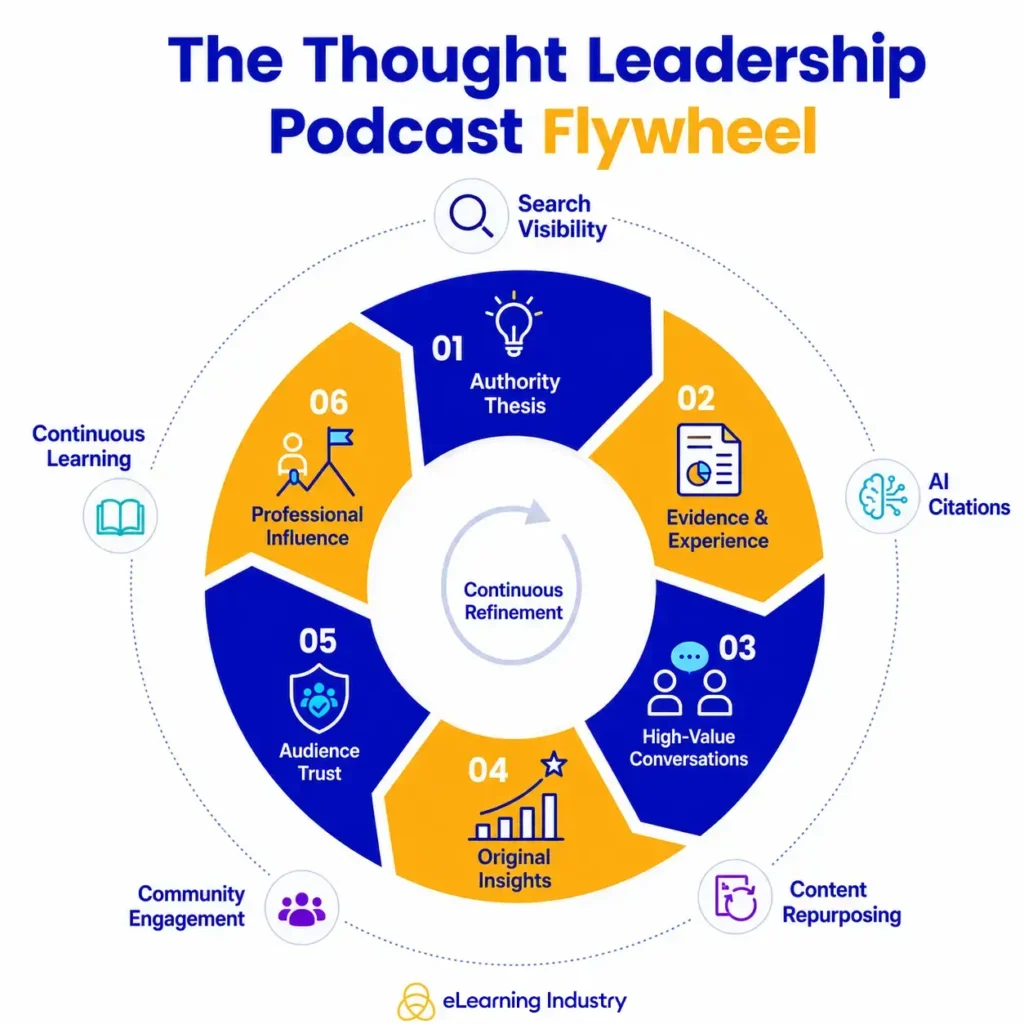
The landscape of corporate communication and professional development has undergone a significant transformation, with audio-visual media now serving as a primary conduit for industry influence. In the sectors of Learning and Development (L&D), Human Resources (HR), and instructional design, the "thought leadership podcast" has emerged as a distinct category, separate from traditional marketing or interview-based series. This evolution reflects a growing demand for nuanced, evidence-based content that moves beyond surface-level trends to offer defensible perspectives and actionable insights for decision-makers.
A thought leadership podcast is not merely defined by its guests or its production value; rather, it earns its status through the consistent delivery of original analysis and the interpretation of complex developments. For executives and specialists, these programs function as a platform to demonstrate how an expert identifies systemic problems, challenges prevailing assumptions, and translates industry volatility into practical strategy.
The Strategic Shift Toward Niche Authority
The transition from generalist content to authoritative audio programming coincides with a broader shift in B2B marketing and professional education. Historically, professional authority was established through whitepapers, academic journals, and keynote addresses. However, as the digital space became saturated with short-form, often superficial content, a "credibility gap" emerged. Decision-makers began seeking longer-form formats that allow for the "showing of work"—the visible process of reasoning that leads to a conclusion.
Podcasting is uniquely suited to bridge this gap. Unlike a polished article that presents a final conclusion, a podcast allows listeners to hear the host and guests weigh trade-offs, discuss exceptions to the rule, and adjust their viewpoints based on real-world trial and error. This transparency builds a level of trust that static text often fails to achieve. In fields like HR and L&D, where success is often contingent on specific organizational cultures and technological constraints, the ability to discuss nuance is a significant competitive advantage.
A Chronology of Professional Media Evolution
The rise of the thought leadership podcast can be traced through several distinct phases of digital professional engagement:
- The Broadcast Era (Pre-2010): Corporate communication was largely top-down, consisting of newsletters and infrequent webinars.
- The Interview Explosion (2010–2015): The success of early mainstream podcasts led to a surge in "interview-style" B2B shows. While these increased reach, many lacked a unique editorial voice, often serving as a platform for the guest’s agenda rather than the host’s expertise.
- The Content Saturation Phase (2015–2020): A proliferation of "corporate podcasts" led to audience fatigue. Many shows were viewed as thinly veiled sales pitches or repetitive summaries of industry news.
- The Niche Authority Era (2020–Present): Professionals began gravitating toward "thought leadership" models. These shows prioritize a specific "authority thesis" and focus on helping a defined audience solve recurring, high-stakes problems.
Supporting Data: The Impact of Thought Leadership
The efficacy of this medium is supported by industry research. According to data from Edelman and LinkedIn’s B2B Thought Leadership Impact Report, approximately 54% of decision-makers spend at least one hour per week consuming thought leadership content. More importantly, nearly 50% of C-suite executives state that such content has a direct impact on their purchasing decisions and their choice of strategic partners.
Furthermore, research from Edison Research indicates that podcast listeners are more likely to hold advanced degrees and occupy senior management roles compared to the general population. This demographic alignment makes the format an ideal vehicle for L&D leaders and workplace-learning experts who aim to influence high-level stakeholders.
The Eight-Step Framework for Building Authority
To elevate a podcast from a standard series to a thought leadership platform, industry experts recommend a structured approach centered on intellectual rigour rather than just production metrics.
1. Establishing the Authority Thesis
The foundation of a successful show is a clear authority thesis—a core professional viewpoint that the host wants to be synonymous with their name. Without this, a podcast remains a collection of disconnected conversations. A strong thesis acts as a North Star, ensuring every episode contributes to a coherent body of work.
2. Defining the Territory
Authority is rarely broad; it is usually deep. Experts must identify the specific "territory" where they possess unique evidence or experience. For example, instead of covering "The Future of HR," a thought leadership podcast might focus on "The Integration of AI in Skills-Based Hiring for Mid-Market Firms." This narrow focus allows the host to question industry norms and provide insights that generalists miss.

3. Addressing Recurring Decisions
The most valuable content focuses on the decisions that keep professionals up at night. For L&D leaders, these include selecting learning technology, measuring the ROI of training, or deciding between building versus buying content. By centering episodes on these decision points, the podcast becomes a practical tool for the listener’s daily work.
4. Maintaining Editorial Boundaries
Credibility is maintained as much by what is excluded as by what is included. Thought leadership podcasts must avoid becoming a platform for vendor sales pitches or uncritical reactions to every new technology announcement. Setting strict editorial boundaries ensures the show remains an objective resource rather than a promotional tool.
5. Selecting High-Utility Formats
The format must serve the thesis. Effective styles include:
- Analytical Recaps: Deconstructing recent industry events through the lens of the host’s expertise.
- Research Debriefs: Breaking down complex academic or industry studies into actionable takeaways.
- Case Study Deep Dives: Exploring not just the success of a project, but the failures and pivots that occurred along the way.
6. Engineering Original Insight
An editorial system should be designed to extract evidence. Instead of standard biographical questions, hosts should ask guests for specific data points, examples of "unlearning," and the variables that changed their perspective on a project. Summarizing each episode with a "so-what" for leaders transforms a conversation into a strategic asset.
7. Optimizing for AI and Search Discoverability
In the modern era, authority must be searchable. This involves creating comprehensive transcripts, detailed show notes, and "key takeaway" summaries. These elements allow the podcast’s ideas to be indexed by search engines and synthesized by AI tools, extending the reach of the content beyond the audio file itself.
8. Redefining Metrics of Success
The standard metric of "downloads" is often a vanity metric in the world of thought leadership. True authority is measured by "decision-impact indicators." These include:
- The frequency with which the podcast is cited in internal strategy meetings.
- Invitations to speak at major industry conferences or collaborate on research.
- The conversion of listeners into strategic advisory clients or long-term partners.
Official Perspectives on Authority Building
Christopher Pappas, CEO and founder of eLearning Industry, emphasizes that the hardware of podcasting is secondary to the intellectual software. "Authority is not built by having a microphone; it is earned by consistently asking better questions, applying evidence, and turning expertise into insights that help leaders make better decisions," Pappas stated. This perspective highlights a fundamental truth in the industry: the value of the content is directly proportional to the host’s ability to help the audience navigate uncertainty.
Industry analysts suggest that the "microphone" is merely a tool for the democratization of expertise. In the past, the "gatekeepers" of authority were publishers and conference organizers. Today, any professional with a defensible perspective and a commitment to evidence can build a platform.
Broader Impact and Industry Implications
The rise of thought leadership podcasts has significant implications for how organizations manage internal knowledge. Many companies are now using these podcasts as internal "searchable knowledge bases," where veteran employees record debriefs of major projects. This prevents "institutional amnesia" and ensures that the reasoning behind major strategic shifts is preserved for future leaders.
Furthermore, the integration of podcasting into the professional ecosystem is forcing a change in how "influence" is perceived. It is no longer enough to be a "known name"; one must be a "trusted voice." As AI-generated content continues to flood the market, the human element of the podcast—the tone, the hesitation, the excitement, and the logic—becomes a premium commodity.
In conclusion, a thought leadership podcast serves as more than an audio project; it is a dynamic record of professional judgment. For those in L&D and HR, it offers a way to shape the industry’s agenda and provide a steady hand in a rapidly changing corporate environment. The ultimate goal of such a program is not just to attract an audience, but to improve the quality of decision-making across the profession. Before investing in equipment or guests, the modern expert must first decide exactly what kind of authority they intend to build.






