
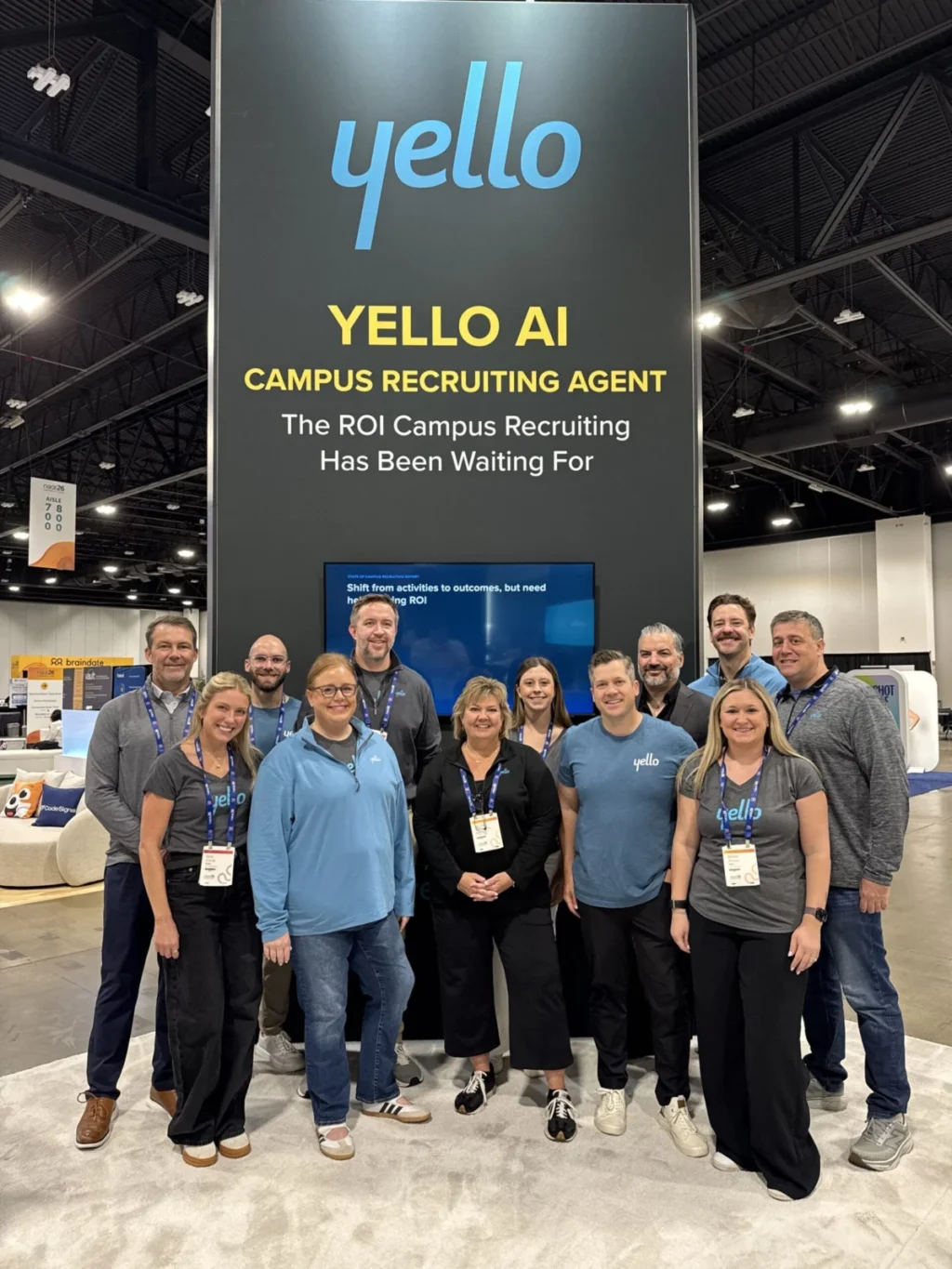
Denver, CO – In a significant move set to reshape early talent acquisition, Yello, a leading provider of recruiting software, leveraged its platinum sponsorship at the National Association of Colleges and Employers (NACE) 26th annual conference to unveil its groundbreaking AI Campus Recruiting Agent and announce a strategic partnership with Symplicity. The conference, a pivotal gathering for the early talent community, served as the backdrop for these innovations, which directly address the most pressing challenges facing campus recruiters today: the intelligent application of AI, the evolving strategy for recruitment events, and the persistent issue of offer reneges.
The NACE26 conference, held in Denver, brought together hundreds of university relations and recruiting professionals from across the nation to discuss trends, share best practices, and explore the future of connecting students with employers. As a cornerstone event in the talent acquisition calendar, NACE provides a crucial forum for understanding the dynamics between academic institutions and corporate hiring needs. This year, the discussions were heavily weighted toward technological integration, particularly artificial intelligence, and a re-evaluation of traditional recruiting methodologies in a highly competitive and digitally-influenced market. Yello’s prominent presence, marked by speaking sessions, networking events, and an interactive booth, underscored its commitment to driving innovation in this sector.
AI’s Evolving Role in Campus Recruiting: Automation, Not Autonomy
One of the most profound themes emerging from NACE26 was the rapid integration of artificial intelligence into recruiting processes, accompanied by a clear delineation of its preferred application. While 2024 has seen a surge in AI adoption across industries, the early talent community, as highlighted by Yello’s own State of Campus Recruiting report, indicates that current AI usage in campus teams is heavily concentrated in top-of-funnel activities. Specifically, 26% of AI usage is directed towards sourcing candidates, and 25% towards candidate communications. This data suggests a strong initial focus on efficiency gains in high-volume, repetitive tasks.
However, a critical gap was identified: AI’s potential in data analysis and demonstrating recruitment ROI remains largely untapped. This disparity sparked considerable debate, notably during Yello’s session, "Can Campus Recruiting Be Autonomous? The Answer Is Complicated." Panelists, including Tamara Welch from LPL Financial, NACE’s Matthew Brink, and Yello’s Dan Bartfield, explored whether the ultimate goal should be fully autonomous recruiting or rather empowering recruiters to focus on higher-value, human-centric work. The overwhelming sentiment from the audience, composed of experienced recruiters and talent leaders, firmly favored the latter. Recruiters are not seeking AI to make hiring decisions for them, but rather to alleviate the administrative burden and recurring tasks that consume valuable time better spent engaging with candidates and building relationships.
The implications of this preference are significant. It points towards a future where AI acts as an intelligent assistant, purpose-built for the unique nuances of campus recruiting. By automating manual processes such as event logistics, candidate matching, outreach, and interview scheduling, AI can free recruiters to dedicate more resources to strategic engagement, personalized candidate experiences, and deeper analytical insights. This approach not only enhances recruiter productivity but also addresses a growing concern among candidates. Matthew Brink underscored that students are increasingly wary of employers who rely too heavily on undisclosed AI in their hiring processes. An impersonal, AI-driven experience risks alienating qualified candidates and subtly eroding employer brand reputation in a market where authentic connection is paramount.
Yello’s response to this industry need was the unveiling of its AI Campus Recruiting Agent. This new AI-powered solution directly targets the automation of manual work, simplifying the complex processes of building events, sourcing candidates, managing campaigns, and scheduling interviews. Unlike generic AI tools, Yello’s agent is designed to identify best-fit candidates and pre-schedule interviews even before an event commences. This fundamentally shifts the traditional model of campus recruiting from a reactive "hope-and-wait" approach at career fairs to a proactive, data-driven strategy where recruiters arrive with a pre-populated interview schedule of highly relevant candidates. This innovation not only promises substantial efficiency gains but also aims to deliver a measurable ROI that campus recruiting has historically struggled to quantify effectively.
Rethinking Event Strategy: Purpose Over Presence
The dialogue at NACE26 also highlighted a significant paradigm shift in employer event strategies. Despite steadily climbing application volumes, recruiters are finding it increasingly difficult to identify qualified candidates. This paradox, as articulated by Vincent Bond from Synchrony, Kristin Leek from Boeing, and Christopher Cantu from Marathon Petroleum during their session, "Purpose Over Presence: Rethinking Your Event Strategy for Better ROI," is partly attributable to the proliferation of AI-assisted resume tools. As Vince Bond noted, "every resume looks the same now," indicating a scenario where AI-generated resumes are being filtered by employer AI tools, creating a complex "AI fighting AI" dynamic that obscures genuine talent.
In response, leading organizations are moving away from a volume-based, activity-centric approach to in-person events. The focus is now firmly on "outcomes-based" strategies, prioritizing events that demonstrate a clear return on investment (ROI) in terms of quality hires. This necessitates an earlier and more intentional investment in relationship building. Christopher Cantu likened career fairs to the "end zone"—the point of closure, not the starting line. The foundational work, he argued, must begin months, even years, in advance through targeted events, consistent touchpoints, and cultivating "relationship equity." This strategic pivot is crucial for combating both rising application volumes and the growing concern of candidate fraud, which can be mitigated through genuine, sustained engagement.
The implications for employers are clear: a more strategic, data-driven approach to event planning is essential. Instead of casting a wide net, companies are now focusing on smaller, more intimate engagements designed to foster deeper connections with potential candidates. This includes workshops, mentorship programs, and targeted networking sessions that allow recruiters to assess soft skills and cultural fit more effectively. The shift also emphasizes the importance of robust analytics to track the efficacy of different event types and channels, ensuring resources are allocated to initiatives that yield the highest quality talent.
Further bolstering access to qualified candidates, Yello announced a pivotal partnership with Symplicity. This collaboration provides Yello customers with unparalleled access to Symplicity’s extensive network of over 600,000 early talent candidates. Through this integration, employers utilizing the Yello Campus Recruiting Agent can now match against active candidates from the Symplicity database, in addition to candidates from their own Applicant Tracking Systems (ATS), Yello database, WayUp, and more than 35 other sources across the web. This expanded access significantly broadens the talent pool available to recruiters, enabling more precise targeting and streamlined candidate identification, further supporting the move towards outcomes-based event strategies.
Combating Candidate Renege Rates Through Sustained Engagement
The issue of offer reneges continues to be a formidable challenge in early talent acquisition, occupying a significant portion of discussions at NACE26. In today’s competitive market, an offer acceptance is no longer a guarantee of a new hire. Recruiters and talent leaders acknowledged that the post-offer period must be treated as an active recruiting phase, requiring consistent, personalized communication to retain top talent. The consensus was that organizations with robust, proactive engagement strategies between offer and start date consistently experience lower renege rates, reinforcing the critical role of relationship building throughout the entire candidate journey.
The financial and operational costs associated with reneges are substantial. Industry data suggests that the average cost of a renege can range from thousands to tens of thousands of dollars, accounting for lost productivity, additional recruitment efforts, and potential damage to employer brand. Moreover, a high renege rate can disrupt project timelines, impact team morale, and force companies to restart lengthy hiring processes, making it a critical metric for talent acquisition teams to manage proactively.
In a virtual session titled "Designing the Complete Journey: From Pre-Boarding to Off-Boarding," Yello’s Ahva Sadeghi introduced the KEEP framework—Kick Off, Engage, Enable, and Perform. This comprehensive framework provides employers with a structured approach to keep talent engaged from offer acceptance through to their first day and beyond. Sadeghi delved into the multifaceted reasons why candidates renege, which often extend beyond compensation to include factors like perceived lack of engagement, competing offers with more personalized follow-ups, or a misalignment with company culture identified post-offer. She also presented compelling evidence, citing how Symba customers have successfully reduced their renege rates by over 55% through the application of structured engagement strategies enabled by technology. This demonstrates a clear path for employers to mitigate a persistent and costly problem by fostering stronger, more consistent connections with their future employees.
The insights from NACE26, coupled with Yello’s strategic announcements, paint a clear picture of an early talent landscape undergoing profound transformation. The intelligent application of AI, the strategic re-evaluation of event engagement, and the proactive combatting of offer reneges are no longer optional but imperative for organizations striving to secure top talent. Yello’s new AI Campus Recruiting Agent and its partnership with Symplicity represent significant strides in providing recruiters with the tools and access necessary to navigate this complex environment, enabling them to focus on what truly matters: building authentic relationships and delivering exceptional candidate experiences that translate into successful hires. As the early talent market continues to evolve, these innovations underscore a commitment to efficiency, strategic insight, and a more human-centered approach to recruiting, promising a more effective and equitable future for both employers and job seekers.






