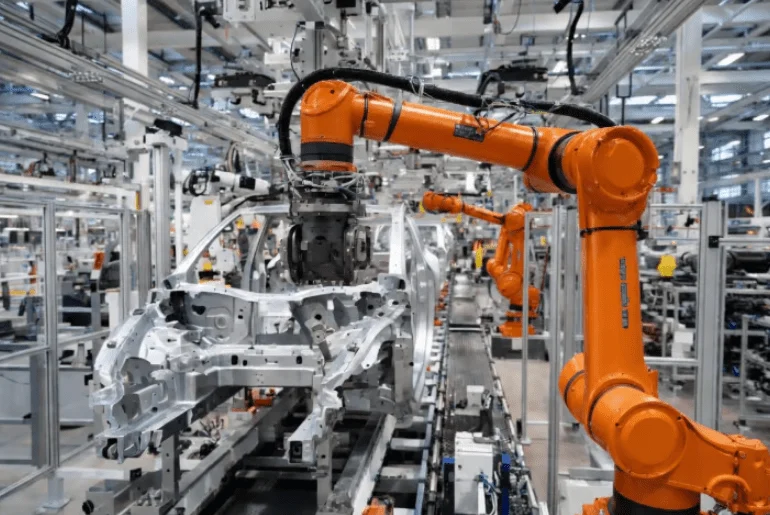
General Motors (GM) has significantly expanded the integration of collaborative robots, or cobots, at its flagship Factory Zero electric vehicle (EV) plant in Michigan, a pivotal move within its broader manufacturing modernization strategy. This technological enhancement, aimed at bolstering efficiency and safety, coincides with reports indicating that over 1,000 employees at the facility have been impacted by workforce reductions, a development that has drawn sharp criticism from the United Auto Workers (UAW).
The Strategic Imperative: GM’s EV Transformation and Manufacturing Modernization
GM’s decision to escalate its use of automation at Factory Zero is deeply rooted in the automotive industry’s seismic shift towards electrification and the company’s ambitious commitment to an all-electric future. The Detroit-Hamtramck Assembly Plant, reborn as Factory Zero in 2020 after a $2.2 billion investment, stands as a testament to GM’s dedication to EV production, housing the manufacturing of vehicles like the GMC Hummer EV pickup and SUV, the Chevrolet Silverado EV, and the Cruise Origin autonomous shuttle. This transformation is part of GM’s stated goal to invest $35 billion in electric and autonomous vehicles by 2025, aiming for an annual EV production capacity of over 1 million units in North America by the end of 2025.
The strategic rationale behind advanced manufacturing technologies, including robotics and artificial intelligence, is multifaceted. Automakers are under immense pressure to achieve economies of scale, reduce production costs, and accelerate time-to-market for new EV models, which often involve complex battery integration and novel assembly processes. Industry 4.0 principles, emphasizing smart factories, interconnected systems, and data-driven decision-making, are at the core of this transformation. For GM, the adoption of cobots is presented as a means to enhance competitiveness, improve product quality, and establish a more agile and resilient manufacturing ecosystem capable of adapting to rapid market changes and diverse product portfolios.
Cobots in Action: Enhancing Production at Factory Zero
Around 50 cobots have been strategically deployed across Factory Zero’s assembly lines, designed to work in close proximity to human employees. Unlike traditional industrial robots, which typically operate in caged-off areas due to safety concerns, cobots are equipped with advanced sensors and safety features that allow them to detect and react to human presence, preventing collisions and enabling shared workspaces. This distinction is crucial to GM’s narrative that these machines are intended to "assist" rather than "replace" human labor.
The specific applications of these cobots at Factory Zero include highly repetitive and ergonomically challenging tasks. These range from fitting vehicle body panels with precision and consistency, to supporting other production processes such as material handling, quality inspections, and intricate assembly operations that demand high accuracy. By automating these strenuous or monotonous tasks, GM asserts that it can significantly improve workplace safety by reducing the physical strain on employees, minimizing the risk of repetitive motion injuries, and allowing human workers to focus on more complex, cognitive, or supervisory roles that require human judgment and adaptability. Furthermore, the company highlights the potential for increased production flexibility, as cobots can often be reprogrammed and redeployed more easily than fixed automation, allowing for quicker adaptation to changes in vehicle models or production requirements. The ultimate goal, as stated by GM, is to enhance overall manufacturing efficiency and output, thereby contributing to the company’s ambitious EV production targets.
Workforce Reductions and the UAW’s Strong Opposition
The expansion of automation at Factory Zero has coincided with significant workforce adjustments, with reports indicating that over 1,000 employees have been impacted. While GM has stated that some affected employees have been placed on temporary layoff, it has not provided a definitive timeline for their return or clarified the full scope of these reductions, including whether they involve permanent layoffs, reassignments, or voluntary separation programs. This lack of transparency has fueled concerns among the workforce and the union.
The United Auto Workers (UAW) has been a vocal critic of GM’s increased reliance on automation, arguing that such technological advancements are directly contributing to the erosion of employment opportunities for its members. The union’s historical stance on automation dates back decades, with past negotiations frequently involving provisions to mitigate job losses due to new technologies. In the current context, the UAW has reportedly filed grievances over the deployment of cobots at Factory Zero, questioning whether the technology is indeed contributing to lower staffing levels at the plant and whether GM is adhering to the spirit and letter of existing labor agreements.
For the UAW, the core issue is job security and the potential for a shrinking bargaining unit. The union views any reduction in the human workforce, whether through layoffs or a slower pace of hiring for new roles, as a direct threat to its members’ livelihoods and its collective bargaining power. They argue that while automation can improve efficiency, it should not come at the expense of American manufacturing jobs, especially given the substantial government incentives and tax breaks often afforded to companies investing in advanced manufacturing within the U.S. The UAW’s concerns are amplified by broader economic anxieties about automation’s impact on blue-collar employment across various industries.
Chronology of GM’s EV and Automation Journey
- 2019: GM announces a $2.2 billion investment to retool its Detroit-Hamtramck plant into an all-electric vehicle manufacturing facility, later renamed Factory Zero. This marked a significant commitment to EV production in North America.
- 2020: Factory Zero is officially inaugurated, with production slated to begin in late 2021. The plant is touted as a cornerstone of GM’s "Ultium" battery platform strategy and future EV lineup.
- Early 2020s: GM begins a broader restructuring effort across its business, including headcount reductions in engineering and information technology functions, while simultaneously increasing investments in AI, robotics, and advanced manufacturing technologies.
- Late 2021: Production of the GMC Hummer EV Pickup begins at Factory Zero, marking the plant’s operational debut.
- Throughout 2022-2023: GM continues to scale up EV production at Factory Zero and other facilities, encountering both successes and challenges in ramping up battery module production and vehicle assembly.
- 2023 UAW Contract Negotiations: The UAW engages in historic contract negotiations with the Detroit Three automakers (GM, Ford, Stellantis). Job security in the transition to EVs and the impact of automation are key contentious points, leading to a targeted strike. While the new contract included significant wage increases and some protections, the long-term implications of automation remained a major concern.
- Late 2023 – Early 2024: Reports surface regarding the expanded deployment of approximately 50 cobots at Factory Zero, alongside workforce reductions impacting over 1,000 employees. The UAW confirms filing grievances related to these developments.
Broader Implications and the Future of Automotive Work
The situation at Factory Zero is emblematic of a broader, complex transformation unfolding across the global automotive industry. Manufacturers are navigating the dual pressures of intense competition in the EV market and the imperative to adopt smarter factory technologies to remain competitive. This delicate balance between technological advancement and workforce security presents significant challenges for both employers and labor organizations.
Labor-Management Relations: The tension between GM’s drive for efficiency and the UAW’s fight for job preservation is likely to intensify. Future collective bargaining agreements will undoubtedly feature clauses pertaining to automation, retraining programs for displaced workers, and potentially new job classifications for roles that involve working alongside robots. The UAW’s recent successes in securing significant wage increases and some job security provisions during the 2023 strike demonstrate its enduring power, yet the long-term structural changes driven by automation pose a different kind of challenge.
Economic Impact: While automation can lead to increased productivity and potentially lower consumer costs for EVs in the long run, the immediate impact on local economies, particularly in manufacturing hubs like Michigan, can be significant if job losses are not offset by new job creation. There is a critical need for robust retraining and reskilling programs to equip the existing workforce with the advanced technical skills required to maintain, program, and supervise automated systems.
The "Cobot Paradox": The promise of cobots is to augment human capabilities, making work safer and more efficient, rather than simply replacing human labor. However, as seen at Factory Zero, the line between augmentation and displacement can blur. While some argue that cobots free humans for higher-value tasks, the reality for many assembly-line workers is that their specific, often repetitive, tasks are the most amenable to automation. This necessitates a careful examination of how "higher-value" tasks are defined and whether the new roles created by automation are accessible to the existing workforce.
Global Competitiveness: The adoption of advanced manufacturing techniques is crucial for the U.S. automotive industry to maintain its global competitiveness against manufacturers in Asia and Europe, which are also heavily investing in automation. Companies like Tesla have built their manufacturing ethos around advanced automation from the ground up, setting new benchmarks for production efficiency. For traditional automakers like GM, integrating these technologies into existing operations, or even new greenfield plants, is a complex undertaking with significant capital outlays.
Policy Considerations: The ongoing shift highlights the need for public policy to address the societal implications of automation. This includes investments in STEM education, vocational training for emerging manufacturing roles, and social safety nets for workers in transition. Discussions around "just transition" frameworks for the automotive workforce, similar to those proposed for energy sector workers, are becoming increasingly relevant.
In conclusion, General Motors’ expanded deployment of cobots at Factory Zero represents a strategic leap forward in its EV manufacturing capabilities, underscoring the industry’s irreversible trajectory towards advanced automation. However, this technological progress is inextricably linked to critical questions about workforce security and the future of labor in an increasingly automated world. The tension between the promise of efficiency and the reality of job displacement will continue to define the narrative for automakers, unions, and policymakers as the automotive industry charges into its electric future.