The era of viewing employee recognition as a mere perk, akin to a complimentary coffee, is definitively over. In today’s dynamic and competitive talent landscape, a robust employee recognition platform has emerged as a strategic imperative, a cornerstone for fostering motivation, cementing loyalty, and empowering individuals to consistently deliver their best work. This is not anecdotal sentiment; it is a quantifiable driver of business outcomes. Research, such as the comprehensive State of Recognition Report, consistently demonstrates that employees who experience monthly recognition are four times more likely to envision and pursue a long-term career trajectory within their current organization. Such data underscores the profound, measurable impact of effective recognition, moving it from the realm of "feel-good moments" to a critical component of human capital strategy.
However, the implementation of truly impactful recognition is nuanced. It must resonate authentically with employees, be delivered frequently, and possess the versatility to serve every segment of the workforce, from frontline staff directly interacting with customers to the executive leadership in the C-suite. This is precisely where advanced recognition platforms prove invaluable. The most effective systems transcend mere facilitation; they embed recognition into the very fabric of an organization’s operational culture, making appreciation an intuitive and integrated aspect of daily work life. As organizations look ahead to 2026, the selection of the right platform is paramount, influencing everything from employee engagement to bottom-line performance. This article rounds up the top employee recognition platforms for the coming year, providing a detailed comparison to guide strategic decision-making.
The Evolution and Strategic Imperative of Employee Recognition
Historically, employee recognition often took the form of annual awards, length-of-service milestones, or sporadic "employee of the month" accolades. While well-intentioned, these traditional approaches frequently lacked the immediacy, frequency, and personalization required to sustain motivation in a rapidly evolving workforce. The advent of the digital age, coupled with the dramatic shift towards remote and hybrid work models, accelerated the need for more sophisticated, accessible, and integrated recognition solutions. Modern employees, particularly younger generations, expect continuous feedback, meaningful appreciation, and a clear understanding of how their contributions align with broader organizational values.
The strategic imperative for robust recognition platforms stems from several critical business challenges:
- Talent Retention: In a tight labor market, retaining top talent is a major concern. Recognition directly correlates with higher job satisfaction and a reduced propensity to seek opportunities elsewhere.
- Employee Engagement: Engaged employees are more productive, innovative, and committed. Platforms that foster peer-to-peer and manager-led recognition create a culture of appreciation that fuels engagement.
- Performance Reinforcement: By linking recognition to specific behaviors and achievements, platforms can reinforce desired performance, align employees with company values, and drive strategic objectives.
- Culture Building: Recognition platforms serve as digital forums for celebrating success, reinforcing positive behaviors, and building a cohesive, positive company culture, especially vital for geographically dispersed teams.
- Data-Driven Insights: Modern platforms offer analytics that allow HR and leadership to track recognition trends, identify top performers, understand cultural health, and measure the ROI of recognition programs.
Defining Excellence: What Constitutes a Best-in-Class Employee Recognition Platform?
The leading employee recognition platforms of 2026 are characterized by simplicity, measurable impact, and seamless integration into existing company culture and workflows. When evaluating and comparing these systems, organizations should prioritize platforms that offer a comprehensive suite of features designed to make recognition effortless, consistent, and strategically aligned with business objectives. Key functionalities to look for include:
- Peer-to-Peer Recognition: Empowering all employees to acknowledge and appreciate their colleagues fosters a more inclusive and collaborative environment.
- Manager-Led Recognition: Tools that enable managers to easily recognize and reward their direct reports are crucial for driving team performance and individual development.
- Automated Milestone Celebrations: Streamlining celebrations for birthdays, work anniversaries, and other significant events ensures no achievement goes unnoticed.
- Customizable Rewards Programs: Offering a diverse and relevant reward catalog that can be tailored to local preferences and company budgets is essential for global workforces.
- Value-Based Recognition: The ability to tag recognition with specific company values helps reinforce organizational culture and desired behaviors.
- Integrations: Seamless compatibility with existing communication and HR systems (e.g., Slack, Microsoft Teams, Workday) ensures recognition fits naturally into the daily flow of work.
- Global Capabilities: For multinational organizations, robust multi-currency support, localized reward options, and multilingual interfaces are non-negotiable.
- Analytics and Reporting: Data dashboards that provide insights into recognition frequency, sentiment, and program effectiveness are vital for strategic decision-making.
- Mobile Accessibility: A user-friendly mobile application ensures that recognition is accessible to all employees, including remote, hybrid, and frontline workers, anytime, anywhere.
- Behavioral Science Backing: Platforms built on principles of behavioral psychology can more effectively drive engagement and positive behavioral change.
These features collectively ensure that recognition is not just a gesture but a powerful, data-driven tool for organizational success.
The Top 15 Employee Recognition Platforms for 2026: A Detailed Overview
Below is a comprehensive analysis of the leading employee recognition platforms poised to make an impact in 2026, offering insights into their core strengths, ideal use cases, and key functionalities.
1. Achievers
- G2 Rating: 4.7/5
- Strengths: Achievers stands out as a highly customizable recognition and rewards platform built for scale, serving mid-market organizations up to large enterprise teams. Its foundation in behavioral science, spearheaded by the Achievers Workforce Institute, links appreciation directly to engagement, retention, and performance metrics. The platform boasts the highest recognition frequency in the industry, with customers reporting up to five times greater improvements in critical outcomes like productivity and culture. Its global rewards marketplace is extensive, covering 190 countries with over 3 million locally relevant options, free from markups. Seamless integrations with major platforms like Microsoft (Teams, Outlook), Slack, and Workday, coupled with a dedicated mobile app, ensure recognition fits into any workflow. Supported by 24/7 global service in over 200 languages and a robust customer success model, Achievers combines innovation with a strong partnership approach to cultivate powerful workplace cultures worldwide.
- Best for: Mid-market and enterprise organizations seeking a science-backed recognition and rewards platform that strategically connects culture and performance, especially as they scale globally.
- Key Features: AI-powered recognition insights, global rewards marketplace, behaviorally intelligent recognition, robust integrations, and a dedicated mobile app.
- Weakness: Designed for organizations with 500+ employees, its extensive depth, flexibility, and scalability might exceed the requirements or budget of smaller teams.
2. Mo
- G2 Rating: 4.6/5
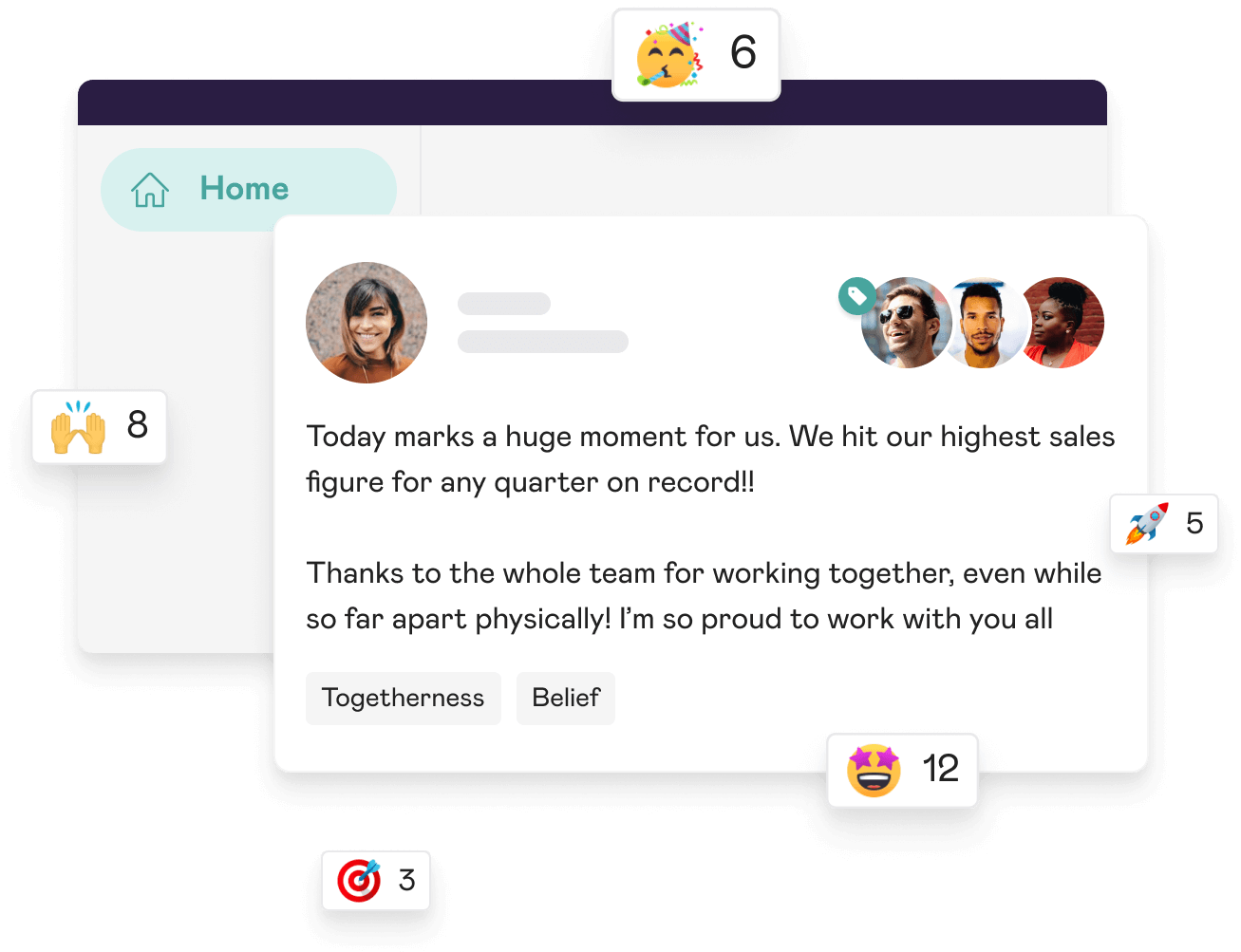
- Strengths: Mo is an intuitive employee recognition platform focused on embedding appreciation into the daily work routine. It supports both manager-led and peer-to-peer recognition, integrating smoothly with communication tools like Microsoft Teams and Slack. Automated features for milestones and values-based recognition ensure consistent acknowledgment. Smart prompts and real-time insights further aid in maintaining high visibility and regularity of recognition across all teams.
- Best for: Organizations prioritizing a social, user-friendly recognition platform that encourages widespread participation and directly links recognition to core company values.
- Key Features: Social recognition feed ("Moments"), manager prompts, real-time insights, values-based recognition.
- Weakness: While strong in recognition and engagement, its rewards catalog and advanced analytics capabilities may not be as extensive as those offered by more comprehensive, enterprise-grade platforms.
3. Worktango
- G2 Rating: 4.7/5
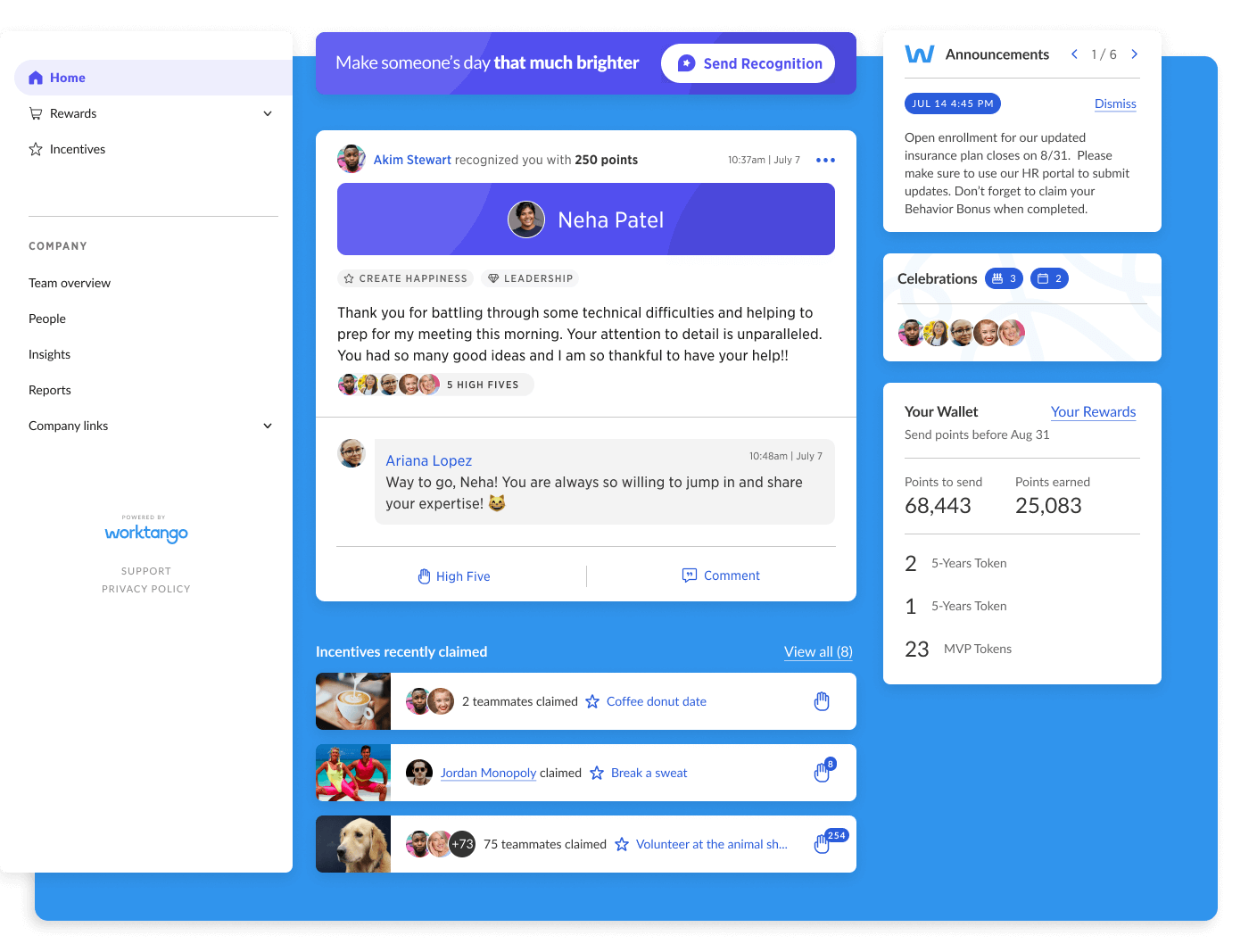
- Strengths: WorkTango provides a recognition and rewards platform designed to streamline appreciation programs and track employee participation effectively. It facilitates both peer and manager recognition, featuring automation for milestones and incentives. The platform also offers detailed reporting to provide insights into recognition activity across various teams. It integrates with popular collaboration tools and offers access to a diverse rewards marketplace.
- Best for: Organizations aiming for an integrated recognition and rewards solution that benefits from automation and robust reporting features to track program effectiveness.
- Key Features: Automated milestones, integrated surveys, performance feedback, and a customizable rewards marketplace.
- Weakness: WorkTango may not offer the same depth of behavioral insights, granular recognition frequency data, or the advanced analytics typically found in platforms tailored for mid-market and enterprise-level clients.
4. Motivosity
- G2 Rating: 4.7/5
- Strengths: Motivosity delivers an employee recognition platform focused on automating and promoting frequent appreciation. It supports peer-to-peer and manager recognition, automates milestone celebrations, and enables spot bonuses. The platform includes built-in tools for challenges, awards, and encourages leader participation. Analytics and dashboards track recognition activity, employee sentiment, and program performance, offering valuable insights into engagement trends.
- Best for: Organizations seeking an automated recognition solution that effectively combines peer recognition, manager tools, and data-driven insights into employee appreciation.
- Key Features: Peer-to-peer giving, automated celebrations, custom awards, and sentiment analysis.
- Weakness: Motivosity’s offerings may not match the enterprise-level scalability, extensive global support, or the deep behavioral science integration found in larger, more established recognition and rewards platforms.
5. Kudoboard
- G2 Rating: 4.8/5
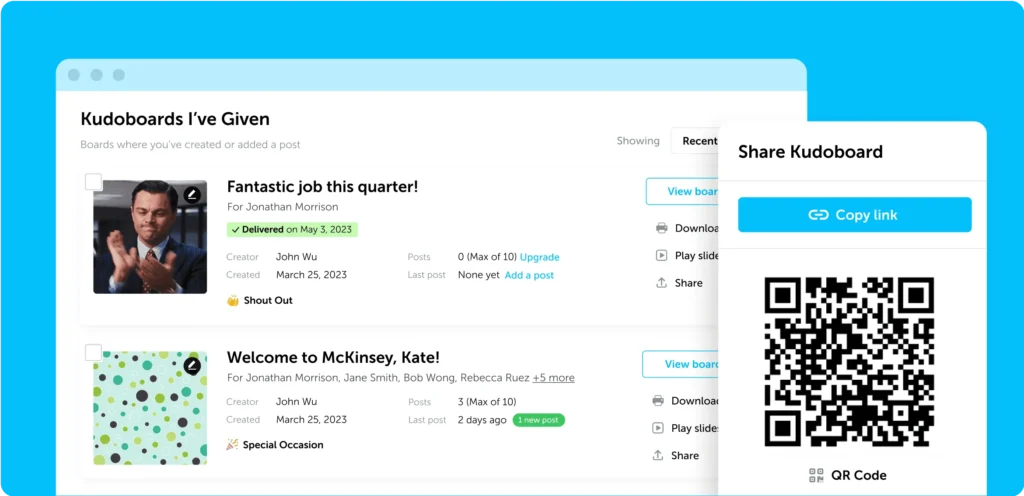
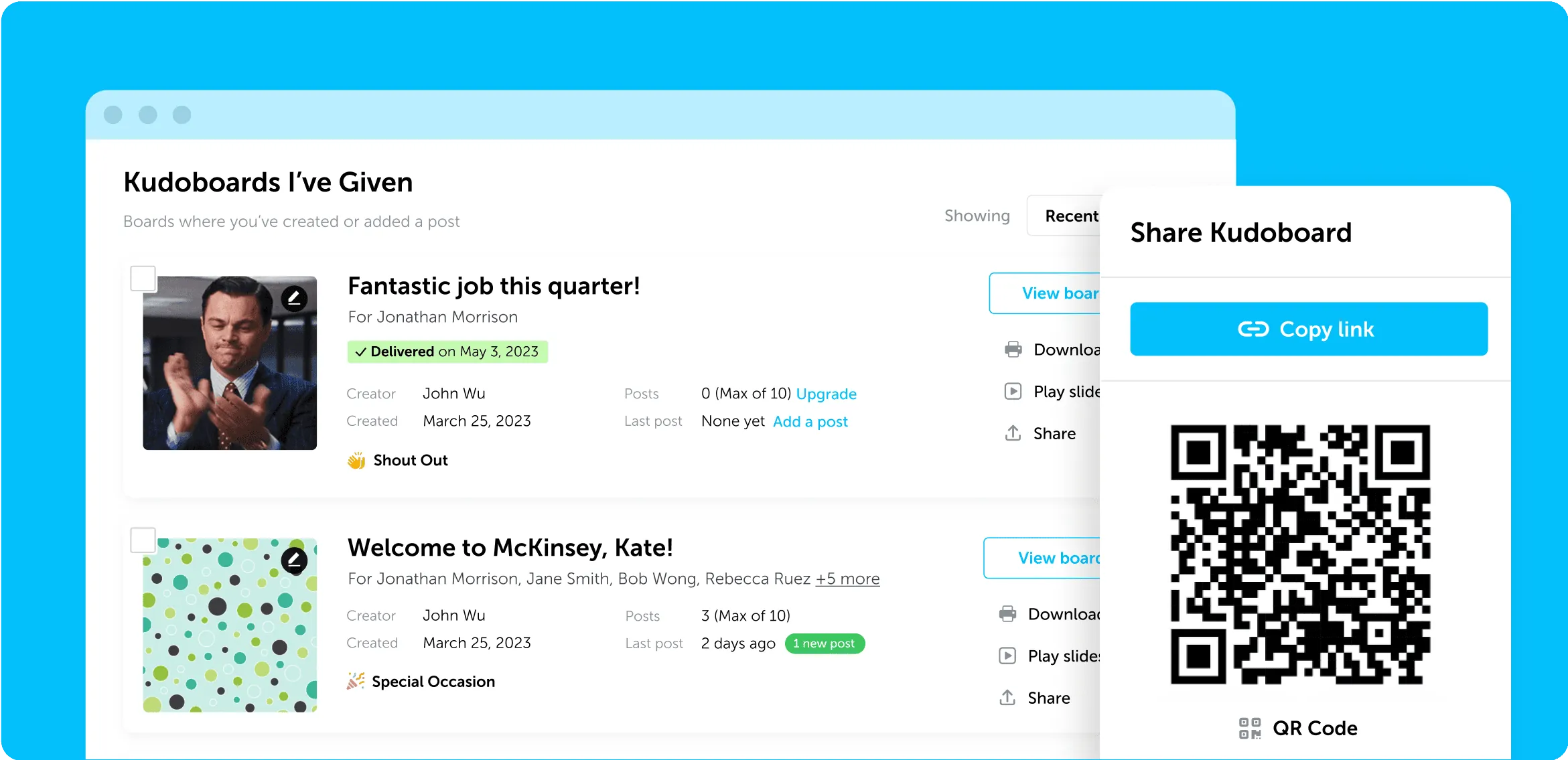
- Strengths: Kudoboard provides a unique digital platform for group appreciation and recognition, primarily through collaborative e-cards and message boards. It enables teams to celebrate milestones, special events, and everyday achievements within a single, shared digital space. Features include automation for birthdays and anniversaries, customizable branding, and integrations with common communication tools, making it ideal for creating visible, personalized moments of appreciation across distributed teams.
- Best for: Organizations looking for a simple, highly visual, and collaborative method to celebrate significant milestones and encourage widespread peer recognition, particularly in hybrid or remote work settings.
- Key Features: Group e-cards, automated event reminders, media attachments, and custom branding.
- Weakness: Kudoboard’s primary focus on social recognition and group celebration means it may not offer the sophisticated behavioral analytics, detailed engagement data, or deep recognition insights provided by more comprehensive recognition platforms.
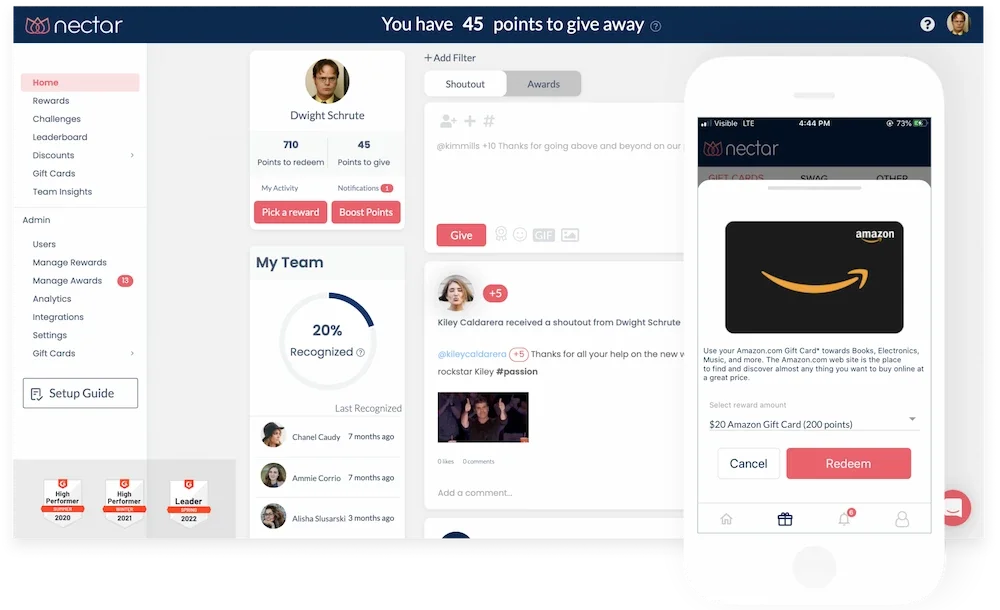
6. Nectar
- G2 Rating: 4.7/5
- Strengths: Nectar offers a recognition and rewards platform designed to foster a strong company culture through frequent appreciation. It facilitates peer-to-peer recognition, supports nomination programs, and automates milestone celebrations. Additionally, the platform includes communication tools for company-wide updates and offers customizable reward options, such as gift cards and branded merchandise.
- Best for: Organizations seeking an all-in-one recognition solution that seamlessly integrates appreciation, nomination processes, and internal communication within a unified platform.
- Key Features: Peer-to-peer recognition, nomination programs, customizable rewards, and company-wide communication.
- Weakness: Nectar may not possess the same global reach, depth of advanced analytics, or behavioral science insights that are characteristic of more specialized enterprise-level platforms.
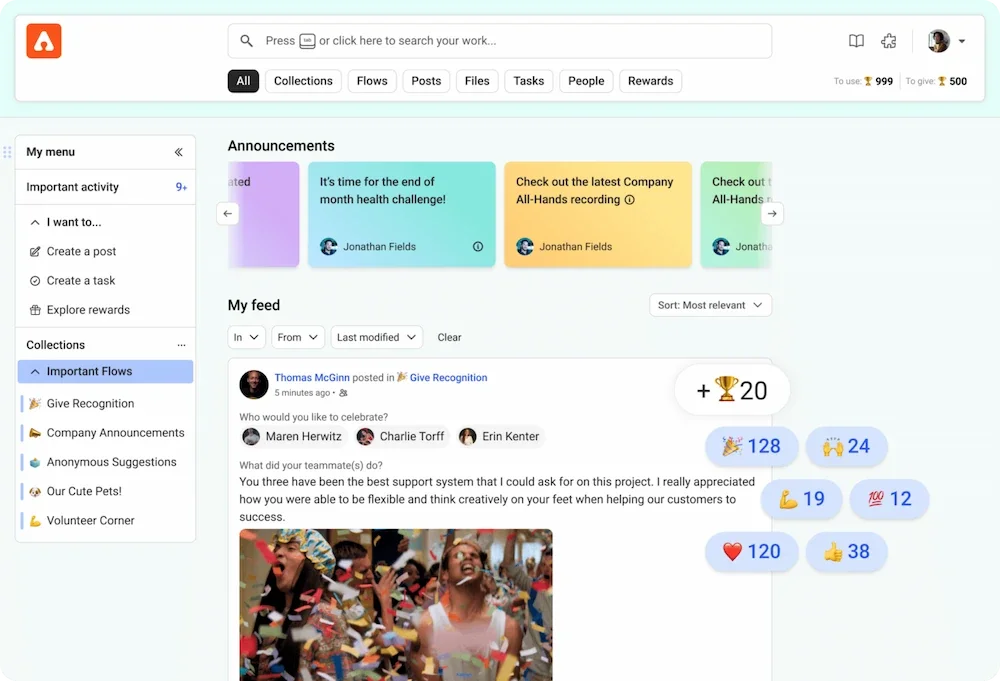
7. Assembly
- G2 Rating: 4.9/5
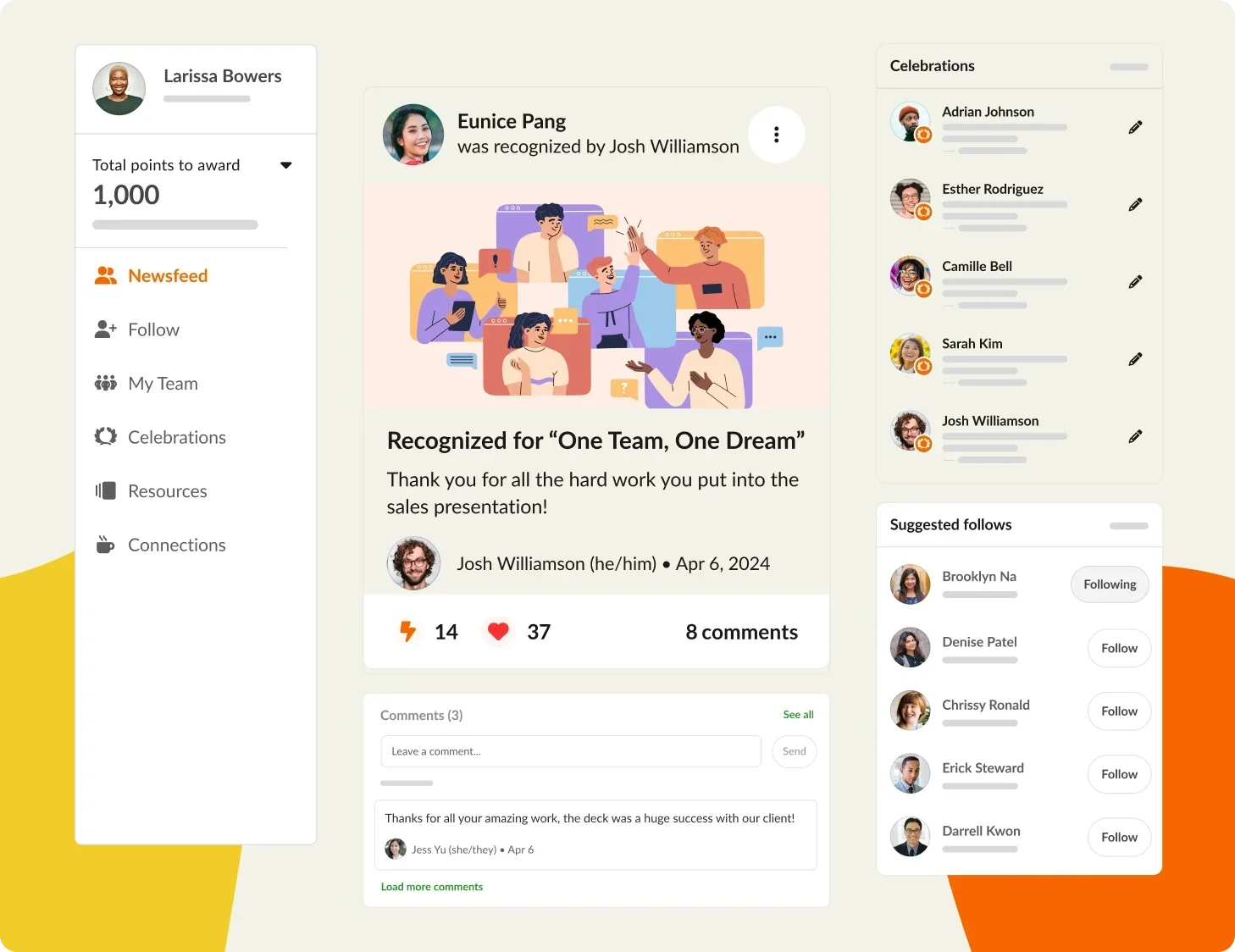
- Strengths: Assembly provides a recognition and rewards platform with a strong emphasis on peer-to-peer appreciation and values-based recognition. It allows employees to deliver recognition directly within their daily communication tools like Slack and Microsoft Teams, or via the web, creating a visible social feed for celebrating achievements and milestones. The platform supports various awards, challenges, and automated celebrations, with analytics to track engagement and participation across teams.
- Best for: Organizations specifically looking for a peer recognition platform that deeply integrates with everyday communication tools, making appreciation a natural part of daily workflows.
- Key Features: Direct integration with communication apps, social recognition feed, automated celebrations, and values-based recognition.
- Weakness: Assembly’s strength in integration and social features may come at the cost of the deeper analytics, behavioral insights, or large-scale customization capabilities found in more data-driven and enterprise-focused recognition platforms.
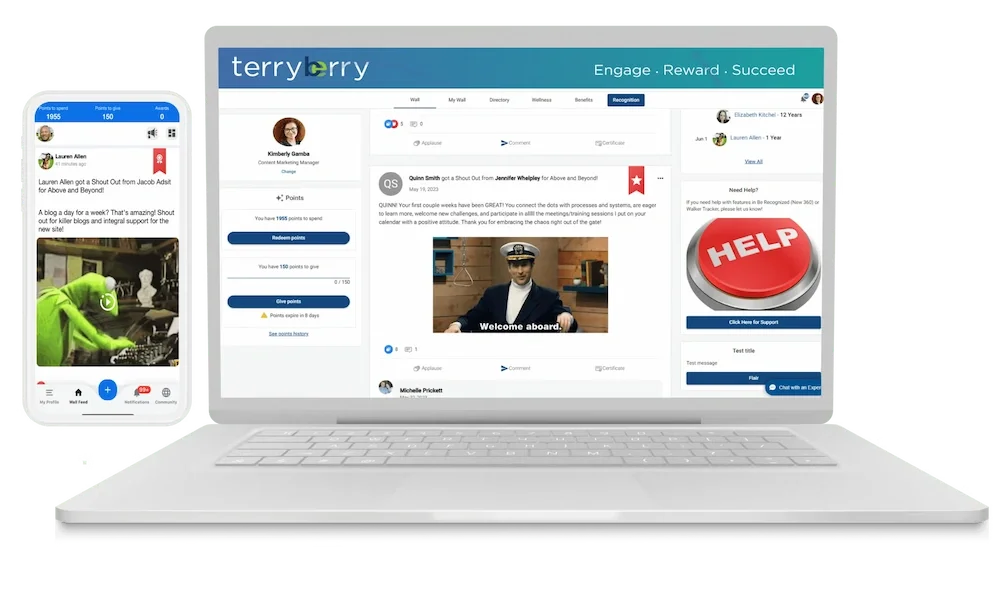
8. Terryberry
- G2 Rating: 4.6/5
- Strengths: Terryberry offers a comprehensive recognition and engagement platform that unifies employee recognition, wellness programs, and feedback tools. It supports traditional service awards, peer recognition, and milestone programs, complemented by sentiment surveys and analytics for measuring culture, retention, and eNPS. Designed for distributed workforces, it combines digital and symbolic awards with data-driven insights.
- Best for: Organizations seeking a holistic, unified approach to managing recognition, employee wellness, and engagement measurement within a single, integrated platform.
- Key Features: Service awards, peer recognition, wellness programs, feedback tools, and eNPS tracking.
- Weakness: Terryberry might not offer the same granularity in recognition frequency data or the extensive variety of a global rewards marketplace as platforms exclusively specialized in recognition and rewards.
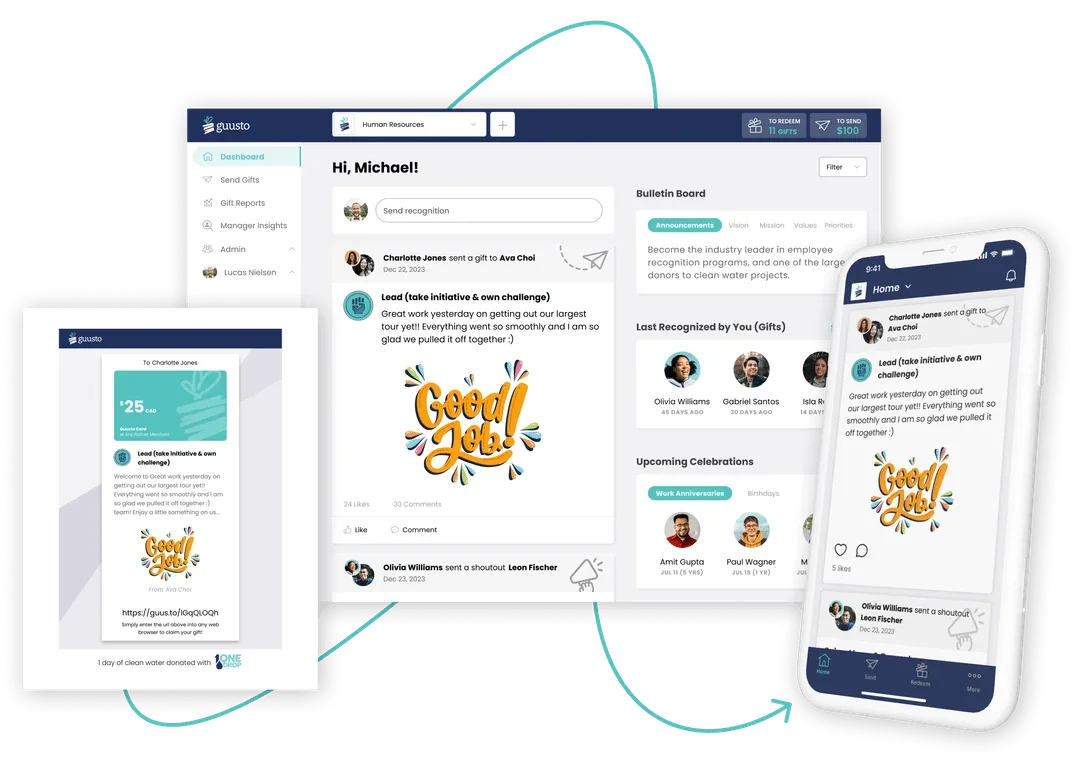
9. Guusto
- G2 Rating: 4.9/5
- Strengths: Guusto delivers an employee recognition platform specifically designed to support both office-based and frontline workers. It operates on a direct dollar-value reward system, eschewing points, and allows recognition to be sent to employees, contractors, or volunteers without requiring corporate email addresses. The platform facilitates peer recognition, milestone programs, and manager-led budgets, with flexible options for digital or printed delivery to ensure deskless teams are included.
- Best for: Organizations with widely dispersed or frontline teams that require an accessible, flexible, and straightforward recognition program with easy reward redemption.
- Key Features: Direct dollar-value rewards, no corporate email required for recipients, peer recognition, and milestone programs.
- Weakness: Guusto’s simplified structure, while offering ease of use, may not provide the same depth of data analytics or program customization typically available in more scalable, enterprise-grade recognition platforms.
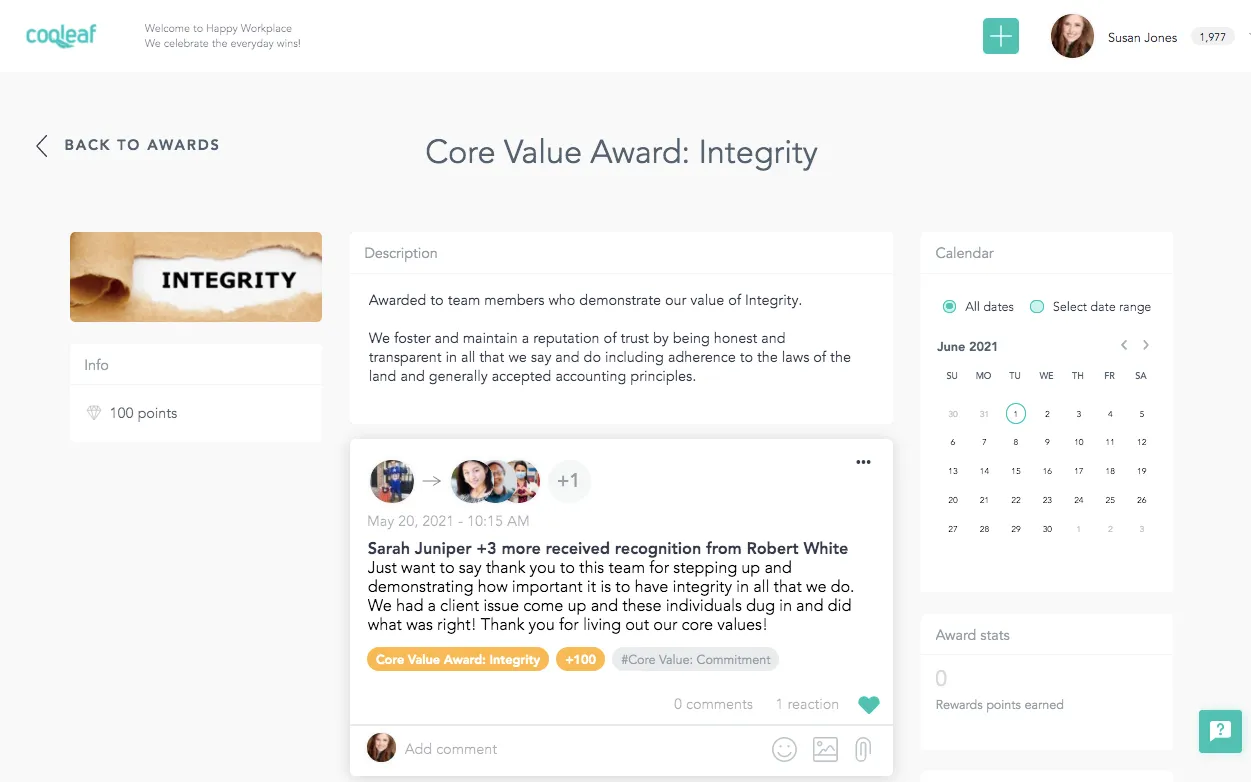
10. Cooleaf
- G2 Rating: 4.9/5
- Strengths: Cooleaf integrates recognition, rewards, engagement programs, and employee feedback into a single, cohesive platform. It enables organizations to celebrate achievements, reinforce company values, and automate milestones, while simultaneously gathering real-time insights through engagement surveys and comprehensive dashboards. The platform also fosters community building through social feeds, learning initiatives, and DEI-focused programs.
- Best for: Companies aiming to manage their recognition, engagement, and feedback initiatives comprehensively within a single, unified platform.
- Key Features: Integrated recognition and rewards, engagement surveys, social feeds, and DEI program support.
- Weakness: Cooleaf’s broad focus on overall employee engagement might result in less specialization and a more limited global rewards variety compared to platforms built specifically for large-scale, dedicated recognition programs.
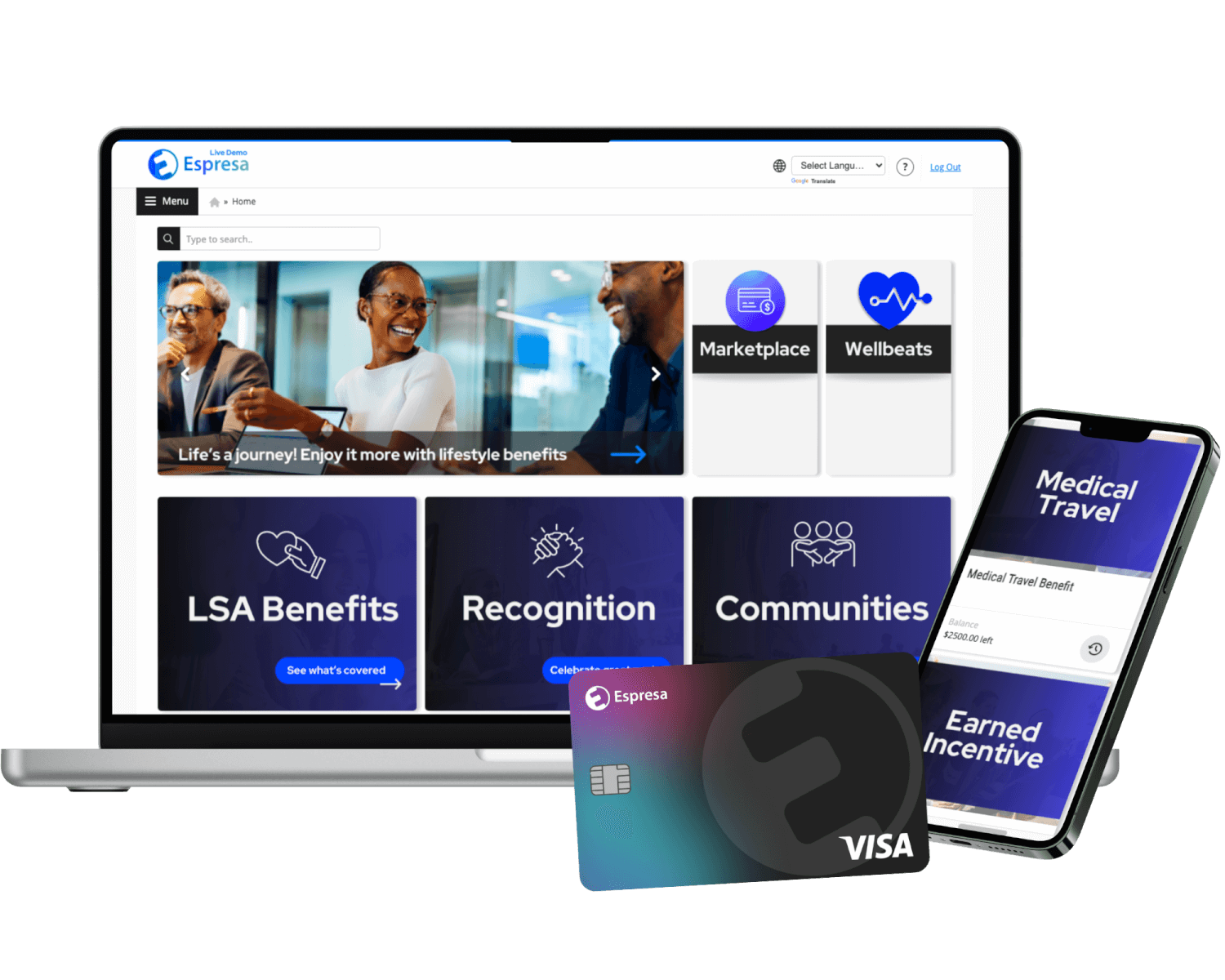
11. Espresa
- G2 Rating: 4.3/5
- Strengths: Espresa offers a recognition and rewards platform that uniquely ties appreciation to broader wellbeing and lifestyle benefits, all within a single system. It supports both peer-to-peer and cross-organizational recognition, offering a blend of monetary and non-monetary options. The platform is mobile-first, ensuring accessibility and ease of use for all employees.
- Best for: Organizations looking to holistically combine employee recognition, comprehensive wellbeing programs, and lifestyle benefits into a single, intuitive digital platform.
- Key Features: Recognition tied to wellbeing, mobile-first design, monetary and non-monetary recognition, and a global rewards marketplace.
- Weakness: Espresa’s all-encompassing nature means that its recognition tools, while present, may not delve as deeply into specialized data and behavioral insights as platforms exclusively focused on advanced recognition.
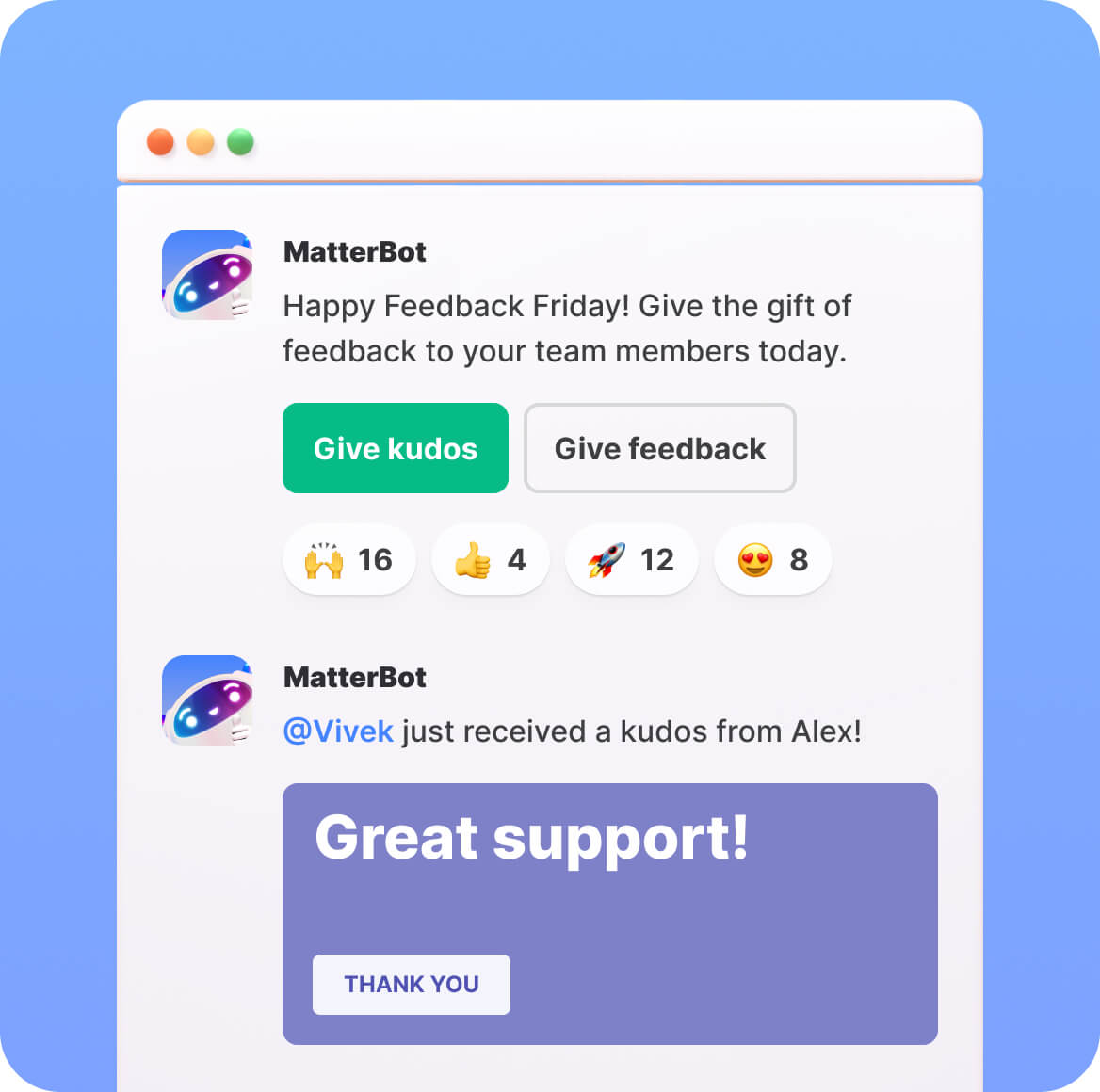
12. Matter
- G2 Rating: 4.7/5
- Strengths: Matter is a recognition and feedback platform seamlessly integrated with popular communication tools like Slack and Microsoft Teams. It promotes peer-to-peer appreciation through features such as kudos, automated celebrations, and customizable templates linked to company values. The platform also incorporates coins-based rewards, pulse and onboarding surveys, and analytics to track overall engagement.
- Best for: Companies seeking a straightforward and effective way to embed recognition, feedback, and engagement directly into their primary communication channels like Slack or Microsoft Teams.
- Key Features: Direct Slack/Teams integration, peer kudos, coins-based rewards, and pulse surveys.
- Weakness: Matter’s emphasis on simplicity and direct integration, while user-friendly, may mean it lacks the extensive reporting, deep customization options, and global scalability offered by more comprehensive recognition platforms.
13. Empuls (Xoxoday)
- G2 Rating: 4.6/5
- Strengths: Empuls, powered by Xoxoday, is a robust employee engagement platform that unifies recognition, rewards, surveys, incentives, and communication tools. It supports comprehensive feedback collection, peer recognition, and efficient reward distribution across global teams. The platform features AI-driven analytics and a wide array of integrations, ensuring both scalability and ease of use for diverse organizational needs.
- Best for: Organizations seeking a single, integrated platform to manage recognition, broad engagement initiatives, and internal employee communication across multiple regions or global operations.
- Key Features: All-in-one engagement suite, global rewards catalog, AI-driven analytics, and comprehensive integrations.
- Weakness: Empuls’ broad focus on overall engagement may limit the depth of specific customization and granular recognition-specific insights that are often found in more specialized recognition platforms.
14. Connecteam
- G2 Rating: 4.6/5
- Strengths: Connecteam offers an all-in-one platform specifically designed for managing deskless teams, integrating operations, communication, HR, and engagement tools into a single mobile application. Its recognition and rewards features allow managers to easily celebrate achievements, issue digital badges, and distribute gift cards directly within the platform, making it highly accessible for non-desk-bound workforces.
- Best for: Organizations with large or widely distributed frontline and deskless workforces that require an integrated mobile application for comprehensive workforce management, including recognition.
- Key Features: Mobile-first design, digital badges, gift card distribution, and integrated communication.
- Weakness: As a broad workforce management solution, Connecteam’s recognition capabilities, while functional, might feel less central or developed compared to platforms that specialize exclusively in engagement and behavioral recognition insights.
15. Vantage Circle
- G2 Rating: 4.7/5
- Strengths: Vantage Circle is an all-in-one engagement platform that consolidates recognition, wellness, surveys, and employee perks into a single system. It is known for its quick rollout capabilities and extensive integration options. Its recognition features include social feeds, awards/badges, automated milestones, and a vast global rewards catalog encompassing gift cards, unique experiences, merchandise, and direct Amazon Business redemption.
- Best for: Organizations looking for a consolidated employee engagement suite that offers comprehensive reward coverage and a wide range of HR functionalities beyond just recognition.
- Key Features: All-in-one engagement platform, social recognition, automated milestones, and a large global rewards catalog.
- Weakness: While comprehensive, Vantage Circle may not offer the same depth of behavioral analytics or advanced recognition science that is typically provided by platforms specializing solely in driving specific recognition outcomes.
Strategic Considerations for Platform Selection
Choosing the optimal employee recognition platform in 2026 is a strategic decision that extends beyond feature lists. It requires a deep understanding of organizational needs, cultural nuances, and long-term business objectives. Not all platforms are created equal, and the "right fit" is highly dependent on what an organization’s people truly require to feel valued and motivated.
Here are 13 key tips to consider when comparing recognition platforms:
- Alignment with Company Values: Ensure the platform can be configured to reinforce core organizational values with every recognition.
- Scalability: The solution must be capable of growing with the organization, supporting expansion in headcount, geographic reach, and program complexity.
- Ease of Use & Adoption: A platform’s intuitive design and user-friendliness are critical for high adoption rates across all employee demographics.
- Global Capabilities: For multinational companies, features like multi-currency support, localized reward catalogs, and multilingual interfaces are essential for equitable recognition.
- Robust Integrations: Seamless connectivity with existing HRIS, communication tools (e.g., Slack, Microsoft Teams), and other business systems prevents workflow disruption.
- Customization: The ability to tailor program rules, branding, and recognition types to fit unique company culture is paramount.
- Reporting and Analytics: Detailed dashboards and actionable insights into recognition patterns, engagement levels, and ROI are vital for program optimization.
- Diverse Reward Options: A wide range of appealing reward choices, from gift cards and experiences to charitable donations, caters to varied employee preferences.
- Mobile Accessibility: A fully functional mobile app ensures that recognition can happen anywhere, anytime, catering to remote, hybrid, and deskless workforces.
- Behavioral Science Foundation: Platforms built on proven psychological principles are more likely to drive consistent positive behaviors and lasting engagement.
- Security and Compliance: Data privacy, security protocols, and compliance with relevant regulations (e.g., GDPR) are non-negotiable.
- Vendor Support & Partnership: Evaluate the vendor’s commitment to customer success, ongoing support, and willingness to evolve with client needs.
- Cost-Effectiveness: Balance features and capabilities with the overall budget, considering both initial setup and ongoing operational costs.
Case Study: General Motors – Driving Global Culture Through Recognition
The experience of General Motors (GM) exemplifies the transformative power of a well-implemented recognition platform. With a vast workforce exceeding 160,000 employees spread across six continents, GM faced the challenge of maintaining a cohesive culture and consistently reinforcing its corporate values. Their existing recognition efforts were fragmented, often manual, and localized, leading to inconsistencies and a diminished sense of appreciation among employees. Leaders struggled to recognize teams effectively, and many employees felt their contributions went largely unnoticed within the vast enterprise. GM recognized the urgent need for a singular, global platform that could simplify recognition, make it visible across the organization, and tightly align it with core company behaviors.
By adopting a unified recognition program powered by Achievers, GM successfully embedded appreciation into the daily workflow of its global workforce. The platform enabled employees to instantly recognize peers, managers to participate with minimal effort, and key milestones to be celebrated automatically. This eliminated the friction associated with previous, disconnected local programs, replacing them with a shared, seamless experience. Recognition at GM became frequent, highly social, and, crucially, scalable across its diverse operations.
The tangible results underscored this success:
- 10x increase in recognition frequency within the first year, demonstrating widespread adoption and consistent usage.
- 90% of employees actively participating in recognition programs, indicating a highly engaged and appreciative workforce.
- 72% of employees feeling recognized monthly, a stark contrast to their previous fragmented experience, leading to enhanced morale and loyalty.
GM’s journey illustrates that when recognition is intuitive, visible, and deeply integrated into everyday work, it rapidly scales, fostering a robust and appreciative global culture that directly contributes to organizational success.
Conclusion: The Real Results of Strategic Recognition
The strategic implementation of an employee recognition platform delivers far more than fleeting positive emotions; it generates tangible, measurable business results. Platforms like Achievers, with their emphasis on high recognition frequency, industry-leading integrations, and a focus on driving desired behaviors, empower companies to significantly improve engagement, boost productivity, and enhance talent retention rates.
Effective recognition is a dual force: it feels good for the recipient and does good for the organization. By transforming everyday moments of appreciation into lasting business momentum, these platforms are becoming indispensable tools for modern HR and business leaders. As organizations navigate the complexities of the 21st-century workforce, investing in a top-tier employee recognition platform is no longer optional; it is a critical investment in human capital that yields substantial returns in culture, performance, and long-term success.
Information and pricing in this article were sourced from each vendor’s website and publicly available G2 ratings as of the publication date.