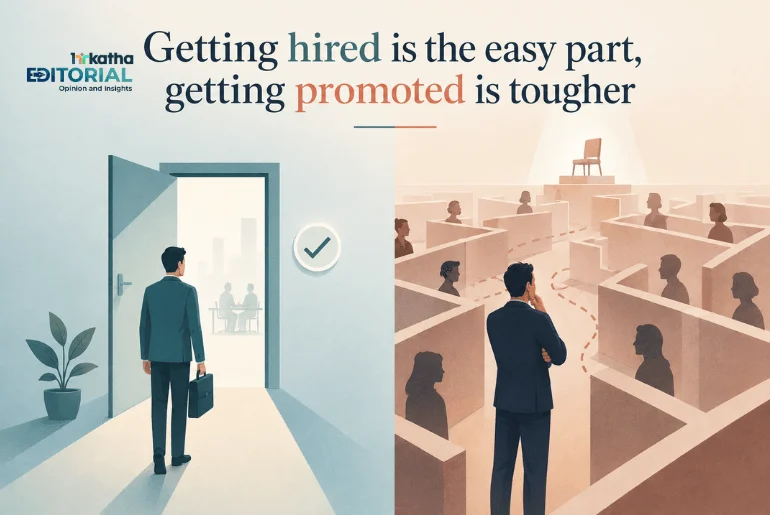
For decades, organizations have meticulously engineered the hiring process, striving for structures that are consistent, defensible, and ostensibly fair. Candidates seeking to join a company undergo rigorous assessments, understand the evaluation criteria, and are afforded formal opportunities to present their case. Yet, for an employee aspiring to ascend within the same organization, the journey to promotion is often starkly different—a realm marked by vague criteria, inconsistent processes, and decisions rendered by individuals whose opinions have been years in the making. The outcome is typically an announcement, rarely a comprehensive explanation, leaving many to wonder about the true determinants of advancement.
The paradox lies in this fundamental disparity: the "harder interview" is not the one that grants entry into an organization, but rather the one that dictates upward mobility. And in a majority of corporate environments, this critical assessment occurs largely unbeknownst to the very individual being judged.
The Silent Ascent: Unpacking the Announcement Model
The notion of a formal promotion interview is often an assumption rather than a reality for many employees. In numerous organizations, particularly within traditional Indian corporate structures, promotion is not an application-driven process but an executive decree. Management deliberates, HR processes the necessary paperwork, and the employee is simply informed of their new role. There is no interview, no formal opportunity for the candidate to articulate their suitability, and no transparent explanation of the decision-making process. The pivotal choice is made behind closed doors, based on evidence that the employee may not even have realized was being collected.
This "announcement model" is a revealing artifact of how organizations perceive their human capital. It rests on an often-unspoken belief that management possesses sufficient insight into its workforce to instinctively identify who merits advancement. Promotion, in this paradigm, is a benefaction bestowed by the organization, rather than a reward earned through a visible and accountable process. This model, while preserving managerial discretion, significantly undermines employee development and morale. When an employee is passed over, the feedback is frequently too generic to be actionable, leaving them confused, disengaged, and without a clear roadmap for future growth. Articulating genuinely honest feedback in such scenarios often necessitates delving into sensitive political dynamics or nuanced performance aspects that are challenging to frame within standard performance management language, thus perpetuating vagueness.
When Interviews Occur: Testing Pre-Formed Judgements
When something resembling a promotion interview does materialize, it is typically under specific circumstances. These might include situations with multiple internal contenders for a single role, the dictates of a formal internal job-posting system, or the necessity of a skip-level conversation before a decision is finalized. Larger corporations and multinational companies often implement structured internal application processes, allowing employees to formally vie for open positions. In contrast, smaller organizations might deem such formality unnecessary, under the assumption that senior leaders are intimately familiar with every employee’s capabilities.
Critically, these promotion interviews often serve less as a discovery mechanism for unknown attributes and more as a validation tool for judgments the organization has already begun to form. This distinction is profound: a hiring interview commences with genuine uncertainty regarding the candidate’s fit, whereas a promotion interview often starts with a foundation of accumulated certainty—some justified, some potentially erroneous—about an internal candidate. This inherent difference introduces a structural problem that external hiring interviews largely avoid: the interviewer already knows the candidate, and this familiarity is a double-edged sword.
The Pervasive Influence of Unconscious Biases
An external candidate typically arrives with a resume and a few initial impressions, possessing the freedom to largely shape the panel’s perception. The internal candidate, however, enters the room carrying years of organizational history, a tapestry woven from past projects, overheard opinions, and pre-existing judgments that can be remarkably difficult to dislodge. The conversation thus becomes less about introduction and more about confirming or disrupting a deeply entrenched perception.
This dynamic is fertile ground for various cognitive biases. Confirmation bias, for instance, ensures that if an interviewer already believes a candidate is ready for promotion, ambiguous evidence will be interpreted favorably. Conversely, if doubts have accumulated over time, even an exceptional interview performance may not fully erase them. The halo effect further exacerbates this: strong performers often receive the benefit of the doubt on equivocal evidence, while others are held to an arbitrarily higher standard of proof.
Perhaps most disquieting is relationship bias. Human nature dictates that individuals find it easier to advocate for colleagues they personally like, trust, or have a pre-existing rapport with. Factors such as familiarity, informal sponsorship, and access to decision-makers inevitably seep into the promotion decision, even if they are conspicuously absent from formal promotion criteria. While these biases do not inherently invalidate every promotion decision, they undeniably compromise the ideal of a level playing field, making genuine meritocracy harder to sustain.
Beyond the Framework: The Unstated Criteria for Advancement
Most organizations formalize promotion criteria, detailing performance metrics, potential indicators, and required competencies in their frameworks, talent reviews, and development conversations. While these are not irrelevant, they often present an incomplete picture of what truly determines upward mobility, particularly as careers progress. Four often-unstated considerations become increasingly paramount:
- Influence: This refers not to formal authority, which is conferred by position, but to the organic influence built through robust relationships, demonstrated credibility, and the consistent quality of thought over time. At senior levels, promotion is less about doing more of the current role and more about shaping the actions of others. Evidence of an ability to influence beyond the immediate boundaries of one’s current role is far more critical than many employees realize.
- Trust: The promotion decision is a profound test of whether the organization can confidently entrust an individual with greater authority, more resources, increased visibility, and access to sensitive decisions. This trust is meticulously built through an accumulated record of behavior during challenging, ambiguous, or politically complex situations. It is an asset that cannot be artificially manufactured in the weeks preceding a promotion decision.
- Reputation: In the context of promotion, reputation encapsulates the collective opinion of everyone who has interacted with, managed, or been managed by the candidate. It is a mosaic formed since their first day, incorporating perceptions from moments of weakness, conclusions drawn from situations barely remembered. Like trust, reputation is not something that can be revised on the eve of a promotion decision; it is cultivated consistently over time through consistent behavior.
- Judgment: Senior roles are characterized by problems without obvious answers, where information is incomplete and consequences are substantial. The focus shifts from efficient execution to making sound decisions under uncertainty. Judgment is demonstrated through actual choices made in real-world scenarios, not through hypothetical answers provided in structured interviews.
Furthermore, Sponsorship plays an increasingly critical, albeit often unacknowledged, role as individuals climb the corporate ladder. Having a senior leader willing to champion one’s case in the decisive room where promotions are deliberated is invaluable. Organizations often shy away from acknowledging this, fearing it implies political maneuvering over merit. However, pretending it does not exist does not enhance meritocracy; it merely renders a crucial mechanism invisible, disadvantaging those unaware of its importance.
Redefining the Promotion Interview: Towards Strategic Assessment
If a promotion interview is to serve a genuine purpose beyond merely providing procedural cover for an already-formed decision, it must aim to uncover information the organization does not already possess. An immediate manager typically has a comprehensive understanding of a candidate’s technical competence, output, and working style. An interview that merely reiterates these aspects adds little new information.
The true value of a promotion interview lies in its ability to evaluate evidence of next-level thinking—qualities that may not be overtly visible in day-to-day performance. Has the candidate begun framing challenges in terms of broader organizational implications, beyond their immediate team? Have they successfully influenced outcomes over which they held no formal control? How do they respond when their judgment proves incorrect? At senior echelons, the capacity to recognize a mistake and adapt course can be more critical than an unwavering appearance of certainty.
Regarding the ideal interview panel, the immediate manager offers the richest evidence but carries the highest potential for bias. A neutral panel provides distance but risks assessing interview performance over years of actual contribution. A skip-level leader often strikes a valuable balance between the two. The most rigorous processes integrate all three perspectives: structured evidence from the immediate manager, a skip-level conversation focused on future readiness, and where feasible, peer perspectives that offer broader insights into influence and reputation.
The Evolving Ladder: Promotion Dynamics Across Organizational Levels

The "game" of promotion changes significantly with each rung of the corporate ladder. At junior to mid-levels, the criteria are relatively clear: performance against measurable targets, demonstrated competence, and a basic readiness for additional responsibility carry considerable weight. While biases persist, the evidence for evaluation is typically more tangible.
The transition from mid to senior level fundamentally alters the equation. Technical competence becomes an assumed prerequisite rather than the primary focus of assessment. Instead, judgment, influence, organizational presence, and the ability to navigate profound ambiguity become paramount. Many accomplished mid-level professionals struggle at this juncture, not due to a lack of capability, but because they continue to demonstrate mastery of their current role, while the organization is actively seeking evidence of their capacity to operate at the next level. They are, in essence, answering a question that is no longer being asked.
At the highest echelons—the CXO level—the formal interview holds the least significance. Decisions at this level are meticulously built over years through business outcomes, accumulated perceptions, board relationships, and unwavering advocacy from the highest levels. By the time any formal conversation occurs, the conclusion is usually well advanced. The interview at this stage is rarely a genuine assessment; it is, more often than not, a final confirmation of a decision already made.
The Internal Candidate’s Peculiar Disadvantage
When an internal candidate competes with an external one for a senior role, the dynamics shift in ways most organizations do not openly acknowledge. Intuitively, the internal candidate should possess a distinct advantage: the organization has direct knowledge of their deliverables, their behavior under pressure, and their trustworthiness. However, familiarity carries an inherent penalty. The organization has also observed every weakness, every misstep, and every developmental curve in real-time. Paradoxically, the candidate’s gradual growth can become almost invisible precisely because it occurred steadily, right before everyone’s eyes.
The external candidate arrives with a meticulously curated CV, bolstered by carefully selected references, their limitations largely undiscovered. The allure of novelty can thus inflate the perceived potential of the unknown candidate, while familiarity subtly discounts the proven, known one. Organizations that pass over strong internal candidates in favor of external hires often incur a dual cost: first, when the internal candidate disengages or departs, taking valuable institutional knowledge with them; and second, when the external hire spends months, if not longer, acclimating and becoming fully effective. Both costs are tangible, yet neither is always fully visible at the point of decision.
Empowering the Aspiring Leader: A Long-Term Strategy for Promotion
The most crucial understanding for any employee aspiring for promotion is that the formal interview itself is merely a checkpoint, not the primary determinant. The substantive evidence—influence built, trust earned, reputation developed, and judgment demonstrated—has been produced over the preceding months and years. No amount of interview technique or last-minute preparation can compensate for a lack of these foundational qualities. Effective preparation for a promotion interview commences the day an individual joins an organization, not in the week leading up to the conversation.
Understanding the real criteria for the next level within a specific organizational context matters infinitely more than polishing answers to generic competency questions. Aspiring leaders should meticulously observe who currently holds those desired roles and identify their common attributes. What does the organization consistently reward when it promotes? What behaviors are truly valued, beyond the official job descriptions?
Identifying and cultivating a sponsor is also profoundly important. A candidate who enters a promotion decision without a champion is at a significant disadvantage, regardless of their interview performance. Knowing who that person is, and having an honest assessment of their belief in one’s readiness, is among the most valuable pieces of information a candidate can possess before any formal process begins.
Finally, addressing the "perception gap" is critical. There is almost always a disparity between an employee’s self-perception and how the organization views them. The promotion interview is unlikely to bridge this gap. Instead, seeking honest feedback from trusted individuals willing to speak candidly about this gap, well in advance, is far more valuable than any amount of interview practice.
HR’s Mandate: Championing Transparency and Accountability in Talent Mobility
Internal promotion processes receive a mere fraction of the design attention that organizations dedicate to external hiring, and this disparity is evident in the outcomes. While hiring benefits from detailed job descriptions, robust competency frameworks, structured interview protocols, and formal feedback mechanisms, promotion often operates with ambiguous criteria, inconsistent processes, and decisions that are notoriously difficult to explain to unsuccessful candidates without resorting to feedback so generic it becomes useless.
HR’s fundamental task is not to eliminate judgment from promotion decisions; senior roles inherently demand qualities that resist reduction to a simple score. Nor should organizations shy away from acknowledging the importance of influence, reputation, and sponsorship, simply because these concepts might seem to contradict the language of meritocracy.
Instead, HR’s mandate is to enhance the legibility of this judgment. If influence is a critical factor for advancement, organizations must articulate what that looks like in practice. If next-level readiness is prioritized over current-role excellence, HR must define these new expectations explicitly. If reputation across various stakeholders significantly shapes the decision, employees should discover this during proactive development conversations, not after the disheartening experience of being passed over.
Greater transparency inevitably fosters greater accountability, which is precisely why some organizations instinctively resist it. Once criteria are made explicit, any deviation from them becomes considerably harder to justify. The opacity that frequently shrouds promotion systems is not always an accidental design flaw; sometimes, it serves as a deliberate mechanism to preserve managerial discretion and insulate decisions from external scrutiny.
The Interview That Has Been Happening for Years
The formal promotion interview, where it even exists, is rarely the moment the ultimate decision is forged. It is, more accurately, the moment when a decision already in progress is either confirmed or, on rare occasions, significantly disrupted. Getting hired requires performing well for a few intense hours in front of people who are strangers. Getting promoted demands having performed consistently well for years in front of people who know you intimately.
The real promotion interview transpired when a project unexpectedly failed, and leaders observed how the challenge was navigated. It happened when a senior leader faced internal dissent, and loyalty was tested. It occurred when a critical judgment call was made with incomplete information. It manifested when a colleague needed assistance, and there was no immediate personal gain for providing it. And, perhaps most significantly, it happened every time a name was discussed in a room where the individual being assessed was not present.
By the time the formal conversation arrives, a substantial portion of the assessment is already complete. Organizations may label that final interaction a "promotion interview," but often, it is merely the concluding act where years of accumulated judgment are finally revealed to the person being judged. The harder interview was never the one that determined entry; it was the one they never knew they were attending.