
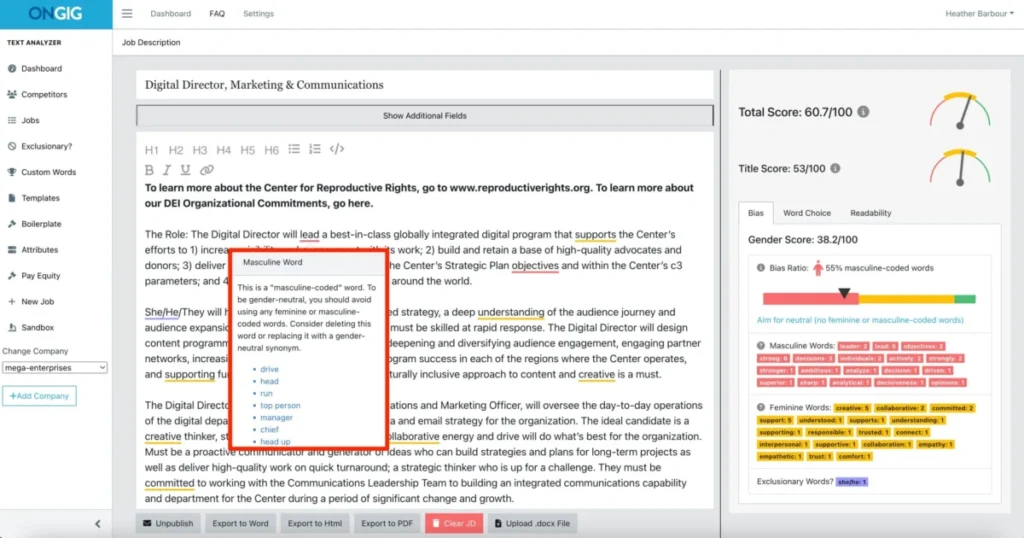
A comprehensive analysis conducted by Ongig, a leader in job description optimization, reveals that "strong," "lead," and "independently" remain the most prevalent masculine-biased words in job postings as of mid-2026. The study, which scrutinized nearly 50,000 job descriptions, underscores an ongoing challenge in attracting a diverse talent pool, particularly women, and highlights the critical role of language in fostering inclusive hiring practices. This latest data, collected between January 1 and July 13, 2026, builds upon years of research demonstrating a direct correlation between gendered language and lower application rates from female candidates.
The findings from Ongig’s Text Analyzer software indicate a persistent pattern where certain words, though seemingly innocuous, disproportionately resonate with a masculine self-perception, inadvertently deterring women from applying. Beyond the top three, other frequently flagged words include "strengthen," "competitive," "leaders," "analyze," "champion," "analysis," and "independent." The report emphasizes that proactively replacing these terms with gender-neutral alternatives is not merely a matter of political correctness but a strategic imperative for companies aiming to enhance their female application rates and cultivate a more equitable workforce.
The Evolving Landscape of Inclusive Hiring and Unconscious Bias
The drive for diversity, equity, and inclusion (DEI) has gained significant momentum across industries globally over the past decade, transforming from a peripheral concern to a core business strategy. Central to this evolution is the recognition that unconscious biases, deeply ingrained societal stereotypes, often manifest in subtle yet impactful ways, including the language used in recruitment. Job descriptions, serving as the initial point of contact between a company and potential talent, are particularly susceptible to these biases.
Historically, professional language, especially in leadership and technical roles, has often been steeped in terms associated with traditionally masculine traits like assertiveness, dominance, and competitiveness. While these traits are not exclusive to any gender, their repeated use in job advertisements can create an implicit message that certain roles are better suited for men. This phenomenon has been extensively studied in social psychology, demonstrating how individuals, particularly women, may self-select out of opportunities if they perceive the environment or requirements as less welcoming or geared towards a different demographic. The current Ongig study provides contemporary evidence that despite increased awareness, these linguistic biases remain deeply embedded in corporate recruitment narratives.
Rigorous Methodology Behind the 2026 Findings
Ongig’s analysis is rooted in a robust methodology leveraging advanced textual analysis. For the 2026 report, the company’s proprietary Text Analyzer software reviewed a substantial dataset of 48,246 random job descriptions. These postings originated from U.S.-based companies spanning various sizes and sectors, ensuring a broad and representative sample of current hiring language.
The core of Text Analyzer’s capability lies in its "masculine vocabulary library." This sophisticated database is meticulously curated from extensive social science research on gendered language and continuously refined using artificial intelligence algorithms. It identifies words and phrases scientifically proven to carry masculine or feminine connotations, even when their surface meaning appears neutral. The software not only flags these biased terms but also tracks their frequency and suggests contextually appropriate, gender-neutral synonyms. This rigorous, data-driven approach allows Ongig to provide actionable insights that move beyond anecdotal observations to statistically significant patterns in recruitment language. The consistent tracking of these linguistic trends ensures that the insights remain relevant as language evolves and societal perceptions shift.
Key Findings: The 2026 Report Details
The latest data from January to July 2026 highlights a persistent top echelon of masculine-biased terms, alongside some notable shifts. The following table summarizes the top 10 words, their frequency of being flagged and swapped by Ongig’s Text Analyzer during the reporting period, and recommended gender-neutral alternatives:
| Rank | Word | Times Swapped | Gender-Neutral Alternatives |
|---|---|---|---|
| 1 | strong | 42 | able, proven, exceptional, sound, steady, excellent, solid |
| 2 | lead | 26 | drive, head, run, chief, manage, steer, guide |
| 3 | independently | 13 | alone, exclusively, unaided, unsupervised |
| 4 | strengthen | 12 | build, reinforce, improve, develop, grow |
| 5 | competitive | 10 | attractive, fair, results-oriented, enthusiastic, comparative |
| 6 | leaders | 10 | managers, people, stars, pioneers, principals, mentors, top people |
| 7 | analyze | 9 | parse, examine, review, study, dissect, break down, research, evaluate |
| 8 | champion | 8 | support, advocate for, promote, back |
| 9 | analysis | 7 | investigation, study, test, testing, research, data |
| 10 | independent | 7 | self-directed, autonomous, self-sufficient |
Rob Kelly, author of the report and a specialist in job description optimization at Ongig, noted the enduring presence of "strong" and "lead" at the top of the list. "These are perennial offenders," Kelly remarked, "appearing nearly every year we conduct this analysis. They are deeply ingrained in our professional lexicon, often used to describe desirable traits, but their cumulative effect can be exclusionary."
Intriguingly, "strengthen" and "champion" have emerged as new entrants to the top 10 in 2026. Kelly elaborated, "These words are common in leadership and strategy-heavy job advertisements. While seemingly benign, our research, informed by social science and AI, indicates they carry a masculine bias. Their rise suggests a subtle shift in the preferred ‘power’ language within job postings, requiring continuous vigilance." Conversely, words like "objectives" and "decisions," which featured on previous lists, have dropped out of the top 10, though Kelly cautioned that this does not signify their complete disappearance from biased language but rather a relative decrease in their frequency compared to other emerging terms.
A Chronology of Research and its Impact
The 2026 report is not an isolated study but part of an ongoing commitment by Ongig and the broader academic community to understand and mitigate bias in recruitment. The foundational academic work, "Evidence That Gendered Wording in Job Advertisements Exists and Sustains Gender Inequality," published in the Journal of Personality and Social Psychology, was a landmark study led by researchers Danielle Gaucher, Justin Friesen, and Aaron C. Kay of Duke University and the University of Waterloo. Published in 2011, this research provided the empirical bedrock for understanding how subtle linguistic cues can influence application behavior. This study was so influential that it inspired tools like Kat Matfield’s free "Gender Decoder," which helps users identify gendered words in text.
Building on this academic foundation, Ongig has consistently conducted its own large-scale analyses. A significant milestone occurred in late 2022 when Ongig collaborated with a global employment website. This joint research effort rigorously examined the impact of gendered and other biased language on application rates across various industries. The study yielded compelling results, demonstrating that Ongig’s scoring system for job descriptions was predictive of higher application rates. Specifically, job postings optimized for gender-neutral language saw a 13% increase in total apply starts, with an even more pronounced 21% boost in application starts from female candidates.
Further validating these findings, a pilot program involving Ongig’s Text Analyzer with a firm operating in traditionally male-dominated sectors—engineering and finance—reported remarkable success. After systematically updating their job advertisements to remove gender-biased words, the firm experienced a significant 22% increase in female applicants. This real-world application underscores the tangible business benefits of adopting inclusive language practices.
The Business Imperative for Gender-Neutral Language
The evidence overwhelmingly points to a clear business case for adopting gender-neutral language in job descriptions. In an increasingly competitive global talent market, companies cannot afford to inadvertently alienate qualified candidates. Research consistently shows that diverse teams outperform homogeneous ones in areas such as innovation, problem-solving, and financial returns. By making job postings more inclusive, organizations can:
- Broaden Talent Pools: Attracting a wider range of applicants, including more women and individuals from other underrepresented groups, expands the potential talent pool, making it easier to find the best fit for a role.
- Enhance Employer Brand: Companies committed to DEI are viewed more favorably by job seekers, employees, and consumers. Inclusive language signals a progressive and equitable workplace culture, boosting employer brand reputation.
- Improve Innovation and Performance: Diverse perspectives lead to more creative solutions and better decision-making. By fostering an environment where all voices are heard and valued from the outset of the recruitment process, companies can tap into a richer wellspring of ideas.
- Address Skill Gaps: Many industries face critical skill shortages. By removing linguistic barriers, companies can access untapped talent, helping to fill these crucial roles more efficiently.
- Ensure Compliance and Ethics: Beyond performance metrics, adhering to inclusive language principles aligns with ethical corporate governance and can help mitigate risks associated with discrimination claims.
Understanding the Nuance: Beyond Individual Intent
It is crucial to clarify the underlying psychological mechanism at play. The intention behind using words like "strong" or "leader" is rarely malicious. There are, unequivocally, numerous women who are "strong" and exceptional "leaders" and who possess all the qualities traditionally associated with such terms. The issue is not about individual capabilities or personal preferences. Instead, the data reveals that as a marketing cohort, women, as a group, tend to apply to jobs at a lower rate when certain masculine-biased words are prominently featured in the job posting.
This phenomenon is rooted in concepts like "stereotype threat" and "belongingness cues." When women encounter language that implicitly signals a male-dominated environment, it can trigger a sense of not belonging or a perception that they might be evaluated more harshly. Even if consciously they know they possess the required skills, this subconscious signal can lead to self-doubt or a reduced likelihood of applying, especially if they only meet a portion of the stated criteria (whereas men might apply even if they meet fewer criteria). Therefore, the shift to gender-neutral language is not about "softening" expectations but about ensuring that the language itself does not create an unnecessary psychological barrier for a significant portion of the talent pool.
Practical Application for Recruiters and HR
Integrating gender-neutral language into recruitment practices is an actionable step that HR professionals and recruiters can implement immediately. The most straightforward approach is to consciously replace masculine-biased words with the suggested gender-neutral alternatives provided by Ongig’s research. For example, instead of "seeking a strong leader," consider "seeking an exceptional manager" or "a proven team head." Instead of "champion initiatives," use "support initiatives" or "advocate for projects."
For organizations looking to automate and scale this process, technological solutions are readily available. Ongig’s Text Analyzer, for instance, operates in real-time, flagging masculine-biased words as they are typed and offering instant pop-up suggestions for gender-neutral synonyms, allowing for easy, one-click replacement. This integration into the workflow streamlines the process and ensures consistency across all job postings. Furthermore, companies should consider regular training for hiring managers and recruiters on inclusive language best practices, fostering a deeper understanding of unconscious bias and its manifestations. Reviewing existing job description templates and style guides to incorporate these principles is also a critical step towards systemic change.
Broader Implications for the Labor Market
The widespread adoption of gender-neutral language in job advertisements carries significant broader implications for the global labor market. By systematically dismantling linguistic barriers, industries can accelerate progress towards gender parity, particularly in sectors where women are historically underrepresented, such as STEM, finance, and senior leadership roles. This shift could lead to a more balanced distribution of talent, fostering greater innovation and economic resilience.
Moreover, a commitment to inclusive language extends beyond gender to encompass other dimensions of diversity, including race, ethnicity, age, disability, and sexual orientation. Ongig’s research also delves into the "10 most used female-biased words" and a list of "25 most-used exclusionary words," providing comprehensive guidance for creating truly inclusive job adverts for all underrepresented groups. By embracing a holistic approach to inclusive language, companies can not only enhance their immediate recruitment outcomes but also contribute to a more equitable and representative global workforce, aligning with broader societal goals of fairness and equal opportunity.
Looking Ahead: Continuous Monitoring and Adaptation
Language is a dynamic entity, constantly evolving with cultural and social shifts. What might be considered neutral today could develop connotations tomorrow. Therefore, the task of maintaining inclusive job descriptions is not a one-time fix but an ongoing process of monitoring, analysis, and adaptation. Ongig’s commitment to regularly updating its research, as evidenced by the 2026 report, highlights the necessity of continuous vigilance. As new words emerge in professional discourse, their potential for bias must be evaluated, and appropriate adjustments made. This iterative approach ensures that recruitment language remains effective in attracting diverse talent and reflects a company’s genuine commitment to inclusion.
Ongig remains dedicated to its mission of transforming job descriptions into powerful tools for diversity and inclusion. The 2026 analysis serves as a timely reminder that while progress has been made, persistent linguistic biases continue to subtly shape the talent landscape. By embracing data-driven insights and leveraging technological solutions, organizations can proactively address these challenges, ultimately building more diverse, innovative, and equitable workforces for the future. Companies interested in optimizing their job descriptions and removing masculine-biased words are encouraged to engage with Ongig for a demo of their Text Analyzer software.






