In an era defined by rapid technological shifts and increasingly volatile global markets, situational awareness has transitioned from a specialized military doctrine to a cornerstone of modern organizational resilience. Situational awareness (SA)—the ability to perceive, comprehend, and project the status of one’s environment—is now recognized as a critical competency for employees across all sectors, from the precision-stakes environment of a surgical theater to the high-volume floors of logistics fulfillment centers. As organizations face mounting pressure to reduce operational risks and enhance decision-making speed, the implementation of structured situational awareness training programs has become a strategic priority for C-suite executives and Learning and Development (L&D) leaders alike.
Historically, the concept of situational awareness gained prominence within the aviation and defense sectors during the mid-20th century. However, its application in the civilian corporate world has surged as businesses recognize that technical skills alone are insufficient in high-pressure environments. Effective SA training provides a cognitive framework that allows personnel to move beyond reactive behavior, fostering a culture of proactive risk management and informed intuition. By synthesizing environmental cues and aligning them with organizational goals, employees are better equipped to mitigate hazards before they escalate into systemic failures.
The Evolution and Chronology of Situational Awareness Theory
The formalization of situational awareness as a scientific discipline began in the 1940s and 1950s, primarily within the context of military aviation. Researchers sought to understand why highly trained pilots occasionally made fatal errors despite having functioning equipment. The focus was initially on "human factors," or the interaction between humans and machines.
By the 1980s, the work of Dr. Mica Endsley revolutionized the field. She developed a theoretical model that remains the gold standard for SA training today. Her framework broke SA down into three distinct levels: perception of elements in the environment, comprehension of the current situation, and projection of future status. This model provided the first measurable roadmap for training individuals to handle complex information streams.
The 1990s and early 2000s saw the migration of these concepts into "High-Reliability Organizations" (HROs), such as nuclear power plants and offshore oil rigs. In these environments, the cost of a lapse in awareness was catastrophic. Following the 2008 global financial crisis and the subsequent rise of digital-first business models, the corporate sector began adopting SA as a tool for managing "soft" risks, such as cybersecurity threats and interpersonal workplace dynamics. Today, in the post-pandemic landscape, situational awareness is viewed as an essential component of workforce adaptability, helping employees navigate the complexities of hybrid work, global supply chain disruptions, and the rapid integration of artificial intelligence.
The Triad of Awareness: Perception, Comprehension, and Projection
To build an effective training program, organizations must first understand the cognitive mechanics of the three levels of situational awareness. These levels serve as the building blocks for all decision-making processes in the workplace.
Level 1: Perception involves the basic sensing of important cues. In a manufacturing setting, this might be noticing a subtle change in the vibration of a conveyor belt. In a corporate office, it could be recognizing a slight shift in a client’s tone during a high-stakes negotiation. Training at this level focuses on "attentional control"—teaching employees how to filter out noise and focus on high-value information.
Level 2: Comprehension requires the employee to integrate these cues into a coherent mental model. It is the "What does this mean?" phase. For instance, a healthcare professional might notice a patient’s rising heart rate (Perception) and combine it with the knowledge of a recent medication change to realize the patient is having an adverse reaction (Comprehension). Training here emphasizes "pattern recognition" and the accumulation of domain-specific knowledge.
Level 3: Projection is the highest form of situational awareness. It involves the ability to forecast how the situation will evolve. An experienced logistics manager might see a brewing storm in a specific geographic region and immediately begin rerouting shipments, predicting that the weather will cause a 48-hour delay in the local hub. Projection allows for "proactive intervention," which is significantly more cost-effective than "reactive recovery."
Industry-Specific Applications and Supporting Data
The implementation of SA training varies significantly depending on the risks inherent to the industry. Recent data underscores the tangible benefits of these programs across various sectors.
In the healthcare sector, a study published in the Journal of Patient Safety suggested that as many as 250,000 deaths per year in the United States are attributable to medical errors, many of which stem from a breakdown in situational awareness during clinical handovers. Consequently, hospitals are increasingly adopting "Simulation-Based Training" (SBT) to improve team-based SA, resulting in a documented reduction in "never events"—serious, preventable medical errors.
In manufacturing and heavy industry, the Occupational Safety and Health Administration (OSHA) notes that workplace injuries cost U.S. businesses over $170 billion annually. Companies that have integrated situational awareness into their safety protocols often report a 20% to 30% reduction in "Lost Time Injuries" (LTIs). By training floor workers to spot "weak signals" of equipment failure or coworker fatigue, these organizations create a self-correcting safety ecosystem.
The logistics and retail sectors have also seen a shift. With the "Amazon effect" driving the need for unprecedented speed, workers are under constant pressure. Situational awareness training in these fields focuses on "spatial awareness" and "cognitive load management." In retail specifically, SA is used for loss prevention and conflict de-escalation. Data from the National Retail Federation indicates that "shrinkage"—loss of inventory due to theft or error—reached nearly $100 billion in recent years. SA-trained staff are significantly more effective at identifying suspicious behaviors without escalating tensions.
Strategic Implementation: Building the Training Framework
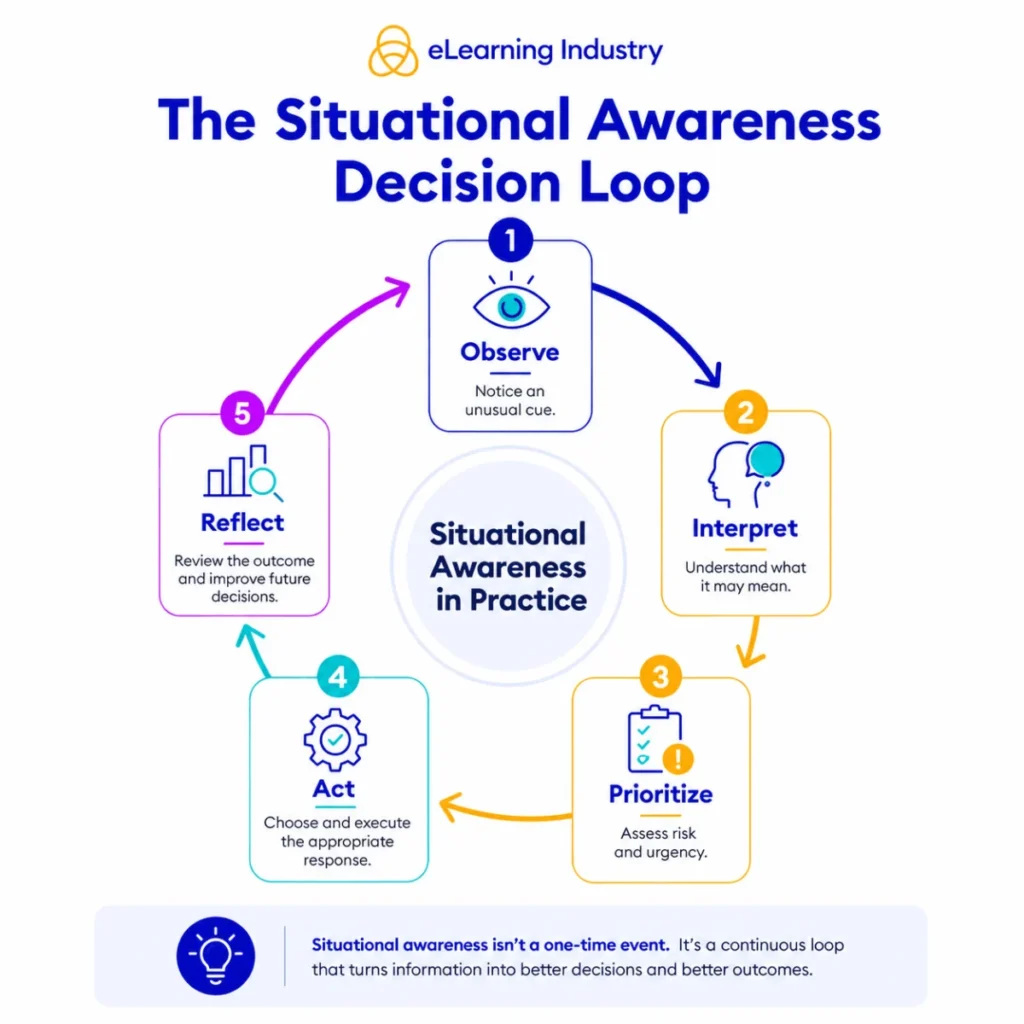
Modern situational awareness training has moved away from static classroom lectures toward dynamic, experiential learning. Experts in Learning and Development suggest a five-step cycle for building these skills: Observe, Interpret, Decide, Act, and Reflect (OIDAR).
- Observe: Training begins with "sensory acuity" exercises. This often involves Virtual Reality (VR) simulations where employees must identify hazards in a 360-degree environment.
- Interpret: Once cues are spotted, trainees are asked to explain the context. Case studies and "tabletop exercises" are used to challenge their mental models.
- Decide: This stage introduces "stress inoculation." Trainees are forced to make decisions under time pressure or with incomplete information, mimicking real-world crises.
- Act: Execution is practiced through role-playing or high-fidelity simulations. This ensures that the physical response to a situation becomes a "muscle memory" rather than a labored cognitive process.
- Reflect: The "After-Action Review" (AAR) is perhaps the most critical component. By analyzing what went right and what went wrong after a simulation, employees refine their internal algorithms for future use.
Expert Perspectives and Official Responses
Industry leaders emphasize that situational awareness is not a one-time training event but a continuous cultural shift. "Situational awareness is the glue that holds a safety culture together," states one safety director at a Fortune 500 manufacturing firm. "You can have the best procedures in the world, but if your people aren’t aware of the changing conditions around them, those procedures are just paper."
Furthermore, cybersecurity experts are increasingly calling for SA training as a defense against social engineering. As hackers become more sophisticated, the "human firewall" is the last line of defense. Organizations are now training employees to maintain situational awareness in the digital realm—recognizing the "digital cues" of a phishing attempt or an unauthorized system access.
Broader Impact and Future Implications
The implications of widespread situational awareness training extend beyond immediate safety and efficiency. As organizations become more "aware," they also become more resilient to large-scale disruptions. The ability of a workforce to collectively sense a shift in market conditions or a looming geopolitical risk provides a significant competitive advantage.
Looking ahead, the integration of Artificial Intelligence (AI) will likely transform SA training. AI-driven analytics can now provide "augmented situational awareness," feeding real-time data to workers via heads-up displays or mobile devices. However, this creates a new challenge: "automation bias," where humans trust the machine over their own observations. Future training programs will need to focus on "calibrated trust," teaching employees how to balance technological inputs with human intuition.
In conclusion, situational awareness training represents a fundamental shift in how organizations prepare their people for the complexities of the modern world. By investing in the cognitive capabilities of their workforce, companies are not only preventing accidents and saving costs but are also building a more agile, confident, and responsive organization. As the business environment continues to evolve, the capacity to "see, understand, and act" will remain the ultimate differentiator between organizations that merely survive and those that thrive in the face of uncertainty.