The landscape of professional life has undergone a seismic shift in recent years, with remote work transitioning from a temporary contingency to a foundational element of the modern workplace. Current data indicates a significant and sustained adoption, with approximately 27% of U.S. employees now operating in a full-time remote capacity. While this paradigm offers unparalleled flexibility, it simultaneously presents a unique constellation of challenges. These include the insidious blurring of work-life boundaries, the pervasive digital fatigue that can accompany constant screen time, and the palpable absence of spontaneous, in-person connection that often fuels team cohesion and innovation. Consequently, maintaining the productivity and engagement of remote teams has become not merely a desirable outcome, but an essential strategic imperative. When employees feel genuinely supported and connected to their colleagues and the organization, the positive ripple effects are undeniable, manifesting in improved performance, a robust company culture, and enhanced employee retention rates.
This comprehensive guide offers 20 actionable strategies for HR professionals and organizational leaders to cultivate thriving remote work environments. By implementing these tips, teams can move beyond merely working remotely to truly flourishing in a distributed setting, fostering focus, motivation, and a profound sense of connection.
Strategies for Cultivating a High-Performing Remote Workforce
Engaging a dispersed workforce is not an organic development; it necessitates a deliberate and people-centric strategic approach. From empowering individual autonomy to intentionally creating avenues for connection, the following 20 tips provide HR professionals with a robust framework for enhancing productivity, bolstering morale, and fostering a strong sense of belonging within any remote or hybrid organizational structure.
1. Establish Unambiguous Expectations and Measurable Goals
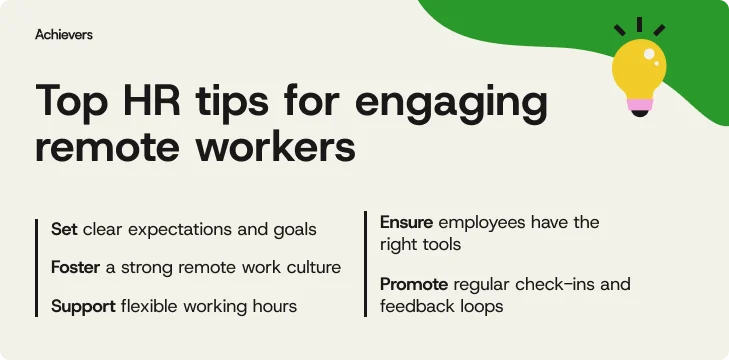
The foundation of effective remote work crumbles when objectives are ill-defined. To prevent this, organizations must meticulously set specific, measurable, achievable, relevant, and time-bound (SMART) goals. Clearly articulating what success looks like, including defined timelines and designated ownership, is paramount. When expectations are transparent, documented, and readily accessible, employees can dedicate their energy to meaningful work rather than deciphering ambiguous directives. This clarity reduces cognitive load and directly contributes to increased efficiency.
2. Nurture a Resilient Remote Work Culture
Organizational culture does not cease to exist simply because employees are geographically dispersed; rather, it manifests in new and evolving ways. Reinforcing core values through consistent leadership behavior, established shared norms, and thoughtfully designed team-building activities is crucial for maintaining continuity. Small, repeatable moments of connection and shared experience often hold more weight and foster deeper engagement than infrequent, large-scale virtual events. The intentional cultivation of these daily interactions is key to embedding culture remotely.
3. Equip Teams with Essential Tools and Technology
The operational efficiency of remote teams is intrinsically linked to the quality and functionality of the tools they utilize. Ensuring employees have access to reliable collaboration software, secure network systems, and ergonomic home office setups that genuinely support their workflows is a non-negotiable aspect of remote work enablement. When technology removes barriers and streamlines processes, productivity naturally follows, allowing individuals to focus on their core responsibilities without unnecessary friction.
4. Implement Consistent Check-ins and Feedback Loops
The absence of regular, structured interaction can lead to feelings of isolation and disconnection within remote teams. Scheduling consistent one-on-one meetings and team check-ins serves as a vital mechanism for sharing progress updates, identifying and addressing challenges, and providing timely and constructive feedback. These frequent conversations are instrumental in maintaining team alignment, ensuring that individuals feel supported, and proactively resolving potential roadblocks before they impede progress.
5. Champion Flexible Working Hours
One of the most significant advantages of remote work is the inherent flexibility it offers. Granting employees the autonomy to structure their workday around their peak productivity periods, while maintaining clarity regarding responsibilities and deadlines, fosters a sense of trust and empowerment. When organizational focus is placed on measurable outcomes rather than rigid adherence to specific hours, flexibility becomes a powerful tool for building employee loyalty and satisfaction.
6. Encourage Effective Time Management Strategies
Remote work inherently demands a higher degree of self-discipline and proactive time management. Sharing practical strategies such as task prioritization frameworks, techniques for blocking dedicated focus time, and methods for breaking down large projects into manageable segments can significantly enhance individual productivity. These small, sustainable habits empower employees to maintain focus and avoid feeling overwhelmed by their workload.
7. Define and Uphold Clear Communication Guidelines
Effective internal communication is the lifeblood of a remote team, preventing burnout and ensuring operational coherence. Establishing shared expectations regarding response times, meeting etiquette, and the appropriate channels for different types of communication is essential. When employees understand when and how to respond, and importantly, when it is acceptable to disengage, the work environment becomes more sustainable and less draining.
8. Institutionalize Recognition and Celebration of Achievements
Employee recognition should not be relegated to annual reviews or infrequent award ceremonies. Regularly acknowledging contributions, publicly sharing team wins, and integrating appreciation into the fabric of daily work—beyond just marking significant milestones—is critical. When effort and accomplishments are consistently acknowledged, employee motivation and a sense of connection to the organization are significantly amplified.
9. Prioritize Mental Health and Holistic Well-being
The principle of "you can’t pour from an empty cup" is particularly salient in the context of remote work, where the demands of constant connectivity and virtual meetings can be taxing. Organizations must actively encourage employees to take regular breaks, respect personal boundaries, and foster an environment where open conversations about workload and the potential for job burnout are not only permitted but encouraged. Supporting employee well-being is not merely a perk; it is a fundamental component of building a resilient and high-performing team.
10. Cultivate Meaningful Social Connections
Beyond their professional roles, employees are individuals with diverse interests and personalities. Creating optional, low-pressure opportunities for colleagues to connect on a personal level—whether through informal virtual coffee chats, engaging online games, shared interest groups, or casual check-ins—can foster a stronger sense of community. These authentic moments of connection make collaborative efforts feel more natural and less transactional.
11. Provide Robust Opportunities for Professional Development
Professional growth should not be impeded by the shift to remote work. Providing employees with access to continuous learning, training programs, and development opportunities is essential for building their skill sets and confidence. When individuals perceive a clear path for growth and advancement within the organization, their engagement and commitment are likely to remain high.

12. Ensure Equitable and Transparent Career Progression
Remote employees should not be left in the dark regarding their career trajectories. Organizations must establish clear, transparent processes for performance evaluation and outline explicit pathways for advancement across various roles. This transparency builds trust and ensures that employees are focused on objectives that align with both their personal growth and the organization’s strategic goals.
13. Design an Inclusive Remote Onboarding Experience
Initiating a career remotely can be an isolating experience without adequate support structures. A well-structured onboarding process, complete with clear documentation, introductions to key team members, and regular check-ins, helps new hires feel confident and integrated more rapidly. A strong onboarding foundation is critical for setting the stage for long-term success and retention.
14. Proactively Address Remote Work Isolation
The adage "out of sight, out of mind" is a significant risk in remote environments. Organizations must proactively combat potential isolation by checking in frequently, encouraging open dialogue about challenges and successes, and creating safe spaces for employees to share their experiences. Feeling consistently supported is a powerful antidote to disengagement.
15. Advocate for Movement and Ergonomic Best Practices
Physical well-being is directly linked to mental acuity and productivity. Sharing simple guidance on ergonomic principles, proper posture, and the importance of regular movement can significantly improve the daily experience of remote workers. Encouraging employees to step away from their screens periodically can lead to noticeable improvements in comfort and focus throughout the workday.
16. Support Employee Resource Groups (ERGs)
Employee Resource Groups are more than just a corporate buzzword; they are vital instruments for fostering a sense of belonging and connection, especially when teams are not physically co-located. Providing ERGs with visibility, resources, and active leadership involvement empowers them to cultivate meaningful communities across diverse locations and backgrounds.
17. Optimize Meeting Engagement and Effectiveness
Not every informational update necessitates a formal meeting. Leveraging asynchronous communication channels whenever feasible can preserve valuable synchronous time. When meetings are convened, they should be focused, purposeful, and respectful of participants’ time. Prioritizing fewer, higher-quality meetings can prevent team fatigue and maintain energy levels.
18. Implement Incentives for Engagement and Performance
Tangible incentives play a crucial role in reinforcing organizational values and motivating desired behaviors. Whether through recognition, performance-based rewards, or meaningful perks, acknowledging effort consistently encourages sustained engagement and strong performance. When contributions are visible and rewarded, employee motivation and retention are demonstrably boosted.
19. Solicit and Act on Regular Employee Feedback
Understanding the lived experience of remote work for employees is essential for continuous improvement. Utilizing satisfaction surveys, open forums, or anonymous feedback channels provides valuable insights. Crucially, organizations must close the feedback loop by demonstrating that employee input leads to tangible changes, thereby validating the feedback process.
20. Lead by Example in Remote Work Practices
The prevailing remote culture within an organization is profoundly shaped by leadership behavior. When leaders consistently communicate with clarity, respect personal boundaries, acknowledge effort, and exhibit authenticity, these positive behaviors cascade throughout the organization. Employees tend to emulate the actions of their leaders, making exemplary remote work practices from the top essential for embedding a successful distributed model.
The Role of Achievers in Fostering Engaged Remote Teams
Even the most meticulously crafted remote work policies require robust technological solutions to be effectively implemented and scaled. The Achievers platform is designed to empower HR leaders, managers, and organizations to support, recognize, and engage remote teams efficiently. Through features specifically built to connect people, ignite motivation, and transform insights into actionable strategies, Achievers provides a comprehensive solution for the modern distributed workforce.
Key offerings from Achievers include:
Recognition and Rewards: Bridging the Distance
Remote work should not equate to working in isolation. The Achievers platform facilitates seamless recognition, allowing managers to offer kudos for significant achievements and enabling colleagues to acknowledge behind-the-scenes contributions with just a few clicks. This continuous stream of appreciation, coupled with the ability to redeem earned points for tangible rewards, ensures that motivation remains high and employees feel valued, regardless of their physical location.
Employee Feedback and Engagement Insights: Data-Driven Engagement
Effective engagement strategies are built on a foundation of accurate data. Achievers captures real-time employee feedback, providing HR teams with clear visibility into employee sentiment rather than relying on guesswork. Leveraging AI-powered insights, organizations can identify emerging trends, proactively address concerns, and implement targeted interventions to boost engagement before minor issues escalate into significant challenges.
Cultivating a Flourishing Remote Workforce
Building a thriving remote workforce is an achievable objective that hinges on intentionality, consistency, and the right technological support. The strategies outlined—from setting clear goals and embracing flexibility to recognizing outstanding work and actively gathering feedback—provide a comprehensive blueprint for developing a remote culture that genuinely succeeds.
When employees feel consistently supported, seen, and celebrated, their contributions extend beyond mere productivity. They exhibit increased loyalty, sustained motivation, and a readiness to consistently deliver their best work. Organizations seeking to unify these strategies within a single, integrated platform will find that Achievers simplifies the process of recognizing, rewarding, and retaining their remote workforce at scale. By exploring the Achievers employee experience platform, organizations can learn how to effectively shape behaviors that drive tangible results, fostering a more engaged and successful distributed workforce.