
The global business landscape is undergoing a profound and rapid transformation, driven by the pervasive integration of Artificial Intelligence (AI). Recent extensive travel and engagements across Europe, Asia, and the Middle East, involving discussions with hundreds of companies regarding their AI strategies, reveal a clear and undeniable trend: AI has definitively arrived as a powerful business tool. While the maturity of AI adoption varies significantly among organizations, the reality is that AI’s presence is tangible, and its application across industries is expanding at an unprecedented pace.
This widespread adoption is corroborated by a recent survey conducted by Wharton, which highlights the increasing reliance of business leaders on Generative AI (Gen AI). The survey indicates that a substantial 46% of business leaders now utilize Gen AI on a daily basis, with an additional 80% using it at least weekly. Crucially, among these active users, a significant majority are measuring the return on investment (ROI), with 72% reporting that they track their AI-driven returns, and an impressive 74% confirming a positive financial outcome. Notably, the Human Resources (HR) department is emerging as a key adopter, ranking as the third-highest department for AI use cases, trailing only IT and Finance. This widespread adoption is naturally being accompanied by increased financial commitment, with 23% of large companies allocating $20 million or more annually to AI initiatives, and 43% investing over $10 million per year.
The Dawn of AI-Powered Productivity: Stage One Adoption
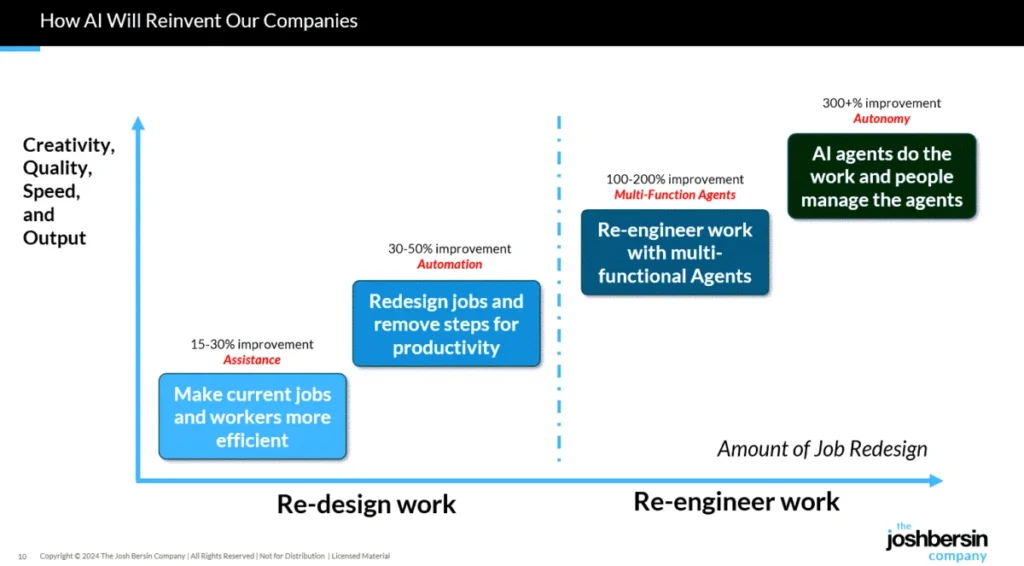
The primary driver behind this surge in AI adoption, according to industry analysis, is the enhancement of productivity. The most prevalent use case, referred to as "stage one" adoption, centers on individual productivity gains. AI tools are empowering employees to perform tasks more efficiently, such as summarizing lengthy meetings, analyzing complex datasets, retrieving information swiftly, and drafting or reviewing documents. These personal productivity enhancements are not merely theoretical; they are tangible benefits that are immediately realized by individual users. However, this initial phase represents only the foundational layer of AI’s potential.
The current wave of individual productivity enhancements through AI bears a striking resemblance to the early days of transformative technologies like word processing, spreadsheets, and internet search engines. These tools initially revolutionized how individuals approached their tasks, offering unprecedented efficiency gains. Microsoft’s evolving suite of AI-powered tools, particularly Microsoft Copilot, is increasingly positioning itself as the next iteration of the "Microsoft Office Suite," aiming to integrate AI assistance seamlessly into the daily workflows of professionals across all sectors. This evolution suggests a future where AI is not an add-on but an intrinsic component of standard business software.
Expanding Horizons: Corporate Agents and Knowledge Management
Beyond individual task optimization, AI is rapidly moving into more sophisticated applications, particularly in the realm of corporate agents and knowledge management. Approximately 12% of companies are now deploying internal AI agents, akin to IBM’s "Ask HR" system, which serve as intelligent interfaces for accessing and managing vast repositories of company information. These "knowledge and information management" chatbots are poised to become ubiquitous, capable of replacing complex internal portals and SharePoint sites, and even serving as sophisticated customer support systems. The expectation is that virtually every enterprise will eventually implement such an agent.
A compelling case study from a large healthcare company illustrates the profound impact of these AI agents. For the past four years, this organization has successfully deployed an employee chatbot that has become so integral to its operations that every HR application is now being integrated behind it. Employees leverage this agent to seek assistance with a wide array of queries, including pay, benefits, work schedules, and even personalized training recommendations. This centralized, intelligent interface streamlines access to critical information and services, significantly improving employee experience and operational efficiency.
Recruiting is another area where AI is demonstrating proven value. Job candidates can now interact with AI agents to initiate the application process, undergo AI-driven assessments, and even participate in AI-conducted interviews. This asynchronous approach allows candidates to engage with the recruitment process at their convenience, even outside of standard business hours, eliminating the need for immediate scheduling with recruiters or hiring managers and potentially broadening the talent pool.
While highly sophisticated "multi-functional agents" capable of complex, high-ROI tasks are still in their nascent stages (often referred to as "stage three" in AI adoption frameworks), companies are actively deploying AI-powered coaching and learning tools. Many large enterprises are implementing AI-native learning systems, which have reportedly led to significant improvements in workforce enablement, with some reporting reductions in staff requirements by as much as 30-40% while simultaneously enhancing overall skill development.
Crossing the Rubicon: The Point of No Return for AI Adoption
The current trajectory of AI integration signifies a critical juncture, a "point of no return," as some observers describe it. Despite persistent narratives highlighting potential negative impacts of AI on careers and society, the reality on the ground is that Gen AI is proving to be a practical, accessible, and valuable business tool. While acknowledging the imperfections and the documented rate of errors, particularly with foundational models like ChatGPT, the learning curve for effectively utilizing these tools, coupled with the development of trusted data sets for training, is enabling a significant level of functional deployment.
Two years ago, concerns about AI’s societal impact, including its potential to form romantic relationships, were prevalent in public discourse. However, the substantial capital investment, estimated to be in the trillions of dollars, directed towards AI infrastructure, engineering, and power generation has fostered a more stable and reliable technological environment. While the risk of generating incorrect information, poorly written reports, or misleading findings remains, organizations are increasingly adept at "checking" AI outputs, fostering a greater comfort with its probabilistic nature.
However, the scaling of AI infrastructure presents new challenges. The significant energy and water demands of data centers and AI processing facilities are raising new environmental and geopolitical concerns. For instance, reports from leaders in the United Arab Emirates suggest that each ChatGPT query can consume approximately four liters of water, highlighting a critical sustainability challenge that needs urgent attention and innovative solutions.
The Road Ahead: From Single-Function to Multi-Functional AI
The future of AI in business promises a transition from isolated, single-function tools to sophisticated, multi-functional agents capable of orchestrating complex business processes. The current productivity tools, while valuable, are often likened to power steering in a vehicle – they assist with a specific function but do not autonomously drive the vehicle. The next evolution will involve AI agents that can "take you from place to place," managing entire workflows and business cycles.
This evolution is already manifesting in areas like recruitment and training, where agents are beginning to integrate multiple functions, from drafting job requisitions and screening candidates to scheduling interviews and managing onboarding. The vision is for a comprehensive "hiring and career" agent that seamlessly connects these processes. The development of "multi-functional AI agents" is a key focus for industry leaders, with blueprints being developed to guide vendors and buyers in their creation. The goal is to move away from fragmented AI tools and towards integrated agents that can manage end-to-end business processes, such as the entire "design to build to distribute to sell" cycle, or the complete sales funnel from "position to target to market to close," followed by billing, collection, renewal, and support.
As these multi-functional agents become commonplace, the impact on job roles will be significant. Positions focused on purely transactional or "steering wheel" tasks, such as interview schedulers, appointment setters, or basic accounts receivable specialists, may be fundamentally reshaped or become obsolete as AI agents handle these functions within broader workflows.

An example of this evolution can be seen in platforms like Galileo, which has transitioned from an HR "assistant" to a comprehensive solution builder. It can now answer queries, develop customized training courses, and provide definitive answers to complex compensation, rewards, or internal company policy questions. This progression mirrors the development of a self-driving car, moving from assisting the driver to autonomously navigating the entire journey.
The Rise of Agents with Memory and Personality
A second significant development on the horizon is the emergence of AI agents that possess "memory" and can learn from user interactions and business context. This personalization will make them more autonomous and significantly more valuable. Imagine an AI agent that, upon a manager’s request to hire new staff, proactively asks clarifying questions about the role’s responsibilities, references internal benchmarks for span of control, and suggests exploring internal candidates based on salary parameters and available skills.
A month later, the same agent might recall the previous hiring process and inquire about the ramp-up time of the newly hired employee, suggesting a development plan for the existing team before proceeding with further recruitment. This level of contextual understanding and proactive engagement signifies a shift towards AI as a true strategic partner, capable of anticipating needs and offering informed recommendations based on accumulated knowledge and past interactions. This advanced form of AI is expected to become increasingly prevalent in 2026.
Data Management: The Mission-Critical Foundation for AI Success
As organizations increasingly rely on AI, the importance of robust data management practices has become paramount. Companies with advanced AI deployments consistently highlight the development of new disciplines around data management, data labeling, and data governance. The success of platforms like Galileo hinges on the quality, currency, and accuracy of the data they process. AI models, fundamentally statistical engines, lack inherent understanding; their outputs are based on probability and mathematical calculations. Even minor inaccuracies in training data can lead to a disproportionately high percentage of errors in AI-generated responses.
This has led to a realization that data ownership and integrity are mission-critical. Organizations like IBM, with its extensive "Ask HR" agent managing over 6,000 HR policies, have appointed dedicated owners for each policy, ensuring they are kept up-to-date. IBM is further developing an agent to proactively monitor regulatory changes across thousands of jurisdictions, identifying potential compliance issues. This learning curve is universal, as organizations across sectors grapple with the imperative of maintaining high-quality, well-governed data for effective AI operation.
Agent-to-Agent Communication: The Next Frontier
The evolution of AI extends to inter-agent communication. As organizations mature in their AI adoption, the ability for different AI agents to interact and collaborate will become crucial. While protocols for this agent-to-agent communication (A2A and MCP) are still evolving, significant progress is being made. For example, Galileo is now integrated with SAP’s Joule, with further integrations anticipated.
Industry experts caution against a fragmented approach to AI adoption, advising organizations to avoid acquiring numerous disparate agents for specific use cases, particularly within HR. The true value of AI will be realized when these agents can work cohesively. Many clients are opting for shorter contract terms to maintain flexibility in a rapidly evolving market. Initiatives like the upcoming "Agentic AI Blueprint for HR" aim to provide guidance on how these agents should interconnect, preventing a scenario where multiple AI tools work at cross-purposes, hindering overall organizational efficiency.
Navigating Vendor Landscape and Emerging Risks
The AI vendor landscape is dynamic and presents both opportunities and risks. The long-term strategies of major AI providers like OpenAI and Microsoft’s Copilot remain under development, with various tools like Gemini and Anthropic facing competition from emerging players. Economic downturns could also lead to consolidation within the AI sector.
However, a segment of vendors focused on pragmatic business applications, such as Galileo, Paradox, Eightfold, and Sana, are well-positioned for sustained growth and potential acquisition. Simultaneously, major Human Capital Management (HCM) vendors, including SAP, Workday, ADP, HiBob, and ServiceNow, are actively embedding AI agents into their core payroll and workflow platforms. These HCM giants aspire to become comprehensive, multi-functional AI solution providers, exemplified by acquisitions like SAP’s of SmartRecruiters and Workday’s of HiredScore, Paradox, and Sana. Staying abreast of these evolving offerings is essential for businesses.
Addressing Fears: Job Security, Skill Gaps, and Human Ingenuity
Concerns about AI’s impact on employment, the authenticity of candidates, and the potential for a decline in human cognitive skills are widespread. The prevailing advice for HR professionals and other employees is to embrace this technological revolution rather than resist it. This era presents a unique opportunity to re-engineer business processes and redefine job roles. Proactive engagement with AI tools, such as utilizing platforms like Galileo, can foster new skills and open up unforeseen career opportunities.
The notion of AI completely displacing human workers is viewed with skepticism by many industry observers. The analogy of self-driving cars is often cited: while they may become commonplace, human drivers will likely continue to exist, and the focus may shift to other aspects of life and work. The rapidly evolving and imperfect nature of AI creates ongoing roles for "superworkers," consultants, and innovators who can identify novel use cases and guide its application.
Historical parallels, such as the introduction of spreadsheets, illustrate that technological advancements often lead to job evolution rather than elimination. Accountants, for instance, now leverage spreadsheets for complex calculations, freeing them to focus on higher-value analytical tasks. Similarly, designers, creators, authors, and analysts are encouraged to view AI as a personal supercomputer, enhancing their capabilities rather than replacing them.
The Inevitable Future: AI as a Permanent Fixture
The era of uncertainty surrounding AI’s role in business is drawing to a close. The "mist has lifted," and AI is firmly established as a permanent fixture in the corporate world. The imperative now is for organizations and individuals to embark on the "Superworker road," actively learning, applying, and leveraging this transformative technology to drive innovation and enhance operational effectiveness. The responsibility and opportunity lie with us to shape this new technological landscape.
Additional Information:
- AI and HR Trends for 2026: A detailed webinar exploring upcoming developments and strategic considerations for AI integration in Human Resources.
- BBC Report on AI Accuracy: Analysis highlighting that 45% of AI queries can produce erroneous answers, underscoring the need for critical evaluation and data governance.
- Podcast: AI – Not Always Right, But Seldom In Doubt: An insightful discussion on the confidence and limitations of AI.
- Galileo: The World’s Trusted Agent for Everything HR: Information on a leading AI platform designed to streamline HR functions and provide intelligent support.







