
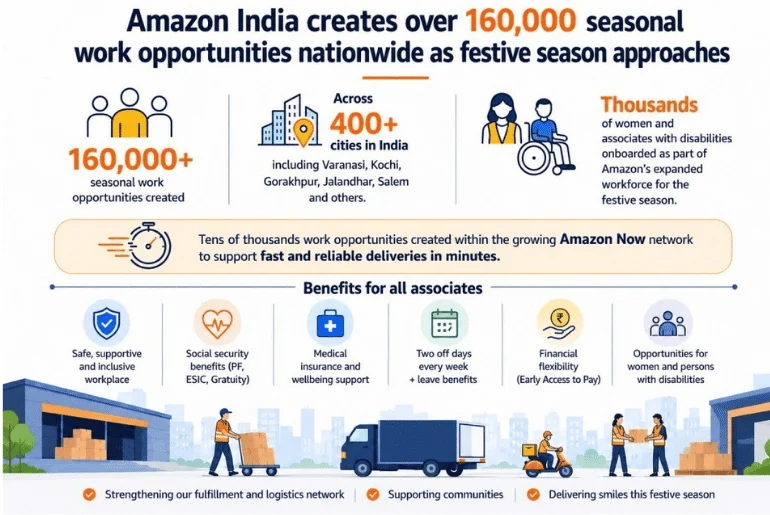
Amazon India has announced a substantial expansion of its workforce, creating over 1.6 lakh seasonal work opportunities across its extensive operations network in anticipation of the upcoming festive season. This strategic initiative spans more than 400 cities nationwide, encompassing both metropolitan hubs and a significant number of Tier 2 and Tier 3 cities, underscoring the e-commerce giant’s commitment to strengthening its logistics and delivery capabilities while simultaneously fostering employment generation across diverse geographies. The new roles are designed to support Amazon’s core e-commerce and rapidly expanding quick-commerce operations, covering critical functions such as picking, packing, shipping, and last-mile delivery. A notable aspect of this recruitment drive is Amazon India’s proactive effort to onboard thousands of women and persons with disabilities, integrating them into the expanded seasonal workforce, thereby reinforcing the company’s commitment to building an inclusive and diverse employee base. The majority of these new associates have already commenced their training, preparing them to meet the expected surge in customer demand that traditionally characterizes India’s festive shopping period.
Scaling Operations for India’s Festive Consumption Boom
The creation of over 1.6 lakh seasonal positions is a direct response to the predictable and substantial increase in consumer spending and online shopping activity that accompanies India’s festive calendar. The period leading up to and including festivals like Dussehra, Diwali, and Christmas typically witnesses an unprecedented surge in e-commerce transactions, often peaking in October and November. Industry reports from previous years indicate that the festive season can account for 25-30% of the annual e-commerce sales volume in India. For instance, data from consulting firms often projects multi-billion dollar sales figures during these periods, with categories like electronics, fashion, home goods, and groceries experiencing exponential growth. Amazon, as one of the leading players in the Indian e-commerce landscape, strategically scales its operations annually to manage this increased volume efficiently and ensure timely deliveries, which are paramount to customer satisfaction during peak periods.
These seasonal opportunities are not merely confined to Amazon’s large fulfillment centers and sortation facilities but extend significantly into its vast last-mile delivery network. Roles span both direct employment with Amazon and indirect opportunities through its network of delivery service partners and logistics affiliates. The emphasis on expanding into Tier 2 and Tier 3 cities is particularly crucial. With increasing internet penetration and smartphone adoption, a growing percentage of online shoppers now reside in these non-metro areas, making a localized and robust logistics infrastructure essential for market penetration and customer reach. This geographical expansion not only caters to a broader customer base but also creates vital employment avenues in regions where formal sector jobs might be less prevalent.
A Focus on Diversity and Inclusion within the Workforce
A significant highlight of this year’s seasonal hiring drive is Amazon India’s intensified focus on diversity and inclusion. The deliberate onboarding of thousands of women and persons with disabilities into the seasonal workforce is a testament to the company’s broader corporate social responsibility initiatives and its commitment to creating equitable employment opportunities. This move aligns with global trends advocating for diverse workforces, recognizing that varied perspectives contribute to innovation and a more robust operational environment. In the Indian context, where certain demographic groups still face barriers to employment, such initiatives by large corporations like Amazon play a crucial role in promoting social inclusion and economic empowerment.
The roles offered to these diverse groups are varied, ensuring that individuals are placed in positions that leverage their strengths and capabilities. For instance, women associates are increasingly being integrated into various operational roles, including packaging, quality control, and even delivery services in some urban areas, challenging traditional gender roles in logistics. Similarly, persons with disabilities are employed in roles where their unique skills can be best utilized, often supported by assistive technologies and accessible workplace environments. This approach not only broadens Amazon’s talent pool but also sets a benchmark for other industry players in fostering an inclusive work culture.
Strategic Imperatives and Leadership Vision
Abhinav Singh, VP – Operations, Amazon India, APAC, Middle East, Africa and Turkiye, articulated the strategic rationale behind this massive recruitment drive, stating, "To meet the anticipated increase in customer demand, we have created over 1.6 lakh seasonal work opportunities across our operations network. As we focus on building one of India’s largest, safest, fastest and most reliable operations network, we are also committed to building an inclusive workforce, with opportunities for thousands of women associates and persons with disabilities. This expanded workforce will help us strengthen our fulfilment and logistics capabilities and ensure we can handle the festive season seamlessly. Many of these associates continue their journey with Amazon beyond the festive period, while several others return year after year to work with us."
Singh’s statement underscores a multi-faceted strategy. Firstly, it highlights the operational imperative: the need for a scalable workforce to manage peak demand without compromising on delivery speed or reliability. Secondly, it reiterates the long-term vision of building a robust and resilient logistics network, capable of supporting Amazon’s ambitious growth plans in India. Thirdly, and perhaps most significantly, it emphasizes the commitment to an inclusive workforce, framing it not just as a social initiative but as an integral part of their operational excellence. The observation that many seasonal associates continue their journey with Amazon or return annually points to the potential for these roles to evolve into more stable employment, offering a pathway for career progression within the company or providing a reliable seasonal income source. This dual benefit of addressing immediate operational needs while also contributing to sustainable livelihood opportunities is a hallmark of Amazon’s hiring strategy.
Comprehensive Welfare and Social Security for Associates
Beyond mere employment, Amazon India has outlined a comprehensive package of safety, welfare, and social-security benefits for its seasonal associates, mirroring those available to its permanent workforce. This commitment to employee well-being is critical, especially for a seasonal workforce that might otherwise lack access to such protections. The benefits include:
- Provident Fund (PF): A mandatory contribution scheme that provides a lump sum payment to employees upon retirement or resignation, offering a crucial long-term financial safety net.
- Employees’ State Insurance Corporation (ESIC): A comprehensive social security scheme that provides medical care, maternity benefits, disability benefits, and other welfare measures to employees and their families.
- Gratuity: A payment made by the employer to an employee as a token of appreciation for services rendered, typically after five or more years of continuous service, though applicable under certain conditions even for shorter tenures in some cases.
These benefits ensure that seasonal workers, often considered part of the informal sector in other contexts, are afforded a degree of formal sector protection and financial security. Furthermore, Amazon India is actively supporting eligible associates through its "Samridhi" programme. This initiative aims to facilitate the enrolment of workers on the e-Shram portal, a national database of unorganized workers established by the Indian government. By enrolling, associates can access various government welfare schemes designed for informal sector workers, thereby extending the safety net beyond Amazon’s direct provisions. This proactive approach by Amazon demonstrates a deeper engagement with the socio-economic welfare of its workforce.
Enhanced Welfare Measures for Delivery Associates: The Backbone of E-commerce
Recognizing the demanding nature of last-mile delivery roles, Amazon India has also expanded specific welfare measures for its delivery associates. These individuals are often the most visible face of the company and play a crucial role in customer satisfaction. The enhanced benefits include:
- Insurance Coverage: Comprehensive insurance plans to protect delivery associates against unforeseen circumstances, including health and accident coverage.
- Financial Inclusion Support: Initiatives aimed at promoting financial literacy and providing access to formal financial services, which can be particularly beneficial for associates managing their incomes and planning for the future.
- Scholarships for Associates’ Children: A significant welfare measure that supports the educational aspirations of delivery associates’ families, reflecting a commitment to intergenerational upliftment.
- Road Safety Initiatives: Ongoing training and awareness programs focused on promoting safe driving practices and reducing road accidents, a critical concern for delivery personnel.
A standout initiative in this regard is the "Ashray" programme. Ashray provides air-conditioned rest facilities for delivery drivers, offering a much-needed respite from the often-harsh Indian climate and the rigors of their demanding jobs. These facilities are equipped with amenities to ensure comfort and allow drivers to refresh themselves between delivery routes. Amazon’s plan to expand this network to 250 centers by the end of 2026 underscores the company’s long-term commitment to the well-being of its delivery workforce. Such infrastructure investments not only improve working conditions but also enhance efficiency and job satisfaction among delivery personnel, which directly translates to improved service quality for customers.
Broader Economic and Social Implications
The creation of 1.6 lakh seasonal jobs by Amazon India carries significant economic and social implications for the country. Economically, it represents a substantial injection of employment opportunities, particularly during a period when many individuals seek temporary work to supplement their incomes or gain entry into the formal economy. This directly contributes to household incomes, stimulating local consumption and supporting various ancillary businesses. The geographical spread of these jobs into Tier 2 and Tier 3 cities is particularly impactful, as it helps to decentralize economic opportunities and reduce the pressure on overcrowded metropolitan job markets.
Socially, the emphasis on inclusivity, particularly for women and persons with disabilities, contributes to a more equitable workforce. It challenges traditional employment barriers and demonstrates the viability of diverse talent pools in demanding operational roles. The provision of social security benefits, even for seasonal workers, sets a positive precedent, pushing towards greater formalization of the labor market and ensuring basic protections for a vulnerable segment of the workforce.
Furthermore, the scale of Amazon’s hiring reflects the robust growth trajectory of India’s e-commerce sector. Despite global economic uncertainties, the Indian market continues to expand, driven by digital penetration, a young demographic, and increasing disposable incomes. Amazon’s investment in its workforce and logistics infrastructure signals its confidence in this growth and its determination to maintain a leading position in a highly competitive landscape that includes formidable players like Flipkart, Reliance Retail’s JioMart, and various other specialized e-commerce platforms. The continuous refinement of its logistics network, coupled with a focus on employee welfare, positions Amazon to capitalize on future market expansion and cater to the evolving demands of the Indian consumer. The seasonal hiring, therefore, is not just a temporary measure but an integral part of Amazon India’s long-term strategy to build a resilient, efficient, and socially responsible enterprise.








