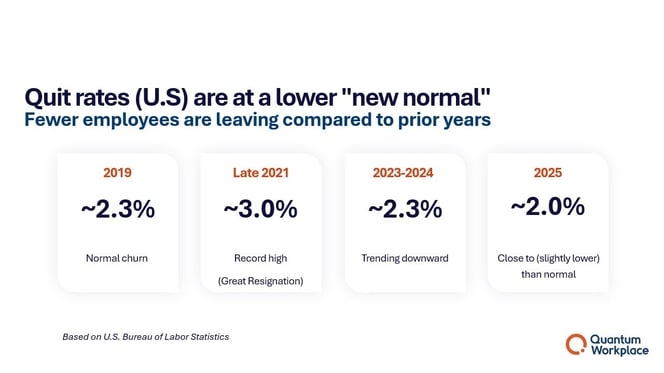
Employee engagement trends in 2026 present a complex tableau, where seemingly stable metrics mask a more intricate reality of workplace dynamics. While headlines in early 2026 highlighted a record low U.S. quit rate of approximately 2.0% in 2025 and largely stable engagement scores, a deeper dive reveals an "illusion of stability." This perception, according to HR experts, obscures mounting pressures, constant organizational flux, and the potential for latent dissatisfaction.
Kristin Ryba, author of the analysis from Quantum Workplace, states, "Steady employee engagement may reflect resilience, not progress. Many organizations mistake stability for strength and miss opportunities to move forward." This sentiment is echoed by Aaron Brown, Senior Manager of People Insights at Quantum Workplace, who cautions, "Many organizations mistake stability for strength and miss opportunities to move forward." The current environment, characterized by high internal pressures and continuous adaptation to new technologies and working models, necessitates a more nuanced understanding of employee sentiment than traditional metrics alone can provide.
The data suggests that the low quit rates do not necessarily correlate with a stronger employee connection. Instead, Quantum Workplace data indicates that "intent to stay is rising faster than other engagement measures." This implies that a significant portion of the workforce remains due to a perceived lack of opportune moments to leave, rather than genuine enthusiasm, alignment, or a clear path for professional growth. Anne Maltese, VP of People Insights, terms this phenomenon "latent risk"—a workforce that appears engaged on the surface but is not fully equipped or motivated for forward momentum. Consequently, high-level engagement and turnover metrics are insufficient for a comprehensive organizational health assessment.
This article delves into four key employee engagement trends for 2026, aiming to illuminate the signals that headline metrics often miss. These trends provide HR leaders with critical insights to determine if their teams are truly thriving or subtly being held back.
Key Takeaways: Navigating the Nuances of 2026 Employee Engagement
The landscape of employee engagement in 2026 is shifting from a purely quantitative measurement to a qualitative understanding of meaning and impact. While retention and engagement scores may appear robust, deeper indicators such as manager capacity, strategic alignment, and interpersonal connection reveal the true state of team readiness. These four trends offer a roadmap for HR leaders seeking to transcend mere stability and cultivate sustained organizational performance.
4 Employee Engagement Trends Shaping 2026
Trend 1: Managers are the First Barometer of Organizational Pressure
Key Trend: Managers are facing escalating demands to deliver results, mentor teams, and implement continuous organizational changes, often without adequate time, clear direction, or sufficient support.
Why It Matters: When organizational expectations outstrip the resources and clarity provided to managers, they become the initial group to exhibit declining engagement, reduced recognition, and wavering confidence. This creates an early warning system, the repercussions of which can rapidly cascade to their direct reports.
What the Data Shows: Across various industries, managers consistently report lower scores in engagement, recognition, and clarity of expectations compared to both senior executives and frontline employees. This pattern suggests a disproportionate burden is being placed on middle management.
.png)
Implication for 2026: The experience of managers is emerging as a primary indicator of organizational alignment. When communication and direction falter at this crucial level, organizational misalignment can spread with greater speed than traditional engagement or turnover metrics can detect.
Action Insight: Beyond merely tracking the frequency of manager-led one-on-one meetings, it is imperative to evaluate the effectiveness of these conversations in fostering clarity, alignment, and focus. This requires equipping managers with the skills and tools to facilitate impactful dialogue.
A Deeper Look at the Data: Examination of manager experience data reveals significant patterns. For instance, data from Quantum Workplace customers indicates that managers often feel less supported in navigating change and less confident in their ability to influence organizational decisions compared to other employee segments. This disparity can lead to burnout and a diminished capacity to effectively lead their teams through turbulent times.
Case Study: Bridging the Feedback Gap: A Modern Leadership Lesson
A large enterprise, upon analyzing its leadership coaching data, identified a critical opportunity. The higher an individual’s position within the organization, the better the quality of feedback they received. Managers further down the organizational hierarchy were not benefiting from the same level of developmental input, exposing a significant feedback gap that quietly hampered performance growth.
The organization’s response was straightforward yet impactful: "coach the coaches." By training leaders to deliver constructive, growth-oriented feedback, the focus shifted from the sheer volume of one-on-one meetings to the tangible value derived from those interactions. The key takeaway is that frequency does not equate to effectiveness. A thorough examination of how feedback is actually delivered can uncover missed opportunities to strengthen team connection, enhance performance, and improve readiness for change at every organizational level.
Trend 2: Top Talent is Observing and Signaling Their Needs
Key Trend: High-performing employees are actively communicating their experiences through feedback mechanisms, survey data, and talent reviews, even when overall engagement and turnover figures appear stable.
Why It Matters: When organizational leaders disregard feedback from their top performers, they miss crucial early indicators from the very individuals who are most vital for performance, operational continuity, and future leadership development.
What the Data Shows: While development and coaching scores remain strong for top performers, indicators related to advancement opportunities, perceived fairness, and accountability consistently lag. This suggests that while high performers are being developed, their aspirations for growth and recognition may not be fully met.
Implication for 2026: The risk of losing top talent is becoming more subtle and harder to detect. Frustration can build among these key individuals even if they are not actively seeking new employment. This "quiet attrition" can significantly impact organizational capabilities.
Action Insight: It is essential to segment engagement and feedback data by performance level or talent status. This allows HR leaders to gain a clearer understanding of the actual work experience of high performers, moving beyond simply assessing whether they intend to stay.
A Deeper Look at the Data: When Quantum Workplace segments customer engagement data by performance and talent status, several patterns emerge. High performers often report lower satisfaction with opportunities for career advancement and recognition for their contributions compared to their overall engagement scores. This divergence highlights a critical need to align development efforts with tangible career progression and reward systems.
Anne Maltese, VP of People Insights, emphasizes the importance of this granular approach: "The first thing I want to know is: how do my top performers feel? You can use surveys, one-on-ones, focus groups – it’s not necessarily more data. It’s being intentional about how you look at the data you already have." This highlights that the challenge often lies not in data collection, but in data analysis and interpretation.
Trend 3: Unfocused Urgency Hinders Productivity
Key Trend: Teams are expending significant effort, but unclear priorities and conflicting objectives impede the translation of this hard work into meaningful outcomes.
Why It Matters: Unchecked urgency can lead to widespread fatigue and confusion. When priorities shift more rapidly than clear communication and established objectives can keep pace, collaboration suffers, and employees lose sight of what truly drives organizational success.
What the Data Shows: Misalignment on objectives is prevalent, even among high performers. Approximately 25% of employees report a lack of clear understanding of organizational priorities. Furthermore, written goals are significantly more common among high performers, indicating a correlation between formalized objectives and sustained effort.
Implication for 2026: Without a sharper focus and improved alignment, organizations risk a state of sustained activity yielding diminishing returns—more effort expended with less impactful results. This can lead to a perception of inefficiency and a decline in overall morale.
Action Insight: Strengthen goal clarity by ensuring that priorities are clearly articulated, directly linked to overarching strategy, and consistently reinforced through one-on-one discussions, feedback sessions, and recognition programs.
A Deeper Look at the Data: An examination of customer alignment and goal data reveals that productivity challenges are rarely rooted in a lack of employee effort. Instead, they stem from misalignment, ambiguous priorities, and a deficit of focus. For example, data may show that while employees are actively engaged in various tasks, a significant portion cannot articulate how their daily work contributes to the company’s strategic objectives. This disconnect between activity and purpose is a significant drag on productivity.

Aaron Brown, Senior Manager of Insights, explains the manifestation of this trend: "It starts with good intentions, but that’s usually where misalignment starts to show up. The clearest example is how organizations have approached AI. It’s wonderful. It’s an amazing tool. But we’re hearing from customers and employee feedback that they’re being told, ‘Just try it out, see what you can do.’ Now add: ‘Learn a new technology.’ Combine that with ‘do more with less,’ and it shows up as good intention but no clear, defined goal—what are we trying to accomplish, and how are we going to support people to accomplish it? If we can solve that, people will feel more excited to try new ventures.” This illustrates how well-intentioned initiatives can falter without clear strategic direction and adequate support structures.
Trend 4: Future Readiness Lags Behind Intent
Key Trend: While many organizations can identify successors and critical roles, the actual preparation, readiness, and retention of these individuals are not keeping pace, creating a gap between designation and true preparedness.
Why It Matters: When potential future leaders and long-tenured employees feel stagnant, overwhelmed, or undervalued, the organization becomes vulnerable, even if overall engagement and retention metrics appear strong. This can lead to a leadership pipeline crisis when critical transitions occur.
What the Data Shows: Data often reveals that succession candidates, senior leaders, and long-term employees are early indicators of risk. They frequently surface signals of burnout, uneven developmental progress, and readiness gaps that are not reflected in headline metrics.
Implication for 2026: Future organizational readiness is contingent not solely on identifying successors, but on intentionally developing them, safeguarding their well-being, and mitigating the over-reliance on a small cadre of leaders. This proactive approach is crucial for long-term sustainability.
A Deeper Look at the Data: When analyzing future-readiness signals in customer data, several trends emerge. For instance, data might show that while individuals are identified as potential successors, their engagement scores related to professional development and perceived preparedness for their next role are lower than expected. Similarly, long-tenured employees, often the backbone of institutional knowledge, may exhibit higher levels of burnout or lower scores on work-life balance, indicating a risk of their valuable experience being lost.
Case Study: When ‘High Engagement’ Hides Leadership Burnout
A notable client’s engagement scores initially painted a picture of resounding success. However, a deeper investigation uncovered a stark reality: the executive team was operating under immense strain, morale was declining, and innovation had stagnated. "High engagement at the surface can mask burnout underneath," explains Aaron Brown.
This case exemplifies a critical insight for 2026: robust engagement metrics do not always signify a healthy organization. When performance expectations outpace organizational capacity or interpersonal connection, employee energy inevitably erodes. HR and leadership teams must look beyond top-line engagement figures to uncover early indicators of fatigue, potential turnover, and unrealized potential within their workforce.
Turning Employee Engagement Data into Informed Decisions
The four trends outlined above converge on a fundamental truth: employee engagement data yields value only when it translates into clearer decisions and proactive actions. In 2026, the objective is not merely to maintain stable metrics, but to achieve informed insight.

To transition from a state of stability to sustained thriving, HR leaders must effectively connect engagement data with critical indicators of performance, development, growth, recognition, and retention. These connections then serve as the foundation for guiding strategic action at every organizational level.
Practical ways to act on these insights include:
- Empowering Managers: Providing managers with the training and resources to foster clear communication, provide meaningful feedback, and support employee development.
- Segmenting Data: Analyzing engagement and feedback data by specific employee groups, such as high performers, tenured employees, or different departments, to uncover nuanced insights.
- Focusing on Alignment: Implementing clear goal-setting processes and ensuring regular communication to connect individual contributions to organizational objectives.
- Investing in Development: Creating robust career development pathways and providing opportunities for skill enhancement and advancement, particularly for identified succession candidates.
- Prioritizing Well-being: Actively monitoring for signs of burnout and implementing strategies to support employee well-being and work-life balance, especially among leadership.
Organizations that adopt this integrated approach are already witnessing tangible improvements. Quantum Workplace customers who synergize engagement insights with performance and talent data are better positioned to retain their top talent, enhance manager effectiveness, and maintain organizational momentum through periods of change.
The Step from Steady Engagement to Thriving Teams
Cultivating thriving teams requires a perspective that extends beyond mere engagement scores. Thriving is not a byproduct of chance; it is the result of treating connection and performance as intrinsically linked and equipping leaders with the foresight needed for early, confident action.
When connection exists without performance, teams can drift without clear direction. Conversely, when performance is present without a strong sense of connection, teams may strain and eventually burn out. When both are weak, teams inevitably struggle.
However, when both connection and performance are robust, teams enter a powerful, virtuous cycle: improved results enhance retention, increased retention strengthens organizational capability, and enhanced capability fuels even better results. To foster this cycle, organizations must fortify both connection and performance across four critical conditions: alignment, empowerment, growth, and the feeling of being valued. HR professionals play a pivotal role in interpreting the signals within these domains and empowering managers to translate insights into actionable strategies.
Final Thoughts: Employee Engagement Trends as the Starting Line
Healthy engagement metrics should not be viewed as the ultimate destination. Instead, they serve as the crucial starting point for strategic organizational growth. The objective is not to overhaul an entire talent strategy overnight, but to proactively address the opportunities that are often present but overlooked. In the current era, organizations must:
- Proactively identify and develop future leaders: Moving beyond simple identification to comprehensive development and support.
- Prioritize manager enablement: Equipping managers with the skills and resources to navigate complex team dynamics and drive performance.
- Foster clear alignment and purpose: Ensuring every employee understands how their work contributes to the broader organizational mission.
- Build a culture of continuous feedback and development: Creating an environment where learning and growth are ongoing processes.
As Anne Maltese wisely states, "Focus on your knowns. You can’t control everything, but you can develop your top performers, nurture your successors, and prepare people now for what’s next." By embracing these nuanced insights and acting decisively, organizations can move beyond a superficial sense of stability and cultivate truly thriving, future-ready workforces.