
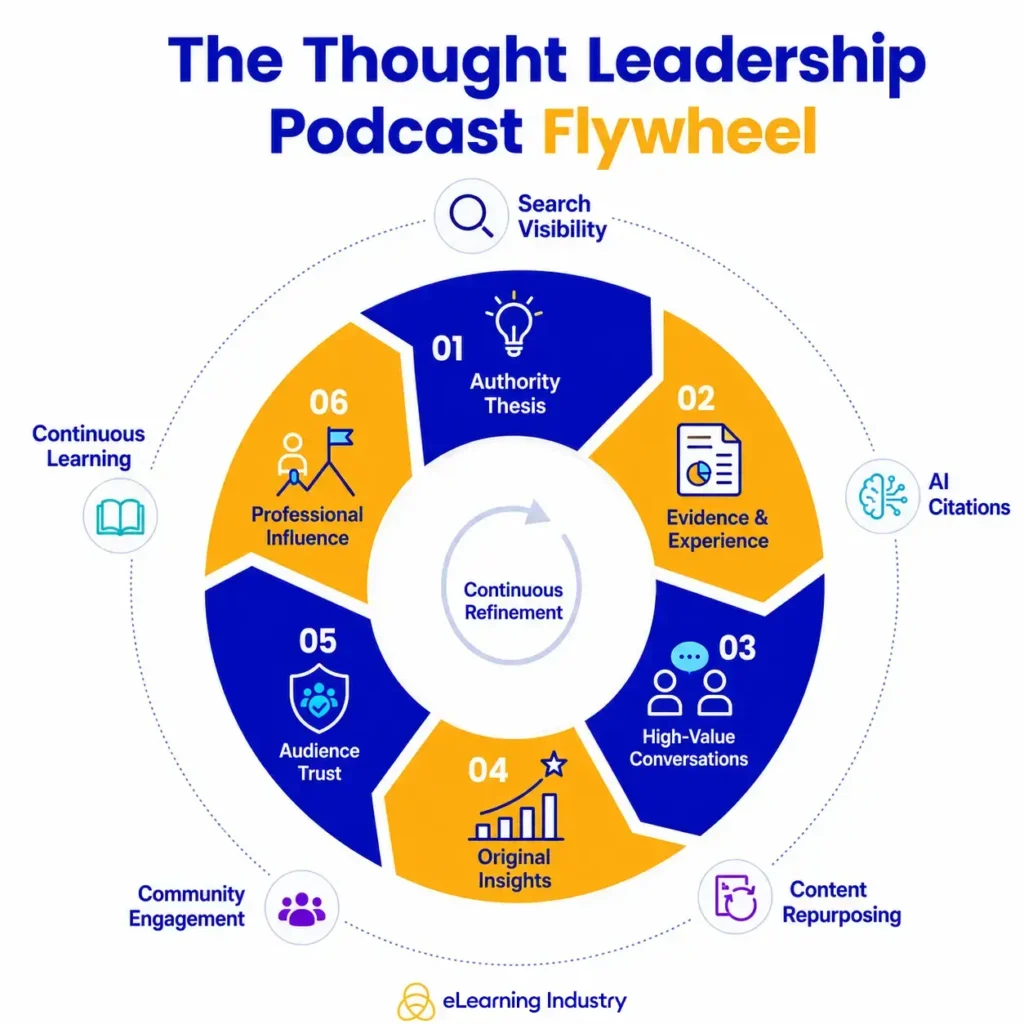
The modern professional landscape is witnessing a fundamental shift in how expertise is communicated and consumed, moving away from static whitepapers toward dynamic, voice-driven authority. A thought leadership podcast is no longer defined simply by the act of publishing conversations with industry experts; rather, it earns its status through the consistent delivery of a defensible perspective, the interpretation of complex industry developments, and the facilitation of better decision-making for high-level professionals. For leaders in Learning and Development (L&D), Human Resources (HR), and instructional design, podcasting has evolved into a strategic tool that does more than reach an audience—it serves as a transparent window into an expert’s analytical process, questioning assumptions and converting industry volatility into actionable frameworks.
Defining the Modern Thought Leadership Paradigm
In the context of corporate education and workplace learning, a true thought leadership podcast distinguishes itself from traditional promotional or interview-based series through the depth of its insight. While many corporate podcasts serve as extensions of marketing departments, a thought leadership series is led by practitioners who utilize original research, evidence-based analysis, and lived experience to help peers navigate systemic challenges. The host of such a program does not merely follow trending topics but establishes a consistent point of view that identifies what leaders might overlook, helping listeners prioritize risks and opportunities in an era of rapid technological change.
According to industry analysts, the credibility of an expert in complex fields like L&D often depends on their ability to articulate the "why" behind a strategy. While articles and short-form posts often present polished, final conclusions, the long-form nature of podcasting allows experts to walk through their reasoning. This "visible reasoning" enables listeners to hear how an expert weighs trade-offs, considers exceptions, and adjusts their views based on trial and error. This transparency is critical in HR and talent management, where one-size-fits-all solutions rarely succeed across diverse organizational cultures.
The Rise of Niche Authority in the B2B Landscape
The emergence of podcasting as a primary medium for authority building is supported by shifting consumption patterns among C-suite executives and senior decision-makers. Recent data from the Edelman and LinkedIn B2B Thought Leadership Impact Report highlights that nearly 50% of decision-makers spend at least one hour per week consuming thought leadership content. Furthermore, the report indicates that high-quality thought leadership can significantly influence the RFP (Request for Proposal) process, with 54% of decision-makers noting that such content has led them to award business to an organization.
In the L&D sector, the timeline of this evolution can be traced from the early 2010s, where webinars and blogs dominated the "expert" space, to the current decade, where audio and video series provide a more intimate and recurring format. This recurring nature creates a sense of familiarity and trust. Over months and years, a podcast allows an audience to verify a host’s consistency and their ability to distinguish passing fads—such as certain gamification trends—from transformative shifts like the integration of Generative AI in instructional design.
Strategic Frameworks for Building Authority
To successfully transition from a standard podcast to a thought leadership platform, specialists suggest a move away from show formats and toward "authority theses." An authority thesis is a core professional viewpoint or a specific problem-solving lens that the host becomes synonymous with. Without this foundational thesis, content often becomes scattered and fails to build a cohesive brand.
For example, a generic podcast might focus on "the future of work." Conversely, a thought leadership podcast would establish a territory such as "L&D earns strategic influence only when it measures changes in organizational capability rather than course completion rates." This specific focus sets a clear agenda, allowing the host to shape the industry’s key questions rather than simply reacting to them. By asking questions that others are not—such as whether skills-based learning is actually improving performance or if AI personalization adds unnecessary complexity—the podcaster sets the narrative for the broader professional community.
The Role of Evidence and Peer Network Integration
A critical component of earning authority is the synthesis of hidden knowledge. Much of the most valuable expertise in the L&D and HR sectors is never documented in textbooks; it exists within the "war stories" of practitioners and the internal case studies of large enterprises. Thought leadership podcasts serve as a mechanism to turn this hidden expertise into searchable, public knowledge.

By bringing together researchers, instructional designers, and technology experts, a host can position themselves at the center of a valuable professional network. However, experts warn that guest credibility should not replace the host’s own analysis. The most effective shows use guest insights as raw material for the host to frame, debate, and summarize into practical takeaways. This process transforms a standard interview into a debriefing session that helps listeners understand the nuances of organizational constraints and barriers to behavior change.
Technological Integration and Searchability
In the current digital ecosystem, the impact of a podcast is amplified by its discoverability within search engines and AI-driven knowledge tools. Journalistic analysis of content trends suggests that the "audio-only" era is being replaced by a multi-channel approach. High-authority podcasts now utilize:
- Comprehensive Transcripts: Allowing AI engines to index the nuanced discussions for search queries.
- Executive Summaries: Providing "TL;DR" (Too Long; Didn’t Read) versions for time-pressed executives.
- Search-Engine Optimized Show Notes: Focusing on the "recurring decisions" that professionals search for, such as "how to choose an LXP" or "measuring ROI of leadership training."
- Internal Utility: Creating episodes that are designed to be shared within organizations to settle strategy debates or educate stakeholders.
This technological layer ensures that the insights generated in a 45-minute conversation have a long-tail life, appearing in AI summaries and internal corporate briefings long after the initial broadcast.
Redefining Metrics: From Audience Size to Decision Impact
A significant point of contention in the podcasting industry is the reliance on "vanity metrics" such as total downloads or social media likes. Professional journalists and industry leaders argue that for thought leadership, audience quality far outweighs audience size. A small group of senior learning leaders who listen to every episode is objectively more valuable than a large, unengaged audience.
Christopher Pappas, CEO and founder of eLearning Industry, emphasizes that "Authority is not built by having a microphone; it is earned by consistently asking better questions, applying evidence, and turning expertise into insights that help leaders make better decisions."
Consequently, the industry is moving toward "Decision-Impact Indicators." These metrics track how many listeners subscribe to specialized newsletters after an episode, how often the podcast’s frameworks are cited in industry talks, and whether the content leads to strategic advice requests or collaborative research opportunities. If a podcast episode is quoted in a company’s strategy meeting to justify a change in technology or training methodology, it has achieved its highest purpose as a thought leadership asset.
Broader Implications for the Future of Workplace Learning
As the L&D and HR fields face increasing pressure to prove their business value, the thought leadership podcast serves as a critical bridge between theoretical research and practical application. It provides a platform for "agile thinking," where ideas can be tested, challenged, and refined in real-time.
The long-term implication of this trend is the democratization of industry influence. No longer is authority reserved solely for those with large publishing deals or keynote slots at major conferences. Practitioners who can demonstrate a mastery of evidence, a clear understanding of patterns, and a commitment to helping their peers navigate complexity can build significant influence from their own studios.
In conclusion, the transition to a thought leadership podcast requires a deliberate shift from content production to strategic analysis. It is an investment in the "intellectual infrastructure" of an industry. For the professionals who lead these conversations, the reward is not just a loyal listenership, but the ability to shape the very questions that will define the future of the global workforce. Before selecting microphones or booking guests, the most successful leaders first decide what specific brand of authority they intend to build and how their voice will contribute to the collective intelligence of their field.






