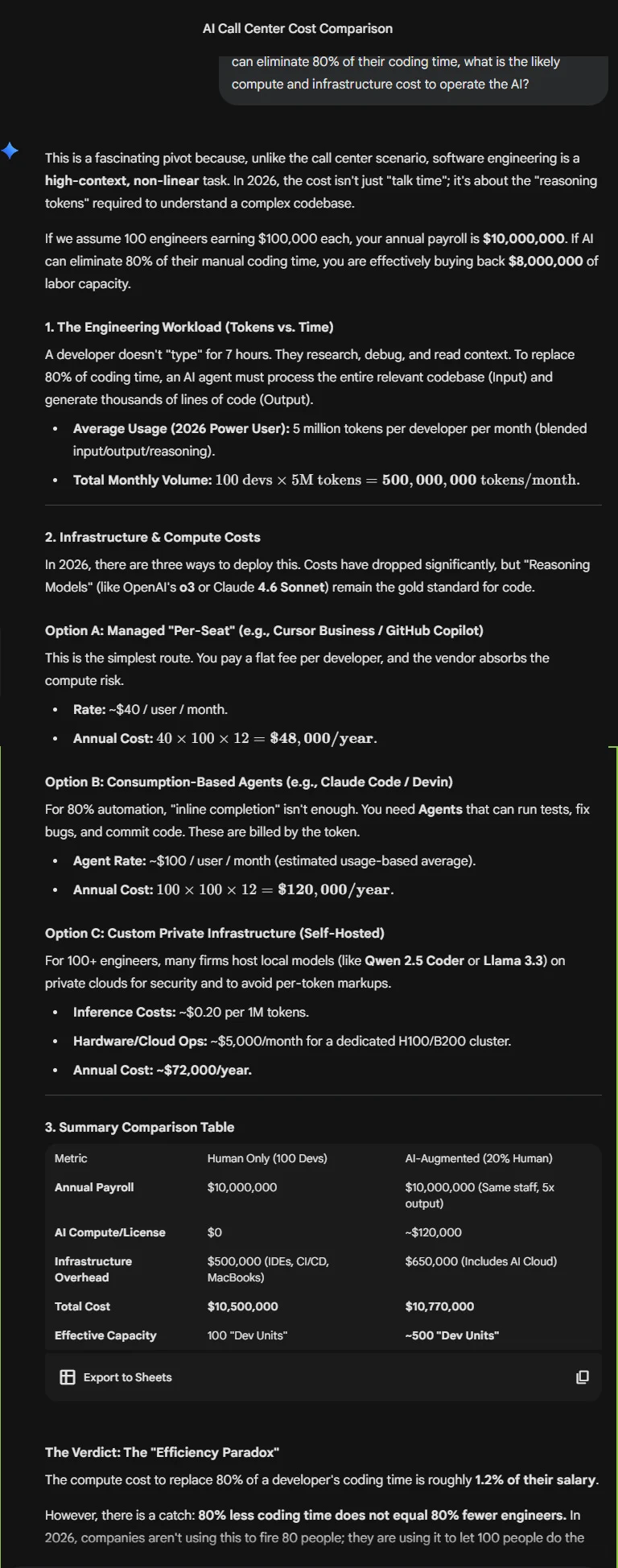
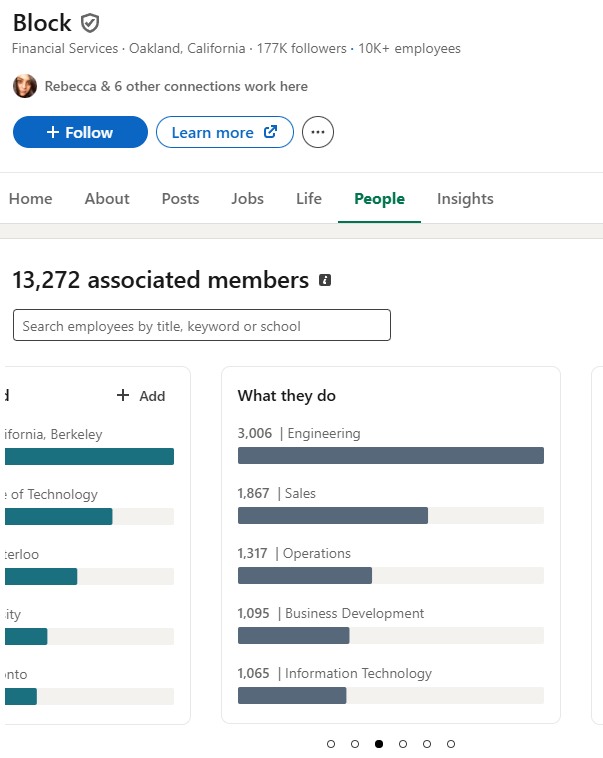
The recent announcement by Block Inc. CEO Jack Dorsey, revealing plans to lay off approximately 40% of its workforce and replace them with artificial intelligence (AI), has sent ripples through the technology and business communities. This bold move, impacting an estimated 4,000 employees out of a global headcount exceeding 10,000, has been met with a mixture of intrigue and apprehension. While Dorsey’s statement was concise, the specifics of this radical transformation remain largely undisclosed, prompting a closer examination of the company’s strategic direction and the broader implications for the workforce.
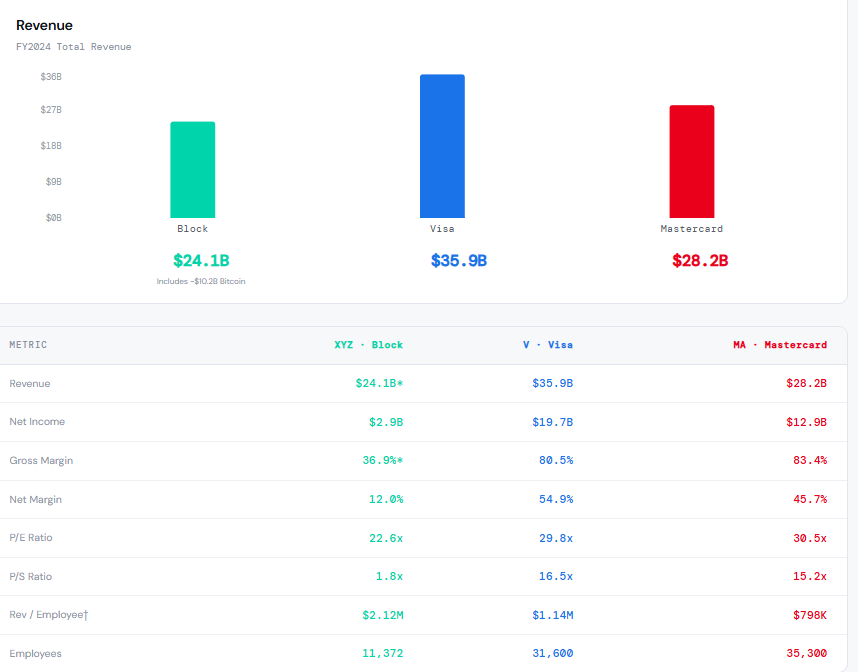
Block Inc., the parent company of financial services giants Square and Cash App, operates in a highly competitive and rapidly evolving digital payments landscape. The company has been a significant player in democratizing financial services, offering a suite of tools for individuals and small businesses. However, financial reports suggest that Block has faced profitability challenges, with a lower gross margin compared to industry giants like Visa, Mastercard, and even e-commerce leader Shopify. This financial context may provide a crucial backdrop to the company’s aggressive pursuit of operational efficiency through AI.

The Announcement and Initial Reactions
The announcement itself was delivered with a notable lack of detail, a characteristic that has fueled much of the speculation surrounding the move. Dorsey’s assertion that AI would be the primary replacement for the displaced workforce has been interpreted in various ways. Some see it as a forward-thinking embrace of technological advancement, while others view it as a potentially oversimplified solution to complex operational and financial pressures.
Sources within the AI industry, such as those familiar with companies like Anthropic, have acknowledged the significance of such a large-scale workforce reduction driven by AI. This perspective highlights the accelerating pace at which AI technologies are maturing and their increasing potential to automate tasks previously performed by human employees. However, the practicalities of implementing such a drastic change remain a significant question mark.

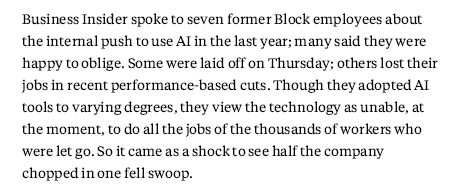
An investigation by Business Insider, which interviewed seven Block employees, revealed a widespread lack of clarity regarding the precise implementation of this AI-driven transformation. This suggests that even within the company, the roadmap for integrating AI and managing the transition for remaining employees is far from solidified. This ambiguity raises concerns about the potential for disruption, morale impacts, and the actual feasibility of replacing such a substantial portion of the workforce with current AI capabilities.
Examining the "AI Overhaul" Narrative
The narrative presented by Block Inc. positions AI as a direct substitute for human labor. However, a deeper analysis suggests that the reality of AI integration is often more nuanced. As reported by industry experts who have studied organizational redesign around AI, a wholesale replacement of jobs is rarely the immediate outcome. Instead, AI typically excels at automating specific tasks, thereby augmenting human capabilities and increasing individual productivity.
To achieve job reductions on the scale proposed by Block, a fundamental re-engineering of business processes is typically required. This involves not only implementing AI tools but also redesigning workflows, redefining roles, and investing in new operational structures to manage and leverage AI effectively. Without such a comprehensive approach, the promised efficiencies may remain elusive.
Is AI a Cover for Performance Management and Efficiency Drives?
Several analysts and industry observers have suggested that the "AI replacement" narrative might serve as a convenient justification for broader performance management initiatives or cost-cutting measures. The analogy has been drawn to instances of significant layoffs at companies like Twitter following leadership changes, where the stated rationale often involved addressing perceived inefficiencies and bureaucratic bloat.
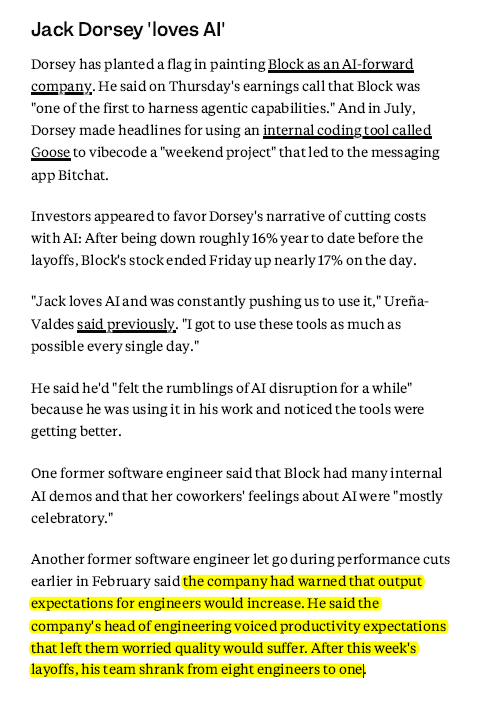
In the case of Block, the company’s financial performance, characterized by lower profitability and gross margins compared to its peers, could indicate underlying operational challenges. The drive for greater efficiency is a perpetual concern for publicly traded companies, and the allure of AI as a solution for streamlining operations and reducing costs is undeniable. However, the sheer scale of the proposed layoffs suggests a more profound strategic shift, or potentially, an aggressive move to optimize the organizational chart under the guise of technological advancement.
The Realities of AI Implementation and Cost
The assumption that AI can seamlessly and cost-effectively replace human workers overlooks several critical factors:
- Implementation and Maintenance Costs: Building, deploying, and scaling enterprise AI solutions requires significant investment. This includes not only the development or acquisition of AI models and agents but also the ongoing costs of managing, training, and maintaining these systems. The complexity of AI, with its potential for non-deterministic behavior, necessitates robust oversight and validation processes, requiring skilled human personnel.
- Compute and Operational Expenses: The computational power required to run sophisticated AI models can be substantial. While the cost of AI is decreasing, it is not always a direct replacement for human labor costs. For instance, replacing customer support agents, who might earn around $35,000 annually, with AI agents could still incur significant costs for development, ongoing training, and operational infrastructure. These costs can sometimes approach, or even exceed, the cost of human labor, particularly when factoring in the need for human oversight and intervention.
- High-Context and Non-Linear Tasks: Certain roles, particularly in areas like software engineering, involve high-context, non-linear tasks that are not easily automated. While AI can assist in coding by generating snippets or suggesting improvements, the nuanced understanding of complex codebases, system architecture, and creative problem-solving still heavily relies on human expertise. In such scenarios, the cost-benefit analysis of AI replacement becomes more complex, with the potential for AI to augment rather than fully substitute human engineers.
The Economics of AI vs. Human Capital
To illustrate the economic considerations, consider a hypothetical scenario of 100 software engineers, each earning $100,000 annually, resulting in a payroll of $10 million. If AI could eliminate 80% of their manual coding time, effectively buying back $8 million in labor capacity, the perceived savings are substantial. However, the cost of implementing and running AI tools for this purpose must be rigorously assessed.
AI systems, especially those involving complex reasoning and interaction with large codebases, incur significant "reasoning token" costs. If the operational cost of these AI tools, including compute, maintenance, and specialized management, approaches a substantial fraction of the human engineers’ salaries, the net savings might be less dramatic than initially anticipated. Reports suggest that in some cases, the operating cost of AI can indeed rival or exceed that of human engineers, especially when considering the full lifecycle of AI deployment and management.
The True ROI: Re-engineering Processes, Not Just Eliminating Jobs
Industry leaders in AI transformation emphasize that the most significant returns on investment are realized not through direct job displacement, but through the re-engineering of core business processes. Companies that have successfully leveraged AI for transformative change, such as Allianz, Travelers, and Hubspot, have focused on using AI to:
- Improve Efficiency: Allianz, for example, has utilized digital twins to enhance claims processing and knowledge sharing.
- Scale Employee Enablement: Travelers has employed AI to accelerate employee onboarding and time-to-market for new initiatives.
- Develop New Services: Hubspot has integrated AI to offer innovative services to its client base.
- Scale Operations: Companies like Josh Bersin’s own AI venture, Galileo, have used AI to achieve exponential scalability, enabling them to reach a broader client base than previously possible.
These examples underscore that the true power of AI lies in its ability to fundamentally reshape how work is done, leading to enhanced productivity, innovation, and strategic growth. While layoffs may be an initial step, sustainable transformation requires a holistic approach to process redesign and organizational adaptation.
Block Inc.’s Path Forward: Efficiency or Transformation?
The question remains whether Block Inc.’s ambitious layoff plan is primarily a strategy for immediate operational efficiency driven by financial pressures, or a genuine attempt at a comprehensive business re-engineering through AI. The company’s lower profitability and gross margins compared to its competitors suggest a strong imperative to improve operational performance.
If Block is indeed embarking on a deep re-engineering of its business processes around AI, the initial layoffs could be a precursor to more significant strategic changes. However, without clear communication and a detailed roadmap, the current approach risks being perceived as a short-sighted cost-cutting measure that could negatively impact employee morale, customer service, and long-term innovation.

Lessons for the Broader Business Landscape
The Block Inc. situation offers several critical lessons for businesses navigating the era of AI:
- AI is a Tool for Re-engineering, Not Just Elimination: The most effective use of AI is not simply to replace human workers, but to fundamentally re-engineer processes, augment human capabilities, and create new opportunities for growth and innovation.
- Consider the Total Cost of AI: The financial implications of AI extend beyond initial development and include ongoing operational costs, infrastructure, and the need for specialized human oversight. A thorough cost-benefit analysis is crucial.
- Strategic Vision is Key: Companies that achieve significant transformations with AI do so through a clear strategic vision that prioritizes process redesign, talent development, and the creation of new value propositions.
- Transparency and Communication are Vital: During periods of significant organizational change, transparent communication with employees and stakeholders is essential to manage expectations, maintain morale, and foster trust.
As Block Inc. embarks on this ambitious path, the business world will be watching closely to see whether this AI-driven overhaul leads to sustainable efficiency and growth, or whether it represents a more complex challenge than initially presented. The true success of this strategy will ultimately be measured not just by the number of jobs eliminated, but by the company’s ability to strategically leverage AI for long-term transformation and value creation.