In an era defined by rapid economic shifts and evolving workplace dynamics, organizations are discovering that employee morale is far more than a superficial concern; it is a profound determinant of an enterprise’s overall health, productivity, and capacity for growth. Beyond the ephemeral allure of trendy office perks or isolated engagement initiatives, true morale is rooted in an employee’s fundamental connection to their work, their leadership, and the tangible impact of their contributions. This deeper sentiment directly influences critical outcomes, as evidenced by Gallup research indicating that robust employee engagement can lead to an 18% surge in productivity and a 23% increase in profitability. For businesses aiming to scale and thrive without the constant drain of high turnover, cultivating high morale is not merely beneficial but essential.
The Shifting Landscape of Work: A Modern Imperative for Morale
The concept of employee morale, while always important, has taken on heightened significance in the 21st century. Historically, employers focused on compensation and basic working conditions to motivate staff. However, the rise of knowledge economies and the profound societal shifts of the past two decades have fundamentally reshaped employee expectations. The global pandemic, in particular, served as a catalyst, forcing a re-evaluation of work-life balance, well-being, and the psychological contract between employer and employee. This period, often characterized by "The Great Resignation," saw millions of workers reconsidering their career paths, prioritizing purpose, flexibility, and supportive work environments over traditional incentives.
Today, employees seek more than just a paycheck; they crave a sense of belonging, purpose, and genuine appreciation. The modern workforce, increasingly diverse and distributed, demands transparency, opportunities for growth, and a culture that actively champions their well-being. Against this backdrop, organizations that fail to cultivate a positive and engaging environment risk not only diminished performance but also significant talent drain, hindering their ability to innovate and compete effectively.
The Economic Case for Prioritizing People
The link between employee morale and financial performance is well-documented and irrefutable. Disengaged employees cost companies billions annually in lost productivity, absenteeism, and turnover. A study by the Society for Human Resource Management (SHRM) estimates that the average cost to replace an employee can range from six to nine months of that employee’s salary, factoring in recruitment, onboarding, and training expenses. When morale is low, the ripple effects extend beyond individual performance, impacting team cohesion, customer satisfaction, and ultimately, the organization’s brand reputation.
Conversely, companies with high employee engagement consistently outperform their peers. Beyond the Gallup statistics, research from Forrester shows that highly engaged organizations experience 2.5 times higher revenue growth than those with low engagement. Engaged employees are more innovative, more resilient in the face of challenges, and more likely to act as advocates for their organization. This underscores that investing in morale is not an expense but a strategic investment in human capital, yielding substantial returns.
One of the most effective, yet frequently underutilized, tools in this strategic arsenal is recognition. Not the perfunctory annual award, but genuine, timely appreciation that consistently reminds individuals their efforts are seen, valued, and contribute meaningfully to collective success. The 2026 Engagement and Retention Report highlights a stark reality: only 25% of employees feel genuinely appreciated at work. This significant gap is a primary driver of disengagement and turnover, particularly when recognition systems are cumbersome, inconsistent, or reliant on manual processes. The goal is not to introduce more programs, but to embed a single, impactful recognition framework that seamlessly integrates into daily operations and truly resonates with employees.
Fifteen Pillars of a Resilient Workplace Culture
Building a high-morale workplace requires a multifaceted, sustained approach that addresses various aspects of the employee experience. These strategies are designed for practical implementation, focusing on impact, simplicity, and measurable results, suitable for organizations ranging from mid-market firms to large enterprises.
I. Cultivating a Culture of Appreciation and Belonging
-
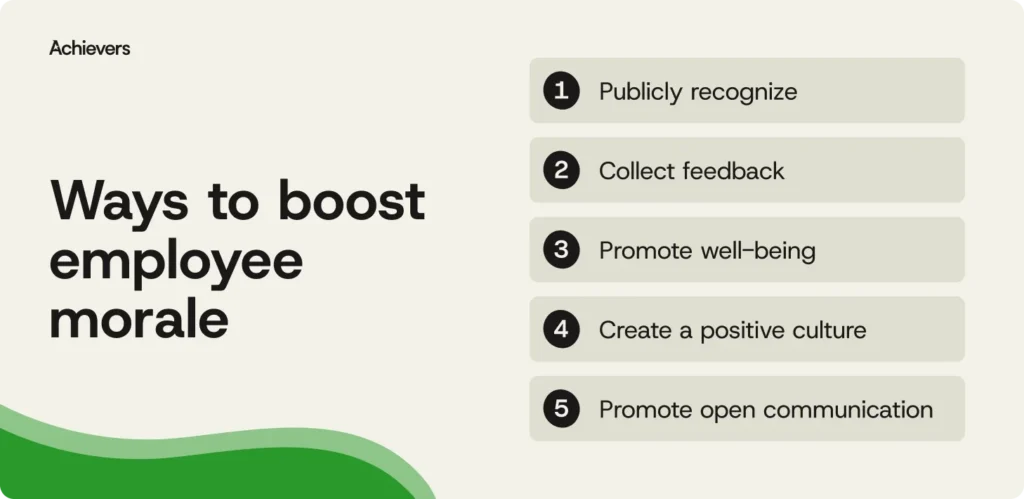
Publicly Recognize and Appreciate: Recognition must transcend quarterly reviews or manager-only acknowledgments. It needs to be frequent, highly visible, and easily administered to ensure consistent adoption. When employees feel genuinely appreciated, their motivation and loyalty increase. For instance, platforms that allow peer-to-peer recognition in real-time can significantly amplify its effect, creating a continuous feedback loop of appreciation across all levels of the organization.
-
Encourage Peer-to-Peer Appreciation: While top-down recognition is valuable, empowering colleagues to celebrate each other’s contributions fosters a stronger sense of community and shared purpose. This horizontal recognition strengthens team bonds, promotes collaboration, and ensures that even smaller, day-to-day efforts receive acknowledgment, reinforcing a culture where appreciation is a collective responsibility.
-
Celebrate Achievements and Milestones: Every accomplishment, whether a major product launch, a successful project completion, or a subtle process improvement, warrants celebration. Publicly acknowledging these wins keeps motivation high, makes progress visible, and reinforces the value of individual and team contributions to the organization’s overarching goals.
-
Celebrate Career Milestones and Life Moments: Beyond project-based achievements, recognizing tenure, promotions, and significant personal life events (e.g., births, weddings) demonstrates that the organization values the whole person, not just their professional output. This comprehensive approach to recognition shows employees that their journey, both professional and personal, is valued at every step.
-
Align Recognition with Company Values: Recognition gains greater resonance when it is explicitly tied to the organization’s core values. By framing appreciation within the context of these values, employees gain a clearer understanding of what constitutes exemplary work and how their actions embody the company’s ethos, thereby reinforcing cultural alignment and purpose.
II. Fostering Growth, Voice, and Purpose
-
Collect Feedback Regularly and Act on It: Merely asking for input without demonstrating a commitment to action is a morale killer. Implementing robust feedback mechanisms—such as pulse surveys, suggestion boxes, or open forums—and, critically, acting on the insights garnered, builds profound trust across teams. This commitment shows employees their voices matter and can drive meaningful change.
-
Encourage Professional Development: In many organizations, particularly mid-market ones, career development can stagnate due to a lack of formalized growth paths. Employees who cannot envision their future within the company are more likely to seek opportunities elsewhere. Providing visible learning opportunities, recognizing skill acquisition, and signaling that growth is a priority can significantly boost morale and retention without requiring complex career frameworks.

-
Tie Outcomes to Purpose: Morale soars when individuals understand how their daily tasks contribute to a larger mission or vision. Leaders should consistently articulate the "why" behind the work, connecting individual contributions to the company’s broader impact on customers, society, or specific objectives. This linkage imbues work with meaning, fostering intrinsic motivation.
III. Cultivating an Empowered and Connected Environment
-
Empower Managers to Boost Morale: Managers are on the front lines of employee experience, yet they often lack formal people-leadership training or adequate support for morale initiatives. Equipping managers with user-friendly tools, clear expectations, and gentle "nudges" to recognize and address disengagement early is one of the most efficient ways to elevate morale without burdening HR with additional administrative overhead. Their direct influence is paramount.
-
Encourage Autonomy and Trust: Micromanagement is a corrosive force on morale. Trusting employees to manage their tasks and offering flexibility in how they achieve their objectives fosters a sense of ownership, accountability, and respect. This autonomy empowers individuals, boosts confidence, and reduces stress, leading to higher job satisfaction.
-
Promote Open Communication and Connection: Transparent, consistent, and multi-directional communication is the bedrock of high morale. When communication channels break down, misinformation and distrust can quickly erode team spirit. Fostering strong interpersonal relationships and ensuring transparent information flow from leadership to all employees keeps teams aligned, informed, and connected, preventing feelings of isolation or uncertainty.
IV. Building a Supportive and Inclusive Culture
-
Promote Well-being and Work-Life Balance: The prevalence of burnout is a critical issue impacting today’s workforce. Organizations must demonstrate a genuine commitment to employee health by integrating well-being initiatives into their culture and benefits packages. This includes offering mental health support, flexible working arrangements, and encouraging boundaries between work and personal life, showing employees that their holistic health is a priority.
-
Create a Positive and Inclusive Workplace Culture: An organization’s true culture is not merely a statement on a careers page; it is the lived experience of its employees every day. When individuals feel aligned with company values, supported by leadership, and part of a positive environment, morale and motivation naturally flourish. This requires intentional effort to build an environment where everyone feels respected, heard, and valued.
-
Foster Diversity, Equity, Inclusion, and Belonging (DEIB): A workplace where individuals do not feel safe, seen, or supported cannot sustain high morale. DEIB is not a superficial checkbox but a foundational driver of trust, engagement, and overall well-being. Organizations must actively champion DEIB principles, ensuring equitable opportunities, celebrating differences, and creating an environment where every employee truly belongs.
-
Host Team-Building Activities: Morale is not solely derived from meeting KPIs; it also stems from meaningful human connection. Thoughtfully organized team-building activities, whether virtual or in-person, create shared experiences that build trust, spark creativity, and inject moments of joy into the workday. These activities foster camaraderie and strengthen the social fabric of the team.
Case Study: Wesley’s Transformative Approach to Recognition
The theoretical benefits of enhanced morale become tangible when organizations commit to actionable strategies, as exemplified by Wesley, a purpose-driven non-profit. Wesley recognized that their aspiration for improved employee morale necessitated a consistent, values-aligned framework for recognizing and rewarding their dedicated staff, moving beyond ad-hoc efforts.
To achieve this, Wesley strategically partnered with Achievers, a leader in employee engagement technology, to launch "Inspire." This innovative social recognition platform was specifically designed to celebrate both the everyday wins and the significant milestones that underpin Wesley’s mission. Through Inspire, employees gained the ability to give and receive real-time recognition, nominate peers for monthly awards, and accumulate points redeemable for personalized and meaningful rewards. The overarching objective was to embed a culture where appreciation was not only visible and frequent but also directly linked to Wesley’s core mission and values.
The primary challenge for Wesley, akin to many mid-market organizations, was consistency and scalability. They required a recognition solution that could seamlessly extend across diverse teams without creating additional administrative burdens or relying on cumbersome manual processes. By integrating recognition into the daily workflow and tying it explicitly to their organizational mission, Wesley successfully transformed morale from an elusive concept into a measurable, sustainable strategic imperative.
The results following the implementation of Inspire were compelling and spoke volumes about the program’s efficacy:
- 97% Recognition Participation: Nearly all employees actively engaged with the platform, demonstrating widespread adoption and enthusiasm for peer and managerial appreciation.
- 90% Managers Recognized Employees: A vast majority of managers utilized the platform to recognize their teams, indicating strong leadership buy-in and consistent reinforcement of positive behaviors.
- 89% Employees Received Recognition: This high percentage underscored that appreciation was broadly distributed throughout the organization, fostering a pervasive sense of value and inclusion.
An HR Director at Wesley noted, "Before Inspire, our recognition was fragmented and often fell through the cracks. We knew our people deserved better. Achievers allowed us to create a unified, dynamic system that not only celebrates our team’s incredible work but also visibly connects their efforts to our purpose. The impact on morale and retention has been profound." By making recognition an intrinsic part of the daily employee experience, Wesley transformed appreciation into a powerful morale-boosting strategy that delivered demonstrable and lasting impact.
The Future of Work: A Strategic Investment in Human Capital
In conclusion, the discourse around employee morale must evolve beyond superficial debates about office amenities or occasional team-building events. Morale is a strategic asset, directly influencing an organization’s ability to attract and retain top talent, foster innovation, achieve operational excellence, and ultimately, drive sustainable growth. The fastest and most impactful route to elevating morale is through a deliberate and consistent investment in recognition that is easy to deploy, simple to manage, and proven to deliver tangible results. This means embedding appreciation into the fabric of daily work, empowering managers to be proactive advocates for their teams, and establishing a system that provides measurable insights into its effectiveness.
This is precisely where specialized platforms like Achievers play a pivotal role. By offering industry-leading recognition frequency, robust adoption support, and sophisticated analytics that quantify impact, Achievers enables organizations to boost morale without adding complexity. The result is higher engagement, stronger retention rates, and the cultivation of resilient teams poised for continuous growth. For leaders ready to move beyond temporary fixes and make a genuine, data-driven investment in their most valuable asset—their people—it is time to embrace a comprehensive recognition strategy.