
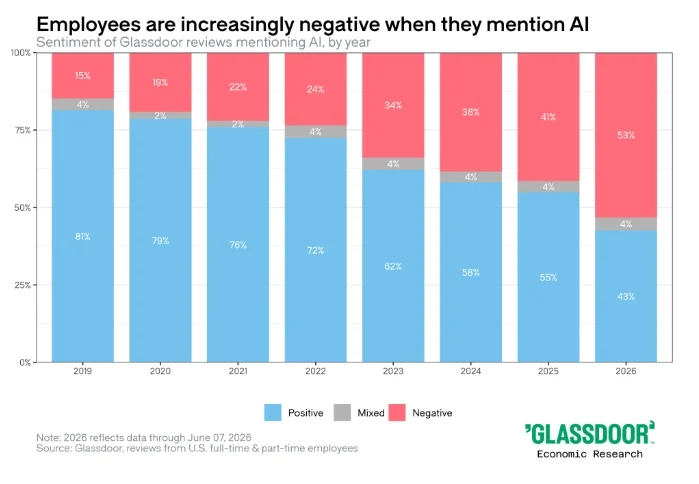
New data from Glassdoor reveals a significant and concerning shift in how U.S. employees perceive Artificial Intelligence (AI) in the workplace. Once viewed with a predominantly positive outlook, discussions surrounding AI in employee reviews have transitioned to a largely negative sentiment since 2019. This evolution in employee opinion appears to be intrinsically linked to a growing public distrust of prominent AI executives, a trend particularly pronounced among younger demographics.
The economic research team at Glassdoor has meticulously tracked the discourse, reporting a staggering 240% surge in AI mentions within U.S. employee reviews between May 2025 and May 2026. This exponential increase in discussion has been mirrored by a sharp decline in the positivity of those references. In 2019, a robust 81% of reviews that mentioned AI carried a positive tone. Fast forward to 2026, and this figure has plummeted to just 43% positive mentions, with a concerning 53% of reviews now framing AI negatively or identifying it as a distinct drawback.
The Evolving Landscape of Trust in AI and its Leaders
Running parallel to the internal workplace sentiment, a narrative of declining trust in AI leadership has solidified as a defining storyline throughout the current year. This sentiment is not confined to anecdotal observations; it is echoed in manifestos penned by tech executives and corroborated by extensive surveys. A recent CNBC Generation Lab survey, for instance, highlighted broad skepticism towards the individuals steering the artificial intelligence sector. The study indicated that approximately 75% of U.S. adults between the ages of 18 and 34 expressed a lack of trust in Anthropic CEO Dario Amodei to act responsibly with the powerful capabilities of AI. Similarly, around 70% of this demographic conveyed the same distrust towards OpenAI CEO Sam Altman and Meta CEO Mark Zuckerberg. Amodei himself has acknowledged the pervasive nature of this issue, describing the broader reaction as "fundamentally a crisis of trust."
This erosion of confidence has not gone unnoticed by industry observers. The Wall Street Journal, in its analysis, has posited that the burgeoning AI backlash offers a critical leadership lesson. It suggests that executives at major technology firms may have underestimated the extent of public resistance to AI, particularly concerning the massive data-center infrastructure required to support its development and deployment. The Glassdoor data appears to underscore a similar risk within organizations themselves, where the integration of AI technologies can exacerbate existing employee anxieties related to job security, the potential for increased surveillance, and a perceived erosion of leadership credibility.
While Glassdoor’s findings do not directly measure public trust in AI CEOs, they offer a compelling proxy. The data strongly suggests that employee confidence in AI is intrinsically tied to whether workers perceive tangible benefits for the business and whether they receive adequate support and training to effectively utilize these new technologies. This indicates that a disconnect between technological advancement and employee well-being can breed significant apprehension.
Decoding Positive and Negative Perspectives on Workplace AI
A deeper dive into the Glassdoor analysis reveals distinct themes shaping both positive and negative employee perspectives on AI. Among the positive comments, two primary drivers emerged. Firstly, employees frequently cited the commercial benefits their companies were realizing from AI adoption, a point mentioned in 44% of positive reviews. Secondly, and closely related, 41% of positive comments highlighted the availability of helpful AI tools, comprehensive training programs, or other forms of employer support designed to facilitate AI integration.
Conversely, negative comments explored a different set of concerns, with the fear of job displacement emerging as the most prevalent anxiety. This concern appeared in 20% of critical AI comments. Other recurring complaints included mandatory usage of AI tools, a perception that AI was diverting the company’s focus from its core business objectives, and significant unease regarding workplace surveillance. The latter concern is particularly resonant in an era where advancements in employee monitoring technologies, as reported by some outlets, have raised questions about data privacy and the ethical implications of constant digital oversight.
The Interconnectedness of AI Concerns and Workforce Strain
The Glassdoor data further illuminates a concerning link between the articulation of negative AI concerns and broader workforce strain. Employees who raised critical points about AI in their reviews were found to be 3.7 times more likely to mention burnout or job insecurity and a substantial six times more likely to reference layoffs compared to other reviewers. Alarmingly, one-quarter of all reviews that listed AI as a con also directly referenced layoffs. This correlation suggests that anxieties surrounding AI are not isolated incidents but are often symptomatic of a more profound sense of instability and apprehension within the workforce.
The implications of this trend are significant for businesses navigating the AI revolution. When employees feel threatened by AI, their overall job satisfaction and commitment can diminish, leading to decreased productivity and higher turnover rates. Conversely, the research also offers a glimmer of hope. Employees who discussed AI in positive terms were found to be 47% less likely to actively seek new employment in the month following their review. This finding underscores the crucial role of strategic AI implementation and transparent communication in fostering employee loyalty and engagement.
A Timeline of Shifting Perceptions
The trajectory of employee sentiment towards AI can be broadly outlined:
- Pre-2019: AI was largely a nascent technology in the public consciousness, with early workplace discussions often focusing on its potential for innovation and efficiency, leading to generally positive or neutral sentiment.
- 2019: Glassdoor data indicates a significant portion of employee reviews (81%) were positive when mentioning AI. This period likely reflected the initial excitement around AI’s capabilities and the perception of it as a tool for progress.
- 2020-2023: The widespread adoption of AI across various industries accelerated. Public discourse began to shift, with growing awareness of AI’s potential societal impacts, including job displacement and ethical concerns. This period saw the beginnings of increased skepticism among the general public and a gradual, though not yet dominant, rise in negative workplace commentary.
- 2024-2025: The discourse around AI, particularly concerning its ethical implications and the power wielded by its leading figures, intensified. High-profile AI executives faced scrutiny, and public trust began to erode significantly. This coincided with a more noticeable downturn in employee reviews.
- May 2025 – May 2026: This period marks the most dramatic shift. Glassdoor data shows a 240% increase in AI mentions, with the sentiment tipping overwhelmingly negative. The sharp decline in positive reviews (from 81% in 2019 to 43% in 2026) and the rise of negative mentions (to 53%) indicate that employee concerns have become a dominant narrative. This aligns with the broader public distrust in AI leadership highlighted by surveys.
Implications for Businesses and Policymakers
The findings from Glassdoor carry significant weight for businesses and policymakers alike. For organizations, it is evident that a proactive and employee-centric approach to AI implementation is no longer optional but essential. This involves:
- Transparent Communication: Clearly articulating the rationale behind AI adoption, its intended benefits for the company, and how it will impact roles and responsibilities.
- Robust Training and Support: Investing in comprehensive training programs to equip employees with the skills needed to work alongside AI, rather than feel threatened by it.
- Addressing Job Security Concerns: Developing strategies to reskill or redeploy employees whose roles may be affected by AI automation, thereby mitigating fears of widespread job loss.
- Ethical Deployment: Ensuring that AI technologies are implemented responsibly, with clear guidelines on data privacy, surveillance, and fairness.
From a broader societal perspective, the increasing distrust in AI leadership highlights the need for greater accountability and ethical oversight within the technology sector. As AI continues to permeate every facet of life, ensuring that its development and deployment are guided by principles that prioritize human well-being and societal benefit is paramount. This might necessitate stronger regulatory frameworks and industry-wide commitments to ethical AI practices.
The Glassdoor data serves as a critical barometer, indicating that the current trajectory of AI integration, if not managed with careful consideration for employee sentiment and public trust, could lead to significant organizational friction and a deepening societal divide. The "crisis of trust" identified by AI leaders is not merely an abstract concept; it is manifesting in the daily experiences and anxieties of the workforce, demanding a more nuanced and human-centered approach to the AI revolution. The challenge ahead lies in fostering an environment where AI is perceived not as a threat, but as a collaborative tool that enhances both business outcomes and employee livelihoods.







