The pursuit of accuracy in artificial intelligence, particularly within the critical domain of talent acquisition, has historically overshadowed a more nuanced yet equally vital consideration: fairness. While a model might boast impressive overall accuracy, its performance can diverge significantly across demographic subgroups. This disparity, where a system might correctly identify qualified candidates with high success rates for one group but demonstrably lower rates for another, can lead to meaningful and harmful inequities. Such aggregate numbers, while appearing acceptable on the surface, mask underlying biases that can perpetuate systemic disadvantages in the hiring process. Recognizing this inherent challenge, the Eightfold Talent Intelligence Platform is built upon a foundational principle that transcends mere performance metrics. Fairness, in this context, is not an add-on feature but an integral, structural component, meticulously evaluated at every developmental stage, benchmarked against prior iterations, and measured across multiple dimensions before any model is deployed to clients. This article delves into the framework underpinning this approach and elucidates why specific fairness metrics hold paramount importance for AI systems employed in hiring.
The Evolving Landscape of AI in Recruitment
The integration of Artificial Intelligence into recruitment processes has accelerated rapidly over the past decade. Driven by the promise of increased efficiency, reduced time-to-hire, and potentially more objective candidate evaluation, companies have increasingly adopted AI-powered tools. These technologies range from resume screening software and applicant tracking systems (ATS) to sophisticated talent intelligence platforms. The initial allure of AI lay in its ability to sift through vast quantities of applications, identify keywords, and rank candidates based on predefined criteria. However, as these systems have become more sophisticated and pervasive, concerns regarding their potential for bias have also grown. Early AI systems, often trained on historical hiring data, inadvertently encoded existing societal biases, leading to discriminatory outcomes. This realization has spurred a significant shift in the industry, moving from a singular focus on accuracy to a more holistic approach that prioritizes responsible AI development, with fairness and equity at its core.
Understanding the Eightfold Talent Intelligence Platform’s Approach
To comprehend the depth of Eightfold’s commitment to fairness, it is essential to understand how its Talent Intelligence Platform operates. Unlike systems that produce standalone scores for individual candidates, the Eightfold platform generates a "match score" for a specific candidate-position pairing. This score quantifies how well a particular candidate aligns with the requirements of a defined role, calibrated against the hiring organization’s specific needs. Consequently, the same candidate will receive different scores for various positions, and a single position will yield varied scores across different candidates.
This nuanced approach fundamentally shapes the evaluation of fairness. The critical question shifts from "Does the model score Group A higher than Group B?" to "For a given position, does the model identify qualified candidates from Group A and Group B with equal reliability?" This subtle yet significant reframing ensures that the focus remains on equitable opportunity and consistent evaluation quality, rather than on comparative group rankings that could mask underlying issues.
Prioritizing Explainability as a Core Design Principle
A cornerstone of the Talent Intelligence Platform’s design is its emphasis on explainability. Algorithms are selected not only for their predictive power but also for their inherent ability to articulate the rationale behind their scoring. This feature empowers recruiters and hiring managers to understand precisely why a candidate received a particular ranking. This transparency is far more than a mere usability enhancement; it serves as a practical mechanism for scrutinizing model behavior. It is this built-in explainability that enables the Talent Intelligence Platform to meet stringent standards such as FedRAMP Moderate and ISO 42001 certification, benchmarks that general-purpose AI tools often struggle to achieve. In scenarios requiring an audit of hiring decisions, the clear articulation of reasoning provides a robust foundation for accountability. This transparency is not an afterthought but an intrinsic element of the platform’s architecture.
Embedding Fairness Directly into the Training Process
The commitment to fairness begins long before a model undergoes evaluation; it is deeply integrated into the very fabric of the training process. Training data is meticulously partitioned into distinct training and testing sets, governed by stringent controls to prevent data leakage. This ensures that the data used for evaluation has not been previously exposed during the training phase, thereby providing an unvarnctuous assessment of the model’s generalization capabilities.
Crucially, Eightfold incorporates an "early stopping" mechanism based on classification performance across protected categories. If, during the training phase, a model begins to exhibit divergent performance across demographic subgroups – meaning it performs substantially better for one group than for another – the training process is immediately halted. This intervention occurs before such biased patterns become ingrained within the model’s architecture. This is a direct, proactive measure taken at the training stage, rather than a reactive correction applied after the model has been developed.

The objective is to ensure that every candidate receives an evaluation of equivalent quality, irrespective of their application timing, the size of the applicant pool, or their demographic group affiliation. Each candidate, metaphorically speaking, receives the same "nine o’clock interview" – assessed with identical rigor, against the same benchmark, and with an unwavering standard. Early stopping is one of the key mechanisms employed to enforce this standard at the model level.
Further research within Eightfold is dedicated to exploring innovative ways to incorporate anti-bias and fairness objectives directly into the loss functions that models optimize. As the field of AI ethics advances, the aspiration is for models to actively optimize against bias, rather than merely detecting it after the training is complete. This proactive approach signifies a paradigm shift towards building inherently equitable AI systems.
A Dual Framework for Measuring Fairness: Group and Individual
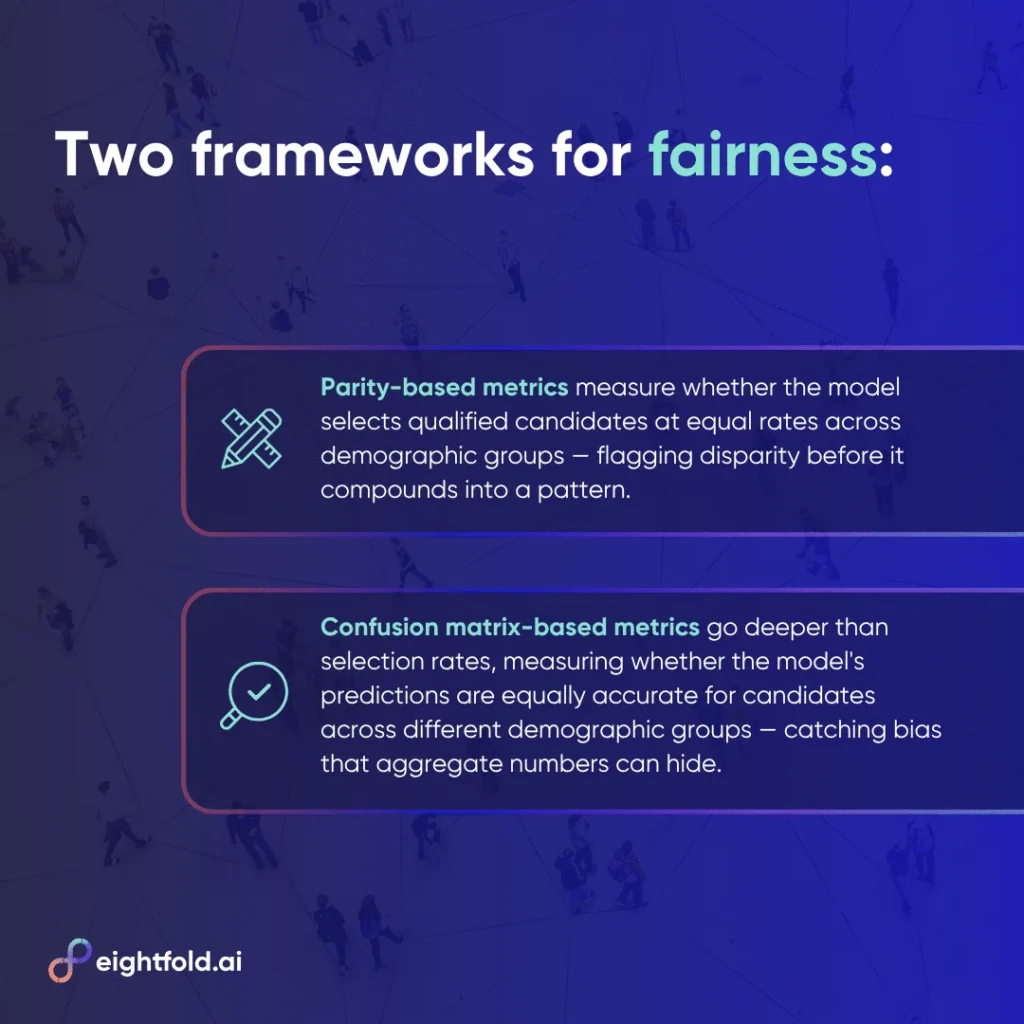
Post-training evaluation at Eightfold employs two complementary frameworks designed to meticulously measure fairness.
Group Fairness Metrics: Ensuring Consistent Outcomes Across Demographics
Group fairness metrics are designed to assess whether the AI model yields consistent outcomes across various demographic groups, defined by protected characteristics such as gender, race, ethnicity, or age. If a model demonstrates a statistically significant difference in its performance for candidates belonging to different groups, it raises a fairness concern, irrespective of whether individual-level consistency is maintained. These metrics act as vital screening tools due to their straightforward calculation and interpretability. However, their limitation lies in the fact that equal selection rates do not always equate to equal model quality across groups. This is where confusion matrix-based metrics become indispensable.
Confusion Matrix-Based Metrics: Delving into Prediction Quality
Confusion matrix-based metrics go beyond mere classification rates to examine the actual quality of the model’s predictions for different groups. They analyze the accuracy of classifications, providing a more granular view of performance. This includes:
- True Positive Rate (Recall/Sensitivity): The proportion of actual positive cases that are correctly identified as positive. For hiring, this means the proportion of truly qualified candidates who are correctly identified as a good fit.
- True Negative Rate (Specificity): The proportion of actual negative cases that are correctly identified as negative. In hiring, this translates to the proportion of unqualified candidates who are correctly identified as not being a good fit.
- False Positive Rate: The proportion of actual negative cases that are incorrectly identified as positive. This refers to unqualified candidates being flagged as suitable.
- False Negative Rate: The proportion of actual positive cases that are incorrectly identified as negative. This indicates qualified candidates being overlooked.
By analyzing these metrics across different demographic groups, Eightfold can identify subtle discrepancies in how well the model identifies qualified candidates or avoids misclassifying unqualified ones for each group.
Individual Fairness Metrics: Upholding Equity for Similar Candidates
Individual fairness metrics, on the other hand, focus on whether two similar candidates receive comparable scores. This is determined based on a predetermined similarity threshold, ensuring that candidates with comparable qualifications and profiles are treated equitably. This approach is crucial for catching instances where aggregate group-level statistics might appear acceptable, but individual-level disparities persist. For example, a model could potentially rate two equally qualified candidates differently based on subtle differences in resume formatting that may correlate with demographic characteristics.
Both group and individual fairness frameworks are indispensable. Relying solely on group fairness can mask underlying individual-level injustices, while focusing only on individual fairness might overlook systematic patterns of bias affecting entire demographic cohorts. A comprehensive understanding of fairness necessitates the integration of both perspectives.
Rigorous Evaluation: A Continuous Cycle of Improvement
The evaluation of these fairness metrics is not a one-time event conducted at the initial launch of a model. Every new iteration of a model undergoes a comprehensive battery of evaluations, with the results meticulously benchmarked against the performance of its predecessor. A model that demonstrates improvements in accuracy metrics but shows a regression in fairness metrics fails to meet the established standards.
Furthermore, these metrics are scrutinized across multiple dimensions. This includes evaluating performance by job title cluster, by language proficiency, and across other relevant segmentations. A model that performs fairly on average but exhibits disparities in specific contexts – such as certain industries, particular languages, or distinct types of roles – is deemed to have failed the evaluation, even if aggregate numbers appear satisfactory. Compliance, in this regard, is not a threshold to be cleared once; it is a standard that must be consistently maintained at every level of specificity. This commitment to granular evaluation ensures that fairness is not a superficial claim but a deeply embedded operational reality.
Beyond Evaluation: The Imperative of Ongoing Monitoring and Governance
Even models that successfully navigate rigorous pre-release evaluation operate within a dynamic and ever-changing world. Production data can diverge from training data, usage patterns evolve, and candidate populations shift in ways that no static model can fully anticipate. This is precisely why thorough model evaluation, while essential, represents only one component of responsible AI.
The critical work continues post-launch. Ongoing monitoring of model performance, the establishment of robust governance structures, and the implementation of mechanisms for detecting and correcting data or performance drift are paramount. It is within these continuous processes that the commitment to fairness is either sustained and strengthened or, conversely, quietly abandoned. The Eightfold approach recognizes that building fair AI is not a singular achievement but an ongoing commitment to vigilance and adaptation, ensuring that the pursuit of equitable talent acquisition remains at the forefront of technological development.
Implications for the Future of Hiring
The implications of this shift towards engineered fairness in AI for hiring are profound. For organizations, it signifies a move towards more ethical and sustainable talent acquisition practices, reducing the risk of legal challenges and reputational damage stemming from biased algorithms. For candidates, it promises a more equitable opportunity to showcase their skills and qualifications, free from the implicit biases that have historically plagued traditional hiring processes. The development of AI systems that are not only accurate but also demonstrably fair sets a new standard for the industry, paving the way for a future where technology truly serves to level the playing field and unlock the full potential of diverse workforces.
To learn more about responsible AI and Eightfold’s commitment to fairness, organizations are encouraged to explore their published research and resources, including whitepapers detailing bias audit results and the principles guiding their AI development. This proactive approach to transparency and accountability is critical for building trust and fostering a more equitable future for talent acquisition.