The competitive landscape for human resources technology has witnessed a significant development this week with Gloat, a recognized leader in skills intelligence and talent marketplaces, launching a strategic entry into the realm of AI Agents for HR. This move signals a burgeoning competition for core HR technology, as companies increasingly seek intelligent solutions to manage their most valuable asset: their people. Gloat’s offering, branded as Gloat Agentic HR, aims to empower organizations to rapidly develop AI agents capable of operating within familiar platforms such as Microsoft Copilot, Teams, and Slack, while seamlessly integrating with existing business rules and security protocols inherent in leading HCM systems like Oracle, Workday, and SuccessFactors.
The Emergence of Agentic AI in the HR Technology Stack
To understand the significance of Gloat’s announcement, it is crucial to contextualize the architecture of modern enterprise AI agents. This evolving ecosystem can be broadly categorized into five distinct layers, each building upon the one below.
Layer 1: Systems of Record
At the foundational level reside the systems of record, the bedrock of organizational data management. These include robust Human Capital Management (HCM) applications and Enterprise Resource Planning (ERP) systems from giants like Workday, SAP, Oracle, and UKG. These platforms meticulously store, update, and maintain critical information spanning financials, customer data, employee records, inventory, and product details, all underpinned by complex databases.
Layer 2: Cross-System Applications and Employee Experience Platforms
Layered above the systems of record are cross-system applications. Recognizing that no single vendor can fulfill every organizational need, companies have historically developed a vast ecosystem of specialized applications. This includes portals, mobile applications, and intricate workflows that bridge disparate systems. The average large enterprise today utilizes approximately 400 such applications, with over 100 directly impacting employee experience. For two decades, as technology transitioned from on-premises to the cloud, companies have cultivated these extensive solution ecosystems. Companies like ServiceNow, a global leader in this space valued at $13.5 billion and experiencing 20% annual growth, have dominated this layer. Furthermore, a surge of employee experience platforms, including Microsoft Viva, Zoom’s Workvivo, Firstup, and Staffbase, alongside tools built on Google and Slack, have become integral to the modern workplace. However, many of these platforms were not initially designed with "agentic" capabilities in mind.
Layer 3: AI Agents – The New Frontier
The third layer represents the burgeoning category of AI Agents. These are far more than simple portals or workflow automators; they possess an inherent intelligence about the user and can act autonomously on their behalf. Within the HR domain, this layer is experiencing explosive growth, with hundreds of agent tools emerging, ranging from those developed by nimble startups to agents embedded within established enterprise systems. These agents are designed to facilitate the creation of cross-functional solutions for workforce management.
Layer 4: "Superagents" – Orchestrating Intelligence
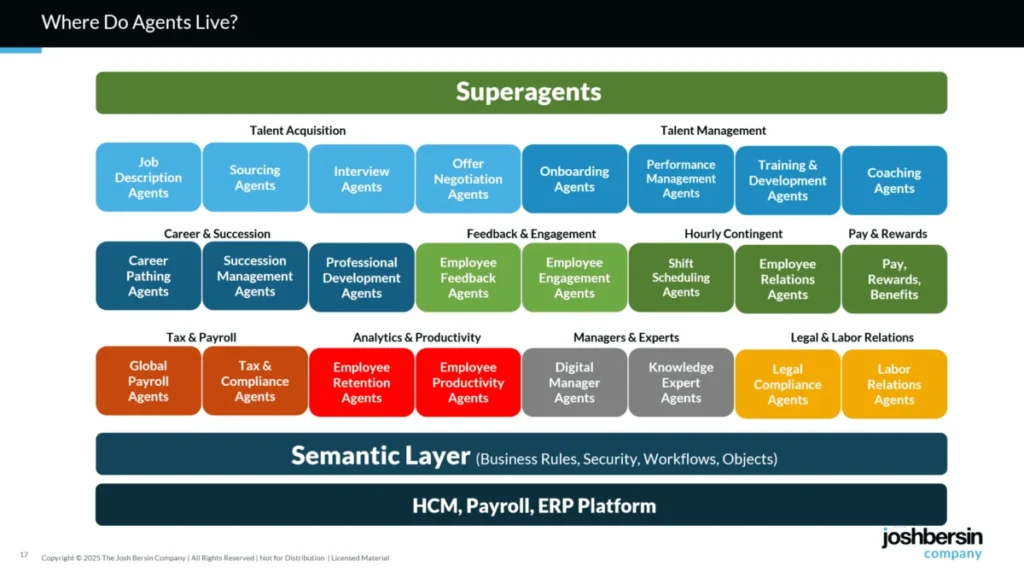
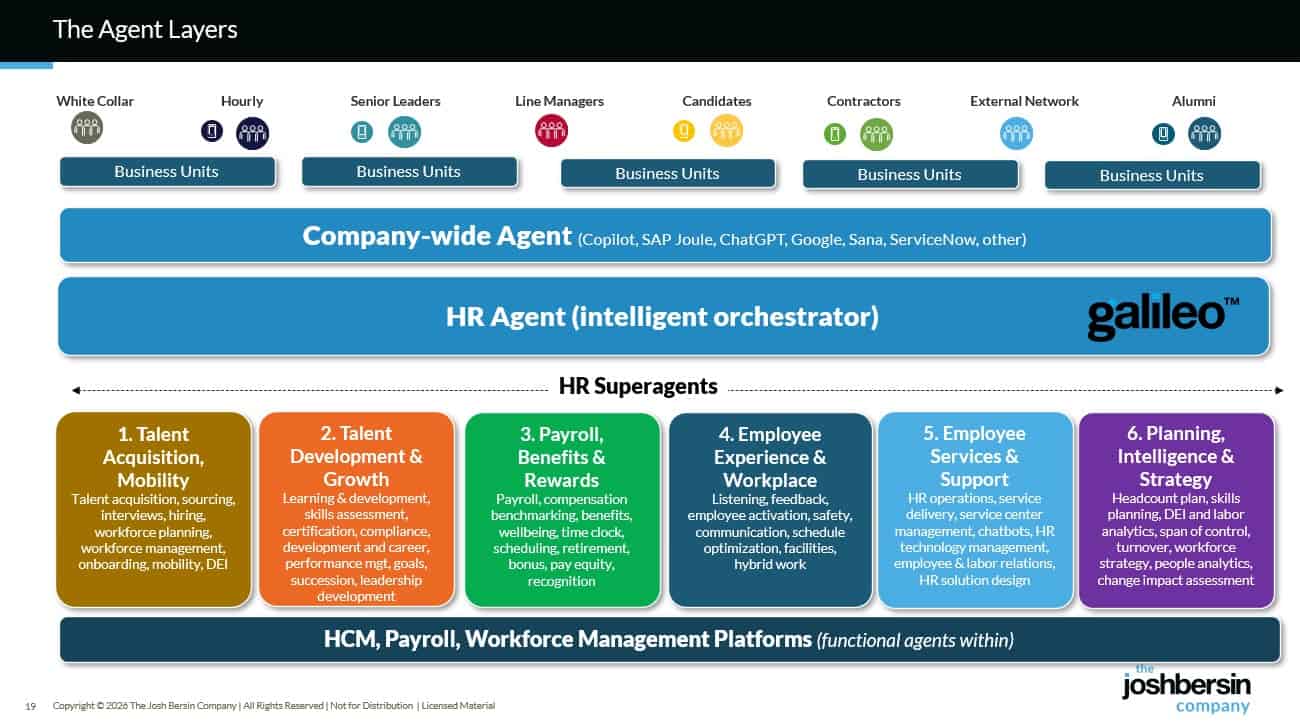
Crowning this architecture are what can be termed "Superagents." These advanced tools possess the capability to seamlessly integrate and access multiple functional agents, offering users an exceptionally intuitive and "walk-up-and-use" experience.
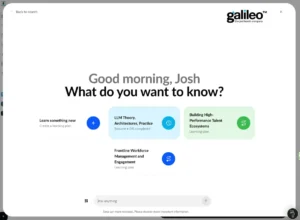
The current market is awash with tools supporting this agentic AI architecture. Prominent examples include Sana (for Workday), Oracle Agent Studio, Microsoft Copilot Studio, Leena.ai, and agents from ServiceNow (further bolstered by its acquisition of MoveWorks). SAP is also entering this space with Joule Studio, alongside foundational AI model providers like Anthropic, OpenAI, and Google. A notable example of a "Superagent" in action is Galileo, which functions as an AI advisor for HR professionals, enabling employees to pose questions, receive answers, and access the underlying agent network.
The Complexities of Agentic AI Implementation
While the prospect of AI agents in HR is undeniably exciting, their practical implementation is fraught with complexities. Organizations must grapple with intricate business rules, stringent security requirements, and the integration challenges posed by legacy systems.
Consider, for instance, a payroll reconciliation agent from Workday, SAP, or Oracle. While it can monitor payroll transactions and reconcile discrepancies related to taxes, timecards, employee movements, terminations, new hires, and pay adjustments, its effectiveness is contingent upon its ability to be "trained" with the company’s specific rules and security protocols. Furthermore, if the agent is intended to monitor pay equity or incorporate performance-based adjustments, it must possess the capability to interact with other agents within the ecosystem.
This underscores the critical importance of robust "agent architecture." Imagine a scenario where an organization aims to redeploy 5,000 employees from an existing business unit to new roles. An AI agent tasked with this endeavor would need to assess job fit, identify skill gaps, and evaluate potential for relocation before initiating large-scale layoffs or recruitment. Such an agent necessitates seamless communication with a multitude of other agents to function effectively.
In a hypothetical example, an agent built within a platform like Galileo would need to comprehend job and skill requirements, then provide coaching to both employees and managers regarding their available options. This "Superagent" would also need access to information on available training programs, geographical constraints, licensing requirements, union agreements, and pay scales. The inherent complexity of such a system is substantial.
Beyond workforce redeployment, common use cases for agentic AI in HR span global onboarding, promotion processes, annual reviews and compensation cycles, talent acquisition, employee certification management, and time and schedule optimization, among others.
The Battle for Enterprise Agents: Navigating Business Rules and Semantic Layers
Every HR technology vendor is actively developing agent solutions, ranging from simple coaching tools to more sophisticated functionalities. Major players like Workday, Oracle, SAP, and ServiceNow are investing heavily in AI studios to simplify agent creation. However, the core challenge lies not merely in selecting or building individual agents, but in their seamless integration. This integration is intrinsically linked to the handling of an organization’s unique business rules, security frameworks, existing workflows, and proprietary "business objects" – such as a company’s specific career framework or performance review model.
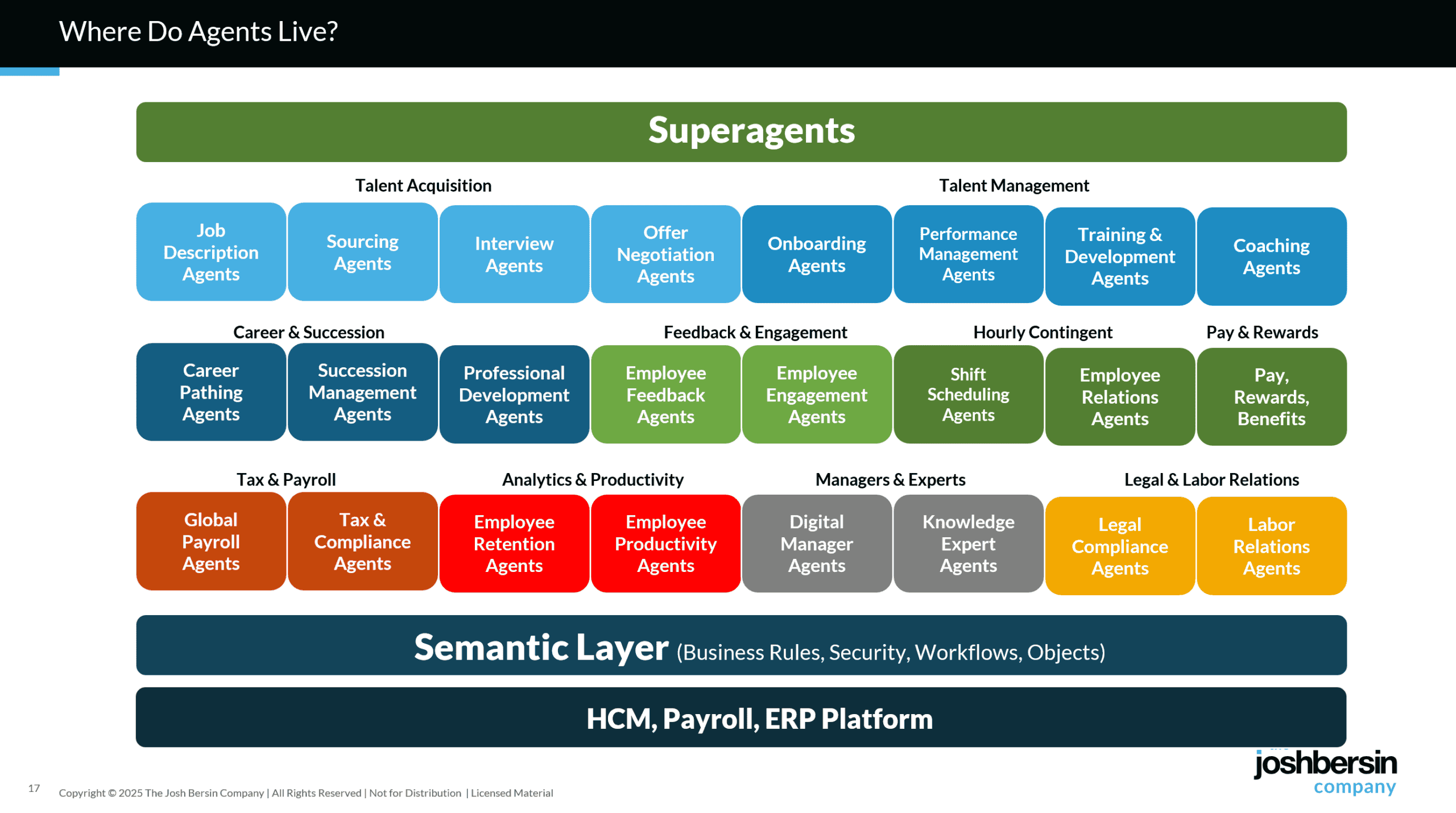
These established rules and rubrics represent the intrinsic value and operational model of a company, evolving alongside its strategic shifts. The goal is to avoid hard-coding these rules directly into agents. Instead, agents should access a dynamic "semantic layer" that encapsulates and maintains this critical information.
Leading HCM vendors, including Workday, Oracle, SAP, and UKG, already possess sophisticated semantic layers, such as Workday’s Business Process Framework. They are now actively integrating these capabilities into their agent development tools. Consequently, any HR agent or agent development platform will aspire to leverage this vital layer. This trend may even challenge the notion of an impending "SaaSpocalypse" by fostering deeper integration within existing ecosystems.
Gloat’s Strategic Play: Loomra and Agentic HR
Gloat’s latest offering aims to liberate organizations from the constraints of traditional, siloed approaches. The company has developed an "agent-driven auto-discovery ‘injector’" named Loomra. This innovative technology mines and synchronizes entities, workflows, and business rules from existing HCM systems, ensuring that the agents built upon it remain current even as the underlying HCM infrastructure evolves. Loomra effectively replicates the rules and objects resident in an organization’s HCM system, thereby facilitating the rapid development of applications.
Gloat further provides an intuitive agent builder that enables users to visually construct their own agents. These agents can be directly deployed into platforms such as Microsoft Teams, Copilot, and Slack. The company has already developed pre-built agents for critical HR functions including Workforce Redeployment, Career Development, Internal Talent Sourcing, Succession Planning, and Learning & Reskilling, leveraging its existing expertise in these domains.
Workforce Context as the Cornerstone
The differentiating factor of Gloat’s Agentic HR platform lies in its underlying workforce context layer, powered by Loomra. This engine is built upon nearly a decade of enterprise-scale workforce data, meticulously modeling skill adjacencies, career trajectories, organizational patterns, and workforce relationships across millions of employees globally.
This sophisticated context engine empowers Gloat’s agents to transcend mere information retrieval. Instead of simply responding to queries like "show me employees who know Python," these agents can intelligently reason about which employees are best positioned to transition into AI engineering roles within the current year, identify teams most vulnerable to future skill gaps, and recommend optimal talent redeployment strategies in response to shifting business priorities.
Comparative Analysis: Gloat’s Position in a Crowded Market
Gloat’s proposition offers a compelling alternative for organizations seeking to accelerate their AI adoption without waiting for their legacy HCM vendors to develop equivalent functionalities. The platform’s open architecture allows for seamless integration with other internal systems. Moreover, Gloat’s context engine appears to be a unique offering, with no readily apparent equivalent developed by other major HCM vendors to date.
However, the market for AI agent tools is intensely competitive. Organizations with a strong commitment to ServiceNow will likely leverage its native agent capabilities. Workday customers are inclined towards Sana, while Oracle users have Oracle AI Studio, and SAP customers are adopting Joule Studio. Workday, for instance, recently published a detailed overview of its agent strategy, underscoring the strategic importance of this domain for established players.
Gloat faces the challenge of demonstrating that its tools offer superior ease of use, seamless integration with existing HCM systems, and a more profound level of contextual awareness compared to alternatives. As the enterprise shifts from "systems of record" to "systems of context," Gloat is strategically positioned to potentially lead this transformation.
Outlook: The Future of Enterprise Agent Development
The evolution of application development tools has historically seen new platforms emerge and gain traction based on their alignment with an organization’s existing infrastructure. From Dreamweaver and PowerBuilder to more recent innovations like Cursor, Anthropic Cowork, and Microsoft GitHub Copilot, companies tend to adopt toolsets that complement their technological foundations.
Gloat’s latest platform represents an innovative stride forward, pushing the boundaries of the agent industry. The company’s early customer successes and ongoing developments will be closely watched as this dynamic sector continues to mature. Industry analysts anticipate further insights as early adopters share their experiences with Gloat’s new agentic HR solutions.
Additional Information:
- Workday and Sana Unveil A Bold New Strategy For AI: Provides insight into a key competitor’s approach to AI integration in HR.
- Agents, Superagents, and Intelligent Orchestration: 2026 Imperatives for Enterprise AI: Offers a broader perspective on the strategic importance of AI agents in the enterprise.
- The L&D Revolution Has Arrived: AI Enables Dynamic Enablement For All: Explores the impact of AI on learning and development, a key area for agentic HR solutions.
- Get Galileo, the AI Superagent for HR: Highlights a prominent example of a "Superagent" designed to enhance HR operations.