
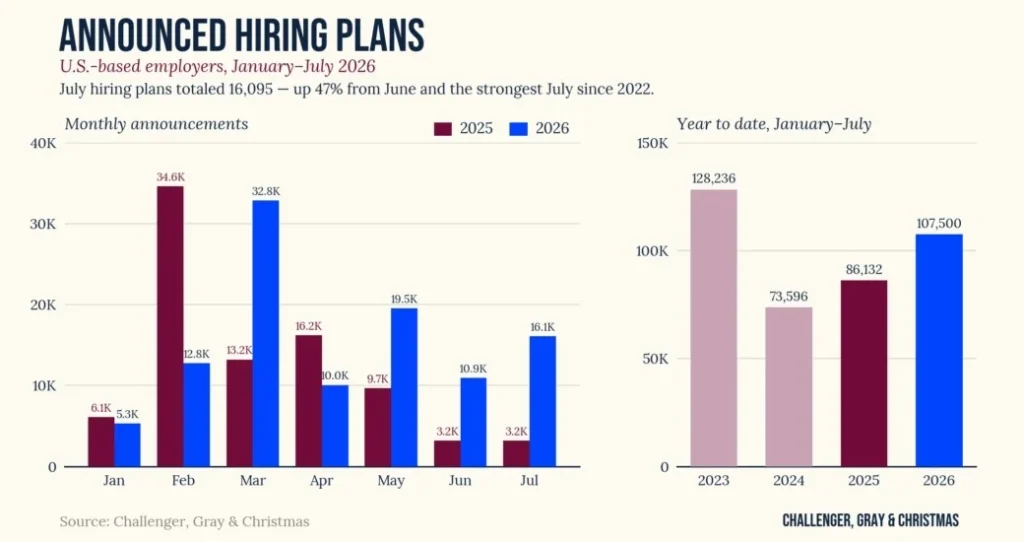
The American labor market displayed a complex and at times contradictory picture in July, marked by a notable decline in payrolls alongside a significant drop in announced job cuts and an uptick in hiring intentions. Fresh data from the Bureau of Labor Statistics (BLS) revealed a fall of 23,000 in non-farm payrolls, while the unemployment rate held steady at 4.1%. This figure contrasts sharply with findings from outplacement and business coaching firm Challenger, Gray & Christmas, which reported merely 33,429 job cuts announced by employers, marking the lowest monthly total in two years. Concurrently, Challenger’s analysis indicated a robust 47% increase in hiring plans from June, reaching the highest July total since 2022. These divergent metrics underscore a labor market in flux, characterized by underlying shifts in demand, sectoral reallocations, and the nascent but growing impact of technological advancements like artificial intelligence. Understanding these nuances is crucial for deciphering the true health and trajectory of the nation’s employment landscape as the economy navigates persistent inflation, elevated interest rates, and a rebalancing from the post-pandemic hiring boom.
Deciphering the BLS Payroll Data and Unemployment Stability
The BLS report, typically a primary indicator of economic health, showed the first net decline in non-farm payrolls in several months, with a loss of 23,000 jobs. This figure is derived from the establishment survey, which polls businesses about their payrolls. While a decline, it is relatively modest in the context of a labor force exceeding 160 million people. Historically, such fluctuations can occur due to various factors, including seasonal adjustments, survey methodology, or specific sector downturns. The unemployment rate, calculated from the household survey which polls individuals, remained unchanged at 4.1%. This stability, despite the payroll dip, suggests that while some jobs may have been lost, the overall number of people actively seeking and unable to find work did not significantly increase. It could also imply a slight contraction in the labor force participation rate, or a marginal increase in part-time employment, which would not typically register as unemployment.
Comparing this to previous periods, the U.S. labor market experienced a robust recovery following the economic disruptions of 2020, consistently adding hundreds of thousands of jobs monthly through 2021 and much of 2022. The recent deceleration in job growth, culminating in July’s slight contraction, indicates a cooling trend, which some economists view as a necessary step to temper inflationary pressures. Average hourly earnings, another key BLS metric (though not explicitly detailed in the source), would typically be scrutinized to understand wage inflation, with slower growth potentially signaling easing price pressures.
A Historic Drop in Layoffs and Surging Hiring Intentions
In stark contrast to the BLS payroll decline, the Challenger, Gray & Christmas report painted a more optimistic picture regarding employer confidence and future hiring. The announcement of just 33,429 job cuts in July represents a significant milestone, marking the lowest monthly total in two years. This figure is particularly noteworthy given the substantial waves of layoffs that characterized late 2022 and early 2023, particularly in the technology sector. The previous low point for job cuts was in July 2021, a period of strong post-pandemic recovery and high demand for labor. The current low suggests that while some companies are still restructuring, the broad-based, reactive layoffs seen earlier in the year may be subsiding.
Further bolstering this positive outlook, Challenger reported a 47% jump in hiring plans from June to July, reaching the highest July total since 2022. This metric reflects employers’ forward-looking intentions to expand their workforces, often indicating confidence in future demand and economic stability. The combination of falling layoffs and rising hiring plans from Challenger’s data suggests a strategic recalibration by businesses, moving away from mass reductions and towards targeted growth in specific areas. This divergence from the BLS payroll data highlights the difference between actual jobs gained/lost in a month and announced intentions, which can sometimes have a lag or reflect different segments of the economy.
The "Summer Swoon": Sector-Specific Vulnerabilities and Shifts
Beneath the headline numbers, the labor market exhibited significant sectoral variations, with some industries experiencing a "summer swoon" while others showed resilience or growth. The technology sector continued to bear the brunt of job cuts, with 149,023 cuts announced through July. This trend, which began in late 2022, reflects a correction from pandemic-era overhiring, rising interest rates impacting venture capital, and a broader push for efficiency in tech companies. Giants in the industry, from software to e-commerce, have announced significant reductions as they streamline operations and re-evaluate growth strategies.
Several other industries also experienced notable cuts in July, including transportation, healthcare/products, services, and government. However, a broader analysis revealed that 18 of the 30 industries tracked by Challenger announced fewer cuts than they did at the same time last year. The government sector showed the most significant slowdown in cuts, followed by retail and warehousing.
Andrew Flowers, chief economist at recruitment marketing platform Appcast, highlighted specific pain points. Local government jobs, in particular, saw a decline of 50,000, which Flowers attributed partly to "seasonal distortions." This often refers to the cyclical nature of educational employment, where many school staff, particularly those on 9-month contracts, are out of work during the summer months, leading to temporary dips in local government payrolls. These positions typically rebound with the start of the new academic year in late summer or early fall.
Leisure and hospitality, a sector highly sensitive to consumer spending and seasonal trends, also experienced a significant downturn, losing over 80,000 jobs in June and July alone. While summer typically sees a surge in tourism and related activities, this decline could signal cautious consumer behavior amidst economic uncertainty or localized oversupply of labor.
Even healthcare, long considered a stalwart and recession-proof industry in the job market, posted a lackluster gain of just 22,000 jobs in July, significantly below its average over the last year. Flowers noted this was primarily driven by a decline in hospital hiring, which he suggested could be related to "looming Medicaid cuts." Potential reductions in Medicaid funding, often tied to government budget negotiations or policy changes, could lead healthcare providers to adopt more conservative hiring practices in anticipation of revenue shortfalls or increased financial pressures. These cuts could impact not only direct patient care roles but also administrative and support staff within hospital systems.
The Ambiguous and Evolving Role of Artificial Intelligence
A defining theme in the current labor market narrative is the increasingly discussed, yet often ambiguous, role of artificial intelligence. Andy Challenger, workplace expert and chief revenue officer for Challenger, Gray & Christmas, underscored this ambiguity, noting that "the ambiguous nature of what constitutes AI-attributed cuts was highlighted in July." Companies are beginning to cite AI as a factor in their workforce reductions, but the direct causal link is not always clear.
A prominent example cited was Visa, which announced a 7% reduction in its workforce, attributing the move to an "efficiency push in which AI would reshape work." This suggests that AI is not merely automating individual tasks but fundamentally altering work processes and organizational structures, thereby necessitating fewer human resources in certain areas. For a global financial technology company like Visa, AI could be deployed to streamline operations in areas such as fraud detection, customer service, data analytics, and back-office functions, leading to a need for fewer human agents or analysts.
However, Dimitri Boylan, CEO of recruiting and talent management platform Avature, offered a nuanced perspective. While acknowledging that AI is indeed "reshaping work, especially in tech," he cautioned against taking every AI-attributed cut at face value. Boylan suggested that "in many cases, ‘AI’ is becoming shorthand for a broader efficiency story that investors want to hear." This implies that companies might be using the buzzword of AI to justify cost-cutting measures or strategic reorganizations that are driven by a wider array of factors, such as economic pressures, competitive landscapes, or a desire to improve profit margins. The perception of embracing AI for efficiency can be favorable to investors, potentially influencing how companies communicate workforce changes. This dynamic necessitates a critical examination of corporate announcements regarding AI and job displacement.
Redirection, Not Disappearance: Where Demand Is Concentrated
Despite the localized downturns and the impact of AI, the overall demand for labor is far from disappearing; instead, it is undergoing a significant redirection. Andy Challenger observed that employers are hiring more than they were at this point last year, "bucking the trend" that has been prevalent since 2020, which saw a general cooling after the initial post-pandemic surge. This points to a more stable, albeit transforming, hiring environment.
The new hubs of demand, Challenger noted, are appearing in sectors like aerospace, energy, and manufacturing – industries characterized by "work that happens on a floor rather than a screen." This shift indicates a potential rebalancing of the economy towards physical production and infrastructure, moving away from the dominance of purely digital services that characterized much of the last decade.
Ger Doyle, regional president for North America at workforce solutions firm ManpowerGroup, articulated this transformation clearly: "What’s becoming clear is that demand is being redirected, not disappearing. We’re entering a labor market where opportunity is increasingly concentrated around specific skills, industries and investments. Where demand exists is becoming just as important as how much demand exists." This insight is crucial for job seekers and policymakers alike, highlighting the need for adaptable skills and targeted training programs.
The growth in manufacturing, for instance, is fueled by a confluence of factors, including government initiatives like the CHIPS and Science Act (aimed at boosting domestic semiconductor production) and the Inflation Reduction Act (promoting clean energy manufacturing). These policies are incentivizing companies to invest in U.S.-based production facilities, thereby creating demand for skilled trades, engineers, and production line workers. Similarly, the energy sector is experiencing robust growth driven by both traditional fossil fuels and the accelerating transition to renewable energy sources, requiring specialized expertise in areas like wind turbine maintenance, solar panel installation, and grid modernization. Aerospace, benefiting from defense spending and a rebound in air travel, also demonstrates strong demand for engineers, technicians, and assembly workers.
Evolving Hiring Priorities and Challenges for Early-Career Professionals
This redirection of demand and the influence of AI are profoundly impacting hiring priorities, particularly for early-career professionals. Bekir Atahan, VP of data/AI center of excellence at Experis (part of ManpowerGroup), observed significant changes in entry-level hiring, particularly in technology roles that have traditionally required a four-year degree.
"Early-career hiring is under pressure, but AI is only part of the story," Atahan explained. He further elaborated that employers are also responding to "slower overall hiring, changing business priorities and a greater emphasis on practical experience and demonstrated skills." This suggests a broader evolution in employer expectations. In an uncertain economic climate, companies may prefer to hire candidates with demonstrable skills and immediate practical experience, rather than investing heavily in training entry-level graduates. The rising cost of education and the perceived disconnect between traditional degrees and real-world job requirements are also contributing to this shift.
For new graduates and those seeking their first professional roles, this means that a university degree alone may no longer be sufficient. There is an increasing premium on certifications, vocational training, apprenticeships, and project-based experience that showcase tangible abilities relevant to specific job functions. This trend compels educational institutions to adapt their curricula to better align with industry needs and emphasizes the importance of continuous learning and skill development throughout one’s career. The focus is increasingly on a skills-based economy, where proficiency in specific tools, technologies, and methodologies often trumps academic credentials alone.
Broader Economic Implications and Outlook
The July labor market data presents a complex narrative for policymakers, particularly the Federal Reserve, which closely monitors employment figures in its fight against inflation. The mixed signals—a payroll dip alongside strong layoff reductions and hiring plans—suggest a labor market that is cooling but not collapsing. This "soft landing" scenario, where inflation is brought under control without triggering a severe recession, remains a delicate balance.
The sectoral shifts indicate a rebalancing of economic activity, moving towards areas of strategic national interest and away from potentially overinflated segments. This transformation will likely continue to reshape the employment landscape for years to come, demanding adaptability from the workforce and innovative solutions from educational and training providers. While the "summer swoon" in certain sectors highlights vulnerabilities, the overall resilience demonstrated by falling layoffs and rising hiring intentions suggests a foundational strength in the U.S. economy. Understanding these intricate dynamics is essential for HR leaders and executives as they navigate talent acquisition, workforce planning, and strategic development in an increasingly dynamic and technologically driven world. The emphasis on specific skills and practical experience will only intensify, making targeted investment in human capital a critical differentiator for organizational success.







