
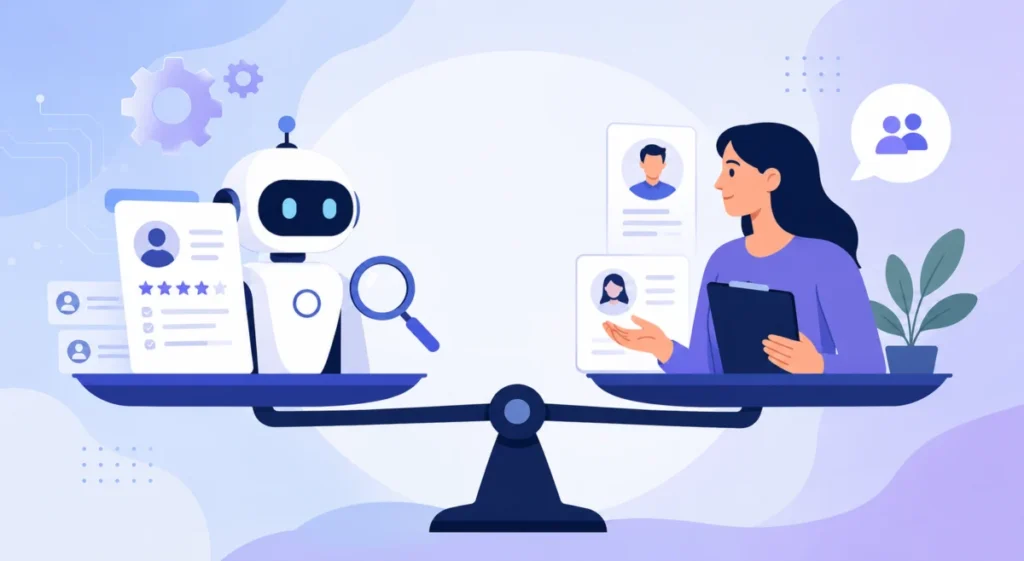
The ongoing discussion around integrating artificial intelligence into talent acquisition has reached a critical juncture, with employers and recruiters grappling with a fundamental question: how can organizations effectively balance the efficiency of AI with the irreplaceable nuances of human interaction in the hiring process? This is no longer a theoretical debate; it is a pressing strategic imperative for talent acquisition (TA) teams worldwide, especially as automated recruitment becomes increasingly entrenched. Current data reveals that a significant portion of the corporate landscape, between 35% and 45% of companies, has already woven AI into the fabric of their core hiring processes. As we look towards 2026, the focus intensifies on not just adopting AI, but on optimizing hiring quality through a thoughtful synergy of automated and traditional recruitment practices.
The Ascent of AI in Talent Acquisition: A Chronology and Context
The journey of AI in human resources is not a recent phenomenon but rather an evolutionary trajectory. Its origins can be traced back to the early 2000s with the widespread adoption of Applicant Tracking Systems (ATS), which, while rudimentary by today’s standards, laid the groundwork for automated candidate management through keyword matching and basic filtering. The mid-2010s saw the emergence of more sophisticated machine learning algorithms, capable of initial resume screening, sentiment analysis, and the deployment of basic chatbots for candidate engagement.
By the mid-2020s, and certainly looking ahead to 2026, AI has transcended its role as a mere administrative tool. As noted by Noelle London, CEO and founder of employee data platform Illoominus, AI is "increasingly functioning as a gatekeeper to employment." This transformation is driven by several factors: the sheer volume of applications global enterprises receive, persistent talent shortages necessitating innovative sourcing, and the demand for data-driven insights to refine hiring strategies. The market reflects this shift, with experts projecting the enterprise sector of AI recruitment to grow at a compound annual growth rate (CAGR) of 6.8% between 2020 and 2032, underscoring its pivotal role in future workforce development. This growth is further propelled by breakthroughs in "agentic AI," which introduces fully autonomous, non-human entities capable of executing complex tasks within the TA pipeline. Global HR technology studies indicate that an impressive 87% of enterprise organizations have already integrated agentic AI tools, such as those used for generating job descriptions, into their recruitment frameworks.
Despite this rapid advancement, a critical consensus has emerged: the necessity of a "human-in-the-loop (HITL)" approach. This philosophy emphasizes that while AI can streamline and accelerate many aspects of recruitment, active human participation remains indispensable for making the strategic and empathetic decisions that define quality hiring. The following sections explore specific strategic use cases of AI in recruitment and outline how human intervention can optimally complement these technologies.
Strategic Applications of AI Across the Recruitment Lifecycle
AI’s utility in recruitment spans various stages, from initial outreach to final candidate selection. Its ability to process vast datasets quickly and objectively makes it an invaluable asset.
Enhancing Candidate Sourcing with AI
One of the most persistent challenges for recruiters is effectively sourcing top talent; a staggering 46% of recruiters report difficulty in this area. The dynamic nature of industry norms and job market expectations further complicates this task. AI-powered candidate sourcing solutions address this by automating the identification and shortlisting of talent based on objective search criteria. These systems leverage constantly refreshed job seeker data, allowing organizations to pinpoint suitable roles for candidates at every stage of their careers, including the 70% of candidates classified as passive job seekers. Beyond immediate needs, AI sourcing tools are increasingly vital for predictive workforce planning, enabling companies to proactively identify and address potential skill gaps.
The Human Element: While AI offers an insightful first pass at talent scouting, it should not be a sole decision-maker. TA teams must apply their expertise to interpret the nuances of candidate profiles. This involves evaluating crucial soft skills, reviewing testimonials, assessing cultural fit, and considering potential for growth—factors that AI, despite its advancements, struggles to fully contextualize. Human discernment ensures that candidates are not merely a match on paper but a genuine asset to the team and organization.
Streamlining Interview Scheduling with AI
Interview scheduling can often be a cumbersome and frustrating experience for both recruiters and candidates, significantly impacting the candidate experience. Poor scheduling practices are a known culprit for candidate drop-offs, with 42% of candidates withdrawing from a hiring process purely due to scheduling complications. Automated scheduling solutions, powered by AI, enhance candidate engagement through a transparent and accurate process. These systems provide self-scheduling links, timely reminders, and prompt status updates, giving job seekers flexibility while keeping them informed. AI significantly accelerates the initial response time to applications, often within 48 hours compared to the seven-day expectation, and can offer self-scheduling links within a single day, far exceeding the 2-6 day industry norm.
The Human Element: Despite AI’s efficiency in coordinating complex interview schedules, human oversight is crucial for maintaining trust and empathy. Research indicates that 25% of hires trust employers less when AI is used to evaluate their information, a sentiment that can extend to automated scheduling. Human teams can mitigate this by vetting automated messages for tone, ensuring personalization, and avoiding impersonal phrases like "Do not reply to this automated email." A human touch ensures that the process, while efficient, remains warm and welcoming, reinforcing a positive employer brand.
Optimizing Resume Screening with AI
For enterprises receiving thousands of applications for a single vacancy, manual resume screening is a Herculean task. AI-powered resume screening solutions automatically scan CVs for data points that align with an employer’s role criteria. High-quality systems analyze a CV’s format and content quality in seconds, scoring profiles to prioritize candidate engagement and flagging issues such as keyword stuffing—a common tactic in exaggerated resumes. Advanced solutions, leveraging Natural Language Processing (NLP) and Large Language Models (LLMs), delve deeper into application context, comparing talent against vast databases of global profiles to identify the best matches.
The Human Element: Empathy remains a vital component of talent selection. Recruiters should manually review resumes for "points of note," such as career gaps, to gain a deeper understanding of prospective hires. While AI excels at summarizing the "what" of a candidate’s profile, it often lacks the contextual analytics to understand the "whys" behind career decisions, personal growth, or unique experiences. Human judgment can uncover hidden potential and provide a more holistic view of a candidate’s fit beyond quantifiable metrics.
Refining Job Description Vetting and Career Sites with AI
Crafting and disseminating thousands of job descriptions (JDs) across various platforms presents significant risks, including readability issues and subconscious biases that can deter ideal candidates and tarnish employer branding. Every published JD increases the potential for undetected content issues, thereby compromising hiring ROI. AI JD-vetting solutions meticulously analyze and correct biases (e.g., gender, educational, ableist), improve readability, and ensure proper formatting, including the presence of key sections like benefits and salary. These platforms also provide enterprise TA teams with organized JD libraries, enabling scalable, one-click uploading.
The Human Element: While AI excels at refining grammar, vocabulary, and syntax to improve readability and eliminate biases, it cannot fully capture the nuanced essence of a company’s workplace culture or its unique Employee Value Proposition (EVP). Culture is an evolving entity, influenced by leadership, industry shifts, and economic conditions. Human teams must step in to enrich AI-polished JDs with authentic storytelling that resonates emotionally with candidates. This includes articulating specific inclusion strategies, showcasing company values, and providing genuine insights into what makes the organization a desirable place to work, championing aspects like intersectionality among underrepresented groups.
The Evolving Role of the Recruiter: Not Replaced, But Redefined
The question of whether AI will replace recruitment jobs is frequently asked, and the short answer remains a resounding no. AI is fundamentally a transformative tool designed to reduce human error and manage complex candidate data more efficiently. As long as organizations continue to hire people, the need for a human touch throughout the TA pipeline will persist. However, the technology undeniably reshapes the rules of the recruitment game.
AI has catalyzed major shifts in recruitment and the broader world of work. Hiring teams are redefining TA priorities, with a notable surge in demand for AI-related skills. Job postings requiring AI expertise in the US rose by 95% in the first half of 2026 alone. This trend is prompting recruiters and employers to shift their hiring agendas towards a smaller pool of high-value, in-demand skills surrounding AI. The modern recruiter must evolve, developing AI literacy, proficiency in data interpretation, strategic thinking, and an unwavering commitment to empathy and candidate advocacy. AI, therefore, serves as an augmentation tool, freeing recruiters from mundane tasks to focus on higher-value activities such as strategic talent mapping, relationship building, and fostering an exceptional candidate experience.
Navigating the Ethical Landscape: Ensuring Responsible AI in Recruitment
The ethical deployment of AI in recruitment is paramount. Its ethical use hinges on proper safeguards, compliance, and transparency, epitomized by the rise of Explainable AI (XAI). XAI mechanisms are designed to clarify how an AI system or algorithm arrives at a particular decision—for instance, prioritizing one candidate over another in an automated ATS. This transparency supports ethical and logical decision-making, moving away from "black box" solutions that offer no insight into their reasoning.
To ensure the legal and ethical use of AI in recruitment, hiring teams must adhere to several key principles:
- Bias Mitigation: Proactively identify and address algorithmic and data biases that could lead to unfair or discriminatory outcomes. Regular audits of AI models and the data they are trained on are crucial.
- Transparency: Clearly communicate to candidates when AI is being used in their application process and explain its purpose.
- Data Privacy and Security: Implement robust measures to protect candidate data, complying with regulations such as GDPR, CCPA, and other relevant privacy laws.
- Fairness and Equity: Design and deploy AI systems that promote equitable opportunities for all candidates, regardless of background.
- Human Oversight: Maintain a human-in-the-loop approach, ensuring that critical decisions are reviewed and validated by human recruiters.
- Compliance: Stay abreast of evolving regulatory frameworks, such as the EU AI Act or NIST AI Risk Management Framework, to ensure all AI recruitment practices are legally sound.
Key AI Tools Shaping the Future of Recruitment
In an increasingly saturated software marketplace, identifying the most effective AI tools to address specific recruitment challenges can be complex. However, several platforms stand out for their innovative application of AI:
-
Ashby (Candidate Sourcing): Ashby’s automated HR solution offers an intuitive candidate sourcing feature designed for shortlisting suitable hires. The platform supports advanced search queries, enabling users to quickly discover candidates with specific skillsets across their comprehensive database. Ashby also facilitates the creation of talent communities and deploys multichannel outreach sequences, diversifying and elevating candidate engagement strategies.
-
X0PA AI (Candidate Screening): This solution leverages an intelligent candidate matching algorithm to significantly reduce manual candidate reviews, potentially by as much as 80%. X0PA AI’s BRIQ scoring model integrates the latest developments in Natural Language Processing (NLP) and Large Language Models (LLMs). The technology meticulously assesses application context and compares talent against over 250 million global profiles, ensuring a precise match to job description requirements.
-
TheHireHub.AI (Interview Scheduling): TheHireHub.AI utilizes AI technology to seamlessly coordinate candidate and interviewer availabilities. Its comprehensive suite of smart features includes automated interview reminders, self-scheduling links, and sophisticated timezone detection, ensuring a smooth and efficient scheduling experience.
-
Ongig (JD Vetting): Ongig is a highly regarded JD-vetting platform specializing in eliminating inherent biases and restructuring content to attract top-tier candidates. The company’s Text Analyzer solution integrates smoothly with existing ATS/HRIS, minimizing disruption during onboarding. With Text Analyzer, hiring teams can:
- Eliminate biased language (gender, age, ableism, etc.).
- Improve readability and engagement for diverse audiences.
- Ensure compliance with hiring regulations.
- Optimize JDs for SEO and search engine visibility.
- Maintain consistent employer branding across all job postings.
- Expedite the JD creation and publishing process at scale.
The Synergy of Human and Artificial Intelligence in Talent Acquisition
In conclusion, the integration of AI into recruitment is not about replacing human recruiters but about empowering them. AI serves as a powerful enhancer, reducing administrative burden, improving efficiency, and providing data-driven insights that were previously unattainable. However, its effectiveness is maximized when paired with strategic human oversight and judgment. The future of talent acquisition is undeniably a hybrid model, where the scalability and objectivity of AI meet the empathy, intuition, and strategic thinking of human professionals. This winning synergy is crucial for optimizing hiring quality, fostering ethical practices, and building diverse, high-performing teams in the evolving landscape of 2026 and beyond. Ongig, with its Text Analyzer tool, stands at the forefront of this innovation, providing solutions that exemplify the powerful collaboration between human expertise and AI efficiency in creating engaging and unbiased job descriptions.






