
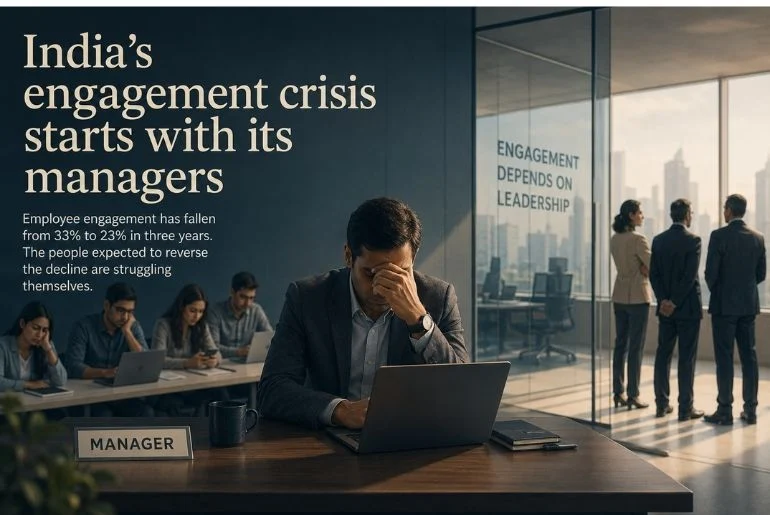
India’s pervasive workplace disengagement problem has now been quantified with an alarming price tag, revealing a profound economic challenge that extends far beyond traditional human resources concerns. Gallup estimates that this widespread disengagement costs the country a staggering $351 billion annually, an amount equivalent to approximately Rs 32.7 trillion, or a substantial nine per cent of India’s Gross Domestic Product (GDP). This startling revelation, detailed in the comprehensive report "Rebuilding Indian Workplaces for the Future 2026," produced in collaboration with the Institute of Directors India, fundamentally reframes what has historically been perceived as a nebulous "people-and-culture problem" into a concrete, urgent economic imperative.
The report underscores a dramatic deterioration in employee engagement across the Indian workforce over a relatively short period. In 2022, employee engagement stood at 33 per cent. By 2025, this figure had plummeted to a mere 23 per cent. Concurrently, the proportion of employees classified as "not engaged"—those who fulfil basic job requirements but invest little to no discretionary effort—surged from 46 per cent to an overwhelming 59 per cent during the same timeframe. This critical shift indicates that India’s primary workplace challenge is not a small contingent of actively hostile or disruptive employees, but rather a vast, quietly indifferent majority that now comprises well over half of the nation’s workforce. This silent erosion of commitment has profound implications for India’s productivity, innovation, and long-term economic growth trajectory.
The Alarming Decline: A Chronology of Disengagement
The period between 2022 and 2025 marks a critical juncture for the Indian workplace. The initial figure of 33 per cent engagement in 2022, while not exemplary, suggested a significant portion of the workforce was invested. However, the subsequent fall to 23 per cent by 2025 indicates a rapid and concerning decline. This period coincides with significant global and national workplace disruptions. The lingering effects of the COVID-19 pandemic continued to reshape work models, accelerating the adoption of hybrid work arrangements. Economic uncertainties, supply chain disruptions, and geopolitical shifts contributed to a volatile business environment. Furthermore, the rapid advancements and integration of artificial intelligence (AI) began to instigate anxieties and shifts in job roles, adding another layer of complexity to employee experience. While no single factor can fully explain the decline, these macro trends undoubtedly contributed to a climate where employee connection and motivation became harder to sustain.
The rise in "not engaged" employees from 46 per cent to 59 per cent is particularly troubling. These individuals are not actively undermining the organisation, but their lack of discretionary effort means they are unlikely to go above and beyond, contribute innovative ideas, or passionately champion their company’s goals. This pervasive indifference can manifest in subtle but cumulative ways: missed opportunities for process improvements, slower adaptation to change, reduced customer satisfaction due to unenthusiastic service, and a general stagnation of organisational vitality. For a rapidly developing economy like India, which relies on its young and dynamic workforce to drive innovation and global competitiveness, this trend poses a significant threat to its ambitions.
The Managerial Malaise: A Critical Node of Failure
One of the most uncomfortable truths revealed by the data is the struggling state of those employees typically relied upon to foster engagement within the broader workforce: managers. Managers occupy an inherently complex and often awkward position within modern organisational structures. They are the critical bridge between strategic vision and daily execution, tasked with translating abstract corporate goals into actionable tasks, coaching individual performance, navigating organisational change, preserving company culture, and ensuring employees remain connected to an organisation whose priorities may be in constant flux. When managers are engaged and effective, they act as powerful multipliers of positive influence. Conversely, when they themselves are disengaged, even the most well-intentioned engagement programmes designed at higher levels have limited impact.
The report highlights a concerning decline in manager engagement in India, falling from 39 per cent in 2024 to a mere 30 per cent in 2025. This parallel decline with individual contributor engagement, which also fell from 24 per cent to 19 per cent over the same period, is highly significant. While the data does not establish a direct causal link, the synchronous movement strongly suggests a deep interdependence. Managers are arguably the strongest single organisational influence on an employee’s daily experience of work, making their disengagement a powerful indicator of broader systemic issues.
This "manager problem" is not unique to India; it reflects a global trend where the managerial role has become increasingly arduous. Managers worldwide are caught in a perpetual balancing act, mediating between the often-conflicting demands of executive leadership and the evolving expectations of their teams. They are simultaneously expected to steer their teams through frequent restructurings, adapt to hybrid work models, oversee the adoption of new technologies like AI, and operate within increasingly tighter resource constraints. The responsibilities of the managerial role have expanded significantly faster than organisations have redesigned the role itself, leading to widespread burnout and disengagement among this crucial demographic.
Adding to this predicament is a pervasive lack of adequate training. Globally, only 44 per cent of managers have received formal management training, a statistic that underscores a fundamental oversight in talent development. The "Rebuilding Indian Workplaces for the Future 2026" report explicitly points to substantially better outcomes in engagement and performance among managers who have undergone formal training, particularly those focused on coaching methodologies. This stark contradiction—organisations routinely identifying managers as the linchpin for engagement while simultaneously treating the capability to manage as an innate quality acquired simply by being promoted—is difficult to reconcile and lies at the heart of the crisis.
The Cultural Undercurrents of Indifference
When members of the Institute of Directors were surveyed on the primary drivers behind the rise of "quiet quitting"—a phenomenon where employees do the bare minimum required by their job description without enthusiasm or extra effort—a significant 42 per cent attributed it to weak organisational culture or a profound misalignment with core company values. This insight decisively shifts the explanatory focus from individual employee attitudes to the environmental conditions within which those attitudes are cultivated.
Culture, in this context, is not an abstract concept but a tangible, visible force experienced daily by employees. It manifests through the behaviours that are overtly rewarded or tacitly condoned, the transparency and empathy with which difficult decisions are communicated, the consistency and authenticity of recognition practices, the quality of the immediate manager-employee relationship, and critically, the gap between what an organisation publicly declares its values to be and what it actually demonstrates through its actions. When this "say-do gap" becomes too wide, it erodes trust and makes it increasingly difficult for employees to justify investing discretionary effort. Engagement, no matter how strong initially, cannot indefinitely compensate for fundamental organisational inconsistency.
Managers are positioned directly within this tension. They are frequently expected to represent and champion decisions they may not have influenced, explain organisational changes they may not fully comprehend, and maintain team morale and confidence during periods of disruption that are entirely beyond their control. Consequently, an organisation can experience a severe manager-engagement problem without necessarily having "bad managers." The issue often stems from a flawed organisational design that burdens managers with immense accountability without providing them with equivalent levels of capability, crucial information, or the necessary authority to fulfil their roles effectively.
The Promotion Paradox: Rewarding Past Performance, Punishing Future Potential
Another critical finding from the Institute of Directors survey illuminates one of management’s most enduring and detrimental structural mistakes. Forty-one per cent of IOD members advocate for senior leaders to select managers based on demonstrable talent and genuine role fit, rather than merely on their past performance as individual contributors. This highlights the widespread, yet often unexamined, practice of treating success in a specialised, individual capacity as automatic evidence of an ability to lead and manage others.
The fundamental fallacy lies in the assumption that the two roles—individual contributor and manager—require the same capabilities. Technical excellence, while crucial for personal output, is distinct from the ability to produce results through other people. The competencies essential for effective management—such as coaching, sound judgment, providing constructive feedback, resolving conflicts, and fostering accountability without eroding trust—do not automatically materialise alongside functional expertise. A brilliant salesperson may excel at closing deals independently, but leading a sales team requires motivating, developing, and coordinating a group of diverse personalities. A talented engineer might produce groundbreaking designs, but managing a team of engineers demands mentorship, delegation, and problem-solving through collaboration. A high-performing HR professional might navigate complex policies, but leading an HR team requires strategic vision and interpersonal finesse.
Yet, promotion remains the predominant mechanism through which many organisations "manufacture" managers. A top-performing salesperson is given a sales team; a technically gifted engineer is tasked with leading other engineers; an exemplary HR professional is placed in charge of an HR team. This promotion, while intended as a reward for past excellence, often inadvertently transforms the fundamental nature of their future job without adequate preparation. When this transition succeeds, the organisation gains a capable leader and retains a valuable contributor. However, when it fails, the organisation suffers a double loss: it loses an excellent individual contributor and gains a struggling, potentially demotivated, and ineffective people leader. The ramifications extend far beyond the individual manager, as a poorly equipped manager invariably shapes the daily experience, productivity, and engagement of every single person reporting to them. The capability of managers, therefore, represents an unusual and potent talent investment, one whose positive or negative effects multiply exponentially throughout the entire organisation.
The Unignorable Cost of Indifference
The estimated $351 billion cost of disengagement makes it impossible to dismiss workplace quality as a mere "cultural nicety" or an issue solely for HR departments. At nine per cent of India’s GDP, the implied productivity loss is substantial enough to elevate workplace quality and employee engagement to the same level of strategic importance as more conventional economic concerns like inflation, investment rates, or trade balances. This economic drain represents lost potential, missed innovation, and a significant drag on India’s overall economic dynamism.
While the aggregate national figure is stark, its true utility lies in what it represents at the micro-level. Disengagement is not an abstract concept; it is experienced in tangible ways, organisation by organisation, team by team, and manager by manager. It manifests as a palpable lack of discretionary effort, a measurable decline in productivity, higher rates of employee turnover, and a workforce that performs the bare minimum required by their job descriptions without contributing anything beyond it.
The steep fall in India’s engagement from 33 per cent in 2022 to 23 per cent in 2025 occurred amidst a backdrop of considerable workplace disruption. The accelerating shift towards hybrid work models, the constantly evolving expectations of employees regarding flexibility and purpose, frequent organisational restructurings, and the pervasive emergence of generative AI have collectively reshaped the fundamental relationship between employees and their organisations. While these factors contribute to the complexity of the current landscape, none, in isolation, fully explains the dramatic decline in engagement.
Instead, the manager data points towards a fundamental structural vulnerability within Indian organisations. There has been a discernible trend of placing ever-increasing responsibility for the employee experience squarely in the middle of the organisational hierarchy—on the shoulders of managers—without making the commensurate and necessary investment. This investment gap spans critical areas: who is selected to become a manager, how they are formally prepared and developed for this complex role, and what genuine authority and support they are granted once they assume the position.
Beyond HR: A Leadership Imperative
The "Rebuilding Indian Workplaces for the Future 2026" report is intentionally directed at boards and senior leadership, a decision that is both appropriate and necessary. While employee engagement metrics may typically reside on the HR dashboard, many of the foundational conditions that foster or hinder engagement are determined by decisions made far beyond the purview of the HR department. These include overarching organisational design, the visible behaviours and priorities of senior leadership, the strategic approach to management selection, the allocation of critical resources, and the overall credibility and consistency of decisions made at the very top of the hierarchy.
HR departments are equipped to measure engagement effectively and to develop comprehensive training programmes for managers. However, HR cannot independently repair a deeply flawed organisational culture that is routinely contradicted by the actions and behaviours of senior leadership. Nor can HR unilaterally bestow upon managers the authority, information, and support that rigid organisational structures or top-down decision-making processes implicitly deny them.
This crucial distinction leads to an inescapable conclusion: India’s pervasive employee disengagement problem is more accurately understood as a profound leadership challenge that merely manifests and becomes visible in HR data. The immediate temptation for many organisations, upon confronting falling engagement scores, is often to implement another employee survey, launch a new wellbeing initiative, or roll out another programme designed to make employees "feel more connected." However, the data strongly suggests that the more difficult, yet ultimately more impactful, questions reside at a level above the individual employee.
The critical inquiry becomes: "Who is managing the managers?" Organisations have, for years, diligently tasked their managers with the responsibility of creating engaged teams. The more urgent, foundational task now appears to be creating a cohort of managers who are themselves capable, adequately supported, and sufficiently engaged to effectively lead and inspire their teams. Addressing this systemic leadership failure is not merely a human resources initiative; it is an economic imperative for India’s future prosperity.








