The proliferation of artificial intelligence in recruitment processes has spurred a complex and rapidly evolving regulatory environment. While many compliance checklists offer a superficial treatment of AI hiring laws, grouping them under a single umbrella with uniform urgency, this approach is fundamentally flawed. Each piece of legislation represents a distinct set of obligations, operating on separate timelines, and demanding unique definitions of compliance. Employers operating across state lines and international borders must recognize these differences to avoid critical missteps that could lead to regulatory penalties or damage candidate relationships. This article delves into the nuances of four prominent AI hiring laws in New York City, Illinois, Colorado, and the European Union, highlighting their distinct requirements, developmental trajectories, and the strategic implications for businesses.
The Unsettled Terrain of AI Hiring Regulation
The simplistic approach of treating all AI hiring laws as a monolithic category is a recipe for obsolescence. As demonstrated by recent legal challenges and legislative amendments, these frameworks are dynamic. A law can be blocked by a federal court before its effective date, or its most impactful provisions can be delayed, with those delays subsequently codified into law. For companies engaged in multi-state or international hiring, this isn’t a matter of trivial detail; it’s about understanding four separate obligations, each with its own compliance calendar and definition of adherence. Misinterpreting a single deadline can result in inadvertently informing candidates or regulators that a control is in place when it is not, or conversely, asserting that a control is not applicable when it already is. This necessitates a granular understanding of each jurisdiction’s specific regulatory demands.
New York City Local Law 144: A Pioneering Framework in Effect
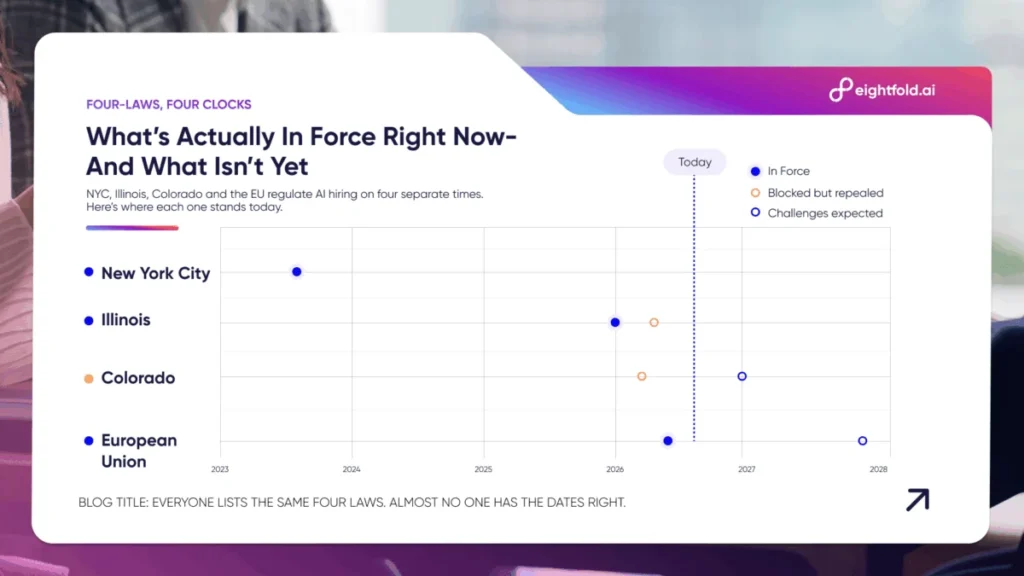
New York City’s Local Law 144 stands as the most mature of the examined AI hiring regulations, having been in effect since July 5, 2023. This law mandates that any automated employment decision tool (AEDT) used for evaluating candidates for roles based in New York City must undergo an independent bias audit annually. The findings of these audits, including selection rates and impact ratios categorized by race, ethnicity, and sex, must be published in a publicly accessible format. Candidates are also entitled to a separate notice at least ten business days before an AEDT is utilized, along with instructions on how to request an alternative selection process.
The law is enforced by the New York City Department of Consumer and Worker Protection. A critical component of compliance is the ongoing requirement for a current bias audit. The absence of such an audit renders a tool non-compliant, irrespective of its performance metrics. The publication of audit summaries and the provision of candidate notices are not merely procedural; they are integral to the law’s aim of transparency and fairness in AI-driven hiring. Eightfold’s own NYC disclosure exemplifies the vendor-side approach to meeting these transparency requirements, detailing the compliance measures integrated into their matching models. The annual nature of the audit underscores the need for continuous monitoring and adaptation, as AI models and their outputs can shift over time.
Illinois HB 3773: Integrating AI into Existing Anti-Discrimination Law
Illinois’s approach, outlined in HB 3773, takes a different tack, folding AI-assisted employment decisions directly into the state’s existing Human Rights Act. This legislation, effective January 1, 2026, focuses on notification and the prohibition of discriminatory outcomes, rather than establishing a new audit regime. Employers are required to inform candidates when AI plays a role in hiring, promotion, discipline, or discharge decisions. Crucially, the law emphasizes that a discriminatory outcome stemming from AI is not a novel AI-specific violation; it is prosecuted under the same framework as human-driven discriminatory decisions, a framework that the state has enforced for decades. The principle that "the algorithm decided, not us" is explicitly not a viable defense.
A significant development in Illinois’s regulatory landscape occurred in June 2026 when the Illinois Department of Human Rights withdrew its proposed implementing rules. This withdrawal was attributed to a need for continued coordination with other state agencies, and a revised timeline for these rules has not yet been provided. Despite the delay in finalized regulatory detail regarding specific notice language or timing, the statute’s core duties concerning notification and non-discrimination remain fully applicable. This situation highlights the ongoing nature of regulatory development, where the underlying legislative intent persists even as the granular implementation details are being refined. Employers must remain vigilant for updated guidance to ensure full compliance with the finalized rules.
Colorado Senate Bill 26-189: A Recalibrated Approach to AI Governance
Colorado’s journey with AI regulation has been marked by significant shifts. The original Colorado AI Act (SB 24-205), enacted with stringent requirements including mandatory impact assessments, an explicit duty to prevent algorithmic discrimination, and ongoing risk-management programs, never took effect as written. In April 2026, a federal court blocked its enforcement following a constitutional challenge. Faced with this legal pressure and industry pushback, Colorado’s legislature repealed the original act and introduced Senate Bill 26-189, which was signed into law in May 2026.
The revised framework, effective January 1, 2027, is considerably less prescriptive. It mandates advance notice to individuals before the use of "covered automated decision-making technology." Furthermore, within 30 days of an adverse decision, individuals are entitled to a plain-language explanation. The law also grants a right to request data correction and a right to request human reconsideration, albeit with the significant qualifier "to the extent commercially reasonable." This caveat means that the unconditional guarantee of human review is absent. Legal challenges to this new version are reportedly anticipated, underscoring the volatile nature of AI regulation in Colorado. Therefore, the January 2027 effective date should be viewed as a target rather than a settled certainty. The shift from comprehensive assessment and risk management to notice and recourse reflects a recalibration of the state’s regulatory priorities in response to legal and industry feedback.
The European Union AI Act: A Comprehensive Framework for High-Risk Applications
The European Union’s AI Act represents a comprehensive regulatory effort to govern artificial intelligence across member states. While the full scope of the Act is broad, its implications for AI in hiring are particularly significant. High-risk hiring obligations, as defined within Annex III of the Act, are set to become effective on December 2, 2027, following a deferral through the Digital Omnibus Regulation (EU) 2026/1744, which entered into force in July 2026. This delay pushed these specific obligations from an initial August 2026 date.
The obligations for high-risk AI systems in recruitment and employee evaluation include mandatory risk management, detailed technical documentation, human oversight mechanisms, and formal conformity assessments. Importantly, Article 50 of the Act, concerning transparency duties, was not subject to this deferral. This means that candidates interacting with an AI interviewer within the EU should already be informed that they are engaging with an AI system. Non-compliance with high-risk provisions carries substantial financial penalties, potentially reaching up to €15 million or 3% of global annual turnover, placing it in the middle tier of enforcement actions, below the ceiling reserved for banned AI practices. The EU’s approach, akin to product safety regulations, requires rigorous pre-market assessment and ongoing compliance, treating AI systems as potentially impactful technologies requiring thorough vetting.
The Enduring Baseline: Federal Anti-Discrimination Laws
It is crucial to underscore that none of these emerging AI-specific regulations supersede existing federal anti-discrimination laws in the United States. Title VII of the Civil Rights Act of 1964, the Americans with Disabilities Act (ADA), and the Age Discrimination in Employment Act (ADEA) continue to apply to covered employers, regardless of whether a human or an AI tool makes a hiring decision. These statutes prohibit employment discrimination for employers meeting specific employee thresholds (15 or more for Title VII and ADA, 20 or more for ADEA).
The Equal Employment Opportunity Commission (EEOC) provides guidance that complements these statutes. Its 2022 ADA technical assistance and 2023 Title VII guidance address the risks associated with algorithmic bias. However, these guidance documents are not enacted laws themselves. Furthermore, an AI vendor’s audit results do not absolve an employer of its own responsibility and potential liability under these federal anti-discrimination laws. The employer remains accountable for ensuring that its hiring practices, even those augmented by AI, are free from unlawful discrimination.
Diverse Regulatory Levers, Unified Employer Imperative
When examined side-by-side, the differences between these AI hiring laws are not superficial but structural. New York City’s Local Law 144 mandates an audit-and-publish approach, requiring annual public disclosure of recruitment metrics. Illinois’s HB 3773 integrates AI into its existing civil rights framework, meaning AI-assisted decisions are adjudicated similarly to human decisions. Colorado’s revised SB 26-189 focuses on notice-and-recourse, requiring advance notification, post-decision explanations, and conditional human review. The EU AI Act adopts a product-safety model, demanding classification, documentation, and pre-market assessment for high-risk AI systems.
While the underlying concern across all these jurisdictions is the prevention of bias and discrimination in AI-driven hiring, the methods of achieving this are fundamentally different. This divergence means that a vendor or employer adept at navigating one regulatory landscape may not be prepared for the complexities of another. A holistic compliance strategy must account for the distinct "levers" each law employs to hold employers accountable.
Constructing a Dynamic AI Hiring Compliance Strategy
The rapid evolution of AI hiring laws necessitates a dynamic and adaptable compliance strategy. A static checklist published today may be outdated by tomorrow, given the fluidity of legislative and judicial actions. Employers must:

- Maintain a Comprehensive Regulatory Map: Continuously track the status and effective dates of AI hiring laws in all relevant jurisdictions where they operate or hire. This map should include not only enacted laws but also proposed legislation and significant court rulings.
- Understand Jurisdictional Nuances: Recognize that each law has unique requirements for notice, audit, transparency, data protection, and recourse. Generic compliance measures are insufficient.
- Foster Cross-Functional Collaboration: Ensure that legal, HR, IT, and compliance departments are working in concert to interpret and implement AI hiring regulations.
- Prioritize Vendor Due Diligence: Scrutinize AI vendors to ensure their tools and processes align with the specific requirements of each applicable jurisdiction. Contracts should clearly delineate responsibilities and liabilities.
- Invest in Ongoing Training and Education: Regularly educate relevant personnel on the latest AI hiring regulations and best practices for ethical AI use in recruitment.
- Consult with Legal Counsel: Given the complexity and evolving nature of these laws, regular consultation with legal experts specializing in employment law and technology is indispensable.
Unanswered Questions and the Path Forward
Despite the progress in establishing AI hiring regulations, significant questions remain. None of these laws definitively articulate what constitutes a "valid" bias audit—the requisite sample size for statistically meaningful results, or the distinction between genuine bias and coincidental data variations. These are not purely legal questions but complex statistical and methodological challenges that are often inadequately explained in public discourse.
Furthermore, the effective dates of these laws are subject to change, as evidenced by the shifts in Colorado and the EU. Employers must treat these dates as provisional and continuously verify the current statutory text before implementing any compliance measures. The information presented here serves as a guide, not a substitute for professional legal counsel.
Frequently Asked Questions on AI Hiring Compliance
Does a later EU deadline delay a live NYC or Illinois obligation?
No. Each jurisdiction’s timeline operates independently. Employers must adhere to all applicable deadlines currently in force, irrespective of pending regulations elsewhere.
Is an employer responsible for a vendor’s tool?
Yes. While vendor contracts may allocate specific tasks, they do not absolve the employer of its employment law responsibilities. Human oversight remains critical at material decision points.
Is a Local Law 144 alternative process the same as an ADA accommodation?
No. These are distinct processes handled separately. One does not substitute for the other.
What do staffing firms need to know?
Under the EU AI Act, firms that develop or significantly modify AI tools are considered "providers" with documentation duties. Those that merely use them for recruitment are "deployers" subject to the provider’s instructions. Both roles entail responsibilities that should be clearly defined in contracts with legal counsel.
How does location affect coverage?
Employers must consider the candidate’s location, the role’s location, and the employer’s operational footprint. For instance, NYC coverage can depend on the job’s base location, even if interviews occur remotely. Remote work scenarios are highly jurisdiction-specific and require consultation with legal counsel.
What if an NYC audit is older than 12 months?
The AEDT cannot be used for covered NYC hiring activities until a current, independent bias audit is completed and the required summary is published.
How often should this regulatory map be reviewed?
At a minimum, quarterly. It should also be reviewed before deploying any new AI tool or expanding into new role locations, as these regulatory timelines are dynamic and outpace annual policy cycles.