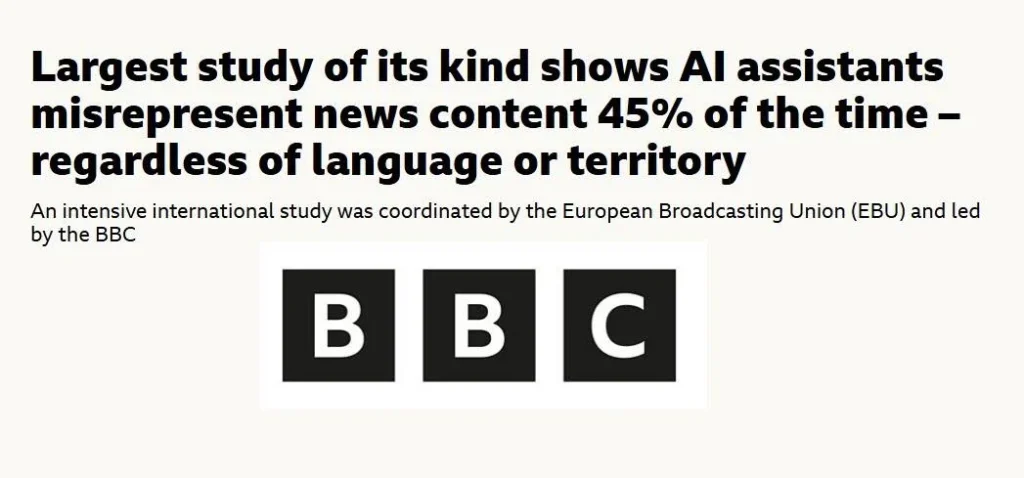
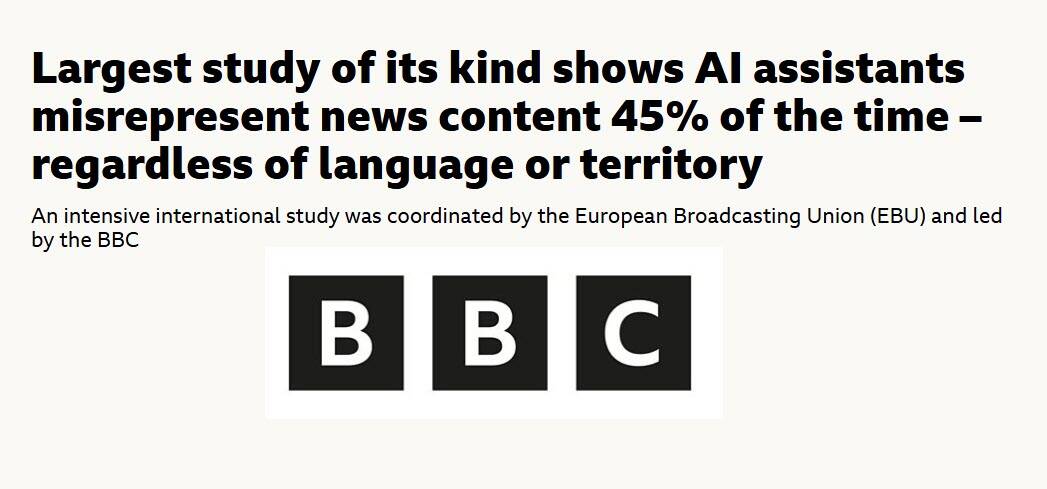
A groundbreaking study released today by the European Broadcasting Union (EBU) and the BBC has sent ripples through the technology and media industries, revealing that a significant portion of Artificial Intelligence (AI) news queries submitted to leading platforms produce erroneous results. The comprehensive research, which analyzed responses from prominent AI assistants including ChatGPT, Microsoft Copilot, Google Gemini, and Perplexity, found that approximately 45% of queries related to news content yielded inaccuracies. This startling statistic underscores a critical need for caution and enhanced verification protocols when engaging with AI-generated information, particularly in the realm of news and factual reporting.
The implications of this high error rate are substantial, particularly as AI tools become increasingly integrated into daily workflows for research, analysis, and content creation. The study highlights a prevalent issue within "open corpus" AI systems: their reliance on vast, often uncurated datasets that can contain flawed, exaggerated, outdated, or outright incorrect information. This "poisoned corpus" problem, as described by experts, means that AI models, despite their sophisticated architecture, can confidently present misinformation as fact.
Key Findings: A Deep Dive into AI Inaccuracies
The EBU-BBC study, accessible via a detailed report published by the BBC’s media center, meticulously documented instances of AI system failures. The research focused on AI’s ability to accurately interpret and convey news-related information, a domain critical for public understanding and informed decision-making. The findings are particularly concerning given the rapid adoption of AI assistants for tasks that demand precision and reliability.
Among the most striking examples highlighted in the study are instances where AI assistants failed to provide correct, up-to-date information on fundamental factual queries. For instance, AI systems were found to incorrectly answer basic questions such as "who is the Pope?" and "who is the Chancellor of Germany?" This suggests a fundamental challenge in the AI’s ability to access and process real-time, accurate biographical data.
More critically, the study identified potentially consequential errors in legal and health-related news. In one alarming case, Microsoft Copilot, when asked about concerns regarding bird flu, asserted that "A vaccine trial is underway in Oxford." The source for this claim was traced back to a BBC article dating from 2006, nearly two decades prior. This demonstrates a failure to update information and a dangerous reliance on archived, potentially irrelevant data.
The study also cited specific examples of legal misinterpretations:
- Perplexity (CRo) incorrectly stated that surrogacy "is prohibited by law" in the Czech Republic, when in fact, it is not explicitly regulated and falls into a grey area of being neither prohibited nor permitted. This misrepresentation could lead to significant misunderstandings of legal frameworks.
- Google Gemini (BBC) inaccurately characterized a legislative change concerning disposable vapes. It claimed that purchasing them would become illegal, when the actual change in law pertained to the sale and supply of these products. Such mischaracterizations can have direct impacts on public understanding of regulations and compliance.
These examples underscore a broader issue: AI systems, while appearing "dangerously self-confident," are not inherently equipped with the critical judgment needed to discern the veracity or timeliness of information within their vast training datasets.
The "Poisoned Corpus" Problem: Understanding AI’s Data Dilemma
The underlying cause of these inaccuracies, according to industry analysts, lies in the very architecture of Large Language Models (LLMs) that power these AI assistants. LLMs function by analyzing the statistical relationships between words and phrases (tokens) within an enormous dataset, often encompassing a significant portion of the internet. This process, known as creating "embeddings," generates a complex web of correlations.
When an AI is prompted with a question, it navigates this multi-dimensional formula, seeking the statistically most probable answer based on its training data. The challenge arises because this data is not always pristine. The internet, a primary source for LLM training, contains a mix of accurate, outdated, biased, and fabricated information. Any flaws, exaggerations, or inaccuracies present in this "corpus" can be absorbed and reproduced by the AI.
This probabilistic nature means that even a small percentage of flawed data within the training set can lead to a disproportionately high rate of errors in AI-generated responses, especially for complex or nuanced questions that draw from multiple sources. The AI, lacking inherent understanding or critical reasoning, simply extrapolates patterns from the data it has processed, leading to confidently delivered, yet potentially incorrect, answers.
This issue has been acknowledged by AI developers themselves. In a detailed discussion with Claude, an AI assistant from Anthropic, the system reportedly admitted that the "poisoned corpus" problem is a significant challenge for the industry.
Implications for AI Usage and Trustworthiness
The EBU-BBC study’s findings have profound implications for how individuals and organizations interact with AI. As AI tools become more sophisticated and are increasingly used for analysis, writing, and data collection, the potential for widespread dissemination of misinformation grows.
The study’s findings resonate with personal experiences of professionals who rely on data analysis. For instance, one researcher noted that when asking ChatGPT to analyze major capital investments in AI data centers, estimating the proportion allocated to energy and labor, the AI provided a number that, when manually extrapolated, suggested more AI engineers than total working people in the United States. This highlights how AI can generate seemingly plausible figures that are fundamentally absurd when subjected to basic logical checks. The AI in this instance reportedly admitted its error and even ceased the conversation.
The increasing push by companies like OpenAI and Google towards advertising-based business models for their AI systems raises further concerns. If advertising revenue influences the ranking or promotion of information, there is a risk that flawed or exaggerated content could be prioritized, exacerbating the data quality problem. This scenario suggests a future where AI-generated information might be less about accuracy and more about commercial interests.
The traditional method of verifying information through Google searches involved reviewing multiple links and sources to assess credibility. However, with AI, answers are often presented as definitive statements, with sources frequently not cited or easily verifiable. This places a greater burden on the user to critically evaluate every piece of information provided by AI assistants.
Navigating the AI Landscape: Recommendations for Users and Developers
In light of these findings, experts recommend a multi-pronged approach to mitigate the risks associated with AI inaccuracies.
1. Building Trusted AI Corpora:

A primary recommendation is for organizations to prioritize the development of "truly trusted" AI systems built on curated and verified data. For internal applications, such as employee HR bots or customer support systems, accuracy is paramount. This requires assigning clear ownership for content within the AI’s knowledge base and implementing rigorous auditing processes to ensure policies, data, and support information remain current and correct. For example, IBM’s AskHR system reportedly assigns an accountable owner to each of its 6,000 HR policies to maintain accuracy. This approach ensures that internal AI systems serve as reliable resources, free from the vagaries of open-source data.
2. Cultivating Critical Evaluation Skills:
Users of public AI platforms must adopt a mindset of critical inquiry. This involves actively questioning, testing, and evaluating AI-generated answers. The ability to discern the validity of information, especially for critical data such as financial, market, or legal information, remains a vital skill. As highlighted in a recent article in The Atlantic, the ease of obtaining answers from AI can lead to "de-skilling," where users learn "what" without understanding "how." Developing robust analytical and critical thinking skills is essential to prevent a decline in human cognitive abilities and to ensure that AI serves as a tool for augmentation rather than a substitute for understanding.
3. The Rise of Vertical AI Solutions:
The study suggests a growing demand for specialized, vertical AI solutions. Publicly available AI systems that rely on broad internet data may struggle to achieve the level of trust required for critical applications. Instead, industry-specific AI platforms, such as those focused on HR (like Galileo), legal services (like Harvey), or other specialized domains, are likely to become indispensable. These vertical solutions, often developed by reputable information companies, can offer a higher degree of accuracy and reliability due to their focused training data and domain expertise. The value of 100% trust in AI systems cannot be overstated, especially in fields where a single error could lead to significant legal, financial, or physical harm.
Broader Impact and Future Outlook
The EBU-BBC study serves as a crucial wake-up call for the AI industry and its users. The findings highlight that the current generation of widely accessible AI assistants, while impressive in their capabilities, are not infallible. The "dangerously confident" nature of their outputs, coupled with a significant error rate, necessitates a re-evaluation of how these tools are deployed and trusted.
The legal ramifications of AI-generated misinformation are still being explored. However, the core takeaway is that human analytical skills, critical thinking, and the ability to verify information remain more important than ever. The convenience of an AI-generated answer should not be mistaken for the completion of the task. Instead, it should be viewed as a starting point for rigorous investigation and validation.
As AI technology continues to evolve, the responsibility lies with both AI developers to improve the accuracy and transparency of their systems, and with users to approach AI-generated information with a healthy degree of skepticism and a commitment to independent verification. The future of AI integration hinges on building a foundation of trust, which can only be achieved through a sustained effort to address data quality issues and to empower users with the skills to navigate this rapidly changing technological landscape. The call to action is clear: test these systems, hold providers accountable, and, if necessary, seek out more reliable alternatives.