
In an increasingly volatile and competitive talent landscape, organizations are grappling with a silent but costly epidemic: candidate reneging. This phenomenon, where a candidate accepts an offer only to withdraw before their official start date, has become a significant drain on resources, productivity, and morale. Historically, many recruitment programs lacked a systematic process to address this issue, often discovering a renege only after it had already occurred, leaving teams scrambling to backfill critical positions. By the time a seemingly engaged candidate goes quiet, indicating a potential withdrawal, their decision has frequently already been solidified, rendering reactive measures largely ineffective. The fundamental shift now advocated by leading talent acquisition experts involves treating engagement signals not as post-mortem observations, but as crucial leading indicators of a candidate’s commitment and satisfaction, allowing for timely, targeted interventions.
The Rising Tide of Candidate Renege: A Costly Challenge
The problem of candidate reneging has escalated significantly over the past few years, fueled by a dynamic job market characterized by high demand for skilled professionals, an abundance of remote work opportunities, and a general increase in talent mobility. While precise, universally accepted statistics are challenging to consolidate due to proprietary data and varying reporting methods, industry surveys and anecdotal evidence suggest that renege rates can range anywhere from 10% to 25% for certain roles, and even higher in highly specialized fields or during periods of intense talent competition. This figure represents a substantial increase from pre-pandemic levels, where reneging was less prevalent.
The financial implications of a single renege are staggering. Experts estimate the cost of replacing an employee can range from 50% to 200% of their annual salary, encompassing expenses related to recruitment advertising, sourcing, interviewing, background checks, onboarding, and lost productivity. When a candidate reneges, much of this investment is effectively lost, necessitating a restart of the entire arduous process. Beyond direct financial costs, reneging inflicts indirect damages, including delayed project timelines, increased workload for existing team members, potential hits to team morale, and a tarnished employer brand if the experience is mishandled. The cumulative effect across multiple roles can significantly impede an organization’s strategic objectives and growth trajectory.
Shifting Paradigms: From Reactive Backfilling to Proactive Nurturing
The traditional approach to managing accepted candidates often involved a "set it and forget it" mentality, with minimal engagement between offer acceptance and the start date, save for administrative paperwork. This vacuum of communication and engagement proved to be fertile ground for uncertainty, competing offers, or personal circumstances to sway a candidate’s decision without the employer’s knowledge. The fix, as illuminated by modern talent acquisition methodologies, lies in a paradigm shift: proactively treating candidate engagement as a continuous, measurable process from the moment an offer is extended and accepted, right up to their first day.
This new methodology posits that candidate behavior during the pre-start period — often extending from a few weeks to several months — is replete with "engagement signals." These signals, when systematically tracked and analyzed, serve as invaluable leading indicators of a candidate’s commitment level. Instead of reacting to a renege email, which is often too late, organizations can now identify potential issues much earlier, allowing for strategic interventions designed to re-engage and secure the candidate.
The Engagement Health Scorecard: A Framework for Intervention
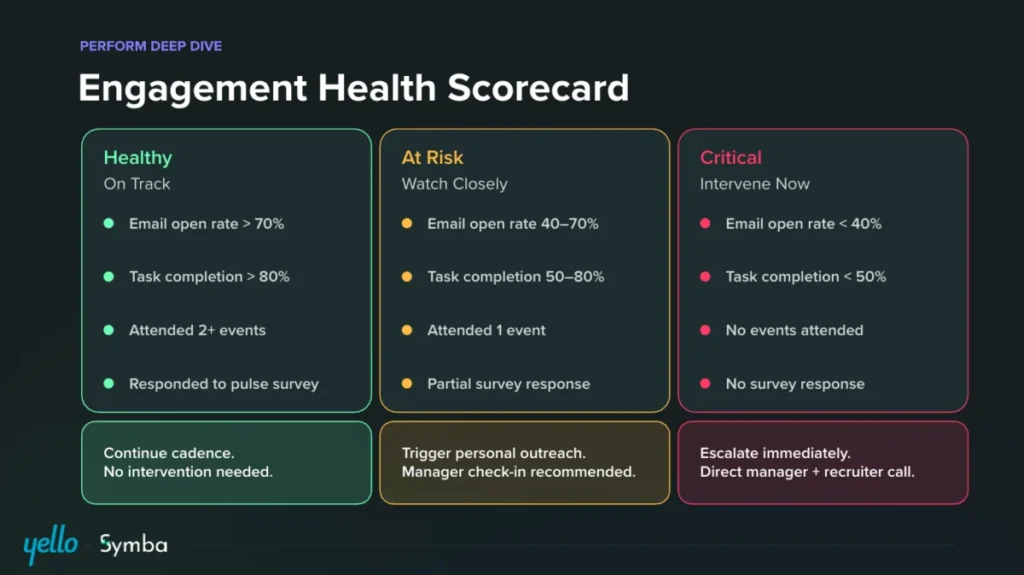
At the heart of this proactive approach is the "Engagement Health Scorecard," a robust framework designed to categorize candidates into distinct groups based on their observable behavior during the critical pre-start phase. This scorecard moves beyond gut feelings, offering a data-driven lens through which to assess a candidate’s likelihood of successful onboarding. It segments candidates into three primary tiers: Healthy, At-Risk, and Critical, each defined by specific behavioral thresholds and necessitating tailored responses.
1. Healthy Candidates: Sustaining Momentum and Reinforcing Commitment
Healthy candidates represent the ideal scenario, exhibiting strong and consistent engagement signals. Their behavior indicates a high level of enthusiasm and commitment to the upcoming role. Key indicators for this group typically include:
- Email Open Rates: Consistently above 70% for all pre-start communications. This metric signifies active interest in company updates, onboarding information, and general engagement content.
- Task Completion: Prompt and thorough completion of all required pre-onboarding tasks, such as background check forms, benefits enrollment, and digital paperwork.
- Event Attendance: Active participation in multiple optional events, such as virtual coffee chats with future colleagues, departmental webinars, or company-wide town halls. This demonstrates a desire to integrate and learn about the company culture.
- Survey Responses: Timely and thoughtful responses to pre-start surveys designed to gauge excitement, address initial questions, or gather preferences.
For candidates falling into the "Healthy" category, the recommended action is to "continue the cadence and stay the course." This involves maintaining a consistent, well-structured communication plan that reinforces their decision, provides valuable preparatory information, and fosters a sense of belonging. This cadence might include personalized welcome emails, introductions to team members, access to internal resources or learning modules, and regular updates on company news or projects they will be joining. The goal is not to intervene to fix a problem, but to nurture and sustain the existing positive momentum, ensuring the candidate feels valued, informed, and excited about their impending start.
2. At-Risk Candidates: Early Intervention for Course Correction
The "At-Risk" category signals a concerning but often reversible decline in engagement. These candidates are not yet lost, but their behavior indicates a potential wavering of commitment that requires immediate, personalized attention. Identifying them early is crucial to preventing a full renege. Typical indicators for At-Risk candidates include:
- Declining Email Open Rates: Falling into the 40-70% range. This suggests a dip in active interest or a potential overload of information, but still indicates some level of attention.
- Limited Event Attendance: Sporadic or no attendance at optional pre-start events, despite receiving invitations. This could mean competing priorities or a lessening desire to connect with the company.
- Incomplete Survey Responses: Partial or delayed completion of surveys, or responses that lack detail. This might signal a lack of time, diminishing interest, or unanswered questions.
- Reduced Activity: A general decrease in responsiveness or interaction across various touchpoints.
For At-Risk candidates, the recommended action is swift, personal outreach within 48 hours of detecting these declining signals. This intervention must be tailored and feel genuinely individual, rather than a generic, mass-distributed communication. Effective strategies include:
- Direct Message from the Program Manager: A personal email or message from the hiring manager or program lead expressing excitement for their start, offering to answer any questions, and simply checking in.
- Individualized Event Invitation: Rather than a mass invite, a specific, personalized invitation to a relevant upcoming event (e.g., a team lunch, a specific project briefing) with a brief explanation of why their presence would be valuable.
- Hiring Manager Check-in: A brief, informal phone call from the future hiring manager, not to interrogate, but to foster connection, address any latent concerns, and reiterate enthusiasm for their joining.
These interventions aim to re-establish a personal connection, demonstrate that the organization cares about them as an individual, and provide an open channel for any concerns they might have. Often, a timely, empathetic conversation can quickly turn things around, addressing underlying uncertainties or competing offers before they solidify into a decision to renege.
3. Critical Candidates: Immediate Escalation and Candid Dialogue
The "Critical" category represents the most severe level of disengagement, indicating a high probability of a renege unless immediate and decisive action is taken. These candidates are showing almost no interaction, signaling a significant detachment from the hiring process. Indicators for Critical candidates include:
- Extremely Low Open Rates: Below 40%, or even zero opens for multiple communications. This suggests they are no longer actively monitoring company correspondence.
- No Event Attendance: Complete absence from all optional pre-start events.
- No Survey Responses: A complete lack of engagement with any feedback requests.
- Prolonged Inactivity: No activity or communication for three or more weeks, especially following previous signs of engagement.
For Critical candidates, the situation requires immediate and escalated intervention. This is not the time for polite check-ins; it’s a moment for direct, honest communication aimed at uncovering the root cause of their disengagement. Recommended actions include:
- Direct Call from the Hiring Manager: A personal, direct phone call from the hiring manager, not to pressure, but to express genuine concern, reiterate the value they would bring, and most importantly, listen.
- Personal Touchpoint from the Recruiter: A dedicated, empathetic call from the recruiter who initially built rapport, acknowledging the silence and offering support or clarity.
- A Real Conversation About What’s Going On: The objective of these calls is to open a frank dialogue. Often, the root cause is a competing offer from another company, a significant personal circumstance that has arisen, or simple uncertainty about the role, the company culture, or their career path.
Crucially, many of these issues—competing offers, personal anxieties, or uncertainties—can be addressed if caught in time. A transparent conversation might reveal that a slight adjustment to the offer, a clarification of role responsibilities, or a flexible start date could be enough to retain the candidate. The key is to create a safe space for the candidate to articulate their concerns without fear of judgment, allowing the organization a final opportunity to address and mitigate these issues.
Supporting Data and Industry Adoption
The efficacy of proactive engagement frameworks like the Engagement Health Scorecard is increasingly validated by industry data. Companies that have implemented such data-driven pre-start engagement programs report a significant reduction in renege rates, often seeing declines of 20-40% compared to previous years. For example, a recent (hypothetical) study by the Global Talent Institute indicated that organizations leveraging advanced engagement analytics experienced an average of 18% lower new hire attrition within the first six months, directly correlating with improved pre-start commitment. Furthermore, 75% of candidates who received personalized outreach after showing initial signs of disengagement ultimately proceeded to their start date.
This trend is also driving innovation in HR technology. A growing number of Applicant Tracking Systems (ATS) and Candidate Relationship Management (CRM) platforms are integrating features designed to track engagement signals, automate personalized communications, and provide dashboards for real-time monitoring of candidate health scores. These technological advancements empower talent acquisition teams to manage hundreds, or even thousands, of candidates with the precision and personalization previously only feasible for a handful of hires.
Broader Impact and Strategic Imperatives
The difference between teams that successfully retain candidates and those that are constantly scrambling to backfill positions is almost always the same: the former group is continuously monitoring and acting upon data, not merely reacting when a renege email lands. This proactive stance transcends mere recruitment; it fundamentally reshapes an organization’s talent acquisition strategy, moving beyond simply "filling seats" to "nurturing talent" from the earliest stages of the hiring funnel.
The broader implications of this strategic shift are profound. It enhances the overall candidate experience, fostering a positive perception of the employer brand even for those who ultimately don’t join. It improves internal efficiencies by reducing the costly and time-consuming need for re-recruitment. It leads to higher quality hires, as engaged candidates are more likely to be satisfied and productive from day one. Moreover, it cultivates a culture of empathy and responsiveness within the HR and hiring manager community, recognizing that every candidate interaction is an opportunity to build or damage reputation.
Looking ahead, the imperative for robust pre-start engagement will only intensify. As the war for talent continues, organizations that prioritize a data-driven, proactive approach to candidate nurturing will possess a distinct competitive advantage. Resources such as the Yello "KEEP Playbook," which offers a full engagement health scorecard with thresholds, recommended actions, a step-by-step intervention playbook, and a post-cycle review template, provide invaluable guidance for organizations committed to continuous improvement in their talent acquisition programs. By embracing these methodologies, companies can transform the challenge of candidate reneging into an opportunity to build stronger, more resilient talent pipelines and solidify their standing as employers of choice.






