The modern talent acquisition landscape presents an intricate challenge for organizations: securing top talent is only half the battle; retaining accepted candidates through the pre-start period has become an equally critical, yet often overlooked, phase. In an era characterized by dynamic job markets, multiple offers, and evolving candidate expectations, the phenomenon of "candidate reneging"—where an accepted offer is withdrawn by the candidate before their official start date—has escalated, posing significant operational and financial risks to businesses worldwide. Historically, many recruitment programs have lacked a structured process to address this vulnerability, often discovering a renege only after it has materialized, by which point the candidate has typically already committed elsewhere, rendering reactive measures largely ineffectual. This prevailing deficiency underscores the urgent need for a paradigm shift from reactive damage control to proactive, data-driven candidate engagement strategies.
The Rising Tide of Candidate Reneges: A Global Challenge
The prevalence of candidate reneges is not merely an anecdotal observation but a systemic issue exacerbated by several macro-economic and socio-professional trends. Industry reports and surveys from major talent acquisition platforms frequently highlight renege rates ranging from 10% to 20% across various sectors, with some high-demand fields experiencing even greater volatility. This phenomenon is particularly pronounced in technology, healthcare, and specialized engineering roles, where competition for skilled professionals is fierce. The cost of a single renege is substantial, extending far beyond the immediate recruitment expenses. Estimates suggest that replacing a lost candidate can cost an organization anywhere from 1.5 to 2 times the position’s annual salary, factoring in recruiter time, advertising costs, interview panel time, onboarding expenses, and the intangible costs of delayed project timelines, reduced team morale, and lost productivity. For critical roles, the ripple effect can disrupt strategic initiatives, impact revenue generation, and strain existing teams forced to absorb additional workload.
The underlying causes are multifaceted. A robust economy often empowers candidates with more options, leading to increased "shopping around" even after accepting an offer. The rise of remote and hybrid work models has broadened geographic search parameters, making it easier for candidates to entertain opportunities from anywhere, intensifying competition. Furthermore, the candidate experience itself plays a pivotal role; a disjointed or uncommunicative pre-boarding process can sow seeds of doubt, making candidates more susceptible to competing offers that project a more organized or appealing employer brand. Candidates are also more discerning, evaluating not just salary but company culture, growth opportunities, work-life balance, and alignment with personal values. Any perceived lack of engagement from the prospective employer during the crucial period between offer acceptance and start date can be interpreted as a red flag, prompting reconsideration.
Shifting from Reactive to Proactive: The Data-Driven Imperative
The conventional approach to managing accepted candidates often involves minimal interaction until closer to the start date, or only reaching out when a candidate goes silent. This reactive stance is inherently flawed because by the time a candidate disengages or stops responding, they have frequently made a firm decision to pursue an alternative path. The key to mitigating reneges lies in adopting a proactive, continuous engagement model that treats candidate interactions as leading indicators of their commitment and satisfaction. This shift necessitates a structured framework for monitoring and responding to engagement signals, transforming what was once an intuitive, often overlooked, phase into a strategic pillar of talent acquisition.
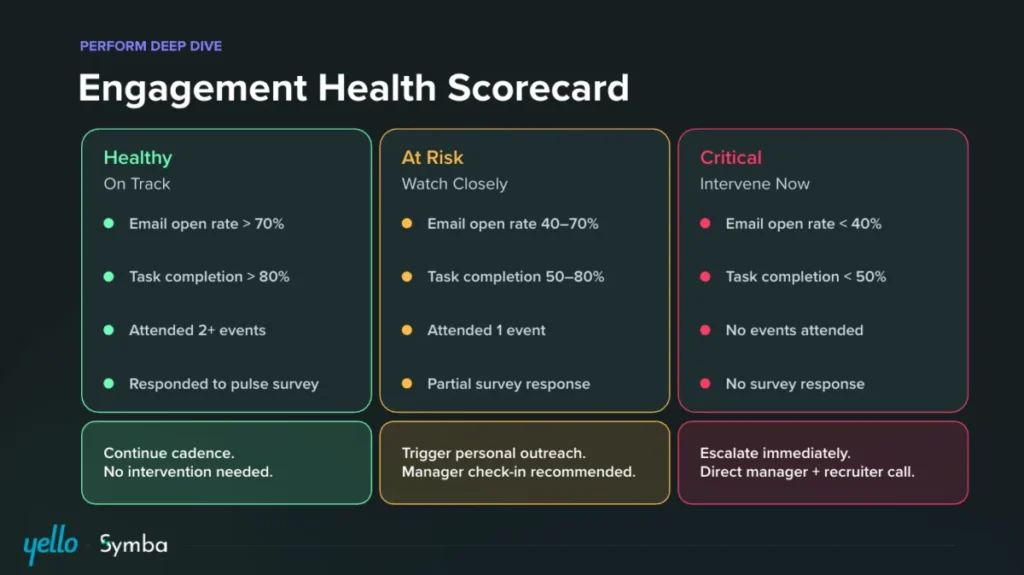
Central to this proactive strategy is the implementation of an "Engagement Health Scorecard." This sophisticated tool categorizes candidates into distinct groups based on their behavior and responsiveness during the critical pre-start period—the time frame spanning from offer acceptance to the candidate’s first day of employment. By systematically tracking various touchpoints and interactions, organizations can identify potential risks early and deploy targeted interventions, thereby significantly increasing the likelihood of successful candidate retention.
The Engagement Health Scorecard: A Framework for Continuous Monitoring
The Engagement Health Scorecard operates on the principle that consistent, measurable engagement reflects a candidate’s sustained interest and commitment. It establishes clear thresholds for various engagement metrics, allowing talent acquisition teams to objectively assess a candidate’s "health" and tailor their approach accordingly. This systematic framework transforms subjective observations into actionable data points, enabling timely and effective interventions.
1. Healthy Candidates: Sustaining Momentum and Reinforcing Commitment
- Behavioral Indicators: Candidates classified as "Healthy" exhibit consistently high levels of engagement. This typically includes email open rates exceeding 70%, prompt completion of pre-boarding tasks (e.g., background checks, paperwork, benefits enrollment), active participation in optional events (virtual meet-and-greets, team introductions, informational webinars), and timely, comprehensive responses to surveys designed to gauge their enthusiasm and address potential concerns. Their digital footprint often shows continued interest in the company’s public-facing content and a general positive demeanor in interactions.
- Strategic Approach: For these candidates, the primary objective is to maintain the positive momentum and reinforce their decision. The recommended action is to continue the established communication cadence, which might include regular updates about their start date, team introductions, company news, and insights into the company culture. This steady flow of relevant information keeps the candidate feeling valued and connected without overwhelming them. The focus is on nurturing their enthusiasm, providing necessary information efficiently, and ensuring a seamless transition into their new role. This sustained, positive interaction builds trust and reinforces their belief in the organization, making them less susceptible to external influences.
2. At-Risk Candidates: Early Detection and Personalized Intervention
- Behavioral Indicators: The "At-Risk" category signals a noticeable decline in engagement. This group typically displays email open rates falling within the 40-70% range, limited or sporadic attendance at optional pre-start events, incomplete or delayed responses to surveys, and a general reduction in overall interaction. While not entirely disengaged, their behavior suggests a potential waning of interest or the emergence of unaddressed concerns. This phase is critical because it represents a window of opportunity for intervention before the situation escalates.
- Strategic Approach: Identifying At-Risk candidates necessitates immediate, personalized outreach within a tight timeframe, ideally within 48 hours of detecting declining engagement. The intervention must feel individual and genuine, contrasting sharply with mass-distributed communications. Key actions include:
- Direct Message from the Program Manager: A personalized message from the program manager or hiring team lead, acknowledging the candidate’s journey and offering support, can be highly effective. This message should not be accusatory but rather express continued excitement and an open invitation for a brief, informal chat to address any questions or concerns.
- Individualized Event Invitation: Instead of generic invites, an explicit, personalized invitation to a relevant upcoming event—perhaps a casual coffee chat with a future colleague or a deep dive into a project they might join—can re-engage them. The emphasis should be on highlighting how this event directly benefits them or addresses their specific interests.
- Hiring Manager Check-in: A brief, informal check-in call from the hiring manager can be extremely powerful. This conversation should focus on reinforcing the manager’s excitement about the candidate joining, reiterating the value they will bring, and providing an open forum for the candidate to voice any hesitations or questions in a low-pressure environment. Often, a direct conversation with their future manager can quickly alleviate concerns and reignite enthusiasm. The goal is to re-establish a personal connection and demonstrate the organization’s continued investment in them.
3. Critical Candidates: Immediate Escalation and Root Cause Resolution
- Behavioral Indicators: Candidates designated as "Critical" exhibit almost no engagement. Their email open rates plummet below 40%, they show no attendance at any pre-start events, fail to respond to surveys, and demonstrate a complete lack of activity for three or more weeks. This level of disengagement is a strong precursor to a renege and demands immediate, high-level intervention.
- Strategic Approach: For Critical candidates, immediate escalation is paramount. The interventions must be direct, empathetic, and aimed at uncovering the root cause of their disengagement.
- Direct Call from the Hiring Manager: This is the most crucial step. A personal, candid phone call from the hiring manager, expressing genuine concern and a desire to understand what’s happening, can often break through the silence. The manager should listen actively, validate any concerns, and be prepared to discuss potential solutions.
- Personal Touchpoint from the Recruiter: The recruiter, who has likely built a rapport with the candidate, should follow up with a personal call or message, reinforcing the manager’s outreach and offering a safe space for an open conversation.
- Real Conversation about Root Causes: During these high-level touchpoints, the primary objective is to have a frank, empathetic conversation to uncover the underlying reasons for the disengagement. Common root causes include:
- Competing Offer: The candidate may have received a more attractive offer (salary, benefits, role scope, location). Knowing this allows the company to potentially counter or address specific concerns.
- Personal Circumstance: Unexpected personal or family issues might be causing them to reconsider their career move or delay their start.
- Simple Uncertainty: Doubts about the role, team, company culture, or career trajectory can fester if unaddressed.
- Logistical Challenges: Unforeseen difficulties with relocation, visa processes, or other administrative hurdles.
- Timely Resolution: If the root cause is identified, the organization has a chance to address it in real-time—whether by adjusting an offer, offering flexible start dates, providing additional information, or connecting them with resources. Catching these issues early enough often allows for a resolution that retains the candidate, preventing a costly backfill scenario.
The Data-Driven Advantage and Broader Implications
The fundamental difference between organizations that successfully retain accepted candidates and those that consistently scramble to backfill roles lies in their approach to data. The former group continuously monitors engagement data, leveraging insights to anticipate issues and intervene proactively. The latter remains reactive, only addressing problems after a renege email is sent, by which point it is usually too late. This data-driven methodology represents a significant evolution in talent acquisition, moving beyond intuition to a more analytical and strategic framework.
Enhanced Candidate Experience: A continuous engagement strategy ensures candidates feel valued, informed, and connected throughout the pre-start period. This proactive communication fosters a positive candidate experience, reinforcing their decision and strengthening their initial enthusiasm. A positive pre-boarding experience can significantly enhance employer brand, turning new hires into advocates.
Improved Retention Rates and Reduced Costs: By proactively addressing potential issues, organizations can drastically reduce renege rates. This directly translates into significant cost savings by minimizing the need for expensive and time-consuming backfill processes. It also reduces the strain on recruitment teams and hiring managers, allowing them to focus on strategic talent initiatives rather than crisis management.
Strategic Advantage in Talent Wars: In today’s competitive labor market, organizations that demonstrate a sophisticated, candidate-centric pre-boarding process gain a distinct strategic advantage. It signals to candidates that the company is organized, cares about its employees, and invests in their success from day one. This can be a critical differentiator when candidates are weighing multiple offers.
Leveraging Technology and AI: The efficient implementation of an Engagement Health Scorecard is greatly facilitated by modern HR technology platforms. Applicant Tracking Systems (ATS) integrated with Candidate Relationship Management (CRM) tools can automate the tracking of engagement metrics, flag at-risk candidates, and streamline communication workflows. Artificial intelligence (AI) can further enhance this process by analyzing behavioral patterns, predicting potential reneges with higher accuracy, and even suggesting personalized intervention strategies based on historical data.
Expert Perspectives and Industry Commentary
"The days of ‘set it and forget it’ after an offer acceptance are long gone," states Dr. Evelyn Reed, a leading HR technology expert and consultant. "Companies that embrace continuous engagement and data analytics in their pre-boarding process are not just preventing reneges; they are fundamentally transforming their entire talent acquisition lifecycle, creating a more robust and resilient hiring ecosystem."
Similarly, Marcus Thorne, Chief Talent Officer at a multinational tech firm, recently commented, "Our investment in an Engagement Health Scorecard has paid dividends. We’ve seen a measurable decrease in renege rates and a significant improvement in our new hire retention. It’s not just about preventing loss; it’s about building a stronger foundation of trust and commitment with our future employees from the moment they say ‘yes’." These sentiments underscore the growing recognition within the industry regarding the strategic importance of proactive candidate management.
Looking Ahead: The Future of Pre-Boarding and Continuous Improvement
The adoption of structured engagement methodologies like the Engagement Health Scorecard is setting a new standard for pre-boarding. It represents a mature approach to talent acquisition that acknowledges the fluidity of candidate decisions and proactively manages potential risks. Organizations are increasingly recognizing that the journey from candidate to committed employee is a continuous process requiring sustained attention and strategic intervention.
Resources such as "The KEEP Playbook" exemplify this forward-thinking approach, offering comprehensive tools including detailed engagement health scorecards with specific thresholds, a step-by-step intervention playbook, and post-cycle review templates. These resources empower organizations to not only implement effective pre-boarding strategies but also to continuously refine and improve their programs with every recruitment cycle. By embracing data, personalization, and a proactive mindset, companies can transform the precarious pre-start period into a powerful opportunity to solidify commitment, enhance the candidate experience, and ultimately build a more stable and successful workforce. This strategic pivot is no longer a luxury but an essential component of competitive talent acquisition in the 21st century.