
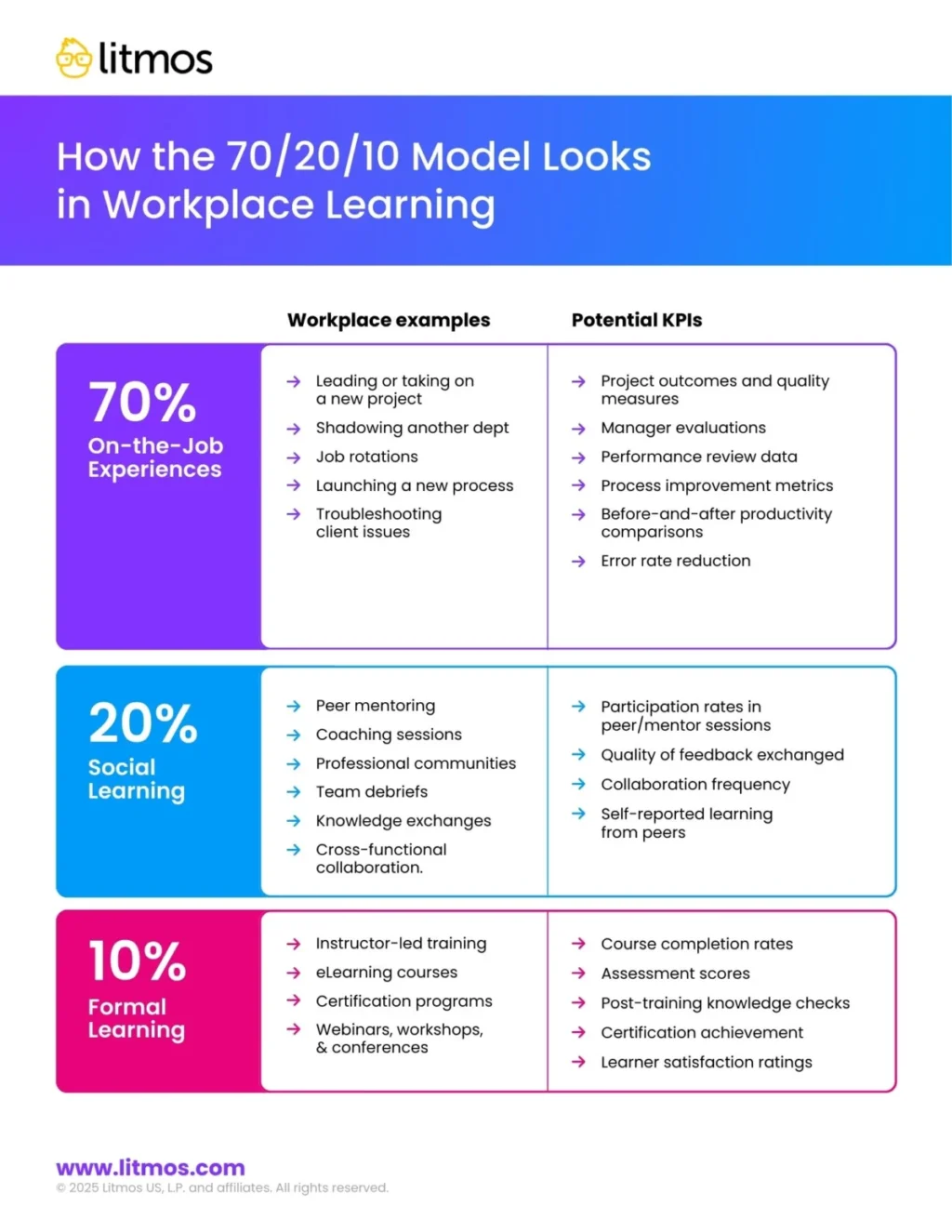
The landscape of corporate education is undergoing a fundamental shift as organizations move away from traditional, classroom-centric training toward a more integrated approach known as the 70-20-10 learning model. This framework, which emphasizes experiential and social learning over formal instruction, has become a cornerstone for Learning and Development (L&D) professionals seeking to bridge the widening skills gap in a rapidly evolving global economy. As companies grapple with the demands of digital transformation and remote work, the 70-20-10 model provides a structured yet flexible roadmap for fostering continuous improvement and long-term employee retention.
The Evolution of Workplace Education: Beyond the Classroom
For decades, the standard for professional development was defined by "event-based" learning. Employees would attend a multi-day seminar, complete a mandatory workshop, or sit through a series of PowerPoint presentations to acquire new skills. However, recent data from industry analysts suggests that these isolated events often fail to produce lasting behavior change. According to research from the Ebbinghaus Forgetting Curve, humans lose approximately 70% of new information within 24 hours if it is not applied in a practical context.
In response to these inefficiencies, the 70-20-10 model has re-emerged as a vital strategy for modern HR leaders. The model posits that individuals obtain 70% of their knowledge from job-related experiences, 20% from interactions with others, and only 10% from formal educational events. By acknowledging that the majority of learning happens "in the flow of work," organizations are now redesigning their workflows to encourage informal knowledge sharing and hands-on experimentation.
The Historical Context and Scientific Origins
The 70-20-10 framework is not a new concept, but its relevance has intensified in the digital age. The model originated in the 1980s from research conducted by Morgan McCall, Michael Lombardo, and Robert Eichinger at the Center for Creative Leadership (CCL). Through extensive interviews with high-performing executives, the researchers sought to identify the specific experiences that contributed most significantly to their professional success.
The findings were transformative: successful leaders did not attribute their prowess to MBA programs or corporate retreats. Instead, they pointed to "stretch assignments," challenging projects, and the influence of mentors. This research was later formalized in the book The Lessons of Experience (1988), which challenged the then-dominant belief that formal schooling was the primary driver of professional competence. Over the following three decades, the model transitioned from a niche academic theory to a globally recognized standard for talent management.
Deconstructing the 70-20-10 Framework
To effectively implement the model, organizations must understand the nuances of each component and how they interact to create a cohesive learning ecosystem.
The 70%: Experiential Learning
The largest portion of the model focuses on "learning by doing." This involves tasks that push employees out of their comfort zones, such as managing a new team, troubleshooting a technical failure, or leading a cross-departmental initiative. In a modern context, this also includes "micro-learning" opportunities where employees seek out quick solutions to immediate problems while performing their daily duties.
The 20%: Social Learning
Social learning encompasses coaching, mentoring, and collaborative feedback. In the current era of hybrid and remote work, this often takes place via digital platforms like Slack, Microsoft Teams, or dedicated internal social networks. It is the process of learning through observation and conversation, allowing for the transfer of "tacit knowledge"—the unwritten rules and nuanced skills that are rarely captured in a formal manual.
The 10%: Formal Learning
While it represents the smallest percentage, formal learning remains the essential foundation. It provides the theoretical framework and vocabulary necessary for experiential and social learning to be effective. Formal training includes certified courses, webinars, and structured eLearning modules that ensure all employees possess a baseline level of compliance and technical understanding.
Current Industry Data and the Efficacy of Experiential Learning
Recent studies underscore the financial and operational benefits of adopting a holistic learning model. According to a 2023 report by the Association for Talent Development (ATD), organizations that prioritize diverse learning methods report a 24% higher profit margin than those that do not. Furthermore, LinkedIn’s 2024 Workplace Learning Report found that "opportunities to learn and grow" is now the number one driver of work culture, surpassing even work-life balance in some demographics.

Supporting data also indicates that social learning (the 20%) has a significant impact on employee engagement. Companies with robust mentoring programs see a 72% increase in retention rates for both mentors and mentees. When employees feel they have a support system for asking questions and receiving feedback, they are more likely to take the risks necessary for the "70%" experiential component to succeed.
Strategic Implementation: Beyond the Ratio
L&D experts caution that the 70-20-10 model should be treated as a guideline rather than a rigid mathematical formula. The goal is to create a balance that suits the specific needs of the organization and the individual role. For example, a junior software engineer may require a higher percentage of formal training (the 10%) to master a new coding language, whereas a senior executive may derive nearly all their growth from high-stakes decision-making (the 70%).
To integrate this model into existing workflows, HR leaders are increasingly adopting the following strategies:
- Redefining the Role of Managers: Managers are moving from "supervisors" to "coaches," responsible for identifying stretch assignments that align with an employee’s career goals.
- Investing in Social Infrastructure: Implementing internal "knowledge hubs" and peer-to-peer recognition systems to facilitate the 20% social learning aspect.
- Modernizing Content Delivery: Transforming long-form training into bite-sized, on-demand resources that employees can access at the moment of need.
The Measurement Challenge: Redefining Key Performance Indicators
One of the primary hurdles in adopting the 70-20-10 model is measurement. Traditional L&D metrics have historically focused on "vanity metrics," such as the number of employees who completed a course or the average test score. However, these metrics do not account for the 90% of learning that happens outside the classroom.
Forward-thinking organizations are now shifting toward performance-based KPIs. These include:
- Time-to-Productivity: How quickly a new hire can perform tasks at a standard level.
- Internal Mobility Rates: The frequency with which employees are promoted or moved into new roles.
- Behavioral Observations: Using 360-degree feedback to assess whether an employee is applying new skills in their daily work.
- Collaboration Patterns: Analyzing digital footprints to see how often employees engage in cross-functional knowledge sharing.
Global Perspectives and Organizational Responses
The shift toward the 70-20-10 model has garnered support from major global enterprises. Tech giants and manufacturing leaders alike have voiced the need for a more agile workforce. A spokesperson for a leading global Learning Management System (LMS) provider noted, "The organizations that thrive in the next decade will be those that view learning not as a destination, but as a continuous process embedded in the work itself. We are seeing a massive surge in demand for tools that support social and experiential learning, rather than just hosting static videos."
In the public sector, government agencies are also beginning to adopt these frameworks to address the aging workforce and the need for rapid upskilling in cybersecurity and data science. By focusing on mentorship and on-the-job training, these agencies are attempting to capture the expertise of retiring veterans before they leave the workforce.
Future Outlook: The Role of Technology in Holistic Learning
As Artificial Intelligence (AI) and Machine Learning (ML) continue to permeate the workplace, the 70-20-10 model is expected to evolve further. AI-driven "nudge" technology can now suggest specific learning resources or social connections based on an employee’s current project or performance gaps. This "intelligent" layer of support enhances the 70% experiential component by providing real-time guidance without removing the employee from their task.
Ultimately, the 70-20-10 model serves as a reminder that human development is a complex, social, and active process. By moving beyond the limitations of the traditional classroom, organizations can create a culture of curiosity and resilience. As the boundaries between "working" and "learning" continue to blur, the ability to effectively leverage experiential and social knowledge will become the ultimate competitive advantage in the modern business world.
For HR leaders and managers, the message is clear: training is an event, but learning is a lifestyle. Implementing the 70-20-10 framework is not merely an administrative change; it is a strategic commitment to the long-term growth and adaptability of the human capital that drives organizational success.






