
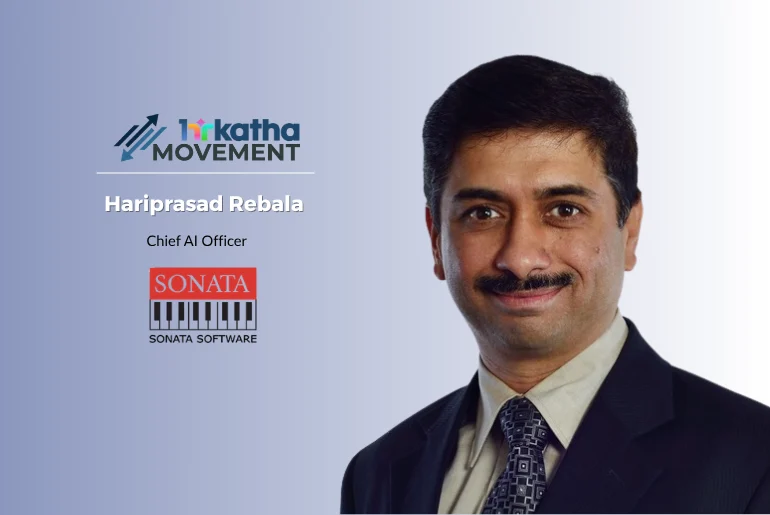
Bengaluru, India – Sonata Software, a global leader in modernization engineering, has officially announced the appointment of Hariprasad Rebala as its new Chief AI Officer (CAIO). This strategic leadership addition underscores Sonata’s aggressive push to cement its position as an AI-first enterprise, a move reflective of the broader industry’s pivot towards artificial intelligence as a core driver of business value. Rebala’s mandate is comprehensive, encompassing the full spectrum of Sonata’s AI initiatives, from the conceptualization and development of AI products and platforms to their efficient delivery, strategic partnerships, and the cultivation of AI talent within the organization. His primary objective is to intricately embed AI capabilities across Sonata’s operational framework and, crucially, to assist clients in translating their significant AI investments into demonstrable speed, scale, and tangible business outcomes.
The Strategic Imperative: Sonata’s AI-First Vision
Sonata Software, a robust $1.2 billion-plus entity headquartered in Bengaluru with nearly four decades of distinguished product-engineering heritage, is not merely adopting AI but aiming to become AI-native. This distinction signifies a profound organizational shift where AI is not an add-on but an intrinsic element woven into the very fabric of its operations, service offerings, and strategic decision-making. The appointment of a dedicated Chief AI Officer at this juncture highlights the criticality of AI in the company’s future growth trajectory and its commitment to staying at the forefront of technological innovation.
In an increasingly competitive global technology landscape, enterprises are under immense pressure to leverage advanced technologies to maintain relevance, improve efficiency, and unlock new revenue streams. Artificial intelligence, particularly with the advent of generative AI capabilities, has emerged as the quintessential differentiator. For an IT services and consulting firm like Sonata, transitioning to an AI-first model means not only integrating AI into its internal processes but also developing sophisticated AI-powered solutions that address complex client challenges across various industries. This strategic pivot is expected to enhance Sonata’s existing platform-led digital transformation capabilities, offering clients more intelligent, adaptive, and predictive solutions that drive measurable value. The move also aligns with the global trend where IT service providers are actively reshaping their portfolios to emphasize AI-driven transformation, moving beyond traditional IT outsourcing to become strategic partners in their clients’ AI journeys.
Hariprasad Rebala: A Blend of Startup Agility and Enterprise Acumen
The selection of Hariprasad Rebala for this pivotal role is particularly noteworthy given his diverse and extensive professional background. Rebala brings a unique amalgamation of entrepreneurial drive and large-scale enterprise experience, a combination that Sonata’s CEO, Rajsekhar Datta Roy, explicitly cited as a rare and valuable asset. This blend is crucial for navigating the dual challenge of pioneering innovative AI solutions while ensuring their robust, scalable, and secure implementation within complex enterprise environments.
A Track Record of Innovation and Transformation
Most recently, Rebala served as the Chief of AI Solutions and Growth at a deep-tech AI startup, a role that immersed him in the cutting edge of AI development and market penetration strategies. This experience would have provided him with firsthand insights into the rapid pace of AI innovation, the nuances of product-market fit for AI technologies, and the agility required to scale nascent AI solutions. Prior to his startup tenure, Rebala also co-founded Forfend, where he was instrumental in developing advanced Internet of Things (IoT) and conversational AI platforms. This entrepreneurial endeavor demonstrates his capability not only to conceptualize but also to build and bring to market complex technological solutions, particularly in areas critical for enterprise automation and customer experience. IoT, for instance, generates vast amounts of data that AI can analyze for predictive maintenance, operational efficiency, and new service models, while conversational AI is transforming customer service and internal knowledge management.
Earlier in his career, Rebala held significant senior roles at prominent global IT consulting and services firms including Mindtree, Capgemini, and Wipro. During these tenures, he was responsible for leading large-scale digital transformations and building specialized practices, with a notable focus on the Banking and Financial Services (BFS) sector. His deep expertise in BFS is particularly relevant as this industry is a prime candidate for AI-driven disruption, ranging from fraud detection and risk management to personalized banking and automated compliance. His experience in these large organizations would have honed his skills in navigating complex stakeholder environments, managing extensive teams, and delivering enterprise-grade solutions that meet stringent regulatory and performance standards. This career arc, transitioning from established IT giants to agile startups and back to a strategic leadership role in a growth-focused enterprise, positions Rebala as an ideal leader to bridge the gap between AI innovation and its practical, impactful deployment within large organizations.
Leadership Perspectives: Reinforcing Commitment to AI
The official statements from Sonata’s leadership and Rebala himself provide profound insights into the strategic intent behind this appointment and the operational philosophy that will guide Sonata’s AI journey.
CEO’s Vision for an AI-Native Future
Rajsekhar Datta Roy, CEO of Sonata Software, articulated the fundamental importance of this transition, stating, "Making Sonata an AI-native company is core to the company’s growth." This declaration is not merely a statement of ambition but a strategic imperative that underpins the company’s future competitive differentiation and market leadership. Roy further elaborated on Rebala’s unique value proposition, noting that Hari "brings rare experience across both startups and large IT firms, and understands how to build enterprise-grade AI platforms and deliver results through outcome-based models." This emphasis on "outcome-based models" is critical in the current enterprise AI landscape, where clients are increasingly demanding clear, measurable returns on their AI investments rather than just experimental deployments. Roy concluded by affirming that Rebala’s leadership "strengthens the executive bench as the company accelerates this transformation," indicating a substantial investment in top-tier talent to drive this strategic shift. This suggests that the CAIO role is not merely symbolic but central to Sonata’s executive strategy, reflecting a company-wide commitment to AI integration at the highest levels.
The CAIO’s Focus: Execution Over Experimentation
Hariprasad Rebala’s own commentary resonates with a pragmatic and results-oriented approach to AI implementation. He asserted that "the next phase of AI is about execution, not experiments." This statement succinctly captures the industry’s shift from exploratory AI projects to demanding concrete, scalable, and integrated solutions. Rebala observed that "AI is now central to how companies compete and operate, but technology alone will not decide winners." This nuanced perspective acknowledges that while AI is transformative, its true power lies in its strategic application and seamless integration into business processes, rather than just the adoption of cutting-edge algorithms. He emphasized that "it is about translating AI into enterprise velocity," highlighting the need for AI to accelerate business operations, decision-making, and market responsiveness.
Rebala also articulated Sonata’s inherent strengths, identifying its "mix of AI engineering, modernisation expertise, industry depth, and partner ecosystem" as key differentiators that position it strongly to help clients scale their AI initiatives. This comprehensive view underlines Sonata’s integrated approach, where AI is not a standalone technology but an enhancement to its existing core competencies in engineering, modernization, and industry-specific solutions. His personal focus, he stated, "would be on creating differentiated AI platforms with customers and partners that deliver measurable value and long-term advantage." This client-centric and collaborative approach is vital for developing bespoke AI solutions that genuinely address specific business challenges and foster enduring client relationships.
The Broader AI Landscape: A Sector in Flux
The appointment of a Chief AI Officer at Sonata Software is not an isolated event but a clear indicator of broader trends sweeping across the global technology and business landscapes. The past few years have witnessed an unprecedented acceleration in AI adoption, driven by advancements in machine learning algorithms, the availability of vast datasets, and significant improvements in computational power.
The Global Surge in Enterprise AI Adoption
According to various industry reports, the global artificial intelligence market size, which was valued at approximately USD 200 billion in 2023, is projected to grow at a compound annual growth rate (CAGR) exceeding 37% from 2024 to 2030, potentially reaching over USD 1.8 trillion by the end of the decade. This exponential growth is fueled by enterprises across sectors—from finance and healthcare to manufacturing and retail—recognizing AI as a critical component for competitive advantage, operational efficiency, and innovation. A recent survey by McKinsey & Company indicated that over 70% of organizations have adopted AI in at least one business function, with a significant increase in the number of AI capabilities embedded across the enterprise. Furthermore, the emergence of generative AI, exemplified by large language models (LLMs), has opened new frontiers for content creation, personalized customer interactions, and code generation, compelling companies to rethink their entire operational paradigms.
For IT services firms, this translates into a booming demand for AI consulting, implementation, and management services. Clients are looking for partners who can not only build AI solutions but also integrate them seamlessly with existing legacy systems, ensure data governance, address ethical AI concerns, and ultimately deliver a tangible return on investment. The challenge for these firms is to move beyond proof-of-concept projects to industrial-scale AI deployments that are robust, secure, and aligned with strategic business objectives.
The Evolving Role of the Chief AI Officer
The creation and proliferation of roles like Chief AI Officer or Head of AI within large enterprises underscore the strategic importance of AI. Historically, AI initiatives might have been siloed within R&D departments or driven by data science teams. However, as AI becomes foundational to business strategy, a dedicated C-suite executive is required to provide overarching leadership, ensure cross-functional alignment, and articulate a clear AI vision that permeates the entire organization. The CAIO is typically responsible for setting the AI strategy, overseeing its implementation, managing talent acquisition and development in AI, ensuring ethical AI practices, and fostering a culture of innovation. This role often involves collaborating closely with the Chief Data Officer, Chief Technology Officer, and other business unit heads to ensure that AI initiatives are integrated into broader data, technology, and business strategies. Rebala’s appointment at Sonata is a testament to this evolving organizational structure, signaling a maturing approach to AI integration within the IT services sector.
Implications for Sonata and Its Clients
The appointment of Hariprasad Rebala as CAIO carries significant implications for Sonata Software’s future trajectory, its competitive positioning, and the value it can deliver to its global clientele.
Enhancing Service Portfolio and Competitive Edge
For Sonata Software, this move is a clear declaration of its intent to deepen its specialization in AI-driven modernization engineering. By having a dedicated CAIO, Sonata can streamline its AI product development, ensuring that new platforms and solutions are not only technologically advanced but also strategically aligned with market needs and client demands. This will likely lead to the creation of differentiated AI platforms that leverage Sonata’s existing modernization expertise, enabling clients to integrate AI into their legacy systems more effectively. For instance, Sonata could develop industry-specific AI accelerators for banking, retail, or manufacturing that address common pain points like fraud detection, supply chain optimization, or personalized customer experiences. This focus on proprietary or co-developed platforms, as articulated by Rebala, could provide Sonata with a significant competitive edge in a crowded market where generic AI services are becoming commoditized. The strengthening of the executive bench with a leader of Rebala’s caliber also enhances Sonata’s ability to attract top-tier AI talent, further bolstering its capacity for innovation and delivery.
Driving Tangible Business Outcomes for Clients
The core tenet of Rebala’s philosophy – "execution, not experiments" and "translating AI into enterprise velocity" – directly benefits Sonata’s clients. In an era where many organizations have invested in AI proofs-of-concept with limited scale or return, Sonata’s intensified focus on outcome-based models will be highly appealing. Clients can expect more robust, enterprise-grade AI solutions that are designed from inception to deliver measurable value, whether through cost reduction, revenue growth, enhanced customer experience, or improved operational efficiency. Rebala’s emphasis on co-creating differentiated AI platforms with customers and partners suggests a highly collaborative approach, ensuring that solutions are tailored to specific client contexts and integrated seamlessly into their existing ecosystems. This client-centric approach, combined with Sonata’s strengths in AI engineering, modernization, and industry depth, positions the company to become a more strategic and indispensable partner for enterprises navigating their complex AI transformation journeys.
Looking Ahead: The Future of AI-Driven Transformation
Sonata Software’s decision to appoint a Chief AI Officer represents a critical juncture in its strategic evolution, aligning perfectly with the overarching trends of the global digital economy. This move is more than just a personnel announcement; it is a clear articulation of a strategic vision that places AI at the very core of its growth and service delivery model. As businesses worldwide continue to grapple with the complexities and opportunities presented by artificial intelligence, firms like Sonata, with dedicated leadership and a clear strategic roadmap for AI, are poised to capture a significant share of this burgeoning market. The success of Rebala’s tenure will not only be measured by the internal AI capabilities developed at Sonata but, more importantly, by the tangible, long-term advantages and measurable value that Sonata’s AI-powered solutions deliver to its diverse global client base, truly embodying the promise of an AI-first enterprise.








