
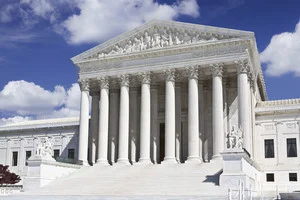
In a landmark ruling that fundamentally alters the landscape of American administrative law, the United States Supreme Court issued a decisive opinion on June 29 in the case of Trump v. Slaughter. The decision effectively grants the President of the United States significantly broader authority to remove the heads of independent federal agencies, a move that legal scholars suggest marks the end of an era for the "independent" nature of the federal bureaucracy. By a majority vote, the Court expressly overruled the nearly century-old precedent established in Humphrey’s Executor v. United States (1935), which for 90 years had protected members of certain regulatory bodies from being fired by the President without "just cause."
The dispute originated from President Donald Trump’s decision in early 2025 to remove Federal Trade Commission (FTC) Commissioner Rebecca Slaughter. While Slaughter challenged the removal as a violation of statutory protections intended to insulate the FTC from political interference, the Supreme Court utilized the case to address the broader constitutional question of executive removal power. The Court held that, under Article II of the Constitution, principal officers who exercise significant executive authority must remain answerable to the President through the threat of removal at will. This ruling effectively dismantles the "for-cause" removal protections that have long defined agencies like the National Labor Relations Board (NLRB), the Securities and Exchange Commission (SEC), and the Equal Employment Opportunity Commission (EEOC).
The End of the Humphrey’s Executor Era
To understand the magnitude of Trump v. Slaughter, one must look back to the 1935 decision in Humphrey’s Executor. During the Great Depression, President Franklin D. Roosevelt attempted to remove William Humphrey, a member of the FTC, because Humphrey’s policy views did not align with the New Deal. At the time, the Supreme Court ruled against Roosevelt, concluding that Congress had the power to create "quasi-legislative" and "quasi-judicial" bodies whose members could only be removed for "inefficiency, neglect of duty, or malfeasance in office."
For decades, this precedent served as the bedrock for the independence of the "alphabet soup" of federal agencies. It allowed these boards to operate with a degree of continuity across different presidential administrations, ensuring that technical expertise and long-term stability took precedence over immediate political shifts. However, in recent years, the conservative majority on the Supreme Court has signaled a growing skepticism toward this arrangement, leaning instead toward the "unitary executive theory"—the idea that the President must have absolute control over all officials exercising executive power.
In the majority opinion for Trump v. Slaughter, the Court argued that the distinction between "executive" power and "quasi-judicial" power was an artificial one. The Court noted that when an agency enforces federal law, it is inherently exercising executive power, and therefore, the President must have the authority to manage those personnel to ensure the laws are faithfully executed.
A Timeline of the Conflict: The Case of Gwynne Wilcox
The implications of this ruling were perhaps most visible in the ongoing saga surrounding Gwynne Wilcox, a member of the National Labor Relations Board. The timeline of her removal and the subsequent legal battles provided a preview of the constitutional showdown that culminated in the Slaughter decision.
- January 2025: Shortly after his inauguration, President Trump moved to terminate Gwynne Wilcox from her position at the NLRB. This was seen as a bold move, as NLRB members were historically protected by the same for-cause standards as FTC commissioners.
- Spring 2025: Wilcox challenged her removal in federal court. A district court judge initially ruled in her favor, citing Humphrey’s Executor and ordering her reinstatement. The judge argued that the President lacked the statutory authority to remove a Board member simply due to policy disagreements.
- Summer 2025: The administration appealed the ruling, and the Supreme Court eventually issued a stay on the district court’s order. This stay removed Wilcox from her seat once again while the broader constitutional questions were litigated.
- Late 2025 – Early 2026: The NLRB faced a period of paralysis as it struggled to maintain a quorum. Eventually, the White House moved to nominate new members to fill the vacancies created by the removals, allowing the Board to resume operations with a new, administration-aligned majority.
- June 29, 2026: The Supreme Court’s decision in Trump v. Slaughter provided the final legal justification for the President’s actions, rendering Wilcox’s legal challenge effectively moot.
Broad Implications for Federal Oversight and Enforcement
The Slaughter decision does not merely affect the FTC and the NLRB; it creates a domino effect across the entire federal government. Agencies that were once considered "independent" are now, for all practical purposes, executive agencies. This shift has profound implications for several key sectors:
The National Labor Relations Board (NLRB)
The NLRB is responsible for enforcing the National Labor Relations Act and overseeing union elections. Historically, the Board’s staggered five-year terms were designed to prevent a single President from completely flipping the Board’s ideological leanings overnight. Under the new ruling, an incoming President can now terminate the entire Board on Day One and install new members who align with the administration’s labor philosophy. For employers and labor unions, this means that the "pendulum swing" of labor law will become faster and more extreme with every change in the White House.

The Equal Employment Opportunity Commission (EEOC)
The impact on the EEOC was immediate. Following the Slaughter decision, Judge Tanya Chutkan of the U.S. District Court for the District of Columbia questioned the standing of former Vice Chair Jocelyn Samuels, who had also sued to challenge her termination by President Trump. Recognizing that the legal foundation for her case had been erased by the Supreme Court, Samuels voluntarily dismissed her lawsuit in July 2026. This signals that other pending challenges from former agency officials will likely face a similar fate.
The Securities and Exchange Commission (SEC) and Federal Communications Commission (FCC)
While the Slaughter case focused on the FTC and NLRB, the legal logic applies equally to the SEC and FCC. These agencies oversee trillions of dollars in market activity and the nation’s telecommunications infrastructure. The ability of a President to remove these commissioners at will could lead to more rapid deregulation or, conversely, more aggressive enforcement, depending on the administration in power.
Reaction from Legal Experts and Stakeholders
The ruling has drawn sharp reactions from across the political and legal spectrum. Proponents of the decision, including many conservative legal scholars, argue that it restores the constitutional order. They contend that "unelected bureaucrats" should not be shielded from the accountability of the only person in the executive branch who is elected by the people: the President.
"The Constitution does not provide for a fourth branch of government that is immune to presidential oversight," said one legal analyst following the decision. "Trump v. Slaughter clarifies that if you exercise the power of the United States government, you must be accountable to the Chief Executive."
Conversely, critics argue that the ruling invites a "spoils system" that will undermine the expertise and neutrality of federal agencies. Labor advocates, in particular, express concern that the NLRB will now become a purely political tool. "The stability of our labor relations depends on a Board that isn’t fired every four years because they made a decision the President didn’t like," said a spokesperson for a major labor federation. "This ruling turns independent agencies into mere arms of the White House political operation."
Analyzing the Impact on the Private Sector
For the business community, the Slaughter decision is a double-edged sword. On one hand, it allows a pro-business administration to quickly remove regulators who are perceived as being over-zealous or hostile to corporate interests. It streamlines the process of regulatory reform and allows for a more cohesive federal policy.
On the other hand, the ruling introduces a significant amount of regulatory uncertainty. Businesses often rely on the long-term stability of agency rules to make investment decisions. If a new administration can fire the entire leadership of the FTC or the SEC and immediately reverse years of established rulemaking, the "regulatory whiplash" could make long-term planning difficult. For example, a merger that is approved under one administration’s FTC could theoretically face renewed scrutiny or different enforcement priorities almost immediately if a new administration takes office before the process is fully complete.
Conclusion and Future Outlook
The decision in Trump v. Slaughter marks one of the most significant shifts in the balance of power in Washington in nearly a century. By overruling Humphrey’s Executor, the Supreme Court has cleared the path for a more centralized and powerful presidency. The immediate fallout—the dismissal of lawsuits by former officials like Jocelyn Samuels and the solidification of the new NLRB majority—is only the beginning.
As the remaining litigation surrounding the 2025 agency removals is formally disposed of, the federal government will begin to operate under a new set of rules. The "independence" of federal agencies will now exist only at the pleasure of the President. For legal practitioners, employers, and the public, the focus now shifts to how future administrations will utilize this expanded power and whether Congress will attempt to find new, constitutionally permissible ways to ensure that technical expertise is preserved in the face of political change. For now, the "Unitary Executive" has moved from a theoretical legal concept to a functional reality of American governance.








