The intricate landscape of recruitment within military, defense, and public safety sectors has long been defined by a critical paradox: the imperative for speed versus the non-negotiable demand for meticulous vetting. For years, organizations in these vital fields have grappled with hiring processes that, while ensuring a high standard of candidate qualification, often stretched timelines to the breaking point. This inherent tension has historically led to a prioritization of rigor over velocity, a pragmatic choice given the elevated cost of a misstep in roles where lives and national security are at stake. However, this long-standing trade-off is undergoing a profound transformation, driven by the emergence of Artificial Intelligence-powered interviewing solutions that promise to reconcile speed with unwavering standards.
The consequences of protracted hiring cycles in these specialized sectors are far from abstract inconveniences. A defense contractor facing a deficit of cleared analysts can experience significant operational slowdowns, impacting critical intelligence gathering or program execution. A fire department operating below minimum staffing levels is forced to stretch its existing personnel thinner, increasing the risk of burnout and potentially compromising response times during emergencies. Similarly, police departments struggling with prolonged academy training schedules and facing recruitment challenges often find themselves stretching patrol shifts, reducing visibility and potentially impacting community safety. These delays do more than just frustrate human resources departments; they leave critical posts vacant, place undue pressure on dedicated professionals, and, in the most severe instances, can directly jeopardize public safety and national security.
For decades, the prevailing wisdom in these high-stakes environments dictated that the potential damage stemming from a poorly qualified hire—whether a security breach, a tactical error, or a lapse in judgment—far outweighed the inconvenience of a lengthy hiring process. This led to a culture of caution, where thorough background checks, multi-stage interviews, and extensive evaluations were the norm, often taking months to complete. The perception was that speed and exacting standards were mutually exclusive, an immutable law of hiring in these critical domains. Yet, this perceived limitation is increasingly being challenged as a constraint imposed by outdated methodologies rather than an inherent reality.
The advent of AI interviewing technology is fundamentally altering this equation. For defense-adjacent employers and public safety agencies, these platforms offer a novel pathway to significantly accelerate the early stages of candidate evaluation without compromising the structural integrity, consistency, and comprehensive documentation that these sensitive roles inherently demand. The crucial insight is that speed and adherence to stringent standards are not diametrically opposed forces; they are simply two facets of an efficient hiring process that, until now, lacked the appropriate tools to address both simultaneously.
The Shared Crucible: Why Defense and Public Safety Face Identical Hiring Headwinds
Despite their distinct operational mandates, military and defense civilian roles, alongside public safety positions, are locked in a battle against remarkably similar hiring challenges. Both categories of employment demand an exceptionally high caliber of candidate. Whether it’s an analyst supporting a sensitive defense program or a paramedic responding to a critical medical emergency in the dead of night, these roles offer little latitude for on-the-job learning. The requisite skills, judgment, and decisiveness must be present from the outset. This necessitates a screening process that can accurately identify these critical attributes early on.
Furthermore, both sectors are experiencing a significant shortfall in qualified candidates. Defense and security employers find themselves in direct competition with the lucrative private sector for talent possessing essential clearances and specialized skills. Concurrently, public safety agencies are navigating what many now openly acknowledge as a severe recruiting crisis. Applicant pools are shrinking, and competition for the individuals who do apply is intensifying. In this competitive environment, every additional day a position remains unfilled represents a lost opportunity, as promising candidates may opt for employers with demonstrably faster hiring pipelines.
The rigorous nature of these professions also dictates a hiring process that can withstand intense scrutiny. Inconsistent interview practices, undocumented decision-making, and variations in how different evaluators assess candidates are not merely poor HR practices in these sectors; they represent significant liabilities. Whether facing an internal audit, a union grievance, or a public records request, the hiring process must be demonstrably defensible and transparent, not just efficient in the immediate moment. It is precisely at this intersection of speed, rigor, and defensibility that AI interviewing emerges as a powerful and relevant solution, engineered to compress timelines without sacrificing essential quality controls.
Fortifying the Front Lines: AI’s Impact on Military and Defense Hiring
Defense-adjacent civilian roles—spanning critical areas such as intelligence analysis, program management, logistics, and positions requiring security clearances—operate at a particularly demanding nexus. The urgency to fill these roles is paramount to maintain the operational tempo of vital programs and ensure the seamless execution of missions. Simultaneously, the hiring process must be robust enough to withstand rigorous oversight and audits, a common requirement in government contracting and defense operations. Inconsistencies in candidate evaluation can quickly become glaring deficiencies during audits, raising questions about fairness and procedural integrity.
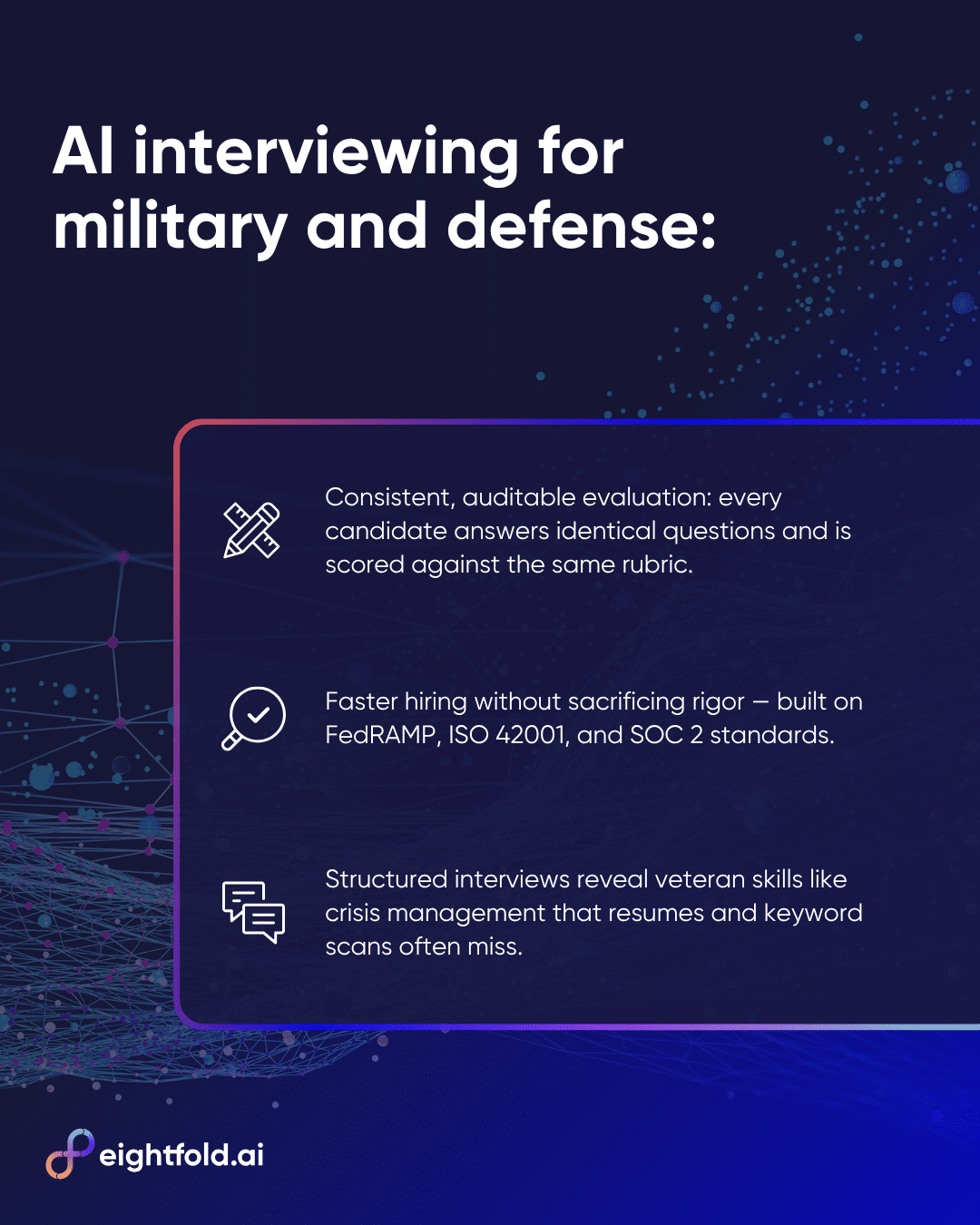
AI interviewing fundamentally reshapes this challenge. By deploying AI interviewers, organizations can ensure that every candidate is presented with the same set of structured, role-specific questions. The evaluation is then conducted against a consistent rubric, eliminating the variability that can arise from different interviewers’ subjective interpretations or biases. This ensures that no candidate is disadvantaged due to the timing of their application or the specific recruiter assigned to their case. The interview can be initiated as soon as a candidate applies, bypassing the often lengthy scheduling bottlenecks, and recruiters receive structured summaries and objective scores within hours, rather than weeks.

A notable example of this paradigm shift in action is Constellis, a global provider of defense and security services. Facing the imperative to fill a high volume of security roles while maintaining the stringent compliance and audit trails demanded by its industry, Constellis leveraged Eightfold’s AI Interviewer. This solution enabled them to achieve both objectives: accelerating the initial screening process without compromising the integrity and traceability of their hiring decisions. Furthermore, the underlying infrastructure of such platforms is increasingly designed to meet stringent government compliance standards, such as FedRAMP Moderate and ISO 42001, alongside SOC 2 certification. These certifications are crucial for organizations that must account for the secure handling of candidate data and the transparent justification of hiring outcomes.
The U.S. Department of Defense itself is among the organizations that trust Eightfold’s Talent Intelligence Platform, underscoring the platform’s suitability for environments that demand the highest levels of scrutiny. This is not a generic tool adapted for defense use; it is a system developed with these specific requirements in mind from its inception. An additional significant benefit of AI interviewing in the defense sector lies in its capacity to translate military experience into valuable civilian competencies. Skills such as crisis management, structured decision-making under duress, and effective team leadership, which can be obscured by conventional resume formats relying on military job titles, can be effectively surfaced through structured AI-driven interviews. This approach can transform transitioning service members and veterans into highly visible and competitive candidates, rather than overlooking their transferable skills.
Safeguarding Communities: AI’s Role in Addressing Public Safety Recruitment Crises
Public safety agencies, including police, fire departments, and Emergency Medical Services (EMS), are confronting a deepening recruitment crisis that has been building for years. Many departments are operating with insufficient staffing to meet the needs of their communities. The demanding nature of the work, both physically and emotionally, inherently limits the pool of individuals willing and able to serve. Consequently, every vacant position places an additional burden on existing personnel, exacerbating stress and potentially impacting service delivery.
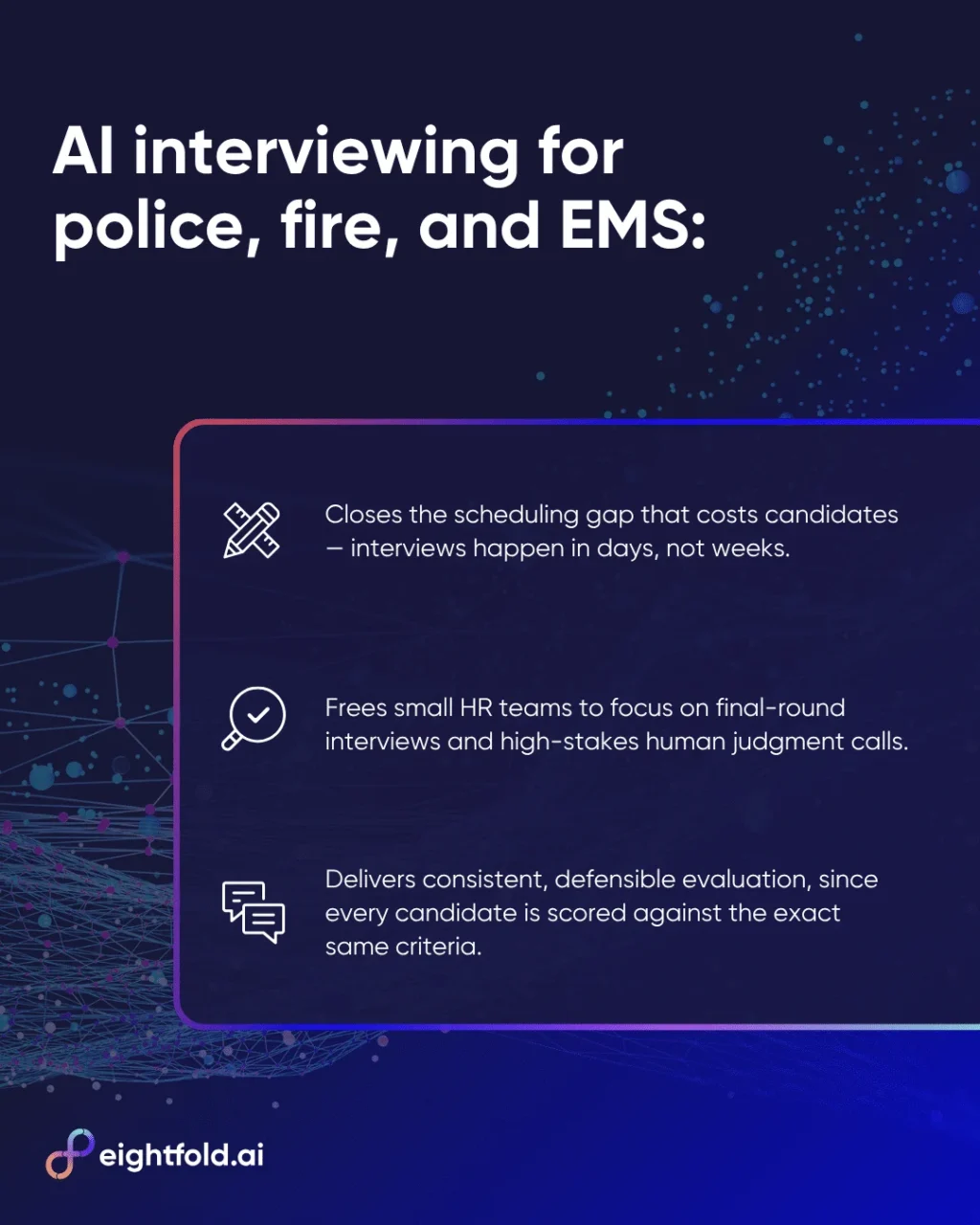
In this critical context, speed in hiring is not merely a desirable attribute; it is a fundamental necessity for operational effectiveness. Public safety agencies are increasingly finding themselves in direct competition with private sector employers for a shared labor pool. A candidate who faces weeks of waiting for an initial interview is a candidate who may readily accept an offer from a quicker-hiring organization. AI interviewing directly addresses this challenge by eliminating the scheduling bottleneck inherent in traditional first-round screening. Candidates can complete a structured interview within days of applying, allowing hiring teams to identify and advance qualified individuals almost immediately.
The importance of consistency in evaluation cannot be overstated in public safety roles. In positions where the consequences of a poor hiring decision can manifest as a loss of public trust or direct threats to physical safety, every candidate must be assessed against the same objective criteria. This ensures that hiring decisions are not influenced by the personal preferences or emphasis of individual interviewers on any given day. A standardized and structured screening process provides public safety agencies with a defensible foundation for their hiring decisions. Crucially, it also frees up their often-limited HR and recruiting teams to focus their valuable time and expertise on the later stages of the hiring process, including final-round interviews and the nuanced human judgment calls that remain beyond the scope of automation.
The Unavoidable Conclusion: Speed and Standards Now Converge
For organizations operating within the military, defense, and public safety sectors, a fundamental constraint has always dictated their hiring strategies: the inability to compromise between speed and accuracy. Historically, this meant accepting the inherent slowness and manual intensity of traditional processes as the unavoidable cost of ensuring meticulous vetting. However, this long-standing dichotomy is rapidly becoming obsolete.
AI interviewing technology offers these critical sectors a paradigm shift, enabling them to screen candidates with unprecedented speed, consistency, and transparency compared to manual methods. The perceived trade-off between accelerating the hiring timeline and maintaining rigorous standards is no longer an inevitable compromise. Instead, it represents an opportunity for innovation. Organizations that embrace these advancements will be strategically positioned to fill essential roles more efficiently, gaining a significant advantage over their more traditional counterparts who may still be navigating the labyrinthine process of scheduling initial interviews. The future of critical hiring lies in the intelligent integration of technology that upholds the highest standards while delivering the speed required to protect and serve.