
The rapid evolution of artificial intelligence continues to redefine our technological landscape, moving beyond intelligent chatbots and sophisticated content generation to introduce a concept with profound implications: the "digital twin." While the term itself might sound futuristic, its origins trace back to the 1960s, a testament to humanity’s enduring quest to replicate and understand complex systems. This groundbreaking technology, now poised to transform how we work and interact, is moving from simulating spacecraft to mirroring individuals, promising unprecedented levels of efficiency and collective intelligence.
From Apollo 13 to Personal AI: The Evolution of Digital Twins
The genesis of the digital twin concept can be found in the critical moments of the Apollo 13 mission. In 1970, faced with a life-threatening oxygen tank explosion, NASA engineers ingeniously constructed a detailed digital replica of the spacecraft. This virtual model, encompassing its intricate electronics and power systems, allowed them to meticulously simulate the unfolding crisis and devise a life-saving solution. This early application demonstrated the immense power of digital replication for problem-solving and predictive analysis in highly complex environments.
Following this pioneering effort, the concept of digital twins gained traction within various engineering and industrial sectors. Major corporations like Boeing, Dassault, and General Electric began employing digital twins to simulate and optimize intricate systems such as aircraft and complex industrial machinery. By the turn of the millennium, the definition of a digital twin was formally articulated by NASA around 2010: "an integrated multi-physics, multi-scale, probabilistic simulation of an as-built vehicle or system that uses the best available physical models, sensor updates, and fleet history." This definition underscored the dynamic and data-driven nature of these virtual counterparts.
Fast forward to the present day, the confluence of advanced AI capabilities, including sophisticated voice and avatar generation, alongside near-ubiquitous access to data, has paved the way for the application of digital twin technology to humans. The question that naturally arises is: with the current affordability and accessibility of replicating human-like digital representations, why wouldn’t we extend this concept to ourselves? This question is no longer hypothetical. Companies are now actively testing and deploying digital twin technology for individuals, marking a significant leap in leveraging AI for a multitude of critical applications.
Viven.ai: Launching the Personal Digital Twin Era
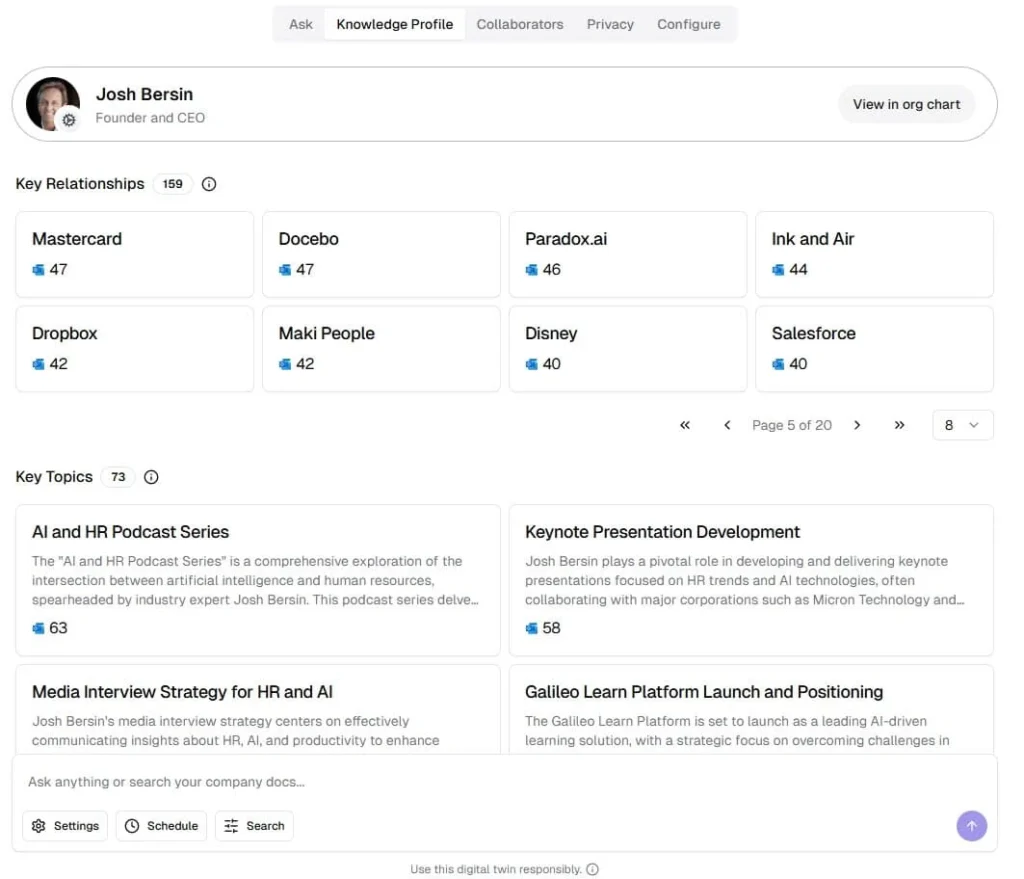
A pivotal moment in this technological transition occurred with the recent launch of Viven.ai. This new venture, founded by a team of seasoned AI experts spun off from Eightfold, has brought the concept of the personal digital twin to fruition. Viven’s platform is designed to ingest a comprehensive array of an individual’s digital footprint within their professional life. This includes a vast spectrum of data points such as emails, meeting transcripts, instant messages, documents, and virtually all user activity logged within major platforms like Microsoft Graph or Google Workspace. The company currently utilizes the Microsoft ecosystem for its implementations.
The ingested information is then meticulously organized and presented online, creating a dynamic digital representation of the individual. This digital twin displays key relationships, organizational structures, ongoing projects, topical expertise, and an extensive contextual understanding of the user’s professional activities, relationships, and overall persona. A crucial aspect of Viven’s platform is its highly configurable security system. This feature empowers users to meticulously control the data that informs their digital twin, enabling them to exclude sensitive personal information, family details, or any non-work-related content, thereby safeguarding privacy.
Unlocking Collective Intelligence: Use Cases and Potential
The power of these personal digital twins is proving to be immense, offering transformative potential across various organizational functions. Imagine a scenario where an employee can query a colleague’s digital twin for actionable insights. For instance, one could ask a co-founder’s twin about their primary action items for the following day or inquire about the current status of a critical client relationship. Similarly, a CFO’s twin could be accessed to provide immediate insights into accounts receivable or the progress of a major business contract.
In organizations characterized by a "talent-dense" structure, where employees often wear multiple hats and engage directly with clients, digital twins offer a revolutionary way to disseminate knowledge and manage information. A team leader could query the digital twins of all 45+ employees to identify who has recently engaged with a specific client, such as Liberty Mutual, and retrieve the latest conversational context. Alternatively, they could ascertain who delivered a particular product demonstration most recently and access the script utilized.
On an individual level, each digital twin functions as an extension of that person’s accumulated knowledge and professional history. For example, an individual who maintains an extensive archive of past emails could have a digital twin capable of recalling details from interactions dating back 15 years. This allows for inquiries such as detailing the history of meetings with a specific company or summarizing learned insights over time. Furthermore, these twins can assist with research-oriented tasks, such as reviewing a document and providing feedback in a manner consistent with the individual’s professional judgment.

Essentially, each digital twin serves as a sophisticated digital representation of an individual’s expertise and professional persona. This has profound implications for roles in customer service, technical support, and training, providing instant access to deep expertise without the need to interrupt or burden subject matter experts. The Viven.ai platform even allows individuals to monitor queries directed at their digital twin, offering visibility into how their expertise is being leveraged and by whom. This can reveal, for instance, that numerous customer success team members are seeking advice, which can be provided efficiently without the need for direct calls, especially for busy individuals.
Addressing Urgent Needs and Enhancing Collaboration
Consider a critical situation where an urgent task requires input from legal, engineering, marketing, or contract specialists, but disturbing them is undesirable due to their busy schedules or time zone differences. With a digital twin, one could pose a question and receive a timely and informed response, significantly streamlining urgent workflows.
The applications are vast, but one particularly exciting use case lies in the realm of research and advisory firms. These organizations constantly engage in numerous conversations with clients, partners, vendors, and the press. The ability to instantly access the status of these relationships and the knowledge gained from recent interactions, without the need for lengthy coordination calls, represents a significant leap forward. This capability fosters what can be termed "Collective Intelligence," where the aggregated knowledge of an entire team functions as a singular, highly informed entity.
The vision extends to a future where digital twins can collaborate. Imagine linking these digital entities to advanced AI systems like Galileo, as the author speculates is on the horizon. This could enable clients to interact with any staff member’s digital twin as if they were physically present, offering unparalleled access to information and expertise. The time saved by avoiding unnecessary meetings or interruptions is substantial, leading to a more agile and efficient organizational structure.
Navigating the Complexities: Security, Privacy, and Intellectual Property
The introduction of personal digital twins inevitably raises critical questions regarding security, privacy, and the protection of intellectual property. Viven.ai has reportedly placed a significant emphasis on addressing these concerns within its platform. While specific technical details of their security protocols are proprietary, the emphasis on user control over data ingestion and the ability to exclude sensitive personal information are key pillars in mitigating privacy risks.
Beyond data privacy, a significant legal and ethical consideration arises when an employee departs from a company. What happens to their digital twin, and who retains ownership of the vast repository of knowledge and professional interactions it contains? While not a legal expert, the author suggests that intellectual property, inventions, and work product created during employment rightfully belong to the company. Therefore, a digital twin could serve as a crucial mechanism for retaining institutional knowledge, particularly when key personnel leave an organization. This ensures that valuable insights and historical context are not lost, contributing to organizational continuity and the preservation of intellectual capital.
The Future of Digital Embodiment
The technology underpinning digital twins is nascent but advancing at an exponential rate. Given the current pace of AI development, it is highly probable that within the next year, we will see widespread availability of digital replicas of key personnel, functioning as sophisticated "digital interview agents." These agents will not only be able to respond to queries but also engage in dialogue with each other, further enhancing collaborative intelligence.
Consider the possibility of asking a Vice President of Research’s digital twin to consult with the broader research team to identify individuals most interested in a new project. The potential applications are virtually limitless, promising to reshape how organizations access and leverage their most valuable asset: human expertise.
The innovation demonstrated by the Viven.ai team represents a significant milestone in this evolving field. For organizations interested in exploring this transformative technology, direct engagement with Viven.ai or seeking demonstrations from early adopters is recommended. The advent of the personal digital twin marks not just an advancement in AI, but a fundamental shift in how we perceive and utilize knowledge, collaboration, and individual expertise within the professional sphere.







