
The modern corporate learning landscape has undergone a radical transformation, moving from passive video modules to highly integrated, AI-driven ecosystems that track every digital footprint an employee leaves. Today, organizations possess an unprecedented level of visibility into how their workforces acquire knowledge. Learning platforms can now monitor completion rates, identify specific points of struggle, track search queries, and analyze the number of attempts made on a single assessment. With the integration of artificial intelligence, these signals are no longer just raw data points; they are used to recommend content, identify skill gaps, and predict an individual’s future career trajectory.
However, as these systems become more sophisticated, a critical ethical boundary is beginning to blur. There is a growing concern among human resources experts and data privacy advocates regarding when data collected to support learning inadvertently becomes data used to judge performance. As learning management systems (LMS) and learning experience platforms (LXP) sync with talent marketplaces and performance management software, the "room to be unfinished"—the psychological safety required to fail and learn—is under threat.
The Evolution of Corporate Learning Analytics
To understand the current tension, it is necessary to look at the chronology of learning technology. In the early 2000s, learning data was largely binary: an employee either completed a compliance course or they did not. The introduction of the Experience API (xAPI) in the 2010s allowed for more granular tracking, enabling companies to see how users interacted with various types of content across different platforms.
By the early 2020s, the rise of AI-powered talent marketplaces created a bridge between learning and career mobility. These platforms were designed to democratize opportunity by matching employees with "stretch assignments" based on their demonstrated skills. However, this connectivity introduced a new risk. Information gathered in a low-stakes learning environment—such as a diagnostic test or a practice session—can now flow automatically into high-stakes HR profiles.
According to recent industry reports, the global corporate training market was valued at approximately $345 billion in 2023, with a significant portion of new investment directed toward AI integration. As companies race to close the "skills gap," the pressure to quantify human potential through data has never been higher. Yet, this quantification often fails to account for the nuance of the learning process.
The Inference Gap: Evidence vs. Reality
A central challenge for learning leaders is the distinction between evidence and inference. An AI system may have objective evidence that an employee took three attempts to pass a leadership assessment. From this, the system might infer that the employee lacks innate leadership potential or struggles with complex decision-making.
Industry analysts point out that these inferences are often flawed. An employee who fails a test multiple times may ultimately develop a deeper, more resilient understanding of the material than a peer who passed on the first try through rote memorization. Similarly, an employee who starts but does not finish a high-level course might simply be managing a heavy temporary workload rather than demonstrating a lack of commitment.
The danger arises when these inferences leave the protected environment of a learning platform and enter a "permanent record" visible to managers. If an AI-generated skill rating suggests an employee is "not ready" for a promotion based on exploratory learning behavior, the technology has moved from a tool of support to a tool of surveillance.
A Framework for Algorithmic Governance in L&D
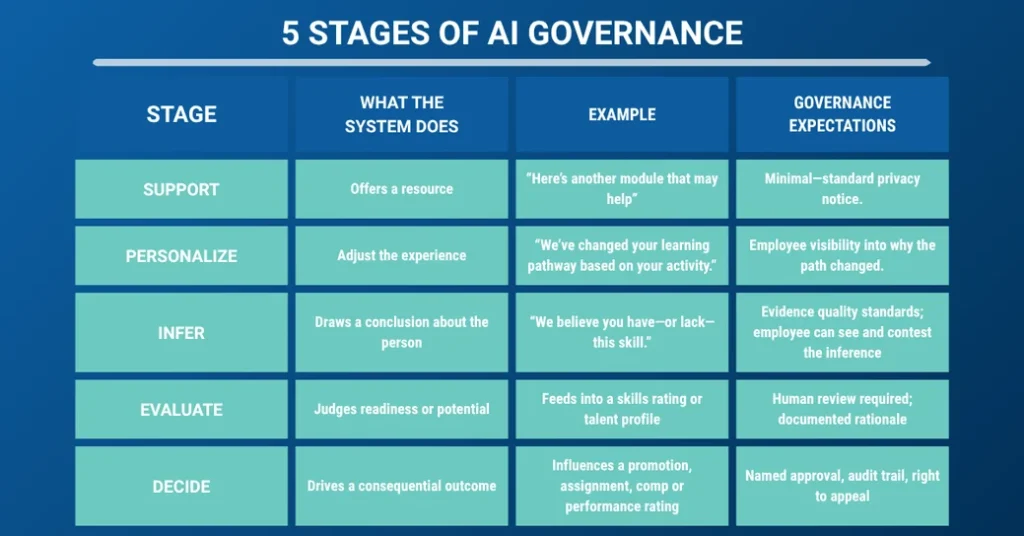
To address these risks, a new governance framework is emerging that scales the level of oversight to the potential consequence of the data use. This framework categorizes AI interactions into five distinct stages:
- Support: AI provides basic information or helps navigate a system.
- Personalize: AI adjusts the interface or content delivery to suit individual preferences.
- Recommend: AI suggests courses or paths based on previous interests.
- Evaluate: AI scores performance or assesses the mastery of a specific skill.
- Decide: AI influences or automates high-stakes outcomes, such as promotions or hiring.
Ethical guidelines suggest that any data usage crossing into the "evaluate" or "decide" stages must require a named human approver and a transparent record of the evidence considered. This prevents "black box" algorithms from making life-altering career decisions without human intervention. Furthermore, experts argue that learning data should not be treated as a monolith. A certification of completion is a public achievement, whereas the transcript of a conversation with an AI tutor is a private learning interaction.

The Privacy Implications of AI Tutors
The introduction of Generative AI (GenAI) tutors and coaches has added a layer of complexity to workplace privacy. Unlike traditional software, employees often interact with AI tutors with a high degree of honesty, admitting to knowledge gaps or expressing uncertainty about their career paths. These conversations can be incredibly productive for development, provided they remain confidential.
However, the question of who "owns" these transcripts remains largely unsettled. If an organization can analyze AI tutor logs to infer an employee’s intent to leave the company or their lack of confidence in a new role, the fundamental trust required for learning is broken. Legal experts warn that without clear "opt-in" policies and data-element level controls, companies could face significant backlash or even litigation under emerging data privacy laws like the EU AI Act.
In response to these concerns, some forward-thinking organizations are implementing "data expiration" policies. Under these rules, exploratory data—such as search history, abandoned courses, and practice attempts—is deleted after a set period, ensuring that an employee’s past struggles do not follow them indefinitely.
Industry Reactions and the Role of the Learning Leader
The shift toward data-driven judgment has sparked a debate among Chief Learning Officers (CLOs) and HR executives. Proponents of integrated data systems argue that a "wall" between learning and talent systems hinders internal mobility. They suggest that employees who are proactively building skills in their own time want that growth to be visible to the organization to secure better opportunities.
Conversely, privacy advocates and organizational psychologists warn of the "chilling effect." If employees believe that every question they ask an AI is being scrutinized, they will stop asking difficult questions. They will "perform" learning rather than actually engaging in it, sticking to safe topics and avoiding the experimentation necessary for innovation.
The consensus among modern L&D leaders is that the solution lies in employee-controlled visibility. Rather than "default-on" data syncing, employees should have the agency to choose which learning milestones are shared with their managers and which remain private.
Broader Impact and Future Implications
As AI continues to permeate the workplace, the role of the learning leader is evolving into that of a data ethicist. The ability to capture and analyze human behavior is a powerful tool, but it carries the risk of reducing complex human potential to a series of algorithmic scores.
The broader implication for the workforce is a potential shift in how "competency" is defined. If organizations rely too heavily on AI inferences, they may inadvertently filter out unconventional thinkers, late bloomers, or those whose learning styles do not align with standardized digital assessments.
To maintain a healthy learning culture, organizations must apply a final ethical test to their AI implementations: Would leadership be comfortable explaining the data collection and inference process directly to an employee without the use of legal jargon? If the answer is no, the system likely undermines the transparency and trust required for a high-performing workforce.
In conclusion, while AI offers transformative potential for personalizing development and uncovering hidden talent, it must not come at the expense of the "right to be unfinished." Preserving a safe space for employees to struggle, experiment, and admit ignorance is not just an ethical imperative; it is a business necessity for fostering genuine growth and long-term resilience in a rapidly changing economy. The challenge for the next decade will be ensuring that as our systems become smarter, our approach to human development remains compassionate and nuanced.






