A tense budget meeting, a room fraught with competing interests and high stakes, often becomes the crucible where leadership is forged. When a vice president, facing two strategic initiatives vying for limited resources, pauses and invites a protégé into the room, it’s not merely an act of inclusion. It’s a profound demonstration of wisdom transfer, a concept gaining critical recognition in organizational leadership development. This moment, seemingly small, underscores a larger truth: effective succession planning is not just about filling roles; it’s about cultivating the deep, experiential knowledge—the wisdom—that enables organizations to navigate complexity and uncertainty.
Recent research from leading organizational development institutions highlights a significant shift in how companies approach leadership transitions. Historically, succession planning has often been reactive, a scramble to identify potential candidates when a key position becomes vacant. This approach, however, is proving increasingly inadequate in today’s dynamic business environment. The new paradigm emphasizes a proactive, systemic approach to leadership development, one that intentionally builds a "wisdom infrastructure" to identify and nurture leaders before they are needed, ensuring continuity and resilience.
From Knowledge Transfer to Wisdom Transfer: A Critical Distinction
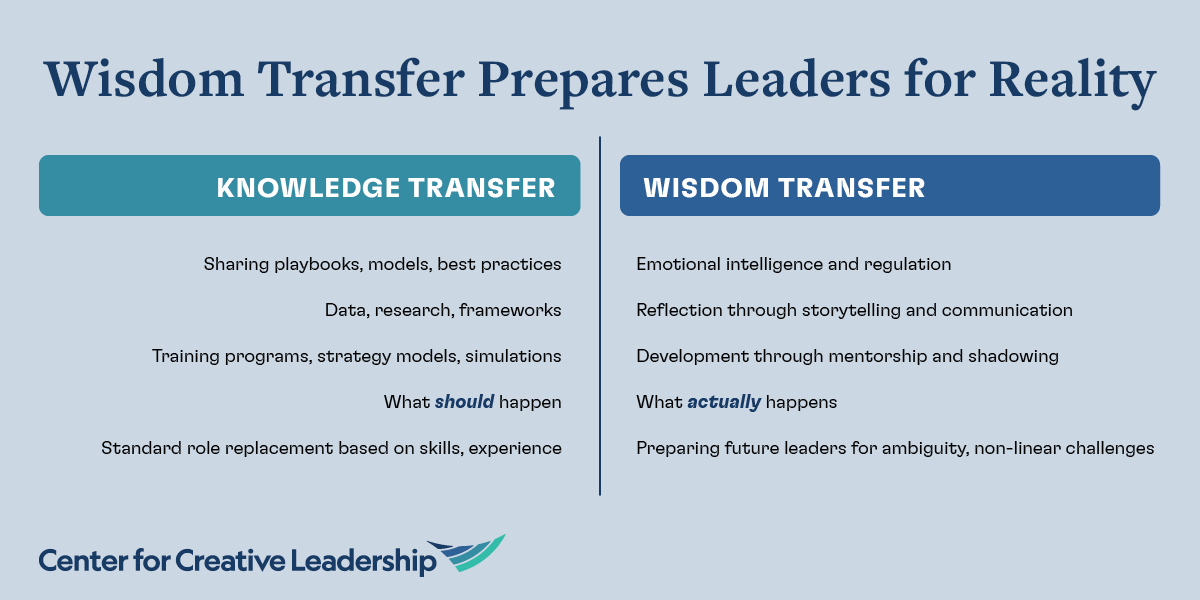
The traditional model of succession planning has largely focused on knowledge transfer. This involves the methodical documentation of processes, the deployment of frameworks and data for decision-making, the communication of best practices, and the identification of candidates based on specific job-related skills. Knowledge transfer addresses questions like: "What are the essential tasks for this role?" or "What are the standard operating procedures?" It prepares individuals for predictable scenarios, equipping them with the technical competencies and procedural understanding necessary to perform specific functions.
However, the reality of leadership is rarely confined to ideal scenarios. Unexpected departures, market shocks, and unprecedented challenges often push leaders beyond the boundaries of their formal training and established playbooks. It is in these moments of ambiguity and crisis that leadership wisdom becomes paramount. Wisdom is defined as the ability to interpret complex contexts, anticipate far-reaching consequences, and exercise sound judgment. Wisdom transfer, therefore, is the deliberate and intentional sharing of this nuanced understanding, experience, and discernment from seasoned leaders to the next generation. It’s about imparting the "how" and "why" behind critical decisions, the ability to read between the lines, and the capacity to lead effectively when the rules are unclear.
Organizations that excel in leadership transitions prioritize the transfer of wisdom. This involves asking deeper questions such as: "What are the implicit understandings that guide our most critical decisions?" or "How do we cultivate the ability to discern and adapt in volatile situations?" By focusing on wisdom, succession planning shifts from a static process of replacement to a dynamic, strategic mindset that views leadership transitions as significant opportunities for growth and institutional strengthening.

The VP’s Lesson: Witnessing Judgment in Action
The opening anecdote of the vice president in the budget meeting perfectly encapsulates the essence of wisdom transfer. The VP’s decision to invite the protégé, rather than closing the door, transformed a high-pressure decision-making moment into a learning opportunity. The protégé, observing the VP’s real-time calculations, persistent questioning ("why often"), and emotional regulation in balancing competing priorities, gained invaluable insights. These were not lessons found in a training manual; they were a masterclass in leadership judgment, delivered through direct observation.
The debrief session that followed, with a disproportionate amount of time dedicated to the VP’s nuanced actions and pauses, underscores the importance of informal learning. The protégé didn’t just learn about the budget; they learned about leading through ambiguity. This experiential learning is often absent from formal succession plans and job descriptions, yet it is crucial for developing leaders who can imagine, request, and ultimately provide such developmental experiences for others. The article emphasizes that wisdom, much like financial capital, depreciates if hoarded but compounds when shared.
Building the Wisdom Infrastructure: Pillars of Succession
To cultivate this vital wisdom transfer, organizations need to establish robust succession infrastructure. This involves creating deliberate avenues for developing and transmitting leadership wisdom. Four core elements form the structural pillars of a modern succession system:
1. Witnessing Decisions in Real-Time
Emerging leaders benefit immensely from being present during consequential decision-making processes. Observing how senior leaders navigate complex situations, sense underlying dynamics, and respond with discernment provides practical wisdom that procedural knowledge cannot replicate. Organizations can foster this by designing development journeys that encourage interpretation and integration of these observations into the emerging leader’s own thinking and action. This direct exposure illuminates essential, often unwritten, capabilities required for advancement. The goal is to witness judgment in action, moving beyond mere observation to active learning.
Actionable Insight: Organizations should map their highest-stakes decision-making moments and identify who is present, and crucially, who should be present to learn from these critical junctures.
2. Communicating Continuity Through Leadership Transition
Leadership transitions are inherently periods of flux. Navigating these moments requires leaders who can maintain organizational orientation and direction amidst shifting landscapes. A proven practice is the establishment of a "wisdom council"—a group comprising individuals with deep institutional memory and real influence across key functions. This council collectively grapples with questions of identity, future direction, and what core values and practices must be preserved. Without this collective wisdom, organizations risk either clinging to outdated strengths or discarding essential elements of their identity, hindering their viability.
Actionable Insight: Before the next leadership transition, identify individuals who embody the organization’s history and core identity and ensure their perspectives are integrated into the transition planning process.
3. Fostering Developmental Relationships
Trust and honesty are the bedrock of effective developmental relationships, which serve as primary conduits for wisdom transfer. These relationships provide emerging leaders with invaluable guidance before they assume new roles. Judgment, a critical yet abstract leadership trait, is best honed within these connections. Seasoned leaders can share their thought processes, articulate their reasoning behind complex decisions, and discuss the myriad factors influencing their choices. Research indicates that these relationships can sustain themselves across decades, demonstrating that wisdom transferred through personal connections has enduring value, compounding over time.
Actionable Insight: Identify existing developmental relationships within the organization and actively protect and nurture them, especially during periods of role changes or leadership turnover.
4. Mapping Influence Networks
Organizational wisdom does not always reside within the formal hierarchical structure. It often flourishes at the nodes where leaders are deeply connected to diverse stakeholders and perspectives. Network science consistently shows that influential carriers of wisdom and institutional memory are frequently found at the "edges" and "bridges" of an organization. Three key network properties are crucial for succession:
- Status: This reflects the depth and breadth of a leader’s connections within the organization. Wisdom-rich leaders are often embedded across multiple influence circles, and their value, though sometimes invisible, is critical.
- Boundary Spanning: Leaders who effectively carry perspectives across functions, generations, and organizational lines are vital. These individuals often set agendas and influence information flow without formal authority, making their contributions essential but potentially overlooked in traditional succession plans.
- Coalition Capacity: The ability to build trust across differences and manage competing perspectives productively is key. Organizations that lose this capacity during leadership transitions struggle to attract and develop future leaders.
Understanding these influence networks helps identify individuals who possess critical wisdom and institutional knowledge, often residing outside formal reporting lines.
Actionable Insight: Map the organization’s influence network to understand where wisdom is concentrated, how it flows, and who the key carriers are, particularly those not reflected on the organizational chart.
The Imperative of Wisdom Transfer in a Changing Landscape
In an era where artificial intelligence can generate competency frameworks and feedback templates instantaneously, the human element of leadership development becomes even more pronounced. The true value lies not in automated processes but in the "labor of wisdom"—the intentional acts of leadership that cannot be prompted or programmed. The VP opening the door, the mentor offering guidance over decades, the assembled council guiding an organization through turmoil—these are the costly, yet invaluable, components of wisdom transfer.
Years of research have consistently shown that organizations that successfully navigate leadership transitions prioritize the movement of wisdom. This includes the judgment, instincts, and hard-won perspectives gained from navigating real-world complexity. When wisdom transfer is central, succession planning evolves from a risk-mitigation strategy into a regenerative leadership system that grows stronger and wiser with each transition.
Leaders have the power to shape the systems, programs, and expectations that influence leadership behavior. By understanding where wisdom resides and how it flows within their organizations, they can champion the intentional transfer of this critical asset. This proactive approach transforms succession planning from a reactive necessity into a strategic imperative, ensuring that organizations not only maintain continuity but also cultivate a future generation of leaders equipped to face evolving challenges.
The Future is Wisdom-Powered
The organizations that will thrive in the coming years, decades, and even centuries will be those that recognize leadership wisdom as their most valuable asset. This asset, however, retains its worth only through deliberate transference. This crucial work cannot be automated; it must be actively built and nurtured.
Wisdom transfer is the bridge from identifying paper successors to cultivating genuinely prepared leaders. It empowers organizations to not only maintain operational stability but also to strategically identify future growth opportunities. The journey begins with a simple yet profound act: opening the door. By committing to this principle, organizations will discover the leaders they seek, and those leaders will be truly ready.
Ready to take the next step? Succession planning is most effective when leadership is transferred, not merely assigned. Explore how programs focused on "Succession Reimagined" can help build a more resilient and wise leadership pipeline for your organization.