

The landscape of corporate human resources and professional development is undergoing a fundamental transformation as organizations pivot from traditional, passive instructional models toward immersive learning environments. This shift, driven by the need for higher skill retention and faster "time-to-proficiency," represents a move away from the "lecture-and-test" format that has dominated the corporate world for decades. Immersive learning, a methodology that places employees within realistic, interactive simulations of their actual work environments, is no longer a niche experimental tool but a central pillar of enterprise strategy for global organizations seeking to maintain a competitive edge in an increasingly complex global economy.
The Evolution of Corporate Pedagogy: A Chronological Context
To understand the current rise of immersive learning, one must look at the trajectory of workplace education over the last half-century. In the 1970s and 1980s, corporate training was almost exclusively instructor-led, requiring physical presence in classrooms and the use of printed manuals. This "one-to-many" approach was high in cost and low in scalability.
The 1990s saw the advent of Computer-Based Training (CBT), often delivered via CD-ROM. While this solved the issue of physical logistics, it lacked engagement. The early 2000s introduced the Learning Management System (LMS) and the era of e-learning, which brought training to the desktop. However, despite the convenience, these platforms often resulted in "check-the-box" compliance exercises where learners passively clicked through slides.
By the mid-2010s, the limitations of passive digital learning became undeniable. Research from the National Training Laboratories suggested that while learners retain only about 5% of what they hear in a lecture, they retain approximately 75% of what they learn when they "practice by doing." This realization, combined with the rapid maturation of Virtual Reality (VR), Augmented Reality (AR), and sophisticated branching logic in software, set the stage for the immersive learning revolution that is now reaching its peak in the mid-2020s.
The Core Strategies of Immersive Environments
The implementation of immersive learning is not a monolithic process; rather, it involves a suite of interconnected strategies designed to mirror the nuances of the modern workplace.

1. High-Fidelity Simulations and Risk-Free Failure
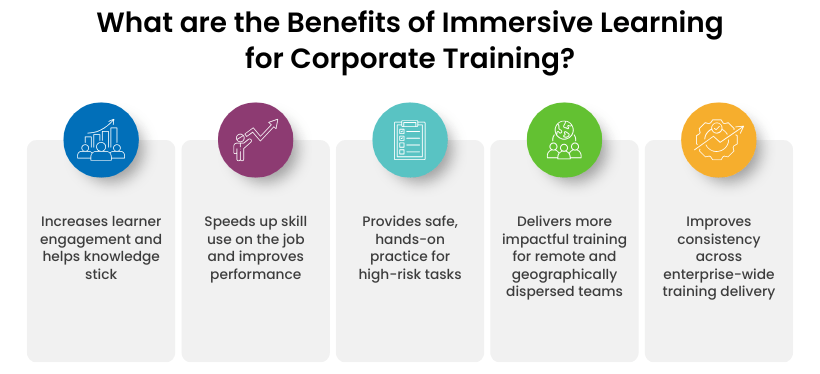
Simulations represent the most direct application of "learning by doing." In a simulated environment, a technician can troubleshoot a high-voltage electrical panel or a surgeon can practice a complex procedure without any risk to human life or expensive equipment. This "psychological safety"—the ability to fail and learn from those failures without real-world consequences—is critical for building confidence. According to recent industry data, employees trained via simulation reach "expert" performance levels up to 40% faster than those using traditional manuals.
2. Advanced Scenario-Based Learning (SBL)
Scenario-based learning moves beyond simple multiple-choice questions. It involves complex, branching narratives where every decision leads to a different outcome. This is particularly effective for "soft skills" or behavioral training. For example, a manager might navigate a difficult performance review with an AI-driven avatar. If the manager chooses an aggressive tone, the avatar responds with defensiveness, demonstrating the immediate interpersonal consequence of the choice.
3. The Power of Narrative Storytelling
Modern immersive learning leverages the psychological concept of "narrative transport." When a training module is framed as a story with a protagonist, conflict, and resolution, the learner’s brain processes the information more deeply. Storytelling transforms abstract compliance rules into a relatable human drama, making the "why" behind a policy as clear as the "what."
4. Gamification and Behavioral Incentives
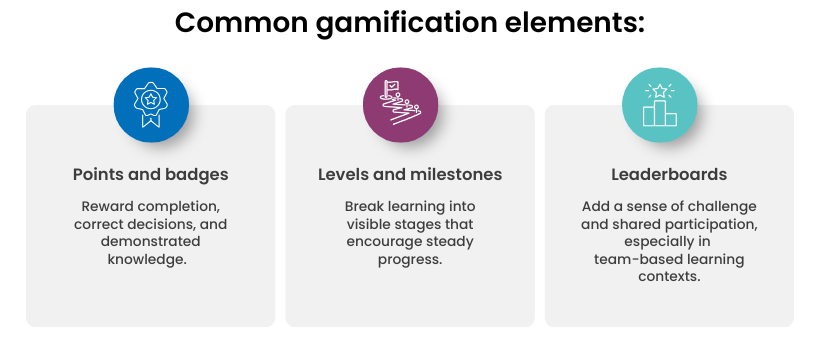
While often misunderstood as simply "playing games," true enterprise gamification applies game mechanics—such as progression bars, badges, leaderboards, and immediate feedback loops—to serious tasks. Market analysis indicates that the global gamification market is expected to grow at a compound annual growth rate (CAGR) of over 25% through 2030, driven largely by its ability to sustain engagement in repetitive technical training.
5. Interactive and 360-Degree Video
Video-based learning has evolved from the "talking head" format to interactive experiences. With 360-degree video, a new hire can take a virtual tour of a manufacturing plant in another country, looking around the environment as if they were physically present. This spatial awareness is vital for safety training and site orientations, reducing the need for costly travel.
Sector-Specific Impact and Data-Driven Results
The adoption of immersive learning is particularly pronounced in "high-stakes" industries where the cost of error is extreme.
Healthcare: In clinical settings, immersive learning has been linked to a significant reduction in medical errors. A study published in the Journal of Advances in Medical Education and Practice found that students trained with immersive VR showed significantly higher accuracy in surgical steps compared to those trained via traditional methods. Hospitals are now using these tools for everything from emergency room triage simulations to empathy training for end-of-life care.
Manufacturing and Energy: For companies like Shell or Siemens, the focus is on "procedural fidelity." Immersive simulations allow workers to practice emergency shutdowns of oil rigs or the maintenance of wind turbines in gale-force winds. This training reduces "on-the-job" accidents, which OSHA (Occupational Safety and Health Administration) estimates cost U.S. employers over $170 billion annually.
Aviation: This sector was the early adopter of immersive learning through flight simulators. Today, that technology has trickled down to ground crews and cabin staff. Training for bird strikes, engine fires, or unruly passenger scenarios is now conducted in immersive digital cabins, ensuring that when a crisis occurs, the response is governed by muscle memory rather than panic.
The Enterprise Perspective: ROI and Scalability
Chief Learning Officers (CLOs) at Fortune 500 companies are increasingly viewing immersive learning through the lens of Return on Investment (ROI). While the initial development of a high-end VR simulation can be more expensive than a standard PowerPoint-based module, the long-term savings are substantial.
"The scalability is the game-changer," says a senior analyst in the HR Tech space. "Once you build a digital twin of a factory for training, you can train 10,000 employees globally for the same marginal cost as training ten. You eliminate travel costs, you don’t have to take expensive machinery offline for training purposes, and you reduce the ‘opportunity cost’ of having employees away from their desks for long periods."
Furthermore, immersive learning provides granular data that traditional training cannot. Enterprises can track exactly where a learner hesitated, which mistakes were most common across a specific demographic, and how long it took for a learner to achieve mastery. This data allows for the continuous refinement of training programs, ensuring they remain aligned with business goals.
Overcoming Implementation Barriers
Despite the clear benefits, the transition to immersive learning is not without challenges. High-quality VR hardware remains a significant capital expenditure, and "VR motion sickness" continues to affect a small percentage of users. Additionally, integrating immersive content with legacy Learning Management Systems requires robust IT infrastructure and cybersecurity protocols, especially when dealing with proprietary or sensitive corporate data.
To mitigate these issues, many enterprises are adopting a "blended" approach. This involves using mobile-based AR for quick "just-in-time" support on the factory floor, while reserving high-end VR for intensive, deep-skill sessions.
Broader Implications: The Future of the "Corporate Metaverse"
As we look toward the end of the decade, the integration of Artificial Intelligence (AI) with immersive learning is expected to create even more personalized experiences. AI can adjust the difficulty of a simulation in real-time based on the learner’s performance, providing a truly bespoke educational journey.
The broader impact of this shift extends beyond corporate efficiency; it represents a democratization of expertise. Immersive learning allows a worker in a developing economy to access the same high-quality, hands-on training as a peer in a major technological hub. By closing the "skills gap," immersive learning is becoming a vital tool for global economic mobility.
In conclusion, the rise of immersive learning marks the end of the era of passive consumption in corporate education. As organizations face a rapidly changing technological landscape, the ability to train employees quickly, safely, and effectively is no longer a luxury—it is a survival imperative. By placing the learner at the center of the experience, enterprises are not just teaching skills; they are building the cognitive resilience required for the future of work. For the modern enterprise, the message is clear: to prepare for the reality of tomorrow, employees must be allowed to experience it today.






