
A recent investigation into the initial experiences of new hires in the United States has unveiled significant systemic frustrations, collectively dubbed the "ick" problem, within corporate onboarding processes. Based on comprehensive research conducted by Adobe Acrobat, surveying 1,006 fully employed U.S. workers who commenced a new role within the past two years, the findings illuminate a widespread struggle with information overload, critical knowledge gaps—particularly concerning artificial intelligence policies—and tangible negative impacts on employee confidence and performance. This deep dive into the modern onboarding landscape underscores a pressing need for organizations to re-evaluate and overhaul their introductory protocols to foster better integration, retention, and productivity.
The Core Findings: A System Under Strain
The Adobe Acrobat research, a critical benchmark in understanding contemporary employee integration, pinpointed several recurring pain points across diverse industries and company sizes. At the heart of the issue lies an overwhelming deluge of information that new hires are expected to absorb in their initial weeks. Employees reported confronting an average of 13 distinct onboarding documents and dedicating approximately 12 hours to reviewing these materials during their first week alone. Despite this significant investment of time, a striking revelation emerged: only 60% of this content was deemed necessary or directly relevant to their new role. This inefficiency is compounded by a profound retention deficit, with 44% of workers admitting they retained half or less of the information presented to them during onboarding. Such figures paint a stark picture of an onboarding system that often prioritizes quantity over quality, leading to disengagement rather than empowerment.
Beyond the sheer volume, the study also identified a critical, modern knowledge gap: guidance on organizational AI policies. A significant 38% of employees reported receiving no information or direction regarding their company’s AI policies during onboarding. This represents the largest informational void identified by Adobe’s tracking, highlighting a critical oversight in an era where AI is rapidly transforming workplaces. Even among those who did receive AI policy information, more than one-third confessed to retaining less than half of it, suggesting that even when provided, the communication methods may be ineffective. This gap carries substantial implications, ranging from ethical considerations and data privacy to compliance and effective tool utilization, signaling a looming challenge for organizations failing to properly equip their workforce for the AI age.
The Genesis of Onboarding Challenges: A Historical and Modern Context
The concept of onboarding, or organizational socialization, has evolved significantly over the decades. Historically, it was a more informal process, often involving a simple orientation day and gradual learning through apprenticeship or mentorship. The industrial revolution brought more formalized training, primarily focused on technical skills and safety. In the latter half of the 20th century, with the rise of human resources as a distinct function, onboarding became a structured process encompassing paperwork, benefits enrollment, and introductions to company culture.
However, the late 20th and early 21st centuries introduced new layers of complexity. Globalization necessitated standardized practices across diverse regions, while increasing regulatory burdens—from data privacy (GDPR, CCPA) to anti-discrimination laws and industry-specific compliance—transformed onboarding into a heavily document-driven process. The digital revolution promised efficiency, but often resulted in a mere digitization of existing paper-heavy processes, leading to the "ick" problem of digital document overload rather than true simplification.
The most recent and perhaps most impactful shift has been the rapid acceleration of remote and hybrid work models, largely catalyzed by the COVID-19 pandemic. This seismic shift fragmented traditional onboarding, moving interactions from physical offices to virtual platforms, often without a corresponding overhaul of the content or delivery methods. Simultaneously, the meteoric rise of artificial intelligence has introduced entirely new ethical, operational, and policy considerations, creating an urgent need for clear guidance that many organizations are still struggling to integrate into their onboarding frameworks. The Adobe research effectively captures the friction points arising from these overlapping historical and contemporary developments, revealing an onboarding paradigm struggling to adapt to the demands of the modern workforce.
Eroding Confidence and Performance: The Human Cost of Poor Onboarding
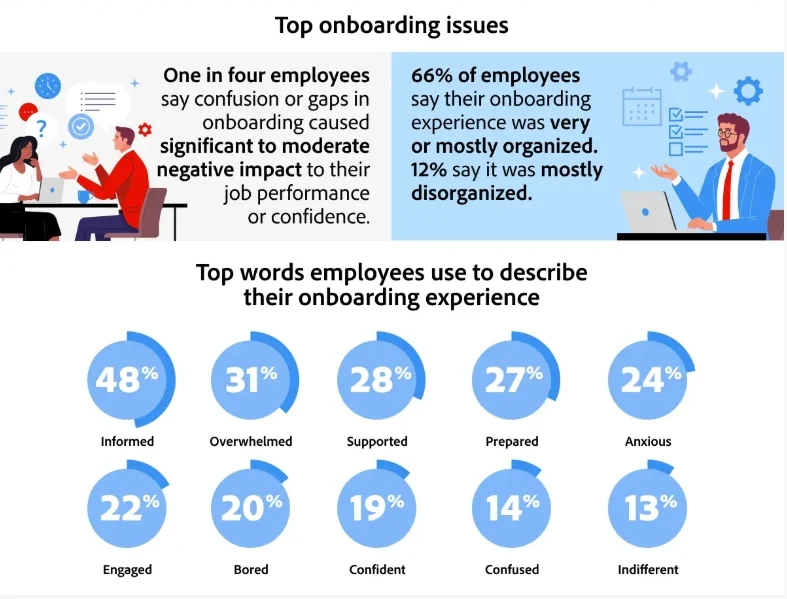
The frustrations highlighted by the Adobe study are far from benign administrative inconveniences; they manifest in measurable, detrimental impacts on new hires. The research indicates that one in four employees reported that confusion or significant gaps in their onboarding experience had a moderate or profound negative impact on their job performance or overall confidence. This direct correlation between inadequate onboarding and reduced efficacy underscores the strategic importance of effective integration. Moreover, the psychological toll is significant: more than one in five employees admitted that their onboarding experience made them question their decision to join the company, a critical early indicator of potential disengagement and future turnover.
This crisis of confidence is exacerbated by a pervasive, problematic behavior identified in the study: 41% of employees confessed to signing or acknowledging an onboarding document without fully reading it. While a signature serves as an acknowledgment of receipt, it offers no guarantee of comprehension. This practice creates significant compliance risks, as employees may unknowingly violate company policies or fail to leverage critical resources simply because they never fully absorbed the information. In a legal context, such acknowledgments may be challenged if an employee can demonstrate the overwhelming nature of the onboarding materials hindered their ability to properly review and understand them. This gap between acknowledgment and understanding is a silent threat to organizational integrity and employee accountability.
While the Adobe survey relies on employee perceptions rather than independently verified outcomes, the consistency and prevalence of the reported frustrations across a large sample size lend significant weight to its conclusions. The findings strongly suggest that administrative friction is not merely an HR headache but a direct contributor to reduced employee confidence, diminished performance, and increased early-stage turnover risk.
Disparities in the Digital Workspace: Hybrid and Remote Onboarding Challenges
The transition to hybrid and remote work models has not only reshaped where and how people work but has also unevenly distributed the challenges of onboarding. The Adobe survey reveals distinct disparities in the onboarding experiences of employees based on their work arrangements. Hybrid employees, those splitting their time between remote and on-site work, were significantly more likely to encounter onboarding materials characterized by overly complex or legalistic language. This suggests that organizations may be struggling to adapt their communication styles for a workforce that requires both digital accessibility and a clear, concise understanding of policies that apply across varied work environments.
The data further illustrates these discrepancies in information retention: only 47% of hybrid employees reported retaining more than half of their onboarding information. This figure contrasts sharply with remote workers and on-site employees, both of whom reported a 59% retention rate. This suggests that the hybrid model, despite its perceived flexibility, may inadvertently create a more confusing or fragmented onboarding experience, perhaps due to inconsistent access to resources or varying levels of support across different work settings.
Remote employees, while showing better retention than their hybrid counterparts, faced their own unique set of difficulties. They were more prone to receiving contradictory or outdated documents, a problem likely amplified by the asynchronous nature of remote work and the reliance on digital repositories that may not be consistently updated. Furthermore, remote workers were the most likely to struggle with locating onboarding documents and resources beyond their initial first week. This highlights a critical need for accessible, well-organized, and consistently updated digital hubs for remote teams, ensuring continuous access to vital information long after the initial onboarding period.
Expert Perspectives and Industry Trends: The Broader Landscape
The findings from Adobe Acrobat resonate with broader trends and concerns voiced by HR leaders and organizational psychologists. Industry reports from organizations like Gallup and SHRM consistently highlight the critical role of effective onboarding in employee engagement, retention, and overall organizational success. Poor onboarding is frequently cited as a significant factor contributing to early employee turnover, which can cost companies substantial amounts—estimates often range from 50% to 200% of an employee’s annual salary to replace them, factoring in recruitment, training, and lost productivity.
"Onboarding is not merely an administrative checklist; it’s the foundation of an employee’s journey within an organization," states Dr. Eleanor Vance, a prominent organizational psychologist. "When new hires feel overwhelmed, confused, or unsupported from the outset, it creates a psychological contract of distrust and disengagement. They learn quickly that the organization might not prioritize their clarity or success, leading to reduced motivation and an increased likelihood of seeking opportunities elsewhere."
The integration of AI into HR processes, while promising efficiency, also introduces new complexities. Experts emphasize the urgent need for clear AI governance and ethical guidelines, particularly for employees who will interact with or be impacted by AI tools. "Companies are rapidly adopting AI, but many are lagging in establishing clear policies and, crucially, communicating those policies to their workforce," comments Mark Jenkins, an HR technology analyst. "The lack of AI policy guidance in onboarding is a ticking time bomb, risking misinterpretations, misuse, and potential legal or ethical breaches. It also signals a lack of preparedness from the organization itself."
The Path Forward: Employee-Driven Solutions and Strategic Imperatives
The Adobe research not only identifies problems but also offers clear pathways for improvement, largely derived from employee preferences. The most frequently requested change was the creation of a single, searchable hub for all onboarding documents and resources. This desire for centralized, easily accessible information speaks to the frustration with fragmented, disparate materials. Employees also expressed a strong preference for fewer, more consolidated materials, clearer checklists, and the gradual delivery of information rather than an overwhelming initial dump. These suggestions collectively point towards a need for simplification, organization, and a more staggered, digestible approach to information dissemination.
Organizations that have successfully navigated these challenges often employ a multi-faceted strategy:
- Digital Onboarding Platforms: Implementing robust, intuitive digital platforms that serve as a single source of truth for all onboarding materials, policies, and training modules. These platforms often incorporate interactive elements, progress tracking, and easy search functionalities.
- Phased Information Delivery: Moving away from front-loading all information into the first week. Instead, critical immediate tasks are addressed, followed by a structured, phased release of information over several weeks or even months, aligning content with an employee’s evolving needs and responsibilities.
- Clear, Concise Communication: Rewriting complex legalistic language into plain English, utilizing visual aids, infographics, and short video explanations to enhance comprehension and retention.
- Dedicated AI Policy Integration: Developing clear, comprehensive AI-use policies and integrating them prominently and understandably into onboarding, perhaps with dedicated training modules or FAQs.
- Mentorship and Peer Support Programs: Pairing new hires with experienced colleagues or mentors who can provide informal guidance, answer questions, and help navigate cultural nuances, complementing formal documentation.
- Regular Feedback Loops: Establishing mechanisms for new hires to provide feedback on the onboarding process, allowing HR teams to iteratively refine and improve their programs.
The Business Imperative: ROI of Effective Onboarding
Investing in a robust and empathetic onboarding experience is not merely a matter of good HR practice; it’s a strategic business imperative with tangible returns on investment. Effective onboarding significantly impacts:
- Retention: Employees who have positive onboarding experiences are more likely to stay with a company longer. Reducing early turnover directly cuts recruitment and training costs.
- Productivity: Well-onboarded employees reach full productivity faster, contributing to the bottom line more quickly. Clarity on roles, responsibilities, and resources empowers them to perform efficiently.
- Engagement: A welcoming and informative onboarding process fosters a sense of belonging and commitment, boosting employee engagement from day one. Engaged employees are more innovative, productive, and less likely to leave.
- Employer Brand: A positive onboarding experience enhances the company’s reputation as an employer of choice, attracting top talent and reinforcing its brand image. Negative experiences, conversely, can lead to poor Glassdoor reviews and reputational damage.
- Compliance and Risk Mitigation: Ensuring employees fully understand policies, especially around critical areas like AI, data security, and ethics, significantly reduces legal and operational risks.
The "ick" problem in onboarding, as revealed by Adobe Acrobat’s research, serves as a critical wake-up call for organizations globally. In a competitive talent market where employee experience is paramount, the initial impression an organization makes can dictate the trajectory of a new hire’s success and tenure. By addressing information overload, bridging critical knowledge gaps, and adopting more human-centric, technology-enabled approaches, companies can transform onboarding from a source of frustration into a powerful tool for building confident, engaged, and high-performing teams, ultimately safeguarding their investment in human capital and future growth.








