The modern workplace is characterized by relentless change, a constant barrage of challenges that can drain the very energy leaders need to foster growth, both for themselves and their organizations. As artificial intelligence continues to redefine how we work, the fundamental truth remains: human leaders are the linchpins of organizational success. These leaders, though often feeling the strain of compounding obstacles, possess an innate human superpower—a psychological fuel that quietly propels organizations forward. This vital resource, known as psychological capital, or PsyCap, is not only essential for leaders but is also something they actively cultivate and produce, proving to be an invaluable asset in achieving humanly possible outcomes. PsyCap acts as the essential lubricant for the organizational machinery, sustaining leaders who maintain operational synchronicity and preventing the entire system from faltering.
Understanding the Core of Psychological Capital
Psychological capital is broadly defined as an individual’s positive psychological state, a robust foundation built upon four interconnected pillars:
- Hope: The capacity to set goals and the perseverance to achieve them, coupled with the belief in one’s ability to find pathways to those goals.
- Self-Efficacy: A belief in one’s own capability to organize and execute the courses of action required to manage prospective situations.
- Resilience: The capacity to bounce back from adversity, uncertainty, and conflict, maintaining a positive outlook and adapting effectively to changing circumstances.
- Optimism: A positive attributional style, characterized by the expectation that good events will be forthcoming and that negative events will be temporary and specific.
Extensive research has consistently demonstrated the profound impact of high PsyCap among employees. Studies indicate that individuals with elevated levels of psychological capital exhibit greater commitment to their roles, demonstrate superior performance, experience enhanced well-being, and are significantly less susceptible to burnout. This robust psychological framework equips individuals to not only navigate challenges but to thrive amidst them.
The Critical Role of PsyCap in Leadership
For leaders, psychological capital is not merely beneficial; it is essential. Leaders who embody high PsyCap tend to exhibit stronger authentic leadership behaviors. These behaviors, such as profound self-awareness, transparent relational interactions, and a clear moral compass, foster higher levels of trust within their teams and are directly correlated with improved organizational performance. Leadership, fundamentally a social process, is fueled by human energy, motivation, and this vital psychological capacity. Sustaining effective leadership, especially in environments fraught with complexity, requires more than just technical skills; it demands a deep wellspring of inner fortitude.
Leaders require robust mental resources to persevere through adversity, adapt to unforeseen circumstances, and ultimately flourish. This is precisely where psychological capital plays a pivotal role. Decades of academic inquiry into PsyCap have yielded compelling findings, suggesting that it is a significant predictor of key organizational success metrics, including overall performance, employee engagement, and retention rates. PsyCap encapsulates the uniquely human strengths that empower leaders to effectively manage disruption and propel their organizations toward their objectives.
Crucially, psychological capital is not an immutable trait; it is a dynamic and developable resource. Through intentional experiences, professional coaching, and robust organizational support systems, leaders can actively build and continuously enhance their psychological capital over time. This developable nature of PsyCap makes it a particularly valuable investment for organizations seeking to foster resilient and effective leadership. Furthermore, PsyCap serves as a powerful indicator of the tangible return on investment derived from leadership development initiatives.
Research conducted with participants in comprehensive leadership development programs consistently highlights the transformative power of PsyCap. Findings suggest that PsyCap is not merely a passive outcome of development but a key explanatory factor in why development initiatives are effective. Leaders who demonstrate elevated levels of hope and optimism post-program often report a concomitant increase in goal attainment and team engagement. This underscores the imperative for effective leadership development strategies to prioritize the cultivation of leaders’ psychological capital.

Elevating Psychological Capital Through Strategic Leadership Development
Organizations are increasingly recognizing that leadership development must extend beyond the acquisition of new skills. When leaders are provided with dedicated opportunities to step back, engage in deep reflection, receive candid feedback, and experiment with novel approaches, they not only gain new competencies but also replenish their internal reserves of motivation and drive. This process, in essence, fortifies their psychological capital, providing them with the inner resilience to effectively apply their newly acquired skills when faced with significant challenges.
A tangible demonstration of this growth can be observed by comparing psychological capital levels before and after intensive leadership development programs. Studies examining custom programs designed for educational leaders, for instance, consistently reveal significant and measurable increases in PsyCap over the course of the program. In one typical cohort, the percentage of leaders reporting "high PsyCap" surged from 36% prior to the program to an impressive 79% upon its completion.
This data prompts an essential question: what specific elements within a development experience contribute to this enhancement of psychological capital? A closer examination of program data reveals that PsyCap growth is not always linear. In fact, it can sometimes experience a temporary dip midway through an intensive program. This often occurs when leaders receive challenging feedback, perhaps through 360-degree assessments that heighten their self-awareness. Paradoxically, following this initial dip, PsyCap tends to rebound and often surpasses its initial levels as leaders acquire new skills and strategies to address their identified areas for development.
This temporary dip is a noteworthy phenomenon. It reflects a period of intense processing and integration of feedback, where confidence or optimism might momentarily waver before strengthening. The crucial factor is what transpires subsequently. This is where targeted support becomes paramount.
The Synergistic Power of Coaching in Nurturing Leader PsyCap
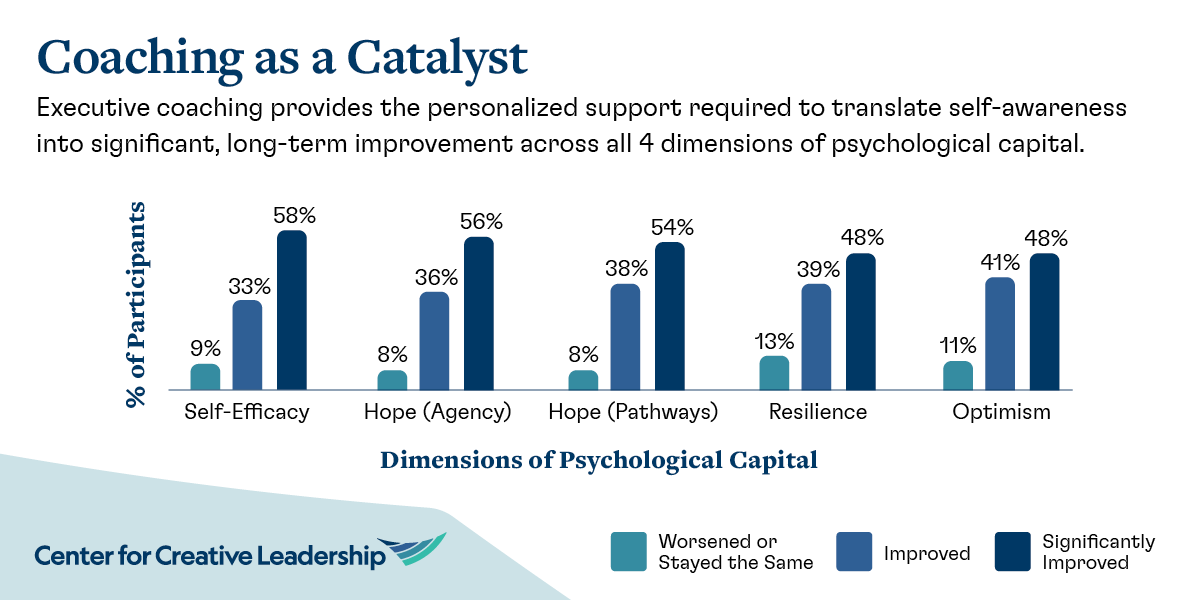
Coaching emerges as one of the most direct and effective avenues for providing leaders with intentional, personalized support. Comprehensive evaluations have demonstrated that coaching offers a tailored approach for leaders to address ongoing challenges, even beyond the conclusion of formal development programs. This personalized guidance fosters goal-achieving behaviors that have a direct and positive impact on their psychological capital.
Even highly experienced leaders who engage in executive coaching services frequently report significant improvements in their PsyCap. This aligns perfectly with the fundamental principles of coaching, which aims to move beyond skill acquisition to cultivate the crucial self-awareness and internal work necessary for more effective leadership. Coaching also plays a vital role in replenishing the energy of leaders who consistently practice these demanding behaviors.
The Impact of Bite-Sized Interventions on Psychological Capital
While immersive, in-person leadership development programs are highly effective, the benefits of psychological capital are not solely confined to these formats. Encouraging evidence suggests that PsyCap can also be effectively strengthened through shorter, targeted online leadership training experiences, particularly when the learning content is directly linked to a real-world work challenge.
A pilot study of a self-paced online course specifically designed to build leaders’ PsyCap yielded positive results. Participants who completed the course reported a meaningful and statistically significant increase in their psychological capital. On average, PsyCap scores increased by nearly a full point on a 1-to-5 scale (+0.74), with a remarkable 86% of leaders in the online course indicating an overall improvement. The efficacy of this format is amplified by its focus on the leader’s most pressing professional challenge, ensuring that personalized reflections and practice opportunities remain anchored in tangible, real-world scenarios.
Navigating PsyCap Differently: The Experience of Neurodiverse Leaders
A growing body of research highlights the significant benefits that organizations derive from neurodiverse leadership teams and workforces. However, studies have also indicated that leaders who identify as neurodivergent—for instance, those with Attention Deficit Hyperactivity Disorder (ADHD) or autism—tend to report lower overall levels of psychological capital when compared to their neurotypical counterparts.
It is imperative to emphasize that these findings do not imply a deficit in leadership potential. Instead, they underscore the reality that leaders bring diverse strengths and unique psychological resource needs into their roles. For organizations, this reinforces the critical importance of establishing the necessary psychological conditions to support the sustained impact of all leaders, regardless of their neurotype. Creating inclusive environments that acknowledge and accommodate these differences is paramount for unlocking the full potential of every leader.
Psychological Capital: The Essential Fuel for Navigating Workplace Disruption
In an era defined by persistent disruption, leadership development must transcend the mere imparting of skills. It must actively provide the psychological fuel that enables leaders to maintain their effectiveness amidst ambiguity, demanding workloads, and rapidly evolving environments. Psychological capital serves as this indispensable fuel, and empirical data consistently demonstrates its enhancement through strategic leadership development initiatives.
Across a spectrum of programs, including immersive development courses, personalized coaching, and digital learning experiences, PsyCap demonstrates growth when leaders are exposed to an optimal blend of heightened self-awareness, meaningful professional challenges, and supportive conditions that facilitate the translation of insight into tangible action.
This journey of growth is not always linear; it frequently involves a temporary period of introspection and challenge as leaders integrate difficult feedback. However, with appropriate support, this transitional phase can become a powerful turning point, empowering leaders to regain their sense of agency, clarity, and confidence to embrace new ways of working.
This development is not solely an individual endeavor. While leadership sets the overarching tone, it is the organizational culture that ultimately channels and amplifies this collective energy. Organizations that actively cultivate cultures supportive of PsyCap—by normalizing constructive feedback, celebrating incremental progress, and fostering a balanced approach to performance and recovery—witness a multiplicative impact. High-performing organizations create environments where hope, self-efficacy, resilience, and realistic optimism gain momentum, flowing organically from leaders to their teams and radiating throughout the entire organization.
However, it is crucial to recognize that developing psychological capital is not a panacea for systemic issues. It is not intended as a mechanism for individuals to simply "muscle through" unhealthy workloads or toxic organizational cultures. The full potential of leadership resilience and optimism is realized when these inner resources are complemented by systemic support, genuine psychological safety in the workplace, and thoughtful, well-defined boundaries. The ultimate aim is not to cultivate leaders who can endure any circumstance, but rather to nurture the inner resources that empower them to confront harsh realities, devise innovative solutions, and inspire a future that benefits all stakeholders.
Embarking on the Path to Enhanced Leadership Capacity
The commitment to exploring and strengthening the human dimension of leadership is ongoing. For individuals and organizations alike, the next step in building this essential capacity is clear. Programs such as the Leadership Development Program (LDP)® and dedicated executive coaching services are meticulously designed to cultivate the psychological capital and inner resources that empower leaders to perform at their peak, even when confronted with formidable challenges. By investing in these developmental pathways, organizations can ensure their leaders are equipped not only with the skills but also with the unwavering inner fortitude required to navigate the complexities of the modern business landscape and drive sustainable success.