Well-designed employee rewards and recognition programs are not merely optional perks; they are practical necessities for organizations aiming to foster engagement, enhance performance, and improve retention, especially in today’s dynamic and demanding work environments. While the concept of acknowledging employee contributions is straightforward, the effectiveness of these programs hinges critically on their execution and frequency. Research consistently underscores that the impact of recognition is directly proportional to how consistently and meaningfully it is delivered.
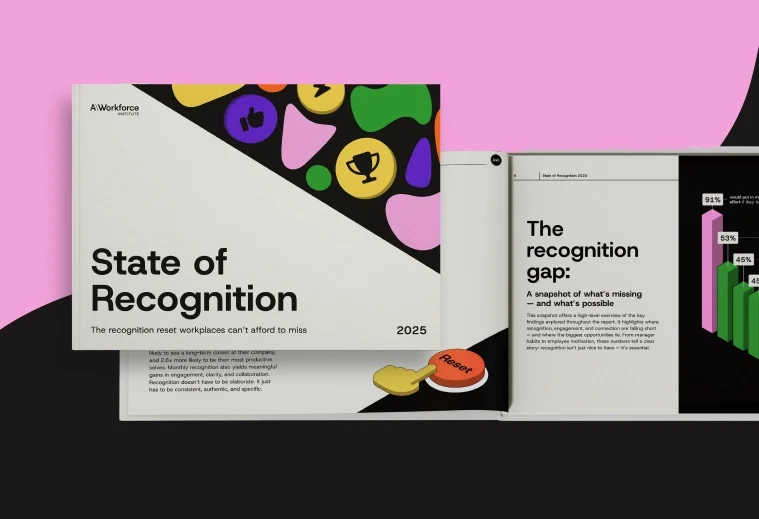
A pivotal study, the State of Recognition Report, compiled from insights of 2,500 employees across eight global regions, revealed a compelling correlation: employees who receive recognition on a weekly basis are 2.6 times more likely to be performing at their peak. This data point offers a clear directive: for recognition to be effective, it must be frequent, genuinely meaningful, and explicitly linked to the behaviors and outcomes an organization wishes to cultivate.
The Foundation of Employee Engagement: A Culture of Appreciation
Employee engagement is not an attribute that can be mandated; it is meticulously built. One of the most potent tools in an organization’s arsenal for constructing this engagement is a robust recognition strategy. At its core, employee recognition involves acknowledging and valuing the contributions, behaviors, and achievements that propel an organization forward. This can range from a simple, timely "thank you" to grand, company-wide celebrations. However, it is the consistent and meaningful application of these acknowledgments that transforms recognition into a powerful catalyst for engagement.
The significance of this cannot be overstated. Recognition directly influences how employees perceive their work and their workplace. According to the Achievers Workforce Institute (AWI), a mere 25% of employees report feeling appreciated and engaged, indicating that a vast majority of organizations are underutilizing a critical driver of employee commitment. Conversely, when employees do feel genuinely appreciated, the impact is profound: they are 12 times more likely to find their work meaningful and an impressive 17 times more likely to envision a long-term career within their company.
The key differentiator is consistency. Recognition should not be viewed as a singular event but as an ingrained habit that shapes the daily work experience. AWI research further substantiates this, showing that employees who receive frequent, meaningful recognition are 2.6 times more productive and six times more likely to remain with their company long-term. Therefore, recognition transcends mere feel-good gestures; it is a strategic lever that strengthens a sense of belonging, clarifies expectations of success, and connects individuals to a shared organizational purpose. When executed effectively, recognition not only boosts engagement but also drives performance and retention at scale. This strategic integration is often facilitated through structured and consistent employee rewards and recognition programs.
Evolving Trends in Employee Recognition: An Executive Overview
Employee recognition is rapidly evolving from a peripheral HR initiative to a central driver of engagement, retention, and overall performance. For executives, understanding the key trends is paramount to developing effective strategies. The most significant shifts point towards more frequent, data-driven, and culturally embedded recognition programs.
Key trends shaping employee recognition today include:
- Continuous Recognition: Leading organizations are moving beyond traditional milestone-based programs to embrace continuous recognition that reinforces desired behaviors in real-time, fostering an ongoing cycle of positive reinforcement.
- Peer-to-Peer Empowerment: Expanding recognition beyond managerial channels increases its reach, authenticity, and overall engagement across large and complex workforces. Empowering peers to recognize one another democratizes appreciation and captures contributions that might otherwise go unnoticed.
- Value Alignment: Organizations are increasingly aligning recognition efforts with core company values and strategic objectives. This ensures that recognition not only celebrates achievement but also actively influences company culture and drives performance in desired directions.
- Platform Consolidation: The trend is towards consolidating recognition, rewards, and feedback mechanisms into unified platforms. This integration simplifies management, enhances scalability, and provides richer data for analysis and strategic decision-making.
- Data-Driven Insights: Leaders are leveraging recognition data to track program participation, identify engagement gaps, and establish clear connections between recognition initiatives and tangible business outcomes like retention and productivity.
- Employee Expectations: Modern employees expect timely, personalized recognition that accurately reflects their unique contributions and connects their work to a larger purpose. Generic or delayed acknowledgments are increasingly seen as less impactful.
Collectively, these trends signal a profound shift: recognition is no longer solely about expressing gratitude; it is a strategic imperative for shaping workforce behavior and achieving measurable business results. Platforms like Achievers, which integrate recognition, rewards, and insights, are instrumental in helping organizations operationalize these trends at scale, transforming everyday moments into significant, measurable impact.
Employee rewards and recognition programs serve as a structured framework for organizations to acknowledge and reinforce exemplary work. They not only recognize employee contributions but also pair this recognition with rewards that hold genuine value for the recipients. Most contemporary rewards and recognition programs are delivered through scalable systems that provide a consistent approach to acknowledging great work, while also supporting organizational growth and increasing complexity over time. This approach ensures that recognition is visible across teams, reinforcing shared values, while rewards, often points-based, offer employees flexibility, and provide HR leaders with budget control and operational simplicity. This model is equally effective for mid-market businesses as it is for large enterprise organizations or those operating on a global scale.
Budgeting for Impact: Benchmarking Employee Rewards in 2026
A frequently posed question in strategic HR planning is: "What is the benchmark for an employee rewards budget per employee in 2026?" The reality is that a universal benchmark is elusive. The optimal budget is contingent upon several factors, including workforce size, specific recognition goals, anticipated participation rates, and overarching business objectives.
A pragmatic starting point involves viewing rewards budgets on an annual, per-employee basis rather than as a monolithic company-wide allocation. High-performing recognition and rewards programs typically align budget decisions with desired recognition frequency, ensuring employees receive meaningful acknowledgment throughout the year, rather than concentrating rewards around a few annual events.
When benchmarking an employee rewards budget, organizations should consider:
- Frequency of Recognition: How often do you aim to recognize employees? More frequent recognition requires a more consistently distributed budget.
- Type of Rewards: Are you offering monetary rewards, experiences, merchandise, or a combination? The cost and perceived value of different reward types will influence budget allocation.
- Program Participation Goals: What percentage of your workforce do you expect to actively participate in recognition activities? Higher participation rates will necessitate a larger overall budget.
- Company Culture and Values: Does your budget reflect a culture that prioritizes continuous appreciation and the reinforcement of specific values?
- Budget Flexibility: Does the budget allow for adjustments based on evolving business needs or unexpected achievements?
The most effective programs do not solely focus on expenditure but rather on creating frequent, meaningful recognition experiences supported by rewards that employees genuinely value. A substantial budget with low participation yields minimal impact, whereas a well-designed program that encourages regular recognition can significantly strengthen engagement and retention without incurring excessive costs.
Before establishing a budget, it is crucial to define clear success metrics. These could include participation rates, frequency of recognition activity, employee engagement scores, retention rates, and productivity measures. This data-driven approach enables leaders to ascertain whether their rewards investment is generating measurable business value and ensures that budgets can scale in tandem with program adoption.

A strategic tip for budget planning: Instead of asking, "How much should we spend per employee?" reframe the question to, "What outcomes are we trying to achieve?" The strongest employee rewards programs intrinsically link budget decisions to culture, engagement, and retention goals, thereby facilitating the demonstration of ROI and securing sustained executive support.
Exemplary Employee Rewards and Recognition Programs
The landscape of employee rewards and recognition is diverse, with various program types catering to different organizational needs and cultures. Understanding these options is key to designing an effective strategy.
1. Peer-to-Peer Recognition Programs
These programs empower employees to recognize their colleagues for everyday contributions, collaborative efforts, and mutual support. By shifting the focus from solely manager-led acknowledgment, recognition emanates from those who work most closely with employees daily. Peer recognition software is invaluable for capturing efforts that managers might not directly observe, thereby increasing the frequency of recognition across the organization.
2. Points-Based Rewards and Recognition Programs
Combining recognition with employee choice, points-based programs award employees points for accomplishments, demonstrating company values, achieving goals, or going above and beyond. These accumulated points can then be redeemed for rewards that hold personal significance for the employee. This approach allows for consistent recognition of achievement while enabling employees to select rewards that align with their individual preferences and interests, moving away from a one-size-fits-all reward model.
3. Manager-Led Recognition Programs
These programs focus on equipping leaders with the tools and framework to acknowledge employee contributions in a timely and specific manner. Recognition can be directly tied to performance objectives, project milestones, customer impact, teamwork, innovation, or adherence to company values. A well-executed manager recognition program clarifies what success looks like and underscores the importance of individual contributions.
4. Service Anniversary and Milestone Programs
Celebrating career milestones such as work anniversaries, promotions, certifications, and significant career achievements is a cornerstone of service anniversary programs. Milestone recognition is particularly effective in highlighting an employee’s enduring relationship with the company and provides opportunities for public celebration of their journey and accomplishments.
5. Awards and Nomination-Based Recognition Programs
Awards programs are designed to recognize exceptional contributions that have a substantial impact on teams, customers, or business outcomes. Employees are typically nominated by peers, managers, or leaders and are celebrated for accomplishments that extend beyond their routine responsibilities. These programs are highly effective for acknowledging standout achievements, groundbreaking innovations, exemplary leadership, and major business wins.
6. Employee Appreciation Events
Employee appreciation events offer dedicated occasions for organizations to collectively recognize their workforce. These can encompass appreciation days, team celebrations, recognition weeks, cultural observances, or company-wide thank-you initiatives. While events should complement ongoing recognition, they powerfully reinforce a culture of appreciation when integrated with more frequent recognition programs.
7. Flexible Rewards Marketplace Programs
Flexible rewards programs grant employees access to a wide array of reward options, including gift cards, merchandise, unique experiences, travel opportunities, charitable donations, wellness-related incentives, company swag, and other desirable perks. Offering a diverse selection of reward choices ensures that recognition remains personal and relevant, thereby enhancing the perceived value of the reward and boosting overall program participation.
8. External Recognition Programs
These programs allow customers, clients, patients, partners, or guests to directly recognize employees for exceptional service or contributions. This external validation provides employees with valuable insights into the impact of their work beyond the confines of the organization. External recognition is particularly impactful for customer-facing and frontline roles, as it directly connects employees to the individuals they serve. Hearing firsthand from customers about the positive difference they have made imbues recognition with deeper meaning and reinforces a stronger sense of purpose.
Distinguishing Rewards from Recognition
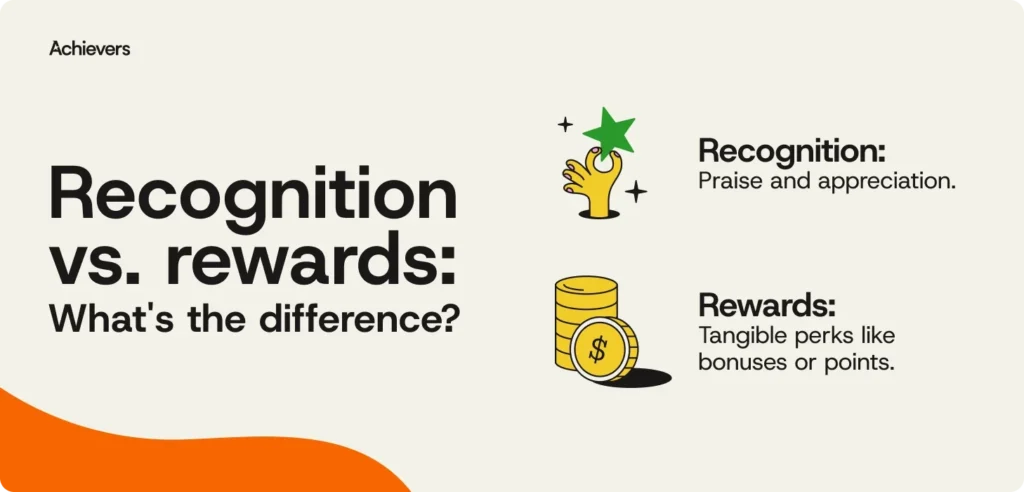
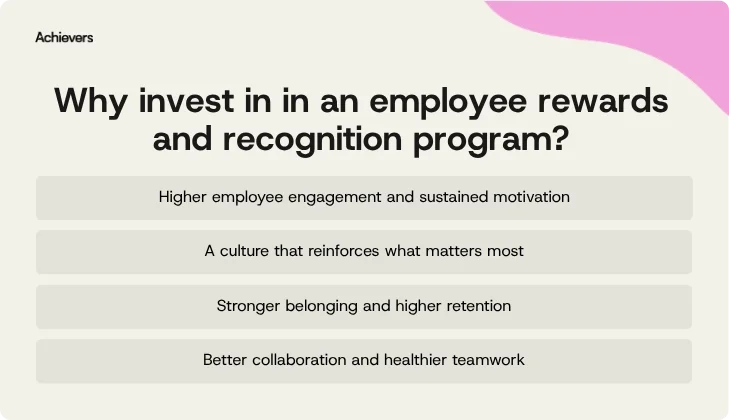
The fundamental difference between employee rewards and recognition lies in their function: recognition acknowledges a contribution or behavior, while rewards provide a tangible means of reinforcing that acknowledgment.
Recognition is typically a social, visible, and immediate act. It can manifest as a manager’s verbal appreciation, a peer-to-peer shoutout, or a public acknowledgment tied to company values. The primary purpose of recognition is to make outstanding work visible and to help employees understand the significance of their contribution.
Rewards, on the other hand, encompass tangible benefits such as points, gift cards, bonuses, experiences, company swag, or other incentives provided to employees in recognition of a contribution or achievement. Rewards serve to reinforce desired behaviors, but their effectiveness is maximized when paired with meaningful recognition that contextualizes the contribution and imbues it with purpose. In essence, recognition explains why an employee’s work matters, while rewards reinforce the value of that contribution.
The Business Case for Investing in Rewards and Recognition
Beyond fostering a sense of appreciation among employees, robust rewards and recognition programs are instrumental in cultivating a workforce that is more engaged, more connected, and demonstrably more inclined to remain with the organization. While the prospect of employees eagerly anticipating Monday mornings might be an ambitious stretch goal, the positive impacts are substantial.
Effective rewards and recognition programs enable:
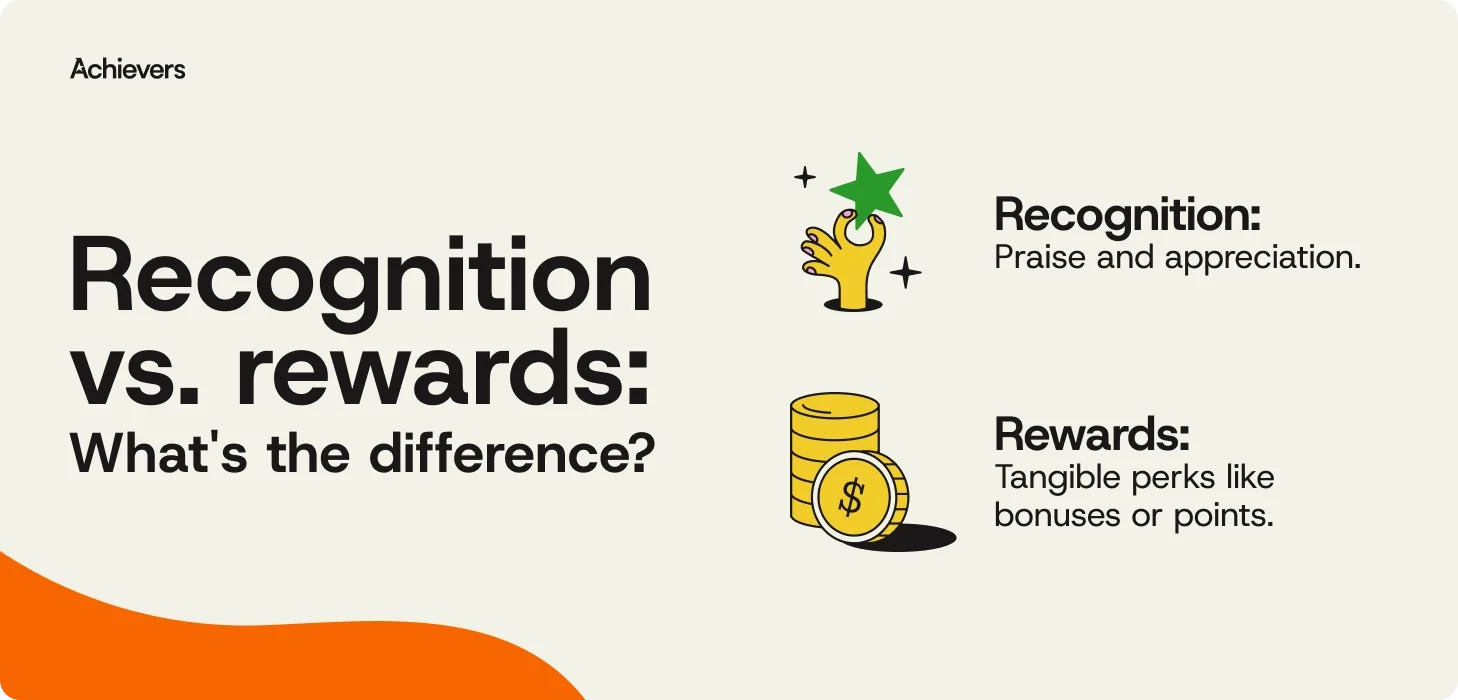
- Higher Employee Engagement and Sustained Motivation: When employees feel acknowledged and valued, they bring greater energy and commitment to their work. Regular recognition, particularly through points-based programs, ensures that appreciation is delivered in real-time, rather than being deferred to annual reviews when the impact may have diminished.
- A Culture That Reinforces Core Values: Recognition stands out as one of the most effective mechanisms for reinforcing company values and priorities. By consistently highlighting behaviors that align with the organizational mission, recognition helps these desired actions proliferate across teams, transforming abstract values into tangible, repeatable actions.
- Stronger Belonging and Enhanced Retention: Feeling valued is a fundamental building block for connection. When employees understand that their work is meaningful, they experience a greater sense of inclusion, increased motivation, and a stronger likelihood of envisioning a future with the organization. Recognition elevates work from "just a job" to a place of belonging.
- Improved Collaboration and Healthier Teamwork: When recognition is woven into the fabric of daily work—rather than being confined to manager notes or private messages—interpersonal relationships naturally improve. Public appreciation, peer-to-peer recognition, and shared celebrations foster a culture where teams actively support one another, creating an environment where individuals uplift each other, not just during celebratory events.
The Quantifiable Impact of Recognition: The Business Value of Saying "Thank You"
While the intrinsic value of recognition is widely acknowledged, empirical data unequivocally demonstrates its ability to deliver tangible, measurable business results when implemented consistently and with clear intent. Insights from Achievers Workforce Institute’s State of Recognition Report consistently highlight that effective recognition, when designed for scalability and sustainability, yields significant returns.
- Increased Engagement: Employees recognized at least once a month are 45% more engaged. Regular recognition creates positive momentum, signaling to employees that their contributions are noticed in real-time, not just during performance reviews. Engagement flourishes when appreciation is an integral part of the daily work rhythm.
- Reduced Turnover Risk: Consistent manager recognition reduces turnover risk by 35%. Managerial recognition carries significant weight as it directly links effort to organizational expectations and priorities. Regular acknowledgment from managers builds trust, clarity, and confidence, which are critical factors in employee retention.
- Positive Business Outcomes: Organizations with peer-to-peer recognition programs are 37% more likely to achieve positive business outcomes. Recognition that scales beyond managers reinforces culture at every level by making appreciation visible across teams. It also captures contributions that leaders might otherwise miss, transforming recognition into a shared responsibility.
- Program Success: Recognition programs built around frequent, low-cost moments are 26% more likely to succeed. While grand rewards are memorable, small, frequent moments of appreciation are sustainable. Programs prioritizing regular, meaningful recognition over occasional high-cost rewards are easier to maintain and far more effective in shaping behavior over time.
- Social Recognition’s Impact: Social (non-monetary) recognition can account for 60-70% of total recognition and still drive significant results. Recognition does not need to be expensive to be impactful. Public praise, thoughtful messages, and visible appreciation fulfill a fundamental human need to be seen. Monetary rewards add value, but social recognition is what builds connection and culture at scale.
- Value Alignment: A striking 96% of high-performing recognition programs align recognition directly with company values. High-impact programs focus on recognizing what matters most. When recognition is tied to organizational culture and values, it reinforces priorities, guides behavior, and transforms abstract values into everyday actions that employees can emulate.
- Enhanced Retention through Milestones: Milestone awards drive 50% higher retention than generic years-of-service awards. Recognition that reflects meaningful moments of growth, impact, and contribution resonates more deeply than generic tenure awards. Employees are more likely to stay when recognition feels personal, relevant, and earned.
The overarching conclusion is that a substantial budget is not a prerequisite for an effective recognition program. A modicum of intention coupled with consistent follow-through can yield significant positive outcomes.
Best Corporate Practices for Employee Recognition and Rewards
To maximize the impact of recognition and rewards initiatives, organizations should adopt best-practice strategies:
1. Define What Recognition Should Reinforce
Clearly defining the behaviors, values, and contributions that recognition should reinforce is crucial for consistency and for helping employees understand which actions are most valued. This clarity ensures that recognition is perceived as meaningful and outcome-oriented, rather than arbitrary praise.
2. Provide Multiple Avenues for Participation
Offering employees diverse ways to participate makes recognition more inclusive and boosts program adoption. Recognition should not be solely dependent on managers. Recognizing the varied ways employees contribute across teams, locations, and functions necessitates a blend of manager recognition, peer-to-peer acknowledgment, team celebrations, and milestone recognition to ensure visibility at all organizational levels.
3. Align Rewards with Employee Preferences
Ensuring that rewards genuinely align with employee preferences makes recognition more meaningful and relevant. A reward only holds value if it is something the employee desires. Flexible reward options empower employees to choose what matters most to them, whether that includes merchandise, unique experiences, charitable giving, or gift cards.
4. Streamline the Recognition Process
Making recognition easy to give removes the obstacles that can hinder consistent appreciation. Complicated nomination forms, lengthy approval chains, or limited recognition opportunities create friction that can reduce participation. The simpler the recognition process, the more naturally it integrates into the organizational culture.
5. Train Managers for Effective Recognition
Training managers to recognize effectively enhances the quality and impact of recognition across the organization. Many managers understand the importance of recognition but may lack clarity on how to deliver it optimally. Providing guidance on timing, personalization, behavioral reinforcement, and offering practical tools like a recognition checklist empowers managers to move beyond generic praise.
6. Balance Recognition and Rewards Strategically
Balancing recognition and rewards ensures programs feel meaningful without becoming purely transactional. Recognition provides visibility and appreciation, while rewards offer tangible reinforcement. Programs that intentionally integrate both are better positioned to reinforce critical behaviors and acknowledge contributions without over-relying on either element.
Understanding the Business Value of Recognition and Rewards
Most organizations already have some form of recognition and rewards in place, whether it’s a platform, a process, or a budget, driven by the clear intention to improve performance, strengthen connections, and build a culture that drives business results. However, this intention does not always translate directly into impact. Even with the right components, it can be challenging to establish a clear link between recognition efforts and the desired outcomes.
Emma Harvie, Global Head of Recognition and Rewards Insights at Achievers, highlights in her report, "From platform to performance: Unlocking the business value of recognition and rewards," that the gap often stems from a misunderstanding of what truly drives results. It’s not about doing more, but about understanding what is effective and what is not.
Why Most Recognition Strategies Fall Short of ROI Potential
The mere presence of a recognition platform does not guarantee an effective recognition strategy. Programs often begin with strong intent and initial momentum but can falter without consistent reinforcement. Consequently, recognition fails to become a regular, meaningful component of the daily work experience. Data from the Achievers Workforce Institute (AWI) supports this, revealing that while 69% of organizations report having a formal recognition platform, only 24% of employees feel meaningfully recognized. This disparity underscores that recognition is often treated as an existing entity rather than an ongoing activity required to influence behavior. Without this consistency, connecting recognition efforts to critical business outcomes becomes a significant challenge.
From Platform Activity to Genuine Behavior Change
Measuring recognition activity—such as platform logins, shared recognitions, or reward redemptions—can create an illusion of program success. However, activity alone does not indicate whether recognition is genuinely influencing how people work. The critical factor is the frequency with which employees experience meaningful recognition. This consistency is what effectively reinforces behaviors, builds connections, and shapes performance over time. AWI data powerfully illustrates this, finding that employees recognized weekly are 4 times more productive, 3 times more engaged, and 5 times more likely to envision a long-term career at their organization. This represents a fundamental shift in perspective: moving beyond mere platform activity to understanding and driving real behavioral change across the organization.
How Rewards Marketplaces Unlock Scale, Governance, and Impact
While rewards can feel transactional in isolation, their integration with meaningful recognition adds a layer of value that reinforces behavior long-term. Recognition establishes the signal—it communicates what good looks like—while rewards provide the reinforcement. Without this connection, rewards risk becoming disconnected from the behaviors they are intended to encourage. However, when consistently paired, their impact is undeniable. Achieving this requires more than good intentions; it demands the right structure to deliver rewards consistently, equitably, and in a manner that is visible and impactful for teams.
Building Scalable Rewards and Recognition Programs
To construct scalable and effective rewards and recognition programs, organizations should adhere to the following principles:
Recognize Employees Early, Often, and Without Unnecessary Friction
Frequency is paramount. When recognition is integrated into the daily rhythm of work, rather than being reserved for birthdays or annual reviews, employees feel seen and supported in real-time. The most effective programs eliminate barriers to recognition by utilizing simple, intuitive platforms that facilitate participation for everyone, from senior leaders to new hires.
Make Recognition Specific and Meaningful
Generic praise is easily forgotten. Recognition is most impactful when it clearly articulates what an employee did and why it mattered. Instead of a vague "great job," specify the behavior or outcome being reinforced: assisting a team in meeting a deadline, stepping up to assist a customer, or collaborating effectively across departments. Specific recognition fosters clarity and encourages the repetition of exemplary work.
Solicit and Act on Feedback
The most successful recognition programs are dynamic and evolve based on feedback. Regular employee input, gathered through satisfaction surveys, pulse checks, or informal conversations, is essential for understanding what resonates and what needs improvement. Equally important is demonstrating to employees that their feedback leads to tangible changes. Listening and acting on input builds trust, credibility, and long-term engagement.
Select the Right Rewards and Recognition Partner
The effectiveness of a recognition program is intrinsically linked to the platform that supports it. A well-chosen third-party solution not only simplifies the recognition process but also helps embed appreciation as a consistent, measurable habit across the entire organization. When evaluating recognition platforms, prioritize essential features such as ease of use, mobile accessibility, integration with existing workflows, robust reporting capabilities, and a comprehensive rewards marketplace.
Coaching Managers on Effective Employee Recognition
Effective manager coaching is critical for maximizing the impact of recognition initiatives:
1. Coach Managers to Recognize Specific Behaviors
Train managers to recognize specific actions rather than just outcomes, helping them articulate precisely what an employee did and why it was significant. Specific recognition provides employees with a clear understanding of their successful behaviors and offers a model for others. Research from the 2026 State of Recognition Report indicates that employees who receive regular recognition from their manager are 11.5 times more likely to trust them.
2. Coach Managers to Deliver Timely Recognition
Encourage managers to make recognition a part of everyday work by delivering it promptly. Recognition is most impactful when it occurs close to the achievement. Delays can diminish its relevance and impact. Managers should be encouraged to acknowledge progress, collaboration, and wins as they happen, rather than reserving appreciation for formal reviews or major milestones.
3. Coach Managers to Personalize Recognition
Guide managers to tailor recognition by considering what makes appreciation meaningful for each individual employee. Some employees prefer public acknowledgment, while others value a private conversation or a written note. Adapting recognition approaches helps ensure it feels authentic and memorable.
4. Coach Managers to Recognize Everyone Consistently
Emphasize the importance of recognizing all team members consistently, paying attention to who is acknowledged and who might be overlooked. It is easy to focus on significant achievements while neglecting the everyday contributions that sustain team operations. Managers should be encouraged to look across their entire team and recognize a diverse range of accomplishments. Consistent recognition builds trust and promotes greater inclusion in the workplace.
5. Coach Managers to Connect Recognition to Company Values
Instruct managers to link recognition to company values, thereby reinforcing the behaviors the organization wishes to encourage. Recognition is more effective when employees understand the broader significance of their actions. Whether an employee demonstrates teamwork, innovation, customer focus, or leadership, connecting recognition to organizational priorities helps reinforce desired behaviors and illustrates how individual work contributes to larger goals.
Selecting the Right Employee Recognition System
Choosing the appropriate recognition system involves a structured approach:
1. Define the Purpose of the Recognition System
Establish clear objectives for the system, such as improving consistency, increasing manager participation, or reinforcing company values. A system without a defined purpose is unlikely to gain traction. Clear goals ensure the program remains focused on achieving desired outcomes.
2. Opt for a Simple, Intuitive System
Select a platform that allows recognition to be delivered with minimal effort, ideally within a few clicks, and without requiring extensive training. Ease of use is a critical driver of behavior. If the experience is cumbersome or unclear, employees will be less likely to engage, leading to inconsistent recognition across the business.
3. Integrate the System into Daily Workflows
Prioritize systems that seamlessly integrate with the tools employees already use, such as Microsoft Teams, Outlook, Slack, and Zoom. Systems that exist outside of daily workflows necessitate additional effort to access. Platforms requiring employees to switch tools or log into separate applications create unnecessary friction and diminish the impact of recognition.
4. Ensure Support for Both Recognition and Rewards
Choose a system that facilitates visible, shared recognition alongside flexible reward options. Recognition should be easy to give and easy to see, while rewards should offer meaningful choice for employees. Look for platforms that feature interactive newsfeeds to highlight recognitions and awards, and an extensive rewards marketplace that can tailor rewards to specific interests and preferences.
5. Align the System with Company Values
Utilize a system that prompts employees to connect recognition to specific behaviors, goals, or values. Built-in value tagging or structured recognition categories enhance consistency and clearly communicate what strong performance looks like within the organization.
6. Review Reporting and Participation Data
Select a system that provides comprehensive insights into recognition usage across the organization, including frequency, reach, and participation rates. Dashboards and participation tracking enable leaders to identify gaps, such as teams with low recognition activity or managers who are not actively engaging, allowing for timely interventions and program consistency.
7. Test the System with Real Employees Before Rollout
Conduct pilot testing with a small group of employees to confirm that the platform integrates smoothly into their workplace tools and is accessible on both desktop and mobile devices. Early testing also reveals whether employees naturally engage in recognition or require encouragement, providing valuable feedback to address any issues before a full-scale rollout.
Organizations evaluating employee recognition solutions should look beyond mere program design. Independent industry research can validate platform capabilities, innovation, and customer impact. Achievers, for example, has been recognized as a Leader and STAR Performer in the 2026 Everest Group Rewards and Recognition PEAK Matrix® Assessment, offering a benchmark for modern recognition strategies.
Strategic Employee Rewards Budget Planning
When budgeting for employee rewards, initiating with a per-employee budget is a sound strategy. Many organizations establish a fixed annual amount per person, which simplifies cost forecasting, ensures fairness, and allows for program scalability as the workforce grows.
Subsequently, define how the budget will be allocated. Instead of concentrating expenditure on a few significant awards, distribute it across various categories, including:
- Frequent, smaller rewards: To acknowledge daily efforts and ongoing contributions.
- Milestone awards: For significant service anniversaries, project completions, or career achievements.
- Performance-based bonuses: Tied to achieving specific, measurable goals.
- Team-based incentives: To foster collaboration and collective success.
- Special recognition awards: For exceptional contributions or innovations.
This structured approach ensures that recognition is distributed equitably and consistently throughout the business.
Tracking and control are indispensable. Rewards programs should clearly delineate fund allocation and usage, including participation rates and remaining budget. This transparency enables timely adjustments throughout the year, ensuring budgets are fully utilized and aligned with program objectives.
Ultimately, budget decisions must be connected to tangible outcomes. Tools like an ROI calculator can illuminate the impact of a rewards program, empowering HR and people leaders to make more informed budget decisions. A robust budget plan is characterized by ease of management, support for frequent recognition, and a clear contribution to meaningful employee impact.
Supercharging Employee Rewards and Recognition Programs
Well-structured employee rewards and recognition programs are instrumental in making employees feel valued, thereby cultivating a culture of appreciation that directly contributes to business success. Frequent, meaningful recognition that aligns with company values fosters the positive behaviors that lead to improved team dynamics and enhanced results.
Whether an organization is formalizing recognition for the first time or preparing to scale it across a larger workforce, adopting the right approach today can strategically support future growth. A modern, mobile-friendly platform like Achievers streamlines the recognition process, supporting peer-to-peer recognition, manager-driven appreciation, and points-based rewards. Coupled with a diverse array of rewards that employees genuinely desire, these platforms can create a recognition experience that keeps the workforce motivated and committed.