Different types of employee rewards help reinforce key behaviors, boost engagement, and drive real business results. In an increasingly competitive talent landscape, organizations are recognizing that a one-size-fits-all approach to employee recognition and rewards is no longer sufficient. Generic catalogs, limited choices, and obscured value due to markups and fees often lead reward programs to fall flat, failing to resonate with a diverse workforce and consequently making little impact on individual motivation or overall business performance. The modern imperative dictates that the types of rewards an organization offers must be thoughtful, deeply tied to what genuinely matters to its people, and underpinned by flexibility, local relevance, and a strategic framework that connects recognition to tangible outcomes.
Understanding the Core of Employee Rewards
Employee rewards encompass both monetary and non-monetary benefits bestowed upon employees to acknowledge their contributions, celebrate milestones, reinforce desired workplace behaviors, and motivate future performance. These can range from traditional cash bonuses and gift cards to merchandise, travel experiences, lifestyle benefits, and flexible points-based systems that empower employees to choose and redeem rewards based on their individual preferences. The fundamental purpose is to create a positive feedback loop, signaling to employees that their efforts are seen, valued, and directly contribute to organizational success.
The Evolving Significance of Diverse Reward Types
The contemporary workforce is characterized by unprecedented diversity in demographics, life stages, cultural backgrounds, and professional aspirations. This inherent heterogeneity means that a singular reward strategy is inherently ineffective. Employees value different forms of recognition and reward, necessitating a nuanced approach. Research from the Achievers Workforce Institute’s latest State of Recognition Report, which surveyed 3,000 employees globally, underscores this, revealing a strong preference for practical, flexible reward options. These preferences are not static; they are dynamically shaped by individual needs, current life circumstances, geographical location, and personal interests, making choice and flexibility paramount for any successful and scalable reward and recognition strategy.
Historically, employee rewards often centered around annual bonuses, fixed benefits, and seniority-based promotions. The mid-20th century saw the rise of company-sponsored pension plans and health benefits as primary retention tools. As the economy shifted from industrial to knowledge-based, performance bonuses and stock options became more prevalent, particularly in executive compensation. However, the digital age and the rise of a younger, more mobile workforce have necessitated a profound re-evaluation. The "Great Resignation" or "Great Reshuffle" phenomenon of recent years, where millions of employees voluntarily left their jobs, highlighted the critical role of employee experience, culture, and recognition in retention. Employees are now seeking more than just a paycheck; they desire a sense of purpose, belonging, and personalized acknowledgment that aligns with their values and lifestyle. This timeline illustrates a clear progression from purely transactional rewards to a more holistic, intrinsic, and personalized approach.
Impact Across the Organization: Who Benefits Most?
While diverse employee rewards ultimately benefit every individual within an organization by fostering a positive and motivating work environment, certain groups experience a particularly profound impact. These include high-performing employees who consistently exceed expectations and whose contributions often directly drive business results. Tailored rewards ensure their exceptional efforts are not only recognized but also appropriately valued, reducing the risk of burnout or attrition. New hires and junior employees also benefit significantly, as thoughtful reward programs help integrate them into the company culture, reinforce early positive behaviors, and demonstrate a commitment to their growth and development, fostering early loyalty. Employees in critical roles or those working on high-impact projects often shoulder immense pressure; specific rewards for their dedication can alleviate stress and validate their hard work. Furthermore, employees in remote or hybrid work environments, who may feel less connected to the physical workplace, benefit immensely from visible and accessible recognition programs that bridge geographical distances, ensuring they feel seen and appreciated regardless of their location. Finally, diverse teams, with their varied backgrounds and preferences, thrive under flexible reward systems that cater to individual needs rather than imposing a uniform standard.
The Mechanics of Success and the Perils of Failure
Different types of employee rewards achieve their intended purpose when they are meticulously aligned with employee preferences, strategically timed to reinforce a specific milestone or achievement, and delivered in conjunction with meaningful, qualitative recognition. The efficacy of a reward program is significantly amplified when it is perceived as authentic and heartfelt, rather than a mere transactional exchange. Conversely, such programs falter when rewards are generic, feel disconnected from actual performance or effort, or lack personalization. An impersonal gift card, for instance, might be perceived as a token gesture rather than a genuine expression of appreciation, thereby failing to inspire or motivate. The key distinction lies in moving beyond mere compensation to cultivating a culture of appreciation where rewards are an integral part of a larger recognition ecosystem.
Reward systems manifest across various facets of an organization, integrating into performance management frameworks, employee engagement initiatives, talent acquisition and retention strategies, and learning and development programs. They are visible in day-to-day operations through peer-to-peer recognition platforms, quarterly performance reviews, and annual company events. This pervasive presence ensures that the message of appreciation is consistently communicated and reinforced at multiple touchpoints throughout an employee’s journey.
Translating Rewards into Practice: A Multifaceted Approach
In practice, an effective employee reward system operates by recognizing and applauding a spectrum of employee behaviors, contributions, achievements, and milestones through a judicious mix of reward types, rather than relying on a single incentive for every situation. For example, points-based rewards are frequently deployed for everyday recognition, acknowledging consistent effort or minor achievements, offering immediate gratification and choice. In contrast, more substantial rewards such as cash bonuses, travel incentives, or premium merchandise are typically reserved for recognizing exceptional performance, achieving major business results, or celebrating significant career milestones like long-term service anniversaries or the successful completion of a critical project. This tiered approach ensures that the magnitude of the reward appropriately reflects the significance of the contribution.
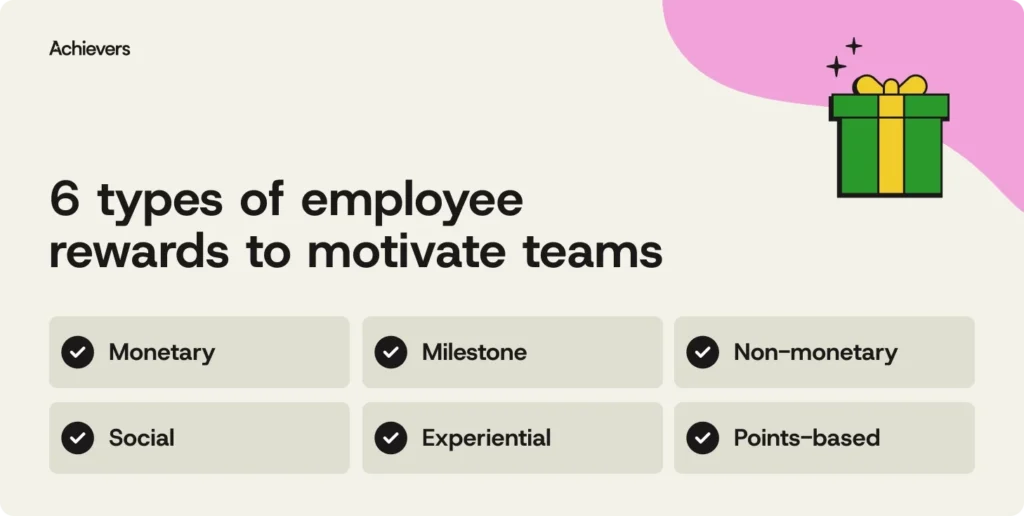
Six Essential Categories of Employee Rewards:
-
Monetary Rewards: These are direct financial incentives designed to reinforce goal achievement, encourage stretch performance, or acknowledge sustained impact. Examples include cash bonuses, raises, profit-sharing, stock options, and spot awards. While undeniably powerful, cash rewards alone are often insufficient to build long-term loyalty and deep engagement. Their effectiveness is maximized when combined with meaningful, personal recognition that explains why the reward is being given, thereby linking the financial incentive to a specific valued behavior or outcome. This combination motivates in the short term and fosters a lasting sense of value and commitment.
- Examples: Annual performance bonuses, project completion bonuses, sales incentives, merit raises, profit-sharing schemes, immediate spot cash awards for exceptional contributions.
-
Non-Monetary Rewards: These rewards signal an organization’s investment in an employee’s growth, well-being, and work-life balance. They send a clear message: "We see your effort, and we’re invested in your future." The Achievers Engagement and Retention Report highlights that a lack of career progression is a primary non-monetary reason employees consider leaving. Offering non-monetary rewards that address this, such as professional development opportunities or mentorship, provides a compelling reason for employees to stay and grow within the company.
- Examples: Professional development courses, certifications, mentorship programs, flexible work arrangements (remote work, compressed workweeks), extra days off, extended lunch breaks, public acknowledgment (e.g., "Employee of the Month"), personalized thank-you notes.
-
Experiential Rewards: Designed to make recognition truly memorable, experiential rewards create lasting positive memories that strengthen company culture and deepen engagement. Platforms like the Achievers Travel Store, powered by Switchfly, offer vast choices, including over 1.6 million travel options worldwide—750,000 hotels, 75,000 airline routes, 45,000 car rentals, and 390,000 activities. From bucket-list adventures for individuals to team-building outings, these rewards cater to a desire for unique experiences over material possessions, fostering a sense of adventure and personal enrichment.
- Examples: Weekend getaways, tickets to sporting events or concerts, cooking classes, spa days, adventure activities (e.g., hot air balloon rides), team celebrations, unique dining experiences.
-
Milestone Rewards: These rewards are crucial for acknowledging significant career points, reflecting long-term dedication, and celebrating achievements that deserve more than a passing mention. Whether it’s a 5-year work anniversary, the successful launch of a major product, or the completion of a challenging certification, celebrating these milestones with intention reinforces the value of commitment and reminds employees that their work has a lasting, cumulative impact. This fosters loyalty and a sense of belonging within the organization.

- Examples: Long-service awards (e.g., watches, plaques, additional vacation days), personalized gifts for work anniversaries, celebratory events for project completions, recognition for achieving significant professional certifications, awards for leadership tenure.
-
Social Rewards: Social rewards are fundamental to cultivating a vibrant culture of appreciation. These include public team shout-outs, company-wide applause on internal communication platforms, and peer-to-peer nominations. They leverage the power of social recognition, making individuals feel valued not just by management but by their colleagues. Research from AWI’s State of Recognition Report indicates that employees who are meaningfully recognized are 1.7 times more likely to envision a long-term career at their company, highlighting the strong link between social validation and retention.
- Examples: Public shout-outs in team meetings, company-wide announcements on intranet, peer-to-peer recognition programs, features in company newsletters, social media praise, virtual high-fives.
-
Points-Based Rewards: This flexible and behavior-driven recognition system allows employees to earn points for actions that align with organizational values, such as going the extra mile, mentoring a new hire, demonstrating resilience, or achieving specific goals. Employees can then redeem these accumulated points for a wide array of choices that matter most to them, from gift cards and merchandise to travel or charitable donations. Points-based rewards are inherently personal, highly scalable, and constantly reinforce desired behaviors by providing continuous, customizable feedback.
- Examples: Points awarded for exceeding sales targets, participating in company initiatives, demonstrating core values, providing mentorship, completing training, which can be redeemed for various items from a curated catalog.
Best Practices for Maximizing Reward Program Efficacy
To ensure employee rewards truly resonate and drive performance, several best practices must be observed. The core principle is to make rewards meaningful and impactful, backed by a strategy that is personal, timely, and explicitly tied to organizational purpose and values.
- Personalization: Understand individual preferences through surveys, feedback, and data analytics. A reward that genuinely speaks to an employee’s interests or needs will always be more impactful than a generic offering.
- Timeliness: Deliver recognition and rewards as close as possible to the achievement or behavior being celebrated. Delayed recognition loses its motivational power.
- Transparency and Fairness: Ensure the criteria for earning rewards are clear, equitable, and consistently applied across the organization to maintain trust and avoid perceptions of favoritism.
- Strategic Alignment: Tie rewards directly to company values, strategic goals, and desired behaviors. This reinforces the organizational culture and drives employees toward collective objectives.
- Multichannel Approach: Utilize a mix of reward types and delivery methods (public, private, monetary, non-monetary) to cater to diverse preferences and ensure broad reach.
- Continuous Feedback and Iteration: Regularly collect feedback on the reward program’s effectiveness and be prepared to adapt and evolve it based on employee input and changing organizational needs.
- Leadership Buy-in and Participation: Ensure leaders at all levels actively participate in and champion the recognition program, modeling the desired behaviors and reinforcing its importance.
When rewards are strategically designed, backed by real insights, and explicitly tied to the right behaviors, they transcend being mere perks and become powerful drivers of performance, engagement, and retention.
Integrating Rewards with Your HR Tech Stack
Making all types of employee rewards work seamlessly within an existing HR tech stack does not necessitate a dozen disparate tools or a dedicated full-time administrative team. The true power lies in the intelligent integration of a recognition platform with other workplace tools and software. This ensures smoother operations across the board—from reward delivery and data collection to insightful decision-making.
-
Seamless Integration into HRIS Platforms: Direct integration between your reward platform and Human Resources Information Systems (HRIS) streamlines administrative processes significantly. This eliminates manual data uploads, reduces errors, and provides a consistent, easy-to-use platform for both employees and administrators.
- Benefits: Automated employee data synchronization, simplified onboarding/offboarding for reward programs, consistent data for analytics, reduced administrative burden.
-
Automation for Timely Recognition: Leveraging automation ensures that critical recognition moments—such as work anniversaries, birthdays, or project milestones—are celebrated precisely when they matter most. This proactive approach ensures no employee is overlooked and reinforces a culture of continuous appreciation.
- Benefits: Automatic triggers for milestone rewards, scheduled recognition reminders for managers, consistent delivery of programmed rewards, enhanced perceived fairness.
-
Data-Driven Decisions: Smart integration enables the collection and analysis of rich data on reward preferences, program utilization, and impact on engagement metrics. This data is invaluable for refining reward strategies, identifying trends, and demonstrating ROI. Achievers, for instance, helps organizations transform raw data into actionable insights, driving continuous improvement.
- Benefits: Real-time dashboards on recognition activity, insights into popular reward types, correlation between recognition and performance, justification for program investment.
-
Amplifying Reach and Consistency: Integrating recognition across your tech stack ensures that no employee is left out, regardless of their geographical location, department, or work arrangement. This consistency in recognition experience is vital for global organizations and those with hybrid workforces.
- Benefits: Global accessibility of reward catalogs, consistent application of company values across regions, seamless integration with communication tools (e.g., Slack, Teams) for broader visibility, unified employee experience.
Marriott’s Success Story: Personalization Driving Engagement and Retention
The Calgary Marriott Hotel faced a common challenge: managing multiple, disparate recognition programs across various departments. This fragmented approach led to an inconsistent employee experience that was difficult to track, measure, and scale effectively. Recognizing the need for a unified and impactful strategy, Marriott partnered with Achievers to consolidate its rewards and recognition initiatives into a single, cohesive program. This new program was meticulously tied to Marriott’s S.P.I.R.I.T. values (Serve Our World, Pursue Excellence, Embrace Change, Act with Integrity, Respect All, Inspire Greatness), ensuring that recognition was not just about monetary value but about reinforcing core organizational principles.
Under the new system, employees earned points for demonstrating key behaviors aligned with the S.P.I.R.I.T. values. These points could then be redeemed for a diverse array of personalized rewards, including gift cards, merchandise, travel experiences, and other unique activities. This shift dramatically simplified the recognition process for managers and made it significantly easier and more appealing for employees to participate.
The results were compelling: the Calgary Marriott Hotel observed a substantial 16% increase in employee engagement and a 15% increase in total rewards satisfaction. Critically, the program also yielded tangible business outcomes, tripling the number of suite upsells. Marriott’s success vividly demonstrates that employee rewards can significantly improve both internal engagement and external business performance when two key conditions are met: employees are empowered to choose rewards that are genuinely meaningful to them, and the recognition is intrinsically linked to the behaviors and values the organization seeks to cultivate and reinforce. This case study serves as a powerful testament to the strategic value of personalized and integrated reward programs.
Choosing Rewards That Resonate and Drive Impact
Ultimately, selecting the right types of employee rewards is not a trivial exercise; it is a strategic imperative. A random gift card or a generic shout-out simply will not build the kind of resilient company culture that fosters long-term commitment and high performance. True impact emanates from rewards that are deeply personal, perfectly timed, and unequivocally tied to the behaviors that propel the business forward.
The most effective reward programs move beyond guesswork. They are seamlessly integrated into the everyday tools and workflows employees use, speak directly to what employees genuinely care about, and are designed to scale effortlessly without losing their intrinsic meaning or personal touch. These programs are powered by robust data analytics, rooted in a clear organizational strategy, and built with the flexibility to evolve and grow alongside the business.
This is precisely where platforms like Achievers provide critical value. They transform everyday recognition moments into something far more significant: catalysts for positive behavior change, architects of a stronger, more vibrant company culture, and drivers of measurable business results. By consciously and strategically rewarding what truly matters, organizations empower their people to bring their best selves and their most impactful contributions to the table, day in and day out, fostering a virtuous cycle of appreciation, motivation, and sustained success.