The global business landscape is undergoing a profound transformation, driven by the rapid integration of Artificial Intelligence (AI). Recent extensive travel and engagements across Europe, Asia, and the Middle East reveal a clear consensus among hundreds of companies: AI is no longer a nascent concept but a powerful, pragmatic business tool with an ever-expanding array of applications. While the maturity of AI adoption varies significantly across organizations, the message is unequivocal – AI has arrived, it is real, and its use cases are proliferating at an unprecedented rate.
Supporting this observation, a comprehensive survey by Wharton sheds crucial light on the current adoption patterns. The report indicates that a significant 46% of business leaders are now utilizing Generative AI (Gen AI) on a daily basis, with an additional 80% engaging with it weekly. Crucially, these active users are not merely experimenting; 72% are actively measuring Return on Investment (ROI), and a substantial 74% report a positive return. This widespread adoption is not confined to specific sectors. Notably, the Human Resources (HR) department ranks as the third-highest area of AI application, closely trailing Information Technology (IT) and Finance, underscoring AI’s broad impact across core business functions.
The financial commitment to AI is also escalating. The Wharton survey reveals that 23% of large companies are allocating $20 million or more annually towards AI initiatives, while 43% are investing over $10 million per year. This substantial investment reflects a growing confidence in AI’s ability to deliver tangible business value.
The Dawn of Individual Productivity: AI as the New "Microsoft Office"
The primary driver behind current AI adoption, according to the findings, is the enhancement of individual productivity. This "stage 1" usage encompasses a range of tasks that empower employees to work more efficiently. AI is proving invaluable in summarizing lengthy meetings, analyzing complex datasets, swiftly retrieving critical information, and assisting in the creation or review of documents. These personal productivity gains, while significant, are widely acknowledged as only the initial phase of AI’s potential.
This paradigm shift in individual productivity tools draws parallels to the early days of transformative software like word processing, spreadsheets, and internet search engines. Just as Microsoft Office revolutionized individual workflow and efficiency, Gen AI is emerging as a similarly foundational technology. Microsoft’s Copilot, for instance, is steadily positioning itself as the "New Microsoft Office Suite," integrating AI capabilities directly into everyday work processes.
Beyond Individual Gains: The Rise of Corporate AI Agents
However, the utility of AI extends far beyond personal productivity. Approximately 12% of companies are now deploying "corporate agents," sophisticated AI systems designed for knowledge and information management. IBM’s "Ask HR" chatbot serves as a prime example, demonstrating how these internal AI agents can streamline access to company information, replacing complex internal portals and SharePoint sites. Moreover, these agents are increasingly being leveraged for customer support, indicating a future where nearly every organization will host such an AI assistant.
A large healthcare company, for example, has been successfully utilizing an employee chatbot for four years. The overwhelming success of this internal agent has led to the integration of virtually all HR applications behind it, enabling employees to seek assistance with queries related to payroll, benefits, work schedules, and even training programs.
Recruitment is another area demonstrating significant AI-driven advancements. Job candidates can now engage with AI agents for initial screening, undertake AI-based assessments, and even participate in AI-avatar interviews. This 24/7 accessibility eliminates the need for rigid scheduling, offering a more flexible and efficient recruitment process for both employers and candidates.
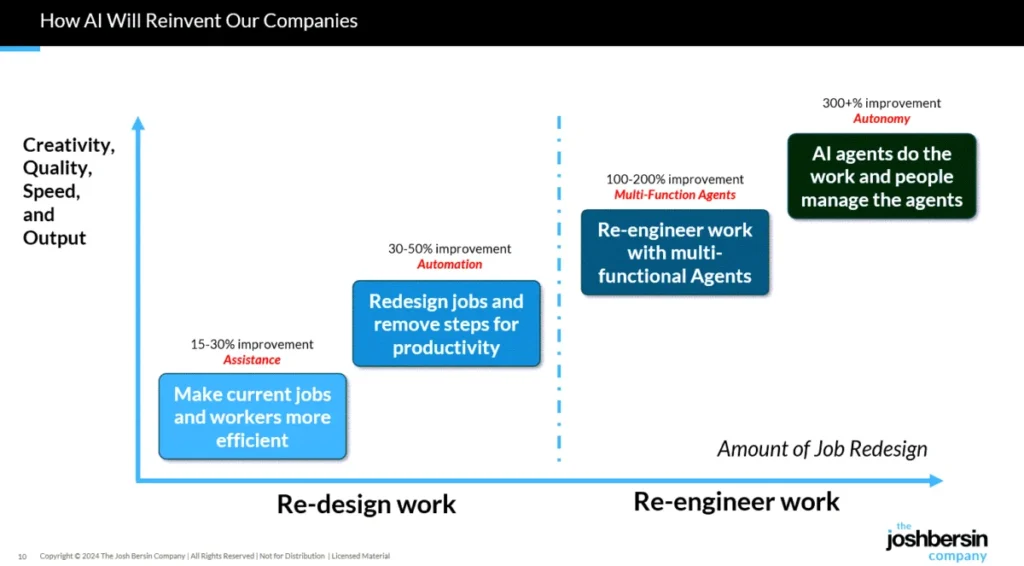
While fully realized "multi-function agents" capable of handling complex, high-ROI tasks are still evolving (representing "stage 3" of adoption), companies are already seeing substantial benefits from AI-powered coaching and learning tools. Many large enterprises are implementing AI-native learning systems, reporting a 30-40% reduction in training staff while simultaneously achieving significant improvements in workforce enablement. The demand for specialized AI solutions in HR has surged, with platforms like Galileo experiencing a notable boom as companies seek highly tailored HR and learning agents for their staff and managers.
Crossing the Rubicon: A Point of No Return for AI Adoption
The current phase of AI integration can be characterized as "crossing the Rubicon" – a point of no return where the technology’s utility and pervasiveness become irreversible. Despite ongoing public discourse and occasional alarmist narratives surrounding AI’s potential negative impacts on careers and society, the prevailing sentiment among businesses is that Gen AI is a pragmatic and accessible tool.
While acknowledging the inherent imperfections and the potential for errors – a phenomenon highlighted by the high rate of inaccuracies reported by ChatGPT in certain contexts – businesses are learning to effectively manage and mitigate these challenges. The development of robust data sets for training AI, coupled with user practices of verifying AI-generated outputs, has led to greater comfort with the technology’s "probabilistic nature."
The significant capital investment, estimated to be in the trillions, poured into AI infrastructure, engineering, and power generation has also contributed to the technology’s increased reliability and safety. While the environmental impact, particularly the water consumption of AI queries, is emerging as a new challenge that requires attention, the foundational concerns about AI’s existential risks have largely receded from the forefront of business discussions.
The Future Trajectory: From Single-User Tools to Integrated, Multi-Functional Agents
The trajectory of AI adoption points towards increasingly sophisticated applications. The next wave of significant ROI is expected to come from "multi-functional agents," which move beyond assisting with individual tasks to orchestrating complex, end-to-end business processes. These agents are envisioned not merely as tools that "help steer" but as autonomous systems that can "take you from place to place."

This evolution is already evident in areas like recruiting and training, where agents can now manage the entire lifecycle from job requisition creation and candidate engagement to interview scheduling and resume screening. The vision is for these agents to seamlessly integrate with onboarding and performance management systems, creating a unified "hiring and career" agent.
The aspiration is for organizations to move away from managing numerous disparate agents, each addressing a narrow function, towards "smart" agents that can manage entire business workflows. This could span the entire product lifecycle, from "design to build to distribute to sell," or the sales cycle, from "position to target to market to close a sale," followed by "bill to collect to renew and support." This integration will necessitate a redefinition of many job roles, as agents take over tasks previously performed by individuals in roles such as interview schedulers, sales development representatives, or accounts receivable specialists.
Platforms like Galileo exemplify this shift, evolving from simple HR assistants to comprehensive solution builders. These agents can now not only answer queries but also develop training courses and provide solutions to complex HR challenges, effectively guiding users from a problem or idea to a fully realized solution, akin to the autonomous navigation of a self-driving car.
The Emergence of Autonomous Agents with Memory and Personality
A critical development on the horizon is the advent of AI agents that possess memory and develop personalized interactions. Agents like Galileo are beginning to retain user history and learn from past interactions and business data, making them more autonomous, personalized, and valuable.
Consider a manager facing a staffing shortage. An AI agent could proactively inquire about the specific needs of the role, benchmark salary expectations against industry standards, and suggest internal candidates before initiating a formal requisition. In subsequent interactions, the agent could recall previous staffing challenges and propose developmental plans for existing teams, demonstrating a proactive and context-aware approach to problem-solving. This evolution suggests a future where AI agents will not only respond to direct commands but also anticipate needs and offer strategic guidance.
Data Management: The Mission-Critical Foundation for AI Success
As AI systems become more sophisticated and integrated, the importance of robust data management practices has become paramount. Organizations that have successfully implemented AI consistently highlight data management, data labeling, and data governance as critical new disciplines. The accuracy and performance of AI are directly contingent on the quality of the data it is trained on.
AI models operate on probabilities and complex calculations, and even minor data inaccuracies can lead to a disproportionately high rate of errors. This underscores the necessity for accurate, current, and meticulously labeled datasets. Companies are increasingly recognizing data ownership as a mission-critical function. For instance, IBM’s "Ask HR" agent, which manages over 6,000 HR policies, assigns owners to each policy, ensuring their continuous accuracy and relevance. IBM is further developing agents to proactively monitor regulatory changes across vast jurisdictions, identifying potential policy discrepancies.
Inter-Agent Communication: The Next Frontier
The growing complexity of AI systems necessitates the development of agent-to-agent communication protocols. While these protocols are still maturing, organizations are actively working towards enabling seamless interaction between different AI agents. The integration of platforms like Galileo with SAP’s Joule signifies the early stages of this inter-agent connectivity.
Businesses are advised to approach the adoption of multiple AI agents with caution, prioritizing those that can integrate and collaborate effectively. The true value of AI will be unlocked when these agents can work in concert to streamline end-to-end business processes, rather than operating in isolation. This collaborative approach is crucial to avoid the pitfalls of fragmented systems that pull an organization in multiple directions.
Navigating Vendor Landscape and Addressing Stakeholder Fears
The AI vendor landscape is dynamic and competitive. While established tech giants like Microsoft and IBM continue to innovate, a host of specialized HR tech vendors are emerging as key players. Companies focusing on pragmatic business applications, such as Galileo, Paradox, and Eightfold, are well-positioned for continued growth and potential acquisition.
Major Human Capital Management (HCM) vendors, including SAP, Workday, ADP, and ServiceNow, are actively integrating AI capabilities into their existing platforms, aiming to become comprehensive, multi-functional AI solution providers. Strategic acquisitions in this space, such as SAP’s purchase of SmartRecruiters and Workday’s acquisitions of HiredScore and Paradox, highlight this trend.
Concerns regarding job displacement and the potential "dumbing down" of the workforce are frequently raised. However, industry leaders emphasize the imperative for proactive engagement with AI. Rather than resisting the revolution, individuals and organizations are urged to embrace it, viewing AI as a catalyst for re-engineering existing processes and unlocking new opportunities.
The narrative of AI replacing human jobs wholesale is often overstated. Historically, transformative technologies like spreadsheets did not eliminate accounting professions but rather redefined them, freeing accountants from tedious manual calculations to focus on higher-value analytical tasks. Similarly, AI is poised to augment human capabilities, enabling individuals to become "superworkers," consultants, and innovators. Designers, creators, authors, and analysts are encouraged to view AI as a personal supercomputer, empowering them to produce more sophisticated and elegant work.
The era of AI is here to stay. The challenges and opportunities it presents require a collective effort to learn, apply, and leverage this transformative technology, paving the way for a future of enhanced productivity and innovation. The path forward involves embracing these new tools and actively shaping their integration to drive organizational success and individual growth.