
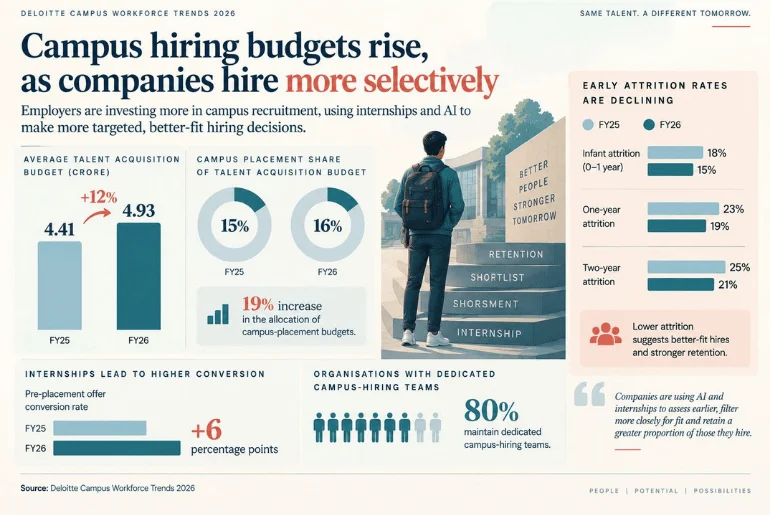
The landscape of campus recruitment in India is undergoing a profound transformation, with Artificial Intelligence (AI) and agentic AI rapidly integrating into hiring processes. A recent Deloitte Campus Workforce Trends 2026 report reveals that an overwhelming 85 percent of Indian organizations anticipate AI influencing their hiring decisions in the upcoming fiscal year (FY26), a significant increase from 79 percent just a year prior. However, a stark contrast emerges when examining AI’s impact on the actual nature of early-career roles: only 35 percent of organizations report that the technology has created new entry-level positions or fundamentally altered skill requirements, though this figure marks an uptick from 21 percent in FY25. This discernible gap between the two statistics underscores a critical trend: AI is revolutionizing the gate through which young talent enters the workforce much faster than it is redesigning the architecture of the entry-level jobs themselves.
The Dawn of AI in Recruitment: A New Gatekeeper Emerges
The narrative surrounding AI’s impact on employment often oscillates between dire predictions of job destruction and optimistic forecasts of new role creation. However, the Deloitte report, focusing on the Indian context, suggests a more nuanced reality for campus hires. The primary large-scale transformation observed is not the wholesale replacement or creation of jobs, but rather the sophisticated overhaul of recruitment methodologies. Historically, campus hiring relied on conventional methods like resume screening, group discussions, and multiple rounds of interviews, often characterized by manual processes and subjective evaluations. The advent of Applicant Tracking Systems (ATS) introduced a preliminary layer of automation, primarily focused on keyword matching and basic eligibility checks.
The current phase, however, marks a far more advanced integration of AI. These intelligent systems are no longer mere administrative aids; they are increasingly involved in making, or at least heavily assisting with, critical recruitment decisions. AI-enabled resume parsing has evolved beyond simple keyword matching to infer skills from project descriptions, analyze certifications, and even predict potential cultural fit. Agentic systems are now capable of building dynamic shortlists tailored to specific role requirements, applying complex eligibility filters, and efficiently coordinating interview schedules. Furthermore, these systems assist recruiters with sophisticated candidate scoring, leveraging data analytics to provide a more objective assessment.
Candidate-facing AI systems are also streamlining the applicant experience, managing response timelines, sending personalized nudges, and offering recommendations. The evaluation phase has seen a significant shift, with simulations, hackathons, and various assessment tools becoming increasingly AI-enabled, providing employers with deeper insights into a candidate’s practical skills and problem-solving abilities. This advanced integration goes well beyond traditional recruitment automation, pushing the boundaries of efficiency and precision in talent acquisition. The immediate value proposition for employers is less about reducing the volume of graduate hiring and more about making the recruitment funnel significantly more discriminating and effective.
Strategic Investment and Enhanced Selectivity
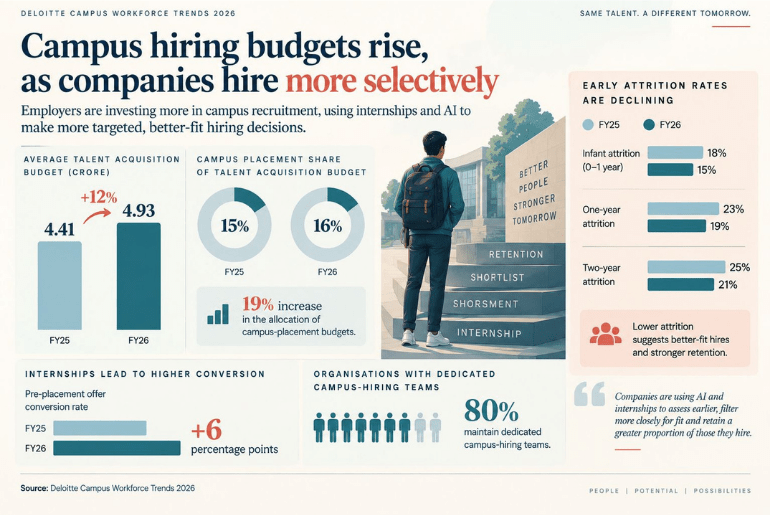
Despite the perceived challenges of an evolving job market, Indian organizations are not retreating from campus recruitment; instead, they are investing more strategically. The average talent acquisition budget among participating organizations witnessed a notable increase, rising from Rs 4.41 crore in FY25 to Rs 4.93 crore in FY26. Concurrently, the share allocated to campus placements within these budgets also grew from 15 percent to 16 percent, representing a substantial 19 percent increase in specific campus placement allocations. This sustained financial commitment is further evidenced by the fact that 80 percent of participating organizations maintain dedicated campus-hiring teams, underscoring the strategic importance placed on early-career talent.
This increased investment, however, is not simply aimed at greater volume but rather at achieving greater selectivity and a better fit. Employers are leaning more heavily on internships as a crucial assessment tool, leading to a rise in pre-placement offer (PPO) conversion rates by approximately six percentage points year-on-year. This indicates a strategic shift towards evaluating candidates over an extended period before committing to full-time hires. The report highlights a trend of "rationalized hiring volumes," where the focus is on more selective conversion and a preference for skill-aligned profiles over broader intake.
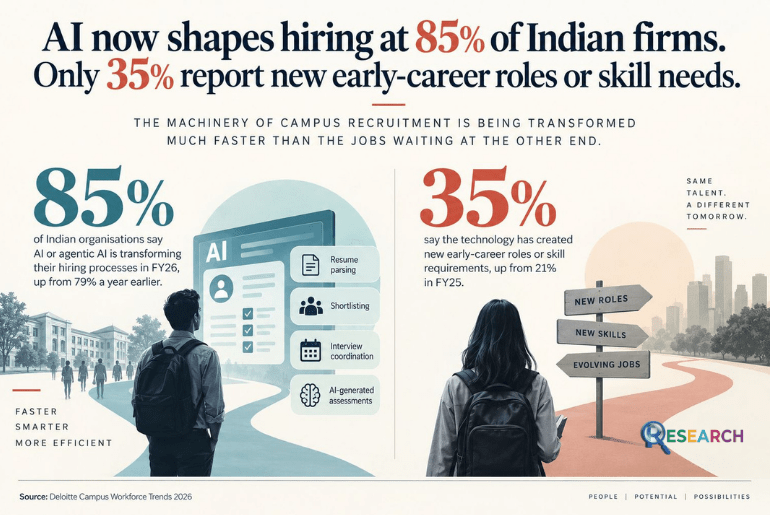
The benefits of this more refined approach are already tangible. Retention rates for early-career hires have shown marked improvement. Infant attrition (within the first few months) fell from 18 percent to 15 percent, one-year attrition decreased from 23 percent to 19 percent, and two-year attrition saw a reduction from 25 percent to 21 percent. These figures collectively point towards a campus market that prioritizes more selective, pre-assessed hiring strategies. Employers are assessing candidates earlier, filtering more closely for cultural and skill fit, and consequently retaining a greater proportion of those they ultimately hire. AI, with its capacity for precision and data-driven insights, naturally fits into and further amplifies this model, making the talent acquisition process more discerning.
The Evolution of Roles: Skills First, Titles Second
While the impact of AI on recruitment processes is undeniable, its influence on the actual job content of entry-level roles appears to be evolving at a more measured pace. The 35 percent figure, though growing, signifies that only a third of organizations are reporting the creation of entirely new early-career roles or a substantial alteration in skill requirements due to AI. This doesn’t mean entry-level work is static; rather, it suggests a more subtle transformation where the skills required for existing roles are changing before the job titles themselves disappear.
The report’s career-preference data illustrates this point effectively. While traditional roles persist, the underlying capabilities demanded within them are shifting towards AI and digital proficiency. For instance, MBA graduates are increasingly sought for roles such as "product manager for AI-enabled products." BTech graduates find themselves in demand for "machine-learning engineer" positions, and MTech graduates are steering towards "data scientist" roles. Even in non-tech fields, the impact is visible, with "legal-tech specialist" emerging as a significant role for law graduates.
A business analyst extensively leveraging AI tools may still carry the title of "business analyst," but their daily tasks, required competencies, and problem-solving approaches are fundamentally different. Similarly, an engineer whose responsibilities increasingly demand machine-learning capabilities remains an engineer, but their professional profile has significantly evolved. This phenomenon explains why the reported creation of "new roles" lags behind the transformation of recruitment. The first effect of AI on graduate employment, therefore, is less about eliminating existing job titles or creating entirely novel ones, and more about redefining the core competencies and expectations associated with those titles. This necessitates a workforce that is not just digitally literate but also adaptable, with a strong emphasis on continuous learning and problem-solving in an AI-augmented environment.
Compensation Dynamics: Differentiation Over Inflation
A surprising finding from the Deloitte report is the relatively modest growth in campus compensation despite the increasing importance of AI and digital capabilities. Pay across major MBA and engineering categories saw a Compound Annual Growth Rate (CAGR) of approximately 2 to 4 percent between FY22 and FY26. This contrasts sharply with broader India Inc salary increases, which have typically ranged from 7 to 9 percent year-on-year during the same period. This suggests that the market is not experiencing across-the-board salary inflation driven by AI demand.
Instead, employers are prioritizing differentiation. The report highlights significant compensation disparities based on institutional prestige. A graduate from a Top 10 MBA institution commands a median annual compensation of Rs 27.4 lakh, a staggering 3.3-fold difference compared to Rs 8.4 lakh offered at Tier 3 institutions. For B.Tech graduates, the gap is equally pronounced, with Top 10 graduates earning Rs 18.7 lakh versus Rs 5.75 lakh at Tier 3 institutions, a 3.2-fold difference. These disparities extend even to internship stipends, where Top 10 MBA students can receive Rs 1.8-1.9 lakh per month, significantly higher than the approximate Rs 26,000 offered at Tier 3 institutions.
While AI- and data-related capabilities do attract the highest compensation premiums across various disciplines, this premium is not leading to a generalized increase in entry-level salaries. Instead, employers are becoming more precise in identifying and valuing specific profiles and skills. This trend aligns with the overall shift in recruitment: more sophisticated selection processes do not necessarily translate into more widespread hiring or higher average remuneration. Rather, it means finer distinctions are being made between candidates, with a premium placed on those from top-tier institutions possessing advanced AI and digital proficiencies.
The Enduring Power of Credentials and the New Asymmetry
Despite the growing emphasis on "skills-first" hiring, the traditional campus hierarchy and the prestige of educational institutions continue to wield considerable influence in compensation outcomes. The substantial compensation spreads between Top 10 and Tier 3 institutions—3.3-fold for MBAs and 3.2-fold for engineers—demonstrate that the institute tier remains strongly associated with earning potential. This hierarchy is evident even before a full-time offer is extended, with Top 10 MBA internship stipends being approximately seven times higher than those at Tier 3 institutions.
This creates an intriguing tension within the evolving recruitment landscape. Employers are actively seeking candidates with learning agility, advanced problem-solving capabilities, AI literacy, and digital fluency, moving beyond a sole reliance on academic indicators. Yet, the financial rewards continue to be heavily stratified by where a student studied. This suggests that "skills-first" hiring is not replacing the existing credential hierarchy but rather being added to it. AI, therefore, introduces another layer of differentiation into a market that was already highly stratified, making the competition for top-tier talent even more intense.
Broader Implications and the New Entry-Level Bargain
The findings of the Deloitte report paint a comprehensive picture of an Indian campus market that is being "re-sorted" by AI rather than being hollowed out. Employers are investing more in campus recruitment, improving retention rates, and refining internship-to-hire pipelines to be more selective. The emphasis on AI literacy, digital fluency, and specialized capabilities is growing, creating a demand for a highly skilled, adaptable workforce. This doesn’t signify a retreat from early-career talent but rather a strategic recalibration of how it is identified, assessed, and integrated.
For employers, the implications are largely positive: enhanced efficiency, better talent-to-role fit, reduced early attrition, and a more strategic approach to talent acquisition that leverages predictive analytics. This allows organizations to build a more resilient and future-ready workforce.
For graduates, however, the "new entry-level bargain" presents a mixed bag. The old campus model relied heavily on credentials as proxies for capability—institute, degree, and academic record often dictated entry. While these proxies have demonstrably not disappeared, AI introduces an additional, highly sophisticated layer of selection. Graduates now face an environment where employers can assess more candidates, scrutinize skills with greater precision, simulate work environments more cheaply, and match individuals to roles with unprecedented accuracy. The expectation is that graduates possess not only foundational knowledge but also advanced AI literacy, exceptional learning agility, and specialized capabilities. This comes at a time when average campus compensation is growing only moderately, creating an asymmetry where expectations are rising faster than across-the-board pay.
Educational institutions face the imperative to adapt their curricula rapidly, embedding AI literacy and practical applications across all disciplines, not just STEM fields. The continued premium placed on top-tier institutions also underscores the need for all educational bodies to enhance the quality and relevance of their programs to prepare students for this AI-driven future.
In conclusion, the first large-scale disruption from AI for Indian graduates is occurring before they even step into the workplace. The AI-powered "gatekeeper" has transformed significantly, becoming more efficient, discerning, and demanding. While the core "job" itself might not have undergone an equivalent revolutionary change in title or fundamental description, the skills, expectations, and pathways to those jobs have been irrevocably altered. This evolving dynamic will continue to shape India’s talent landscape, demanding greater adaptability from both employers and aspiring professionals.








