
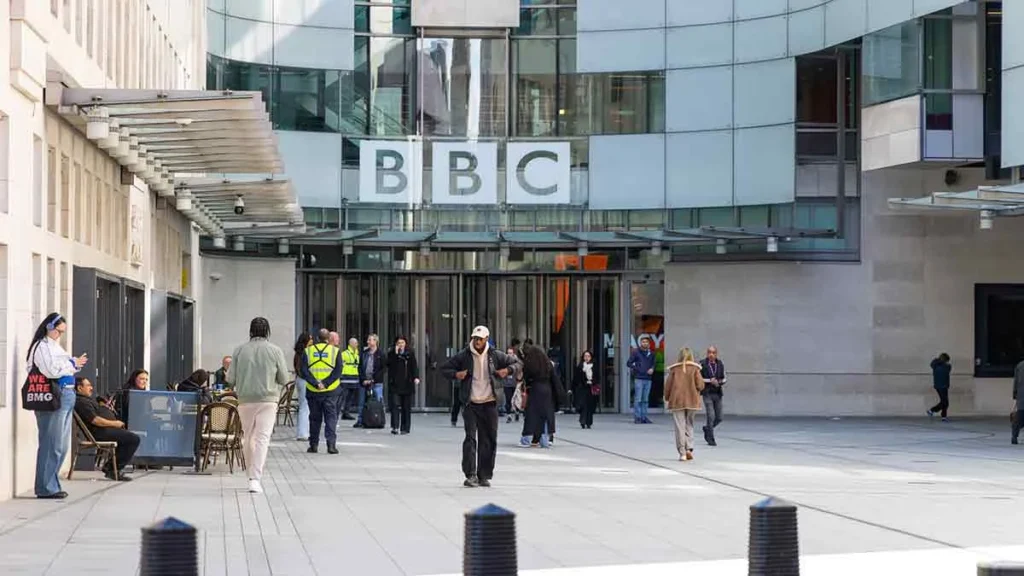
The British Broadcasting Corporation (BBC) has declared its intention to eliminate between 1,800 and 2,000 positions over the next two years, a significant restructuring effort aimed at mitigating escalating financial challenges. This announcement signals a pivotal moment for the venerable public service broadcaster as it grapples with a formidable £500 million "savings challenge" stemming from what it describes as "growing financial pressures." The cuts represent a substantial portion of its workforce, which currently stands at approximately 21,500 full-time staff.
Rhodri Talfan Davies, the BBC’s interim director general, addressed the gravity of the situation during an appearance on The Media Show on Radio 4, following an all-staff meeting. He stated, "Sadly that will have an impact inevitably on the headcount and the number of staff working for the BBC." Davies underscored the immediate task ahead, articulating, "The job in hand now, over the next three or four months, is to work through how we make those changes without damaging the services that we know are critical to the BBC across radio and television and online, and we expect to say more about that between July and September this year." This period of intense internal deliberation is expected to shape the future operational landscape of the institution.
The Intensifying Financial Headwinds
The BBC’s decision comes against a backdrop of complex and multifaceted financial strains. A primary driver of the savings challenge is the increasing cost of content production, which Talfan Davies noted is "certainly above household inflation." This inflationary pressure on production is exacerbated by a fiercely competitive global media landscape, where streaming giants with deep pockets drive up the price of talent, technology, and intellectual property. The bidding wars for premium content and top-tier creative professionals place immense pressure on traditional broadcasters like the BBC, which operates under a public funding model.
Compounding these expenditure-side pressures is a marked decline in income from the universal licence fee. Talfan Davies revealed a concerning trend: "We’re losing between 400,000 and 450,000 households a year." While the BBC maintains an impressively high reach, with "Ninety-five per cent of adults in the UK use the BBC every month," the number of households actively contributing to its funding has fallen "below 80%." This growing disparity between consumption and contribution highlights a fundamental flaw in the current funding mechanism, particularly in an era of diverse and often free-to-access digital content.
The Royal Charter Renewal and Funding Reform
The looming expiry of the BBC’s Royal Charter at the end of 2027 casts a long shadow over these developments. The Charter, which dictates the BBC’s mission, governance, and funding model, is currently the subject of intense negotiations with the government. This quinquennial review is a critical juncture for the broadcaster, offering an opportunity – or a threat – to fundamentally redefine its operational parameters and financial stability.
Talfan Davies articulated the BBC’s stance on this crucial matter, stating, "That is why, in the consultation on the BBC’s future charter, we’re saying to government that we need to see reform so that the universal consumption that we’re seeing is matched by a funding mechanism that reflects it properly." This call for reform signals a recognition that the current licence fee model, a relic from a different media age, may no longer be fit for purpose in a fragmented digital environment. Potential reforms could include a subscription model, advertising, or a broader public levy, each with its own set of advantages and disadvantages for the BBC’s public service mandate.
The interim director general, who is temporarily at the helm following Tim Davie’s departure earlier this month and preceding the arrival of former Google boss Matt Brittin on May 18, did not shy away from the possibility of radical measures. He explicitly "did not rule out axing entire channels or programmes" to achieve the necessary savings. Such a move would undoubtedly be met with significant public and political debate, touching upon the BBC’s cherished role in national culture and regional identity.
Political and Industry Reactions
The announcement has elicited a range of reactions from key stakeholders, underscoring the deep impact of the BBC on British society and its creative industries.
Culture Secretary Lisa Nandy acknowledged the difficult decisions facing the BBC. Speaking to BBC News, she commented, "The BBC has to make difficult decisions like any institution. That is something that I know the leadership of the BBC take very seriously, including exploring commercial options and other revenue raisers that can help to sustain the BBC’s finances." Her statement suggests a governmental expectation for the BBC to explore diverse revenue streams beyond the traditional licence fee, aligning with broader policy discussions around the broadcaster’s future financial model.

However, trade unions representing BBC staff expressed profound concern and dismay. Philippa Childs, head of the Bectu union, warned that job cuts of this magnitude would be "devastating for the workforce." Childs highlighted the cumulative effect of previous austerity measures, noting that "The BBC has faced funding cuts over the last decade with real terms income from the licence fee down £1.3bn – further cuts of this scale will inevitably damage its ability to deliver on its public mission." She emphasized that staff were "already under significant pressure" from prior redundancies and committed Bectu to engaging with the BBC to understand the full implications.
Childs also raised broader concerns about the impact on the UK’s creative economy, asserting that these cuts would "inevitably impact the wider creative industries ecosystem, given the BBC’s crucial anchor role in commissioning content and nurturing talent." This perspective underscores the BBC’s often-underestimated role as a cornerstone of the national creative sector, providing training, commissioning, and a stable talent pipeline. She concluded with a stark warning: "At a time of fake news and an industry that is becoming more concentrated in the hands of a few multinational corporations, the UK needs a confident, ambitious and sustainably-funded BBC more than ever. The government must ensure that Charter renewal puts the BBC’s funding on a more secure, long-term pathway and prevent our national broadcaster facing death by a thousand cuts."
Laura Davison, general secretary of the National Union of Journalists (NUJ), echoed these sentiments, condemning the plans for "more brutal job cuts" as "wrong, damaging and will cause uncertainty and distress for workers at the BBC." Davison detailed the adverse effects of previous redundancy rounds, which have led to "reduced programming, loss of experience, unmanageable workloads, fewer opportunities and have significantly hit staff morale." She argued that these cuts "severely undermine the BBC’s ability to fulfil its purposes: providing quality journalism and programming that informs, educates, and entertains." The NUJ called for urgent action, stating that positive reforms from Charter renewal would not come soon enough and urging the government and the incoming director general to "pay attention and take action to stop these damaging cuts and listen to the views of audiences, workers and their unions. The BBC belongs to all of us and we need to fight for it."
Broader Context and Implications
The BBC’s current predicament is not an isolated event but rather the latest chapter in a long-running narrative of financial challenges and existential debates. Over the past decade, the broadcaster has navigated successive periods of austerity, including licence fee freezes and real-terms funding reductions. These historical pressures have already led to previous rounds of job cuts and departmental reorganisations, often impacting regional services and specialist programming.
The context of these cuts is also shaped by profound shifts in media consumption habits. The rise of digital platforms, on-demand streaming services, and personalised content algorithms has fundamentally altered how audiences engage with media. Younger demographics, in particular, are increasingly less reliant on linear television and radio, posing a significant challenge to the BBC’s traditional distribution and engagement models. While the BBC has invested heavily in its iPlayer and BBC Sounds platforms, the competitive environment requires continuous, costly innovation.
The implications of these forthcoming job cuts are far-reaching. Beyond the immediate impact on the individuals affected, there is a legitimate concern about the quality and breadth of BBC programming. Reduced staffing levels could lead to a less diverse range of content, fewer investigative journalism projects, and a diminished capacity to cover niche subjects or support regional productions. This could, in turn, erode public trust and the BBC’s unique selling proposition as a comprehensive public service provider.
Furthermore, the cuts could have a ripple effect on the wider UK creative economy. The BBC is a major commissioner of independent productions, a significant employer of freelance talent, and a crucial training ground for media professionals. A contraction in its operations could stifle innovation, reduce opportunities for emerging talent, and weaken the overall creative ecosystem.
The debate surrounding the licence fee is also intensified by this announcement. While the government has frozen the licence fee in recent years, contributing to the BBC’s financial squeeze, there is an ongoing political discussion about its long-term viability. The push for "commercial options and other revenue raisers" from the Culture Secretary suggests a potential shift towards a hybrid funding model, which could alter the BBC’s foundational ethos as a universally funded public good.
Looking Ahead: A Critical Juncture
As the BBC embarks on this significant restructuring, the focus will intensify on the incoming Director General, Matt Brittin. His arrival on May 18 will coincide with a period of profound challenge and strategic re-evaluation. Brittin, with his background in the tech giant Google, is expected to bring a strong digital and commercial perspective to the role, potentially accelerating the BBC’s transformation towards a more agile, digitally-focused organisation.
The coming months, particularly between July and September, will be crucial as the BBC details the specific areas affected by the cuts. The balancing act between achieving substantial savings and preserving the core services that define its public mission will be delicate. The outcome of the Charter renewal negotiations will ultimately determine the BBC’s long-term financial security and its capacity to fulfil its mandate in an ever-evolving media landscape. The stakes are undeniably high, not just for the institution itself, but for the future of public service broadcasting in the United Kingdom.








