Employee motivation is the vital engine that propels performance, and for mid-market organizations, where resources are often constrained and every investment must yield tangible results, the stakes are exceptionally high. In environments characterized by lean teams and carefully managed budgets, misjudging the drivers of employee engagement can lead to more than just a temporary dip in momentum; it can directly impact crucial outcomes such as employee retention, overall productivity, and return on investment. The challenge is amplified by the inherent temporal nature of motivation. What inspires employees today may lose its efficacy tomorrow, creating a continuous need for adaptive strategies. For leaders navigating the complexities of growth, change, and resource limitations, a decline in employee engagement is not merely a warning sign but a significant business risk that cannot be overlooked. Recent data from Gallup underscores this concern, revealing that employee engagement in the United States has fallen to a year-low of 31%, a stark indicator that organizational momentum can quickly dissipate if strategies for maintaining employee interest and commitment are not consistently updated and effectively implemented.
This comprehensive analysis delves into practical and scalable strategies for fostering employee motivation, specifically tailored for mid-market organizations. These approaches are designed to deliver immediate impact without introducing undue complexity, empowering leaders to build a more engaged and productive workforce.
Understanding the Core of Employee Motivation
At its essence, employee motivation represents the commitment, energy, and ingenuity that individuals bring to their professional endeavors each day. Within the dynamic landscape of mid-market companies, this intrinsic drive is a direct determinant of team performance. It directly influences not only productivity and output but also the capacity of the workforce to adapt and evolve without necessitating an increase in headcount. The encouraging news is that motivation is not a capricious force; it can be systematically cultivated through a deliberate blend of support and recognition. While compensation and career advancement remain significant factors, employees also place considerable value on elements such as flexible work arrangements, visible opportunities for professional development, and consistent, everyday recognition. These components are crucial for developing motivation strategies that can scale effectively alongside business growth.
Motivated employees are demonstrably more engaged, exhibit higher levels of productivity, and are more inclined to remain with their organization. The advantage for mid-market firms is that fostering motivation is not a matter of guesswork. By implementing the right combination of recognition, opportunities for growth, and a focus on employee well-being, these organizations can cultivate a work environment where employees feel genuinely valued, all without overburdening lean HR and people operations teams.
Key Strategies for Enhancing Employee Motivation
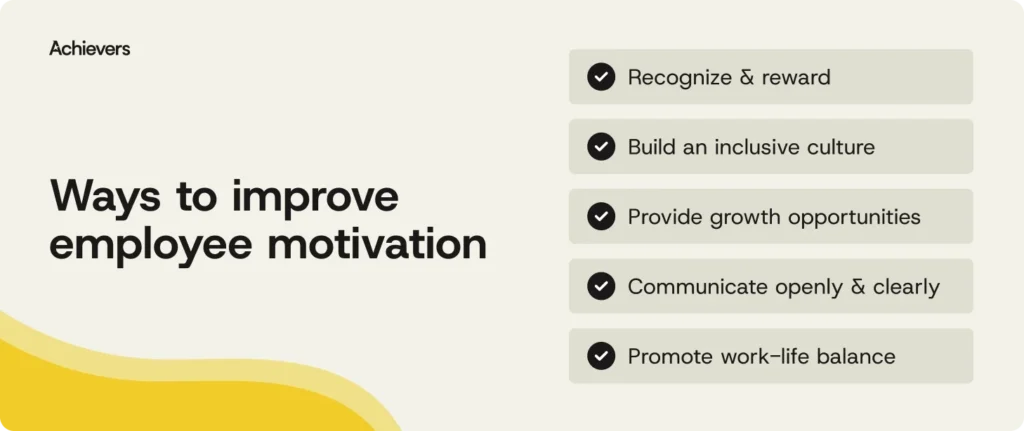
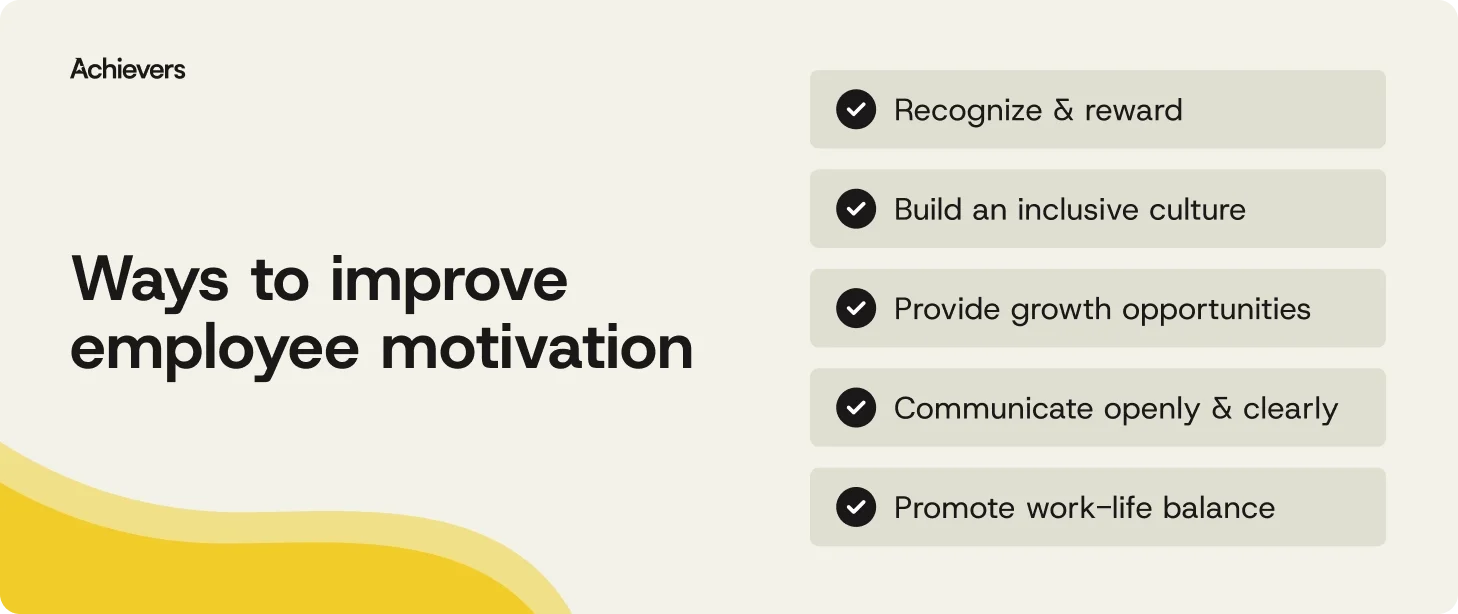
The following strategies offer a practical framework for mid-market organizations seeking to boost employee motivation and drive sustainable business success.
1. Implement Frequent and Meaningful Recognition and Rewards
One of the most potent levers for motivating employees is consistent recognition. When individuals feel their contributions are acknowledged and appreciated, their engagement levels rise, their productivity increases, and their likelihood of staying with the company significantly improves. For mid-market organizations, the most effective recognition programs are those that facilitate ease of use and promote regularity, without generating additional administrative burdens. This can be achieved through peer-to-peer recognition systems, robust manager tools, and the offering of rewards that employees genuinely find desirable.
Research from the Achievers Workforce Institute’s (AWI) State of Recognition Report indicates a strong correlation between recognition frequency and employee trust. Employees who receive recognition at least once a month are three times more likely to trust their managers and two and a half times more likely to perceive them as effective leaders. This highlights how recognition acts as a powerful catalyst for building trust, strengthening performance, and creating a work environment where employees are inspired to perform at their peak. It is crucial to differentiate between genuine motivation and mere administrative compliance; recognition that is confined solely to annual performance reviews often feels like a bureaucratic formality rather than a driver of ongoing motivation.
2. Cultivate a Positive and Inclusive Organizational Culture
The impact of company culture on employee motivation is often underestimated by leadership. A workplace grounded in trust, respect, and a sense of belonging provides employees with compelling reasons to remain engaged and to consistently contribute their best efforts. When employees can clearly perceive how their individual work contributes to the broader company purpose and objectives, motivation naturally flourishes.
Recognition plays a pivotal role in reinforcing this positive culture. Public acknowledgment of achievements links everyday actions to core company values, thereby demonstrating to employees that they are integral to something larger than themselves. Peer-to-peer recognition further amplifies this effect, generating a ripple of increased motivation across teams and departments. However, a culture that is merely articulated in a mission statement displayed on a wall is essentially decorative; it lacks the substance to genuinely influence employee behavior and sentiment.
3. Provide Robust Opportunities for Professional Growth
Few factors motivate employees more effectively than the assurance that their organization is invested in their long-term career trajectory, even within the constraints of lean budgets and small teams. When individuals can discern a clear pathway for skill development and career advancement, their engagement levels increase, their motivation strengthens, and their propensity to seek alternative employment diminishes.
Importantly, professional growth does not always necessitate substantial financial outlays. Opportunities such as mentorship programs, participation in cross-functional projects, and concise, targeted training initiatives can be as impactful as expensive external courses. The fundamental motivator is the clear indication that the company is genuinely committed to employee development, rather than simply offering platitudes in an employee handbook.

4. Ensure Open and Clear Communication Channels
Ambiguity in communication is a swift and effective destroyer of employee motivation. Employees require a clear understanding of expectations, a discernible connection between their work and overarching company goals, and transparent feedback regarding their performance. Clarity in communication fosters confidence, and confidence, in turn, fuels motivation.
Effective communication transcends infrequent quarterly town hall meetings. It encompasses regular check-ins, encouraging open dialogue, and establishing feedback mechanisms that operate in both directions. Tools such as pulse surveys and Voice of Employee platforms empower leaders to actively listen, prioritize concerns, and respond promptly, circumventing lengthy approval processes or complex change management procedures. If communication is a unidirectional flow, originating solely from leadership, it constitutes a monologue, which is unlikely to inspire sustained employee commitment.
5. Champion Work-Life Balance and Employee Well-being
The adverse effects of burnout are fundamentally incompatible with sustained employee motivation. Employees who feel perpetually overwhelmed and overextended exhibit diminished engagement, reduced productivity, and a higher likelihood of seeking employment elsewhere. The implementation of flexible work schedules, comprehensive wellness benefits, and accessible mental health support sends a clear and powerful message: the organization prioritizes its people.
Achieving balance does not necessitate radical policy overhauls. It can be as straightforward as offering flexible working hours, ensuring realistic workloads, or providing access to valuable wellness programs. The overarching objective is to foster a work environment where employees can approach their tasks with energy and enthusiasm, rather than feeling constantly depleted.
6. Empower Employees Through Autonomy
Micromanagement is a direct route to widespread employee disengagement. Individuals are significantly more motivated when they possess a sense of ownership over their work, are granted the freedom to make decisions, and experience the trust of their leaders. Autonomy fosters accountability and provides employees with the necessary space to perform at their highest potential.
The nuanced aspect of autonomy is that it does not equate to managerial abdication. Coaching, support, and clearly defined parameters are essential to ensure employees feel confident and supported, rather than abandoned. A useful analogy is that of a spotter in a gym; managers should be present to provide assistance when needed, but not to constantly intervene in every action.
7. Offer Meaningful and Personalized Incentives
While standard benefits such as health coverage and retirement plans are foundational, they are often perceived as baseline expectations rather than sources of inspiration. Employees are more motivated when rewards are tailored to their individual needs and preferences, rather than being generic.
This can involve the implementation of incentive programs that offer wellness stipends, flexible perk options, or personalized rewards that employees can genuinely utilize and appreciate. The critical factor is aligning incentives with the values and preferences of the workforce. Failing to do so results in the distribution of rewards that may go unappreciated, creating noise rather than fostering genuine motivation.
8. Proactively Address Employee Concerns and Act on Feedback
Employee motivation is prone to rapid decline when individuals feel their concerns are not being heard or addressed. However, the act of listening is insufficient; it is the tangible action taken in response to feedback that truly builds trust and sustains employee motivation.
Within mid-market organizations, closing the feedback loop swiftly is crucial for fostering trust. This trust often becomes the decisive factor in retaining valuable talent, preventing the costly and time-consuming process of restarting recruitment efforts.
Fundamental Aspects of Employee Motivation
Understanding the different facets of motivation is key to developing effective strategies.
Intrinsic Motivation: The Power of Purpose and Fulfillment
Intrinsic motivation stems from the inherent satisfaction derived from performing work that is perceived as meaningful. This can manifest as the intellectual challenge of solving a complex problem, the personal accomplishment of reaching a self-imposed milestone, or the collaborative success of contributing to a team victory. This form of motivation is inherently sustainable, often persisting even in the absence of external rewards.
Extrinsic Motivation: The Impact of External Drivers
Extrinsic motivation is driven by external factors such as formal recognition, tangible rewards, or performance-based incentives. A timely expression of gratitude or a well-structured points-based reward system can be highly effective in this regard. Conversely, neglecting these external drivers can relegate rewards to mere line items in a budget, devoid of their motivational power.
The Symbiotic Relationship Between Motivation and Engagement
The connection between motivation and engagement is straightforward and symbiotic. Motivation provides the "why" behind employee actions, explaining the impetus for effort and initiative. Engagement, in turn, reflects the depth of commitment and enthusiasm with which those actions are carried out, demonstrating how effectively employees follow through on their motivations. In essence, motivation serves as the initial spark, while engagement represents the sustained, steady flame that drives ongoing work and progress.
The Profound Impact of Employee Motivation on Business Outcomes
Employee motivation is a direct driver of the key outcomes that are paramount to mid-market leaders: enhanced performance, accelerated execution, and reduced employee turnover, all achieved without escalating operational costs. Recognition, in particular, stands out as one of the most impactful motivators, and its correlation with positive business metrics is well-documented. According to the Achievers Workforce Institute’s State of Recognition Report, organizations with high levels of recognition report significantly lower voluntary turnover rates compared to those with lower recognition practices.
Moreover, recognition functions as an essential indicator of the health of an organization’s workplace environment. When recognition practices decline, engagement and trust typically follow suit, thereby increasing the risk of employee attrition.
Achievers assists organizations in transforming everyday recognition into measurable business outcomes, offering the scalability of an enterprise solution while retaining the simplicity that mid-sized teams require. By integrating recognition into the fabric of daily operations, providing rewards that genuinely resonate with employees, and delivering actionable real-time insights, Achievers empowers leaders to cultivate lasting motivation. The ultimate result is a culture where employees feel consistently seen, heard, and supported, not just during annual reviews, but throughout the entire year. This sustained focus on motivation ensures that it not only appears but also endures, scales effectively, and ultimately drives the forward momentum of the business.
Driving Employee Motivation and Success with Achievers
When employees experience genuine motivation, they bring a heightened level of energy, creativity, and collaborative spirit to their work. This elevated momentum acts as a powerful catalyst for business advancement. Achievers provides organizations that are poised for growth without increased complexity with the tools and strategies necessary to achieve this. By embedding recognition into everyday workflows, offering rewards that truly connect with employee values, and providing continuous performance insights, Achievers empowers leaders to foster motivation in enduring ways. This cultivates an environment where employees feel recognized, valued, and supported on a daily basis, laying the foundation for sustained success and a thriving organizational culture.
Employee Motivation FAQs
What are the primary drivers of employee motivation?
Employee motivation is driven by a combination of intrinsic factors, such as a sense of purpose and accomplishment, and extrinsic factors, such as recognition, rewards, and opportunities for growth.
How does employee motivation impact business outcomes?
Highly motivated employees are more productive, engaged, and less likely to leave their jobs, which directly contributes to improved performance, higher retention rates, and a stronger return on investment for the organization.
What is the difference between intrinsic and extrinsic motivation?
Intrinsic motivation comes from within an individual, driven by personal satisfaction and interest in the task itself. Extrinsic motivation is driven by external factors, such as praise, rewards, or avoiding punishment.
How can mid-market organizations effectively foster employee motivation?
Mid-market organizations can foster motivation through consistent recognition, building a positive culture, providing growth opportunities, clear communication, promoting work-life balance, empowering employees with autonomy, offering meaningful incentives, and actively addressing feedback.
What is the link between employee motivation and engagement?
Motivation provides the "why" behind an employee’s actions, while engagement reflects the depth of their commitment and enthusiasm in carrying out those actions. They are closely intertwined, with motivation often serving as a precursor to higher engagement.